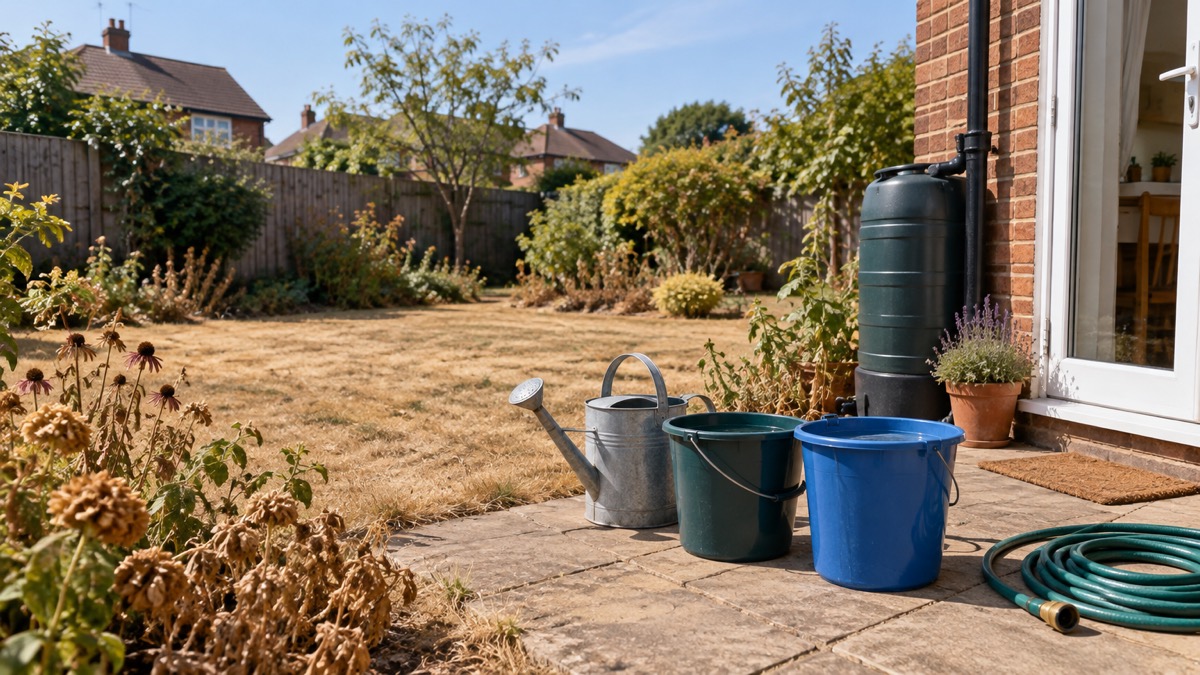
A hosepipe ban, properly called a temporary use ban, is a legal restriction on using a hosepipe connected to your mains water supply for non-essential jobs outdoors. In practice that means no hosepipe for watering the garden, washing the car, filling a paddling pool or hot tub, or cleaning the patio, walls and windows1. It does not stop you using water for drinking, cooking, showering or washing clothes, and it does not stop you watering with a watering can or with water from a water butt3.
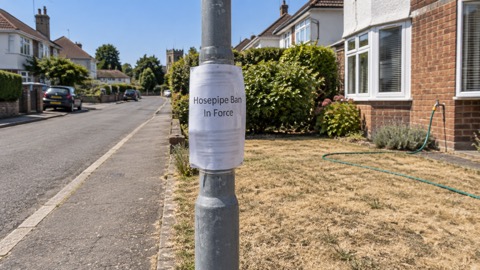
The rules are set by your water company, not by central government, so the detail varies between suppliers and can change during a drought. Water companies may choose to enforce temporary usage bans, or hosepipe bans, to help conserve water5. Breaking one is an offence: companies can fine customers up to £1,000 if they ignore it6.
What follows sets out what is stopped, what is still allowed, who is exempt, where a hosepipe can still be used, and how bans are enforced. If you want the wider picture of how restrictions are declared and lifted, the guide to hosepipe bans and how temporary use bans work covers it.
What a hosepipe ban stops you doing
A temporary use ban is a restriction on using a hosepipe for domestic non-essential activities that, because of high water consumption, can put further stress on water supplies9. The list of prohibited activities is broadly consistent across companies, though the wording differs. South West Water tells customers they must not use hosepipes for non-essential purposes while the ban is in place1, and its Cornwall guidance lists watering gardens, washing cars, patios and boats, hot tubs, and filling swimming and paddling pools10.
The standard restricted list, as set out by Wessex Water, covers watering a garden, cleaning a private motor vehicle, watering plants on domestic or non-commercial premises, filling or maintaining a domestic swimming pool or paddling pool, drawing water for domestic recreational use, filling or maintaining an ornamental fountain, cleaning walls or windows of domestic premises, cleaning paths or patios, and cleaning other artificial outdoor surfaces11. Affinity Water adds jet washers, garden sprinklers and pressure washers to the list of things you will not be able to use12.
Two details catch people out. First, the ban covers more than a hose: Bristol Water prohibits watering gardens including with a sprinkler or irrigation system3, and South Staffordshire Water describes a temporary use ban as covering hosepipes and similar appliances9. Second, allotments are included: Bristol Water states that under the hosepipe ban you cannot use a hosepipe to water a non-commercial allotment or vegetable patch2.
| Restricted with a hosepipe | Still fine |
|---|---|
| Watering the garden, plants or allotment2 | Watering with a watering can or water butt4 |
| Washing a private car, patio, driveway, walls or windows2 | Washing the car at a commercial car wash3 |
| Filling or topping up a paddling pool, pool or hot tub13 | Drinking, cooking, showering, washing clothes3 |
| Filling or maintaining a pond or ornamental fountain2 | Filling a bucket to wash the car2 |
Watering cans, buckets and water butts are still allowed
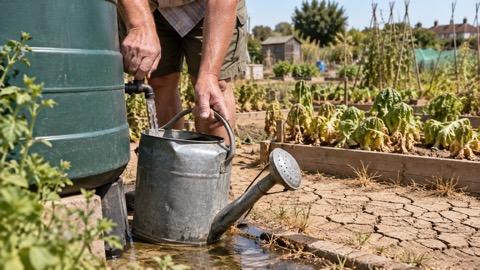
The ban is on hosepipes and sprinklers, not on watering as such. Affinity Water confirms you can water your garden using a watering can or water collected in a water butt, just not with a hosepipe or sprinkler13. Wessex Water lists watering plants with a watering can, using water from a water butt, and filling up a bucket for car washing among the activities the ban does not touch11.
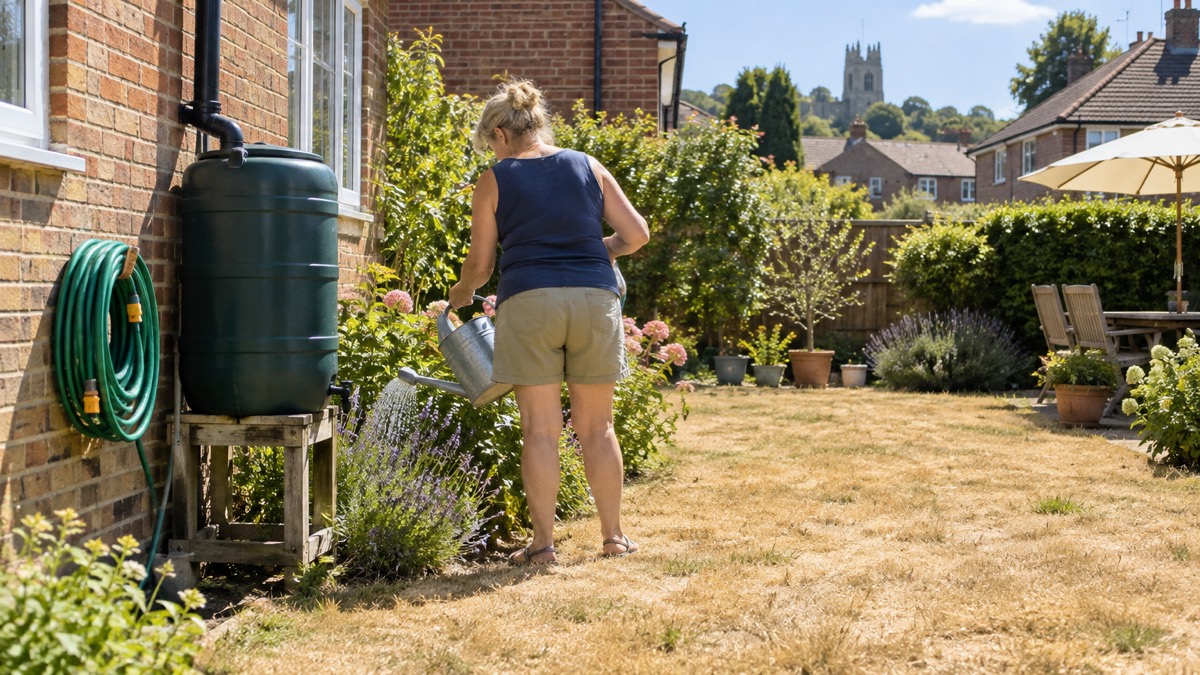
Everyday household use is unaffected. Wessex Water states plainly that the ban does not impact everyday essential household use such as showering and washing11, and Southern Water and Bristol Water both confirm you can use water for things like drinking, cooking, showering and washing your clothes, use a watering can or bucket, and wash your car at a commercial car wash3.
There are also narrow allowances for newly planted things. Bristol Water permits watering trees, hedges and saplings planted within the last planting season where a watering can is not feasible, turf laid within the last 28 days, newly bought plants for the first 14 days after purchase, and food crops grown at home or at a private allotment where a watering can is not feasible4. These are exceptions to a hosepipe rule, not a licence to reach for the hose: the company's own wording ties each one to watering that a can cannot manage.
If you want to go further than the rules require, the guide to saving water at home when supplies are low sets out where the biggest savings are. For the garden specifically, watering the garden, allotment and new lawn in a hosepipe ban goes through the planting exceptions in detail.
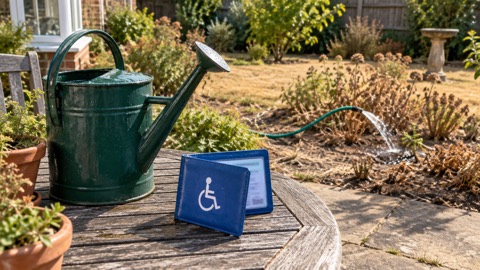
Who is exempt: Blue Badge holders, Priority Services and mobility needs
Exemptions exist so that people who cannot manage with a watering can are not left unable to keep themselves or their property safe. They are set by each company and the detail varies, so check your supplier's own exemptions page rather than assuming.
Southern Water exempts customers on its Priority Services Register with medical or mobility needs, including Blue Badge holders and those on its WaterSure tariff7. It also states that Blue Badge holders are automatically exempt from hosepipe restrictions7. Affinity Water's exemption covers customers on the Priority Services Register, on the WaterSure tariff, and Blue Badge holders who cannot use a watering can or bucket because of a health condition or disability12. Bristol Water's version covers customers who hold a Blue Badge, or are on the Priority Services Register or receive support through the WaterSure Plus tariff and are unable to make a reasonable adjustment due to a health condition or disability4.
Essex & Suffolk Water adds a useful practical point: customers who are Blue Badge holders or have mobility issues and are unable to use a watering can are exempt and do not need to apply or contact the company14. Dŵr Cymru's guidance for bans in parts of West Wales lists certain vulnerable customers, Blue Badge holders, some commercial activities, and Priority Services Register customers who are physically unable, or cannot make adjustments for health reasons, to adhere safely to the prohibition15.
The Consumer Council for Water summarises it simply: if you have mobility problems and are on your water company's Priority Services Register, the hosepipe ban should not apply to you8. If you are not yet on the register and think you qualify, that is the step to take first. The guide to hosepipe ban exemptions for Blue Badge holders and others sets out the categories in more depth, and extra help in an emergency covers the wider support available to older, disabled and medically dependent households.
Pools, ponds, boats and fountains: where a hosepipe is still allowed
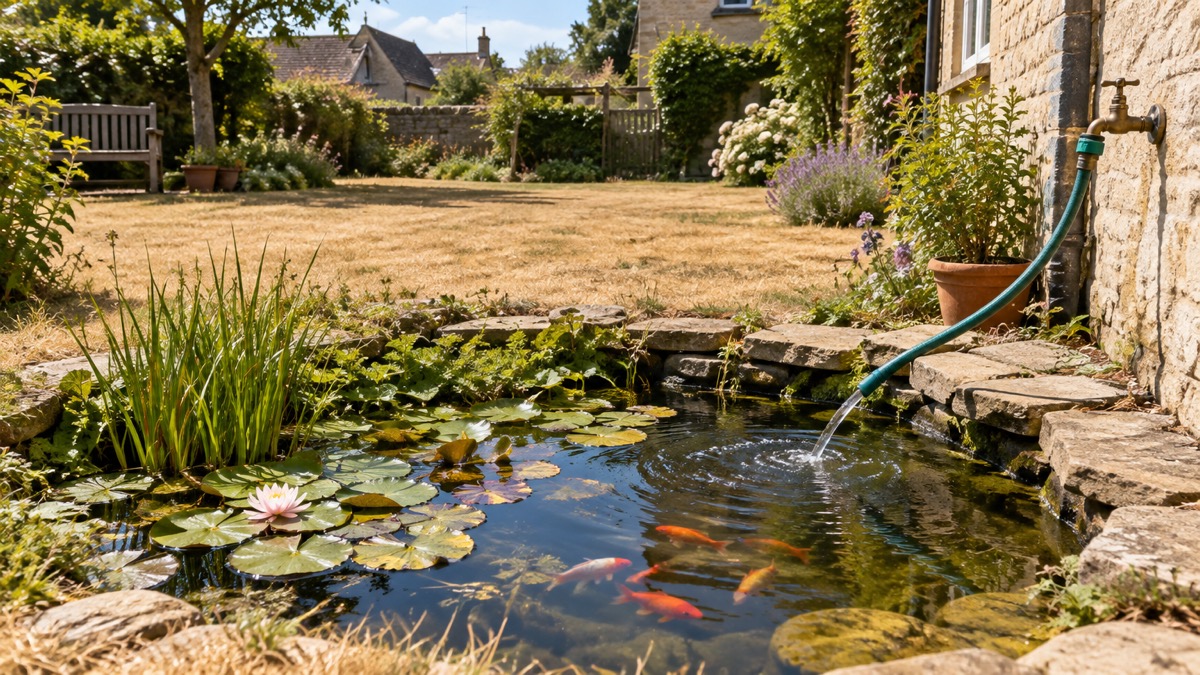
Filling a pool, hot tub or paddling pool with a hosepipe is not allowed during a ban14, and the same goes for filling or maintaining a domestic pond or an ornamental fountain2. But the legislation carves out specific circumstances where a hosepipe can still be used, and these are worth knowing if you keep fish, keep animals, or have a pool under construction.
Essex & Suffolk Water sets out the pool exceptions: you can still use a hosepipe if the pool is being built, is used as part of medical treatment or veterinary treatment, is used to decontaminate animals from infection or disease, or is used to rear or keep fish or other aquatic animals14. For ponds, the exception applies where the pond contains fish or other aquatic animals14.
Wessex Water's list is broader still. You can fill a pool, paddling pool or hot tub if it is under construction and needs to be filled as part of its construction, if you use a bucket or other container, if it is filled using a water recycling system that does not use mains water, if it is designed for medical or therapeutic use, if it is needed for medical or veterinary treatment or animal welfare, or if it is used as part of a religious ceremony in a place of worship or community setting18.
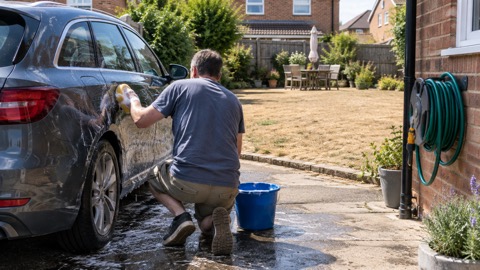
Boats and vehicles have their own rules. Cleaning a private leisure boat with a hosepipe is on the prohibited list2, and Dŵr Cymru's West Wales guidance prohibits cleaning vehicles and boats with a hosepipe, with detailed carve-outs for public service vehicles, goods vehicles, military vehicles, gritters, emergency service vehicles, hearses, recovery vehicles, agricultural vehicles and vehicles over 3.5 tonnes gross plated weight15. In short: the family car and the leisure boat are covered by the ban, while working vehicles generally are not.
Fines of up to £1,000 and how bans are enforced
A hosepipe ban carries legal force, and water companies are able to take enforcement action where the rules are breached2. The maximum fine is consistent across the companies that publish it: up to £1,0006. Cambridge Water sets out the legal basis, stating that under the Water Industry Act 1991 anyone who fails to comply with a temporary use ban could be prosecuted and fined up to £1,000 by a Magistrates' Court19.
Enforcement usually starts with a conversation rather than a penalty. Affinity Water states that if you are seen using a hosepipe during the ban, you can expect the company to get in touch first, to check whether you are aware of the ban and any exemption that applies, before taking further action if hosepipe use continues13. That is worth knowing if a neighbour reports you: the first contact is likely to be a query, not a fine.
If you think someone is breaking the rules, report it to the water company rather than confronting them. Bristol Water asks customers to check the list of exceptions before reporting the activity2, and Essex & Suffolk Water asks anyone concerned to complete its online form and says it will review the information provided14. Westminster City Council's general advice is to stay up to date on local hosepipe bans or legal limits enforced by your water company20, which is also the quickest way to know whether a ban applies to you at all.
How long bans last, and what comes next
There is no fixed end date. The Consumer Council for Water states that hosepipe bans stay in place until the water situation improves, and that your company will announce when they are being removed and should provide regular updates8. Dŵr Cymru's exemption notice puts it in legal terms: the prohibitions have effect from the stated date and remain in force until further notice21. In practice, bans are lifted when storage and river levels recover, as happened when Dŵr Cymru lifted the Ceredigion ban on 4 September 2026 after treated water storage levels improved22.
A hosepipe ban is the first rung, not the last. The Consumer Council for Water warns that if the drought continues, your water company might ban all water use classed as non-essential, which would impact businesses that use water such as car washes8. That escalation matters to households too, because it signals that supplies are under real strain and that wider restrictions may follow.
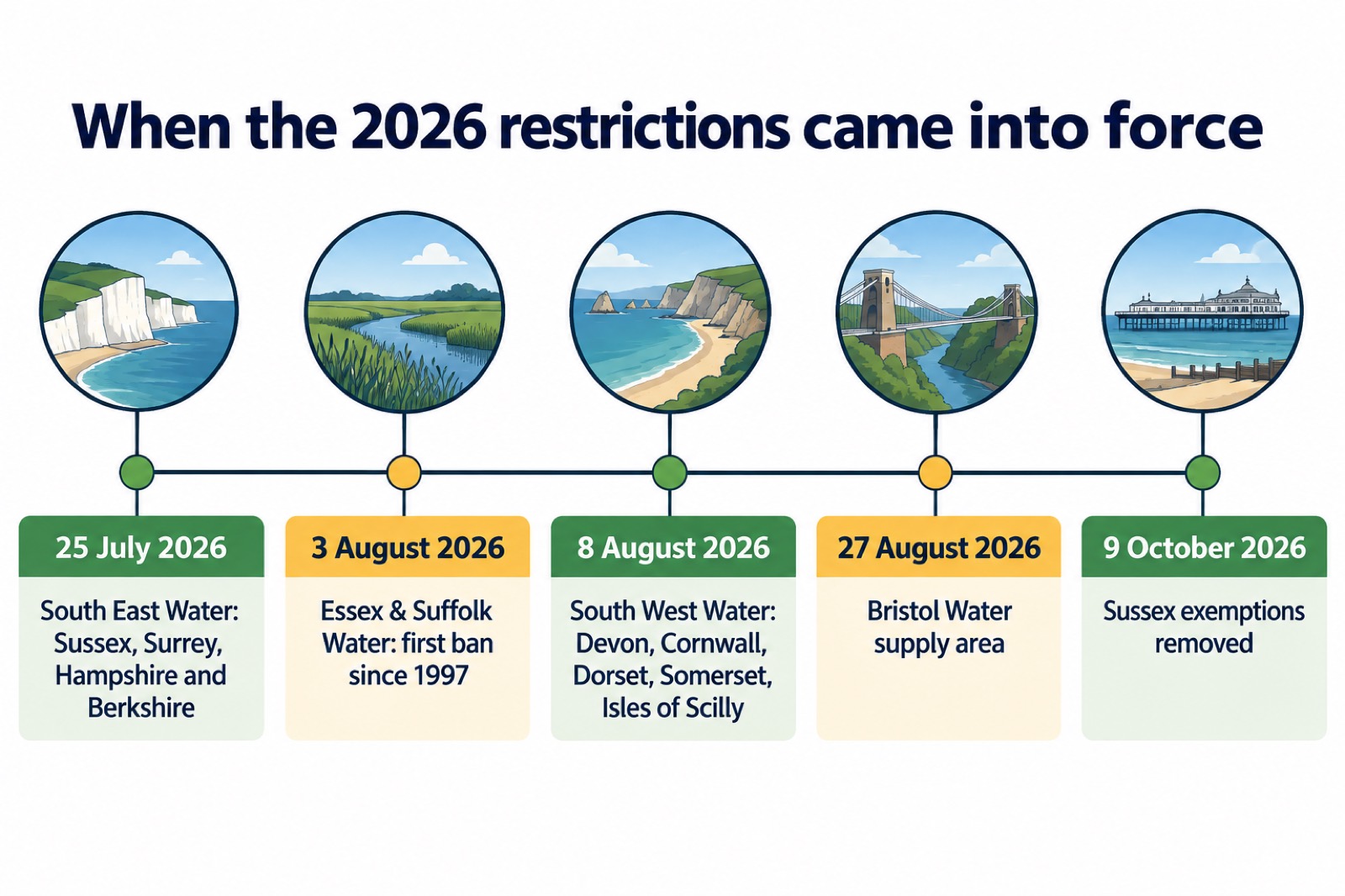
The dates show how quickly the picture can change within one season. South East Water announced its ban for Sussex, Surrey, Hampshire and Berkshire on 20 July 2026, with restrictions in force from 00:01 on 25 July 202623. Affinity Water extended its ban to its East region in August 202612. Essex & Suffolk Water brought restrictions in from 00:01 on Monday 3 August 2026, its first since 199724. South West Water's ban took effect at 00:01 on Saturday 8 August 2026 for customers in Devon, Cornwall, parts of Dorset and Somerset and the Isles of Scilly25. Bristol Water's ban began at 00:01 on 27 August 20261.
Because the rules are local, the practical step is to find your supplier and read its current notice. If you are unsure who supplies you, your bill or your supplier's website will say. The guide to England's 2026 drought and where restrictions apply tracks which companies have bans in place, and the water shortage and hosepipe ban checklist sets out what to have ready at home before restrictions tighten further.
Sources (26)
- Drought 2026, Bristol Water, 2026
- Hosepipe ban household FAQs, Bristol Water, 2026
- Hosepipe ban FAQs, Bristol Water, 2026
- Hosepipe ban exceptions, Bristol Water, 2026
- Droughts, UK Government Prepare campaign, 2026
- Temporary use ban advice, Southern Water, 2026
- Hosepipe ban exemptions, Southern Water, 2026
- Hosepipe bans FAQ, Consumer Council for Water, 2026
- Drought FAQs, South Staffordshire Water, 2026
- Stay safe this summer, Cornwall Council, 2026
- Hosepipe ban | Wessex Water, Wessex Water
- Hosepipe ban, Affinity Water, 2026
- Hosepipe ban FAQs, Affinity Water, 2026
- Temporary use ban FAQs, Essex & Suffolk Water, 2026
- Hosepipe ban frequently asked questions, Dŵr Cymru Welsh Water, 2026
- Sussex hosepipe restrictions FAQs, South East Water, 2026
- Temporary use bans, South East Water, 2026
- Hosepipe ban exemptions, Wessex Water, 2026
- Temporary hosepipe ban FAQs, Cambridge Water, 2026
- Advice and support: drought, Westminster City Council, 2026
- Hosepipe ban exemptions, Dŵr Cymru Welsh Water, 2026
- Drought, Dŵr Cymru Welsh Water, 2026
- Temporary use bans FAQs, South East Water, 2026
- Temporary use ban, Essex & Suffolk Water, 2026
- Hosepipe ban | South West Water, South West Water
- Your Local Water Supplier | South East Water, South East Water
 Flood Warning Checklist
 First Steps After a Flood
 Insurance Claim Records
 Barbecues and Wildfire Risk
 Hosepipe Ban Exemptions
 Hosepipe Ban Fines and Reporting
 Hosepipe Bans and the Garden
 Pools, Ponds and Car Washing
 Private Water Supply Drying Up
 Wildfire Home Protection
 What to Do Near a Wildfire