Dry weather across the UK in 2026 has pushed water companies into hosepipe bans and regulators into drought declarations, and households are being asked to cut how much water they use. The good news is that the biggest savings are simple: take shorter showers, only run washing machines and dishwashers with full loads, reuse water from washing up to water plants, and let your lawn go brown1. Every litre saved reduces the chances of further water restrictions such as hosepipe bans during a drought2. None of this needs special kit, and all of it reduces the strain on rivers, reservoirs and groundwater that supply your taps.
Saving water in a dry spell is not just about keeping your garden alive. It helps avoid restrictions tightening further, protects wildlife in low rivers, and leaves more drinking water available if supplies are interrupted. This page sets out what to do indoors and outdoors, how to reuse grey water safely, what a water butt can and cannot do, and how much water to keep stored for an emergency. One thing to hold in mind throughout: recovery from drought can be slow, and typically requires much more rainfall than you would expect to avoid slipping back into drought conditions3.
Hosepipe bans and drought restrictions in force
If a hosepipe ban, formally a Temporary Usage Ban, is in place where you live, you cannot use a hosepipe connected to your mains water supply for things like watering your garden, filling a paddling pool or washing your car1. The details of what is and is not allowed, and who may be exempt, are covered in our pages on hosepipe bans, the rules in force and exemptions.
Restrictions have spread and shifted through 2026, and they differ between companies and nations:
| Water company | Area | Restriction in force |
|---|---|---|
| Wessex Water | Wessex supply area | Temporary Use Ban: no hosepipes for watering gardens, washing cars, filling pools or cleaning patios and windows1 |
| Southern Water | Hampshire and the Isle of Wight | Hosepipe ban introduced to protect local rivers and keep taps flowing7 |
| Affinity Water | Affinity supply area | No hosepipe use for watering gardens, washing cars, cleaning windows and patios, filling swimming and paddling pools, or using jet washers, sprinklers and pressure washers8 |
| Bristol Water | Bristol supply area | Hosepipes prohibited for watering gardens (including sprinklers and irrigation systems), filling paddling pools, hot tubs, swimming pools, ponds or fountains, and washing cars, patios, driveways or windows9 |
| Thames Water | Thames supply area | Temporary use ban in force, with limited exemptions such as watering food crops at home or on an allotment when a watering can isn't practical10 |
One ban came into effect at 00:01am on Saturday 8 August to help protect water supplies during drought conditions11.
The bans are working where they are in place, and Thames Water's temporary use ban remains in force, with narrow exemptions such as watering new turf, lawns and trees planted by a professional landscaper for up to 28 days10. Every litre a household saves has the same effect, ban or no ban, because reducing demand reduces the chances of water restrictions such as hosepipe bans during a drought2.
If you want to track the wider picture, our page on England's 2026 drought sets out where restrictions apply, and how drought is declared explains what each stage means.
What water scarcity means for your household
Water scarcity is defined by the Scottish Environment Protection Agency (SEPA) as when there is not enough water, of sufficient quality, to meet the demands of humans and ecology12. It occurs when the balance between supply and demand gets disrupted12. In practice that means the impacts spread well beyond your water bill: ecosystems can suffer, farmers face challenges in maintaining crop yields, industrial operations and production can be disrupted, and private water supplies can run dry12.
For an ordinary household, scarcity shows up in three ways. First, restrictions on outdoor use, the hosepipe bans described above. Second, appeals to cut consumption, which is where the indoor savings in the next section come in. Third, in the worst cases, supply interruptions, which is why storing some water in advance matters.
Scotland monitors scarcity in levels: Early Warning, Alert and Moderate Scarcity are set by comparing current conditions against long-term values, and the highest level, Significant Scarcity, is calculated using the Drought Risk Assessment Tool13. Each level has an associated action for different users, including irrigation catchments, Scottish Water and hydropower13. You can find your own area by viewing SEPA's water scarcity area descriptions or entering your postcode in the Drought Risk Assessment Tool search and clicking on Water Scarcity Level13. Note that there can be some variation in the observed water scarcity across a catchment, so conditions a few miles away may differ from yours14.
Two things should not be cut, whatever the scarcity level. Keep drinking enough water to stay hydrated, and continue to wash your hands and maintain hygiene1. NHS inform in Scotland is explicit:
"Do not drink less water than normal to try and save water."
NHS inform, advice on staying safe during a drought3
Why supplies stay low after it rains
It is a common frustration: the rain returns, the news moves on, but the hosepipe ban stays. The reason is that public water supply depends on rivers, reservoirs and groundwater, and these recover at very different speeds.
SEPA's guidance to the public is blunt about this:
"Recovery can be slow and typically requires much more rainfall than you would expect to avoid going back into drought conditions."
SEPA, water scarcity FAQs for the public15
Groundwater is the slowest to recover. Natural Resources Wales explains that when there is a lack of rainfall over a long period, groundwater levels can become exceptionally low, causing spring sources to dry up or pumps to run dry16. Those underground stores refill slowly even when the surface is wet. In the uplands of the north and west of England, the Environment Agency notes a different pattern: water resources deplete relatively quickly after just 2 or 3 consecutive months of below average rainfall, because there is little groundwater base flow to support the rivers17.
The position across the country shows both sides of this. Recovery from drought can be slow, and typically requires much more rainfall than you would expect to avoid going back into drought conditions18. In the uplands of the north and west of England, water resources deplete relatively quickly after just 2 or 3 consecutive months of below average rainfall, because there is little groundwater base flow to support the rivers19. Northumbrian Water advises that when reservoir stocks are below average, particularly for longer than a month, that is the time to start reducing water use in the home and garden20.
So keep saving water after the rain returns. Reservoirs and aquifers are refilling, not refilled, and demand that jumps straight back up can undo the recovery.
Cutting your use indoors: what saves the most
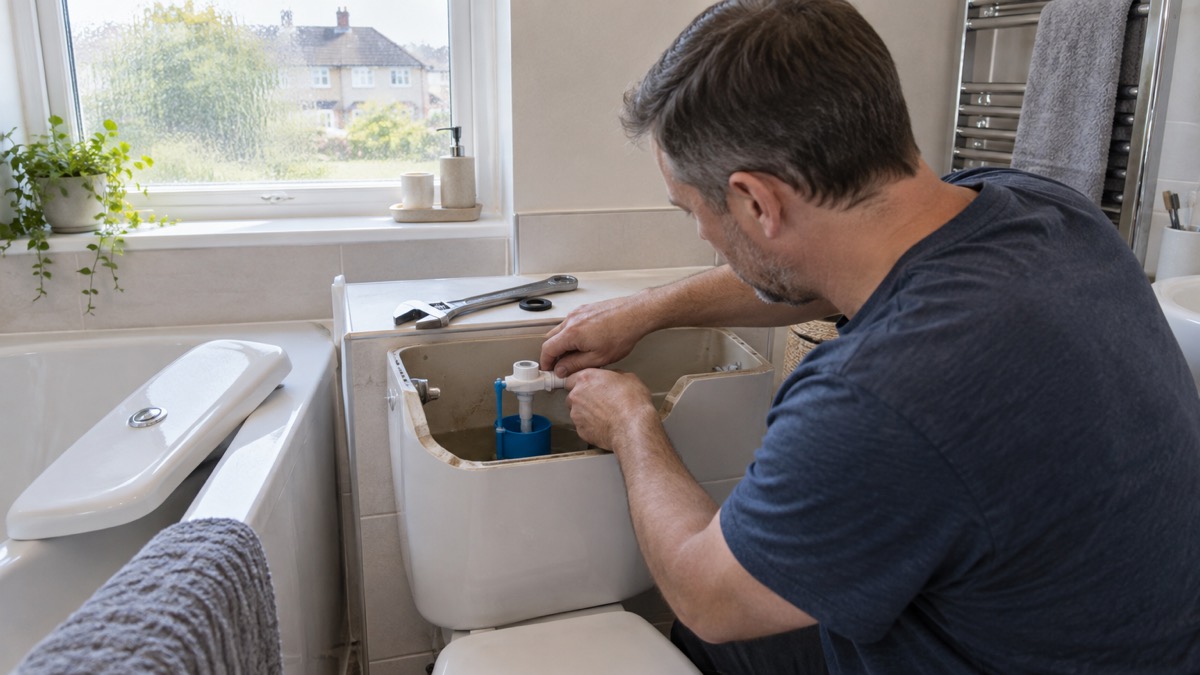
The single biggest saving most households can make is repairing a leaking toilet. Wiltshire and Swindon Prepared's Let's Save Water campaign advises:
"Fix a leaky loo to save up to 400 litres a day."
Cutting demand indoors matters most during a drought, because it reduces the chances of water restrictions such as hosepipe bans2.
That is more than many households use in total for everything else. A loo that keeps running into the pan after flushing, or that trickles silently, is wasting water every minute of the day. If you suspect a leak, listen after flushing and check whether water is still running into the pan after several minutes.
Beyond that, the savings come from many small habits, most of which also cut your energy use:
- Fill the kettle with only the water you need21
- Fill kettles only with the water you need and put a lid on pans when cooking22
- Save the water used for cooking and washing up, for flushing the toilet23
- Use water efficiently, and find out ways to save water from your water company; if you have a water meter this will help you track the effect24
- Know how to turn off water, gas and electricity in your home, so a burst pipe or a leak does not waste water you cannot afford to lose25
If your supply is interrupted, keeping water usage to a minimum will prolong alternative sources of water such as the tanks water companies deploy to streets6. Practising the habits now means you will not have to learn them in a crisis.
Grey water: reusing water safely indoors
Grey water is water that has been used once, for cooking, washing up or washing yourself, plus rainwater collected in a butt. It is not drinking water, and the distinction matters. Official guidance is consistent across the UK: this water can be used for flushing toilets or watering plants6, and Public Health Wales advises that a water shortage may mean there is not enough water to flush the toilet, so save the water used for cooking and washing up for flushing23. Argyll and Bute Council similarly recommends the use of grey water, for example from a rainwater butt, for flushing of toilets, thereby conserving the availability of drinking water26.
A practical routine during a shortage:
- Collect water you have already used indoors, such as washing up water, in a bucket or large bowl.
- Keep it separate from drinking water, in clearly marked containers.
- Pour it into the toilet pan to flush. You do not need the cistern: a steady pour of a couple of litres into the pan moves the contents down the drain.
- Do not pour grey water into the cistern, where it could sit and stagnate or contaminate the mechanism.
If your water supply is switched off for planned work, the Met Office's WeatherReady advice is to capture some of the tap water for drinking and flushing while the supply is still on27. That captured tap water is clean, so use it for drinking first and for flushing only what is left.
Grey water for plants is fine in a drought, but use it on ornamentals rather than anything you will eat raw, and do not store it for long: used water degrades quickly. Fresh is better.
Water butts: what they do, and fitting one to a downpipe
A water butt collects rainwater from your roof via a downpipe and stores it for the garden. Westminster City Council's drought advice is to install a water butt for rainwater storage from your downpipes, which can be connected to greywater systems such as toilet flushing and garden watering28. The national Prepare campaign advice is simpler still: in the garden, use a watering can instead of a hosepipe and install a water butt if you can to capture rain1.
Fitting one is a straightforward job:
- Choose a downpipe that serves a roof section with a decent catchment, and a firm, level base next to it.
- Place the butt on a stand or bricks so a watering can fits under the tap at the bottom.
- Fit a rain diverter to the downpipe at the height of the butt's rim, so overflow returns to the drain.
- Keep the butt covered to keep out debris, insects and light.
On size, the Drinking Water Inspectorate's guidance on storage tanks gives a useful benchmark: a tank should not be too large, so the water in it is frequently replenished with fresh water, and 250 litres is quite sufficient for most homes29. The same logic applies to a butt. A butt that is too large for your roof and your use will hold stale water for months; one that matches them will turn over and stay fresher. If in doubt, start smaller, and add a second butt linked to the first if you regularly empty the first.
Keeping butt water fresh, and what contaminates it
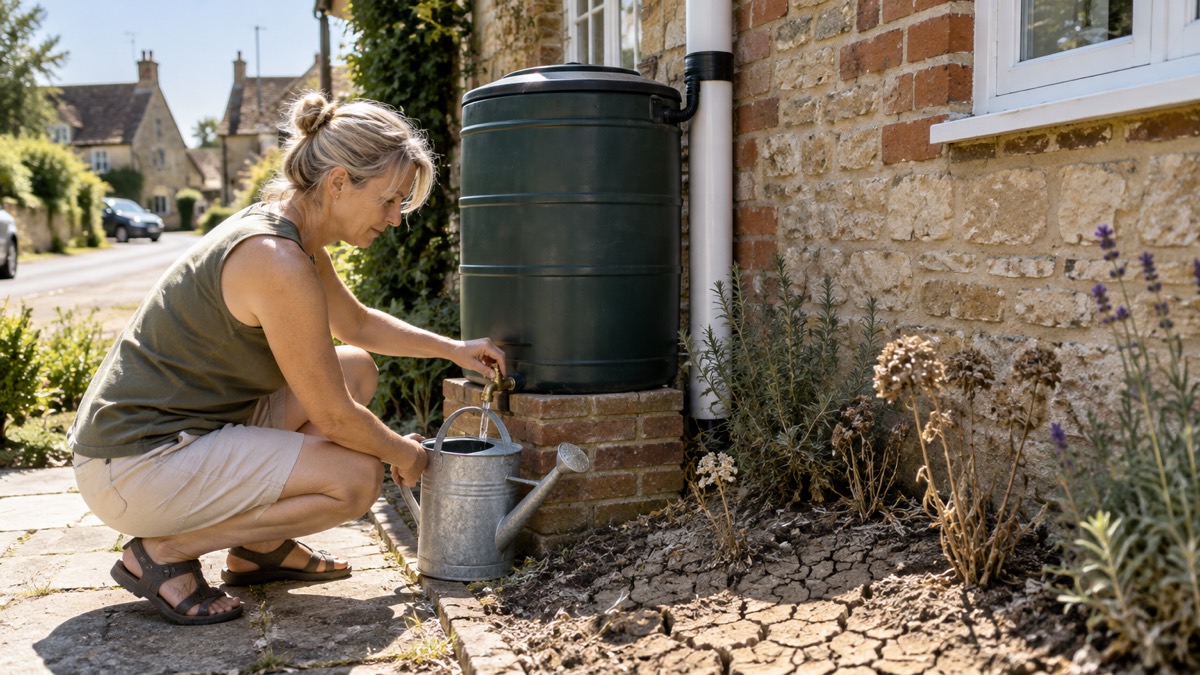
Stored rainwater is not sterile. Bird droppings, roof debris, moss and insects all find their way in. Use the water regularly on the garden rather than letting it sit for months, empty and rinse the butt periodically, and keep the lid on.
For households with a rainwater harvesting system, that is, a plumbed-in system collecting roof water for reuse in the home, the Drinking Water Inspectorate's advice on protecting supplies is to remove or avoid roof-mounted aerials or overhanging trees in the water collection area, discourage birds from perching on roof collection areas, and consider diverting the first flush of rainwater to waste30. The first flush carries the worst of what has accumulated on the roof since the last rain. Larger rainwater harvesting systems, and what else they can support, are covered in our self-reliance guide.
Using stored water to flush the toilet in a supply interruption
When the water goes off, the toilet is the first real problem a household faces. A few simple preparations keep it working.
Before an interruption, if the shut-off is planned, capture some of the tap water for drinking and flushing while your supply is switched off27. Keep at least a three-day supply of water for each person in your household5, and hold a small amount of bottled water in your home, checking it is not past its expiry date31. For sizing, Greater Manchester guidance recommends a minimum of 2.5 to 3 litres of drinking water per person per day for survival, and 10 litres per person per day to be more comfortable by also providing for basic cooking and hygiene needs4.
During the interruption, work through your water in the right order:
- Use mains water you captured, or bottled water, for drinking and cooking first27.
- Use grey water from cooking and washing up for flushing23.
- Use rainwater from a butt for flushing and, if the interruption is long, for watering plants6.
- If your house has a cold-water tank in the loft, it will allow you some water for a short period in an outage; use it only for critical purposes32.
Keep usage to a minimum throughout, so that any water you have put by lasts as long as possible. Our water in an emergency guide covers the fuller picture, including what to do when supply returns.
Outdoors: the garden, the lawn and wildfire risk
In the garden, the advice is consistent: use a watering can instead of a hosepipe, and install a water butt if you can to capture rain1. A watering can forces you to aim water at the roots rather than spraying it into the air and onto paths, which is where much of a hose's output ends up. Our page on watering the garden in a hosepipe ban covers what is allowed in detail.
Keeping the garden watered in dry spells matters beyond the plants. North Yorkshire Fire and Rescue Service, advising on protecting your home from wildfires, recommends keeping your garden maintained and watered in dry spells, and suggests using water from water butts or waste water from the home if hosepipe bans are in place33. A dry, overgrown garden with dead vegetation close to the house is more fuel for a grass or wildfire; a water butt gives you a source that does not depend on the mains. See our pages on wildfire risk and protecting your property.
Longer term, how you shape your outside space changes how much water it needs and how it behaves in both floods and droughts. Natural Resources Wales advises: avoid concreting outside areas and use permeable materials like gravel instead, think about drainage for areas prone to standing water, and land owners could plant trees and bushes to slow or reduce rainfall reaching the ground34. The London Fire Brigade adds that green roofs help hold rainwater, and that planting temporarily stores rainwater in leafy canopies35. A garden that absorbs and holds rainwater needs less watering in the weeks that follow, which is water saving and flood defence in one.
Storing water at home: how much, and what kind
The figures worth remembering are these: a minimum of 2.5 to 3 litres of drinking water per person per day for survival, and 10 litres per person per day to be more comfortable by also providing for basic cooking and hygiene4. Keep at least a three-day supply of water for each person in your household5. For a family of four, that three-day comfort figure is 120 litres, which is 10 litres per person per day for four people for three days4, so a stack of supermarket bottles or filled containers in a cool, dark place covers it.
Practical points from official guidance:
- Hold a small amount of bottled water and make sure it is not past its expiry date31
- Keep at least a three-day supply of food, bottled water and other essentials, including medicines, and tinned and dry foods which store safely without electricity36
- Know how to find the stop valve for your water supply, and protect water pipes from freezing36
- Know how to turn off water, gas and electricity in your home25
Stored tap water in clean, sealed containers is fine for drinking; water in an open butt or tank is not. The same principle applies to anything you store at home: rotate it, and replace anything that has stood for a long time.
Private supplies: a different level of risk
Around a million people in the UK are on private water supplies, from springs, wells, burns or boreholes, and drought hits them first and hardest. NHS inform in Scotland notes that houses with a private water supply may be more vulnerable to drought because private water supplies often rely on small water sources that can dry up quickly3. Natural Resources Wales describes the mechanism: during very low rainfall, groundwater levels can become exceptionally low, causing spring sources to dry up or pumps to run dry16.
If your private supply is running low, Scottish Borders Council advises that first steps are likely to include reducing current usage to conserve the supply and considering where you could access drinking water should the supply stop37. If water levels are very low, Natural Resources Wales advises taking action to seek an alternative supply: speak to neighbours, ensure containers used to transfer water are cleaned and disinfected to prevent contamination, and find out if there is a nearby mains supply to connect to16. Our page on what to do if your private supply dries up goes through this in full.
Reporting water scarcity in your area
In Scotland, the public can report what they are seeing, and SEPA actively asks for it: "Help us have the best possible understanding of the impact of dry weather"19. Submit your information via SEPA's Report an environmental event page, selecting 'Water scarcity impacts' under Water15. Private water supply users are asked specifically to report the impact of dry weather on their supply, as this helps SEPA better assess water scarcity stress in the area14. Reports of dried-up springs, low burns or struggling wells feed into the weekly picture: Scottish Water reports the raw water available in storage reservoirs and rivers across the country on a weekly basis15.
In England and Wales there is no equivalent public reporting route for scarcity itself. Make sure you know the emergency supply number for your water company, and alert your water company if you identify an issue with the water supply8. Reporting a leak in the road or a burst main to your water company is always worthwhile, because that is water lost from the system before it reaches anyone.
Where to get help, and what comes next
If your supply is interrupted, contact your water company and follow their guidance. Households that need extra help, for example because of a medical dependency on water, should be on their water company's Priority Services Register; our extra help in an emergency page explains how to join.
It is worth knowing what water companies are planning behind the scenes, because it shapes what may come next. The Environment Agency explains that water company severe drought plans are not in the public domain and must meet the measures set out in the Water company security and emergency measures: 2022 ministerial direction17. Our pages on water company drought plans and drought permits, orders and emergency rota cuts explain what these powers can mean for your taps, including rota cuts and standpipes in the most extreme cases.
Finally, if you live near a reservoir, Lancashire County Council's advice on reservoir flooding is to put together a grab bag of things you might need in an emergency, know who you would need to contact and how, and be vigilant and prepared to act quickly to get yourself to safety38. This is a rare risk, but a full reservoir in a flood event is the moment to be ready, and our flooding guide covers the preparations.
The through-line of this page is simple. Use less, especially outdoors and down the loo. Reuse what you can, for flushing and plants. Store drinking water before you need it. And keep going after the rain returns, because the rivers and reservoirs are still catching up.
Sources (38)
- Droughts: be informed about hazards, Prepare (UK government campaign), 2026
- Let's Save Water, Wiltshire and Swindon Prepared, 2026
- How to stay safe during a drought, NHS inform Scotland, 2026
- Loss of essential services: prepare yourself, Greater Manchester Combined Authority, 2026
- Create a flood pack, Bradford Council, 2026
- Water supply interruptions or outages, Prepare (UK government campaign), 2026
- Drought update, Dŵr Cymru Welsh Water, 2026
- Dry weather and drought in England: 9 to 15 October 2026, Environment Agency / GOV.UK, 2026
- Sussex hosepipe restrictions FAQs, South East Water, 2026
- Temporary hosepipe ban, Thames Water, 2026
- Drought 2026, Bristol Water, 2026
- What is water scarcity?, Scottish Environment Protection Agency, 2026
- Water scarcity report FAQs, Scottish Environment Protection Agency, 2026
- FAQs for private water supply users, Scottish Environment Protection Agency, 2026
- FAQs for the public, Scottish Environment Protection Agency, 2026
- Drought planning and management, Natural Resources Wales, 2026
- Drought: how it is managed in England, Environment Agency / GOV.UK, 2026
- Water scarcity report, 1 October 2026, Scottish Environment Protection Agency, 2026
- Water scarcity, Scottish Environment Protection Agency, 2026
- Water resources weekly update, Northumbrian Water, 2026
- Hot weather advice, Readiness (Scottish government campaign), 2026
- Keeping your home warm, Frimley Healthier Together NHS, 2026
- Weather and health, Public Health Wales, 2026
- Prepare for emergencies: risks, Surrey County Council, 2026
- Preparing for an emergency, Nottinghamshire County Council, 2026
- Loss of supply: private water supply users, Argyll and Bute Council, 2026
- WeatherReady weather hacks, Met Office, 2026
- Drought advice and support, Westminster City Council, 2026
- Water storage tanks and cisterns, Drinking Water Inspectorate, 2026
- Protecting your private water supply, Drinking Water Inspectorate, 2026
- What is a national power outage?, Wiltshire and Swindon Prepared, 2026
- Failure of water infrastructure or loss of drinking water, Wiltshire and Swindon Prepared, 2026
- Protecting your home from wildfires, North Yorkshire Fire and Rescue Service, 2026
- Preparing for a flood, Natural Resources Wales, 2026
- Planting and flooding, London Fire Brigade, 2026
- Be prepared: home and your community, Argyll and Bute Council, 2026
- Private water supplies, Scottish Borders Council, 2026
- Flooding support, Lancashire County Council, 2026
 Flood Warning Checklist
 First Steps After a Flood
 Insurance Claim Records
 England 2026 Drought Areas
 Past UK Droughts and Heatwaves
 Drought Stages in England
 Water Company Drought Plans
 Wildfires and Grass Fires