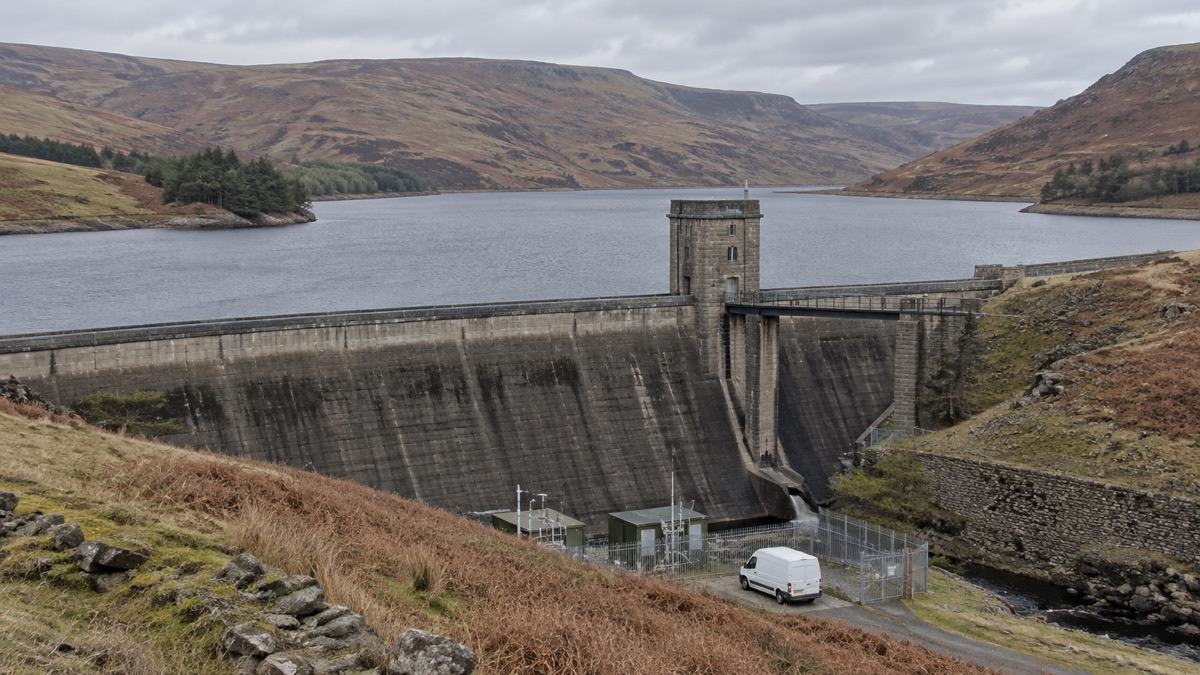
Reservoir flooding is the failure of a dam or other structure holding back a large body of water, and the flooding that follows. It is the rarest form of flooding the UK maps, and it behaves differently from every other kind. Natural Resources Wales states it plainly: "Reservoir flooding is extremely unlikely to happen. There has been no loss of life in the UK from reservoir flooding since 1925."1 The reason to take it seriously anyway is speed. If a dam fails, "a large volume of water could escape at once and flooding could happen with little or no warning"1, which leaves no time for the gradual build-up of alerts that river and coastal flooding allow.
So this page covers two things: how to find out now whether your home sits in a reservoir flood area, and what to do in the very unlikely event you are told a dam may fail. It also explains how large reservoirs are inspected and regulated in England and Wales, because understanding that system goes a long way towards answering the fear a reservoir on the hillside above your town can create.
Rare, but fast: why reservoir flooding is treated differently
Every other kind of flooding the UK maps comes with a likelihood. Reservoir flooding does not. Natural Resources Wales is explicit: "We do not provide a risk level for flooding from reservoirs"2. Instead, the maps show something else: the worst-case scenario for the area that could be flooded if a large reservoir failed5.
That is not because the risk is high. It is because the consequence is what matters. Derbyshire County Council, whose county includes the reservoirs above Whaley Bridge, describes reservoir flooding as "an unlikely source of danger to any property due to the strict regulations and maintenance schedules used by reservoir operators"6. Local risk registers take the same view from the other direction: Wiltshire and Swindon's preparedness partnership rates reservoir collapse as very infrequent, with a likelihood and impact score of 2/47, while Surrey's community risk register and London's risk register both carry reservoir or dam collapse as a planned-for hazard rather than a top-tier one8.
The practical difference for your household is warning time. Ordinary floods can also arrive without an alert, and Cumberland Council warns that "floods can sometimes happen without any warning, or you may not live in a flood risk area, so you may not be notified by a flood alert or warning"10. But a river rises over hours and surface water ponds over minutes. A dam failure releases stored water in a wave. Natural Resources Wales notes that for surface water and small watercourses "there isn't time to issue advance warning messages"11; a dam failure is the extreme version of that problem. Your preparation therefore has to be done in advance, and your response has to be immediate.
Check whether your home is in a reservoir flood risk area
The check takes minutes and is free. The gov.uk guidance on adapting your home to flood risk tells you to check your long-term flood risk from rivers, the sea, surface water, reservoirs and groundwater where data is available12. You can check whether you are at risk of flooding in your area via the gov.uk flood risk check12, and households at risk of flooding are advised to check if their property is in a flood risk area and sign up for flood warnings by text, phone or email12.
Read the reservoir layer carefully, because it does not mean what the other layers mean:
| What the map shows | What it means | What it does not mean |
|---|---|---|
| The area that could be flooded if a large reservoir failed | The worst-case extent of flooding2 | A prediction that it will flood |
| No risk band for reservoir flooding | Likelihood is not given for this flood type2 | That the risk is high, or that it is zero |
| Coverage of large raised reservoirs | Reservoirs over the statutory size threshold3 | Every pond or small reservoir uphill of you |
One threshold matters when reading the maps. A large reservoir is one that holds over 10,000 cubic metres of water, which Natural Resources Wales describes as "equivalent to approximately 4 Olympic sized swimming pools"1. The Reservoirs Act 1975 applies to reservoirs designed or used for collecting 10,000 cubic metres or more of water above the natural level of the surrounding land13. Surrey's risk register notes that every large raised reservoir with a capacity above 25,000 cubic metres has reservoir outline flood maps publicly available on the Environment Agency's website8. Smaller water bodies are not mapped on this layer, so an unmapped home is not necessarily uphill-safe from every body of water, only from the regulated large reservoirs.
If your home is in a reservoir flood extent, the next step is to sign up for free flood warnings by phone, text or email12. Then read the sections below on what to do and how to prepare. If it is not, the same check will have shown you your river, surface water, coastal and groundwater risk, which for almost every household is where the real work lies: see checking your home's flood risk by postcode and the types of flooding.
If a dam fails: get to high ground and follow the emergency services
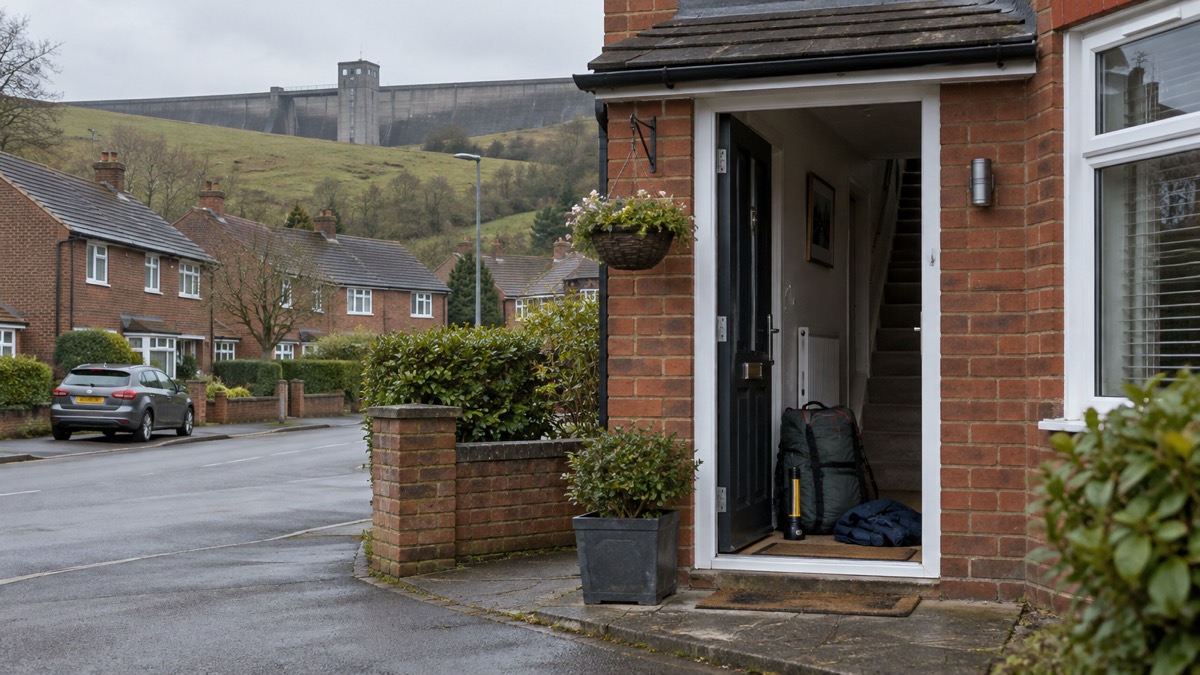
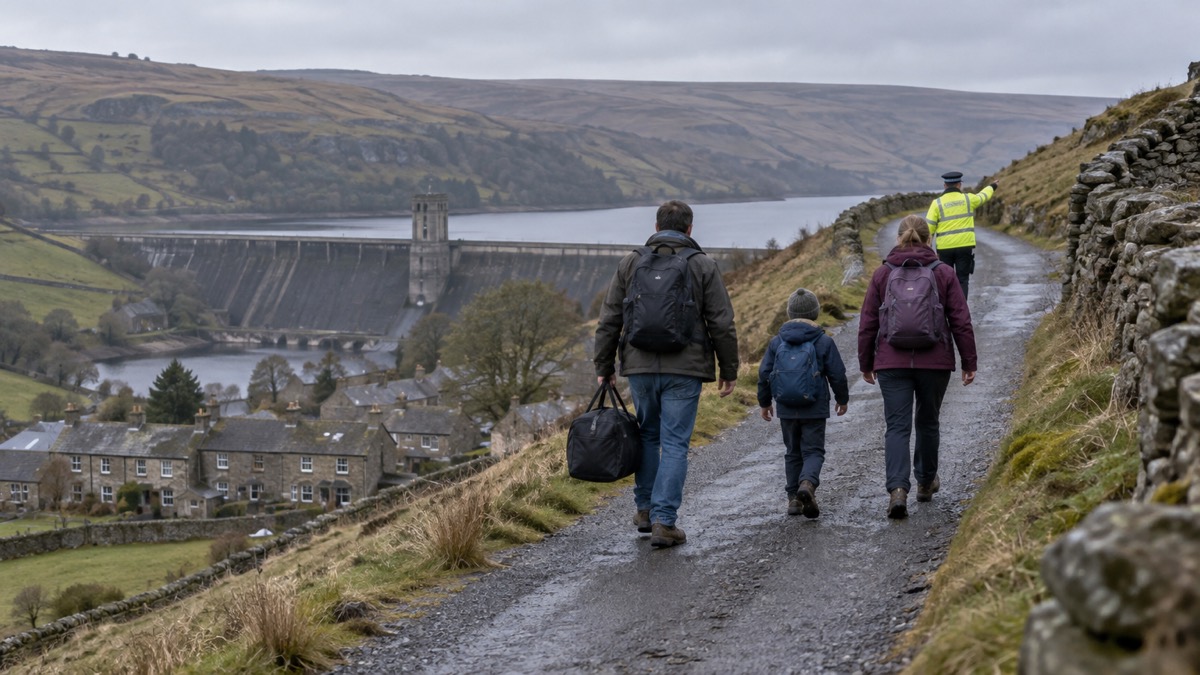
The instruction from Natural Resources Wales for households at risk from reservoir flooding is short and clear: "Consider and plan where, and how, you would go to safety, and be ready to follow the advice of emergency services."1 Because the water can arrive with little or no warning, the plan has to be made before anything happens. Walk your route to high ground now, in daylight, with everyone in the household, and agree a meeting point in case you are separated.
If you are told a dam may fail, or you receive an evacuation instruction:
- Move immediately to high ground, on foot if you can. Do not wait to see the water, and do not drive into valleys or towards bridges.
- Take people and pets with you. Everyone in the household, including pets, needs to be ready to move at the same time.
- Do not stop to protect the house. With river flooding there is time to fit barriers and move belongings; with a dam failure there may not be. Your life comes first.
- Keep listening. Follow the emergency services' instructions, and be ready to act on them.
Two cautions from the wider flood guidance apply with extra force here. First, flood defences reduce but do not completely stop the chance of flooding, as they can be overtopped or fail2, so a defence between you and the water is not a reason to delay leaving. Second, never walk or drive through floodwater: see is it safe to walk or drive through floodwater?. Moving water from a failed dam is the most dangerous floodwater there is.
Get ready now: grab bag, contacts and staying alert
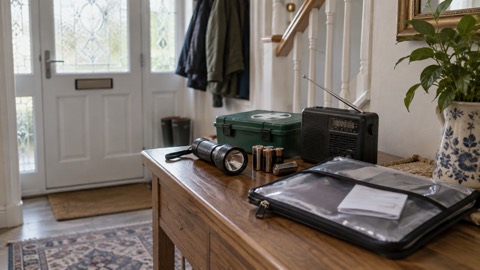
Preparation for reservoir flooding is the same preparation that carries you through every other flood and emergency, which is why it is worth doing even for a very unlikely event. Harborough District Council's resident grab bag guidance sets out the build-up: monitor flood warnings and weather forecasts, start your grab bag, charge phones, power banks and torches, move important items upstairs, and check on neighbours or vulnerable people14. Check the grab bag every 6 months14.
What to have ready:
- A grab bag with essentials, checked every six months14
- Phones, power banks and torches kept charged when flooding is possible14
- Important documents and valuables where they can be moved quickly14
- A written list of contacts, including neighbours or vulnerable people who may need help15
- Flood warnings signed up for by phone, text or email12
Staying alert matters as much as the kit. Sign up for flood warnings in your area12, and keep an eye on local weather reports12; the flood guidance statement and five-day forecasts page explains how that works. For a fuller framework, see making a household flood plan and what to do during a flood at home.
One piece of household admin belongs here too. Public Health Wales's advice on flooding and health is to check your home insurance covers flooding16, and Dorset Prepared adds that households in flood risk areas should check their insurance policy for the property or speak to their landlord17. Some insurers offer reduced premiums for properties that implement property flood resilience measures18, and Flood Re offers affordable insurance to homes identified as at risk of flooding19. The details are on home insurance in a flood risk area and Flood Re.
How dams fail and why the water moves so fast
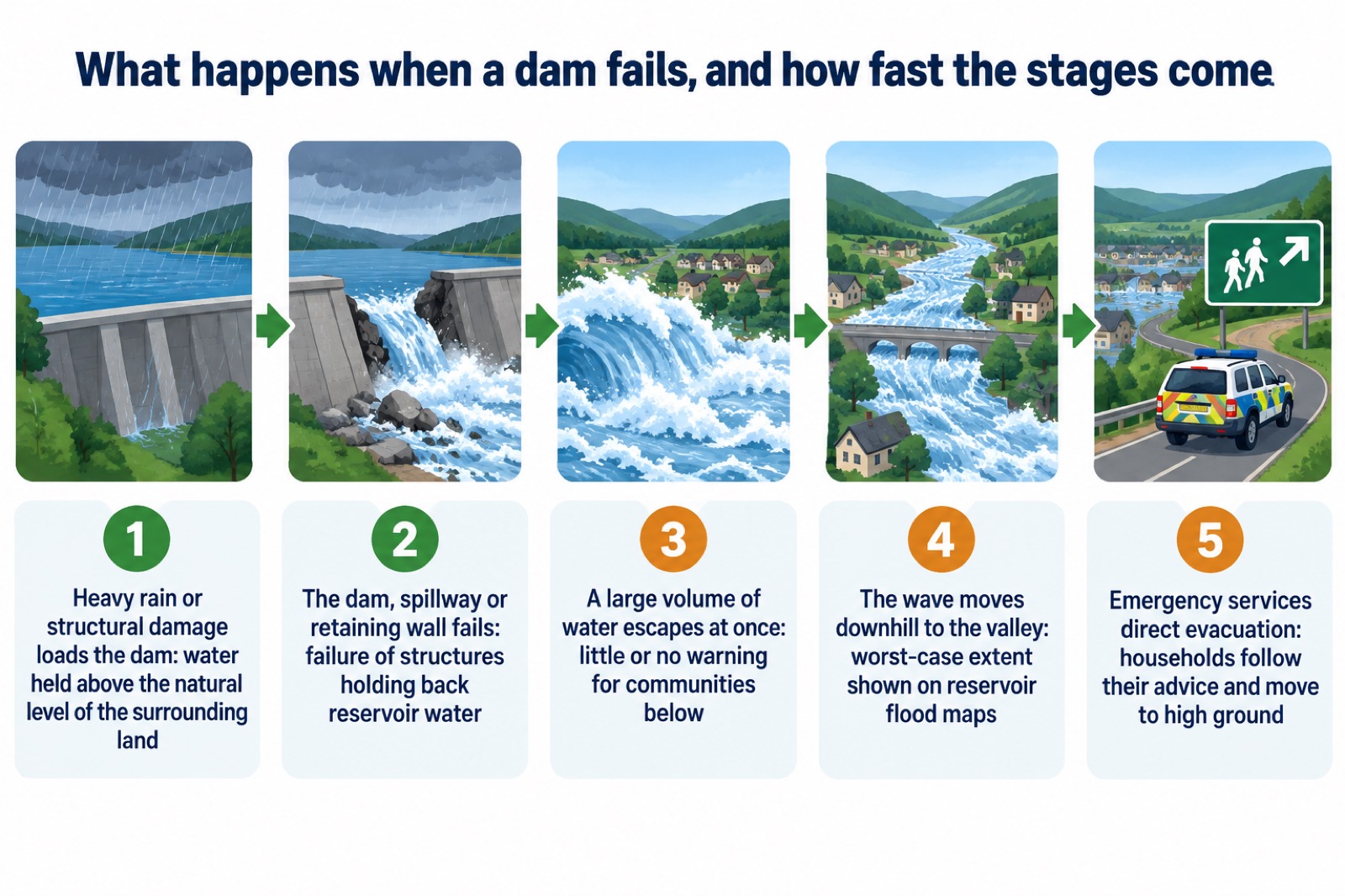
Reservoir flooding happens through the failure of structures holding back reservoir water, for example dams and retaining walls6. A reservoir stores water above the natural level of the surrounding land13, sometimes far above a valley town. When the structure that holds it gives way, the stored water is released at once, and gravity sends it downhill as a wave rather than as a rising river. That is why the official description is "a large volume of water could escape at once and flooding could happen with little or no warning"1.
The causes sit outside normal household experience, and one is deliberately remote: Wiltshire and Swindon's preparedness guidance notes that attacks on dams are now restricted under international law because of the severe effect they would have on huge numbers of the population7. The everyday mechanisms are structural: a dam or spillway can be damaged, overtopped in extreme conditions, or weakened over time, which is what the statutory inspection regime exists to catch. Flood defences of any kind reduce but do not completely stop the chance of flooding, as they can be overtopped or fail2.
The wider flood picture shapes how much water a dam has to hold back. Flood risk can change over time, increasing with heavier or longer rain, more impenetrable surfaces like tarmac, fewer trees and vegetation, and climate change, and decreasing with better natural flood protection5. Public Health Wales describes the basic mechanism of flooding as "a lot of rainfall over a short space of time and the ground, rivers and streams cannot cope to drain away the extra water fast enough"16. A reservoir in the path of that rainfall is doing flood defence work for the valley below it, which is why many exist in the first place: the Environment Agency operates 217 large raised reservoirs in England, mainly for flood risk management purposes20.
Toddbrook: what a near miss looked like
The event that shapes current reservoir safety work happened at Toddbrook Reservoir in August 2019, described in the Environment Agency's national flood and coastal risk management report as "the most significant incident" of that reporting year20. Toddbrook sits above the town of Whaley Bridge, between Stockport and Buxton7. A partial collapse of the spillway chute on 1 August 2019 triggered a major incident20, and a danger to life warning was released by the Environment Agency due to the possibility of the dam collapsing7.
The response is the part worth studying. Over 1,500 residents were evacuated from the areas likely to be affected should the reservoir waters be released7. The Canal and River Trust own and manage Toddbrook Reservoir20. In the end the dam held, and no-one was injured in Whaley Bridge7. The evacuation, not luck, is what stands between a near miss and a disaster, and it worked because people left when told to.
Toddbrook also changed the system. Defra established a reservoir safety reform programme following the incident13, and announced a second stage of the independent review of reservoir safety guidance and legislation in June 202020. The independent review report contained 22 recommendations for the reservoir network and community, which have been accepted by government20. For your household, the lesson is the one this page keeps returning to: know now whether you are in the extent, know your route uphill, and go when you are told.
How large reservoirs are kept safe in England and Wales
The safety of reservoirs is the responsibility of the reservoir's owners or operators4, with the Environment Agency enforcing the Reservoirs Act 1975 across England and Wales4. About 2,000 reservoirs in England and Wales are covered by the Act21. Northumberland County Council summarises the position: large reservoirs in England and Wales are regulated under the Reservoirs Act 197521.
Who the owners are explains why the system is varied rather than uniform. In Wales, undertakers of large raised reservoirs break down as 35% statutory water companies, 26% private landowners, 21% publicly funded bodies (including local authorities at 10%, Natural Resources Wales at 9%, and national park authorities and Cadw at 2%), and 18% other organisations22. A reservoir above your home may belong to a water company, a council, a charity or a private estate, but all large raised reservoirs answer to the same statutory regime.
Incidents happen, and the record shows how the system performs. The average number of incidents reported per year in England is 720. Between 1 April 2019 and 31 March 2020 there were 11 incidents where emergency measures were taken, of which two were classed as level 2 and nine as level 320. In Wales, five incidents were recorded at large raised reservoirs during the report period, requiring some precautionary measures22. In every case the owners responded and none required the enforcement authority to step in using emergency powers22. An incident is not a failure: it is the system catching a problem early.
| Reservoir safety in England and Wales | Figure |
|---|---|
| Reservoirs covered by the Reservoirs Act 1975 | about 2,00021 |
| Large raised reservoirs operated by the Environment Agency | 217, mainly for flood risk management20 |
| Average incidents reported per year in England | 720 |
| Incidents needing emergency measures, 2019/20 | 11, of which 2 were level 2 and 9 level 320 |
| Loss of life from reservoir flooding in the UK since 1925 | none1 |
Wales: 400 large raised reservoirs and their emergency plans
Wales has its own enforcement authority and its own numbers, and they are worth knowing if you live there. Natural Resources Wales is the enforcement authority for the safety of large raised reservoirs in Wales22. There are 403 large raised reservoirs recorded on the public register at the time of the most recent report22.
Around 270 reservoirs in Wales fall into the high-risk category13, and approximately 290,000 people live in areas that could be affected by the failure of a large raised reservoir13. For comparison, over 91,100 residential properties in Wales are at risk of river flooding and 127,000 are at risk of surface water flooding13, which puts reservoir flooding in proportion: it matters because of its speed, not its scale. Eight reservoirs were designated as high-risk, where Natural Resources Wales thinks a flood from the reservoir, caused by a failure of the dam, could endanger life23.
Emergency planning is where Wales is still building. Natural Resources Wales has provided guidance on the voluntary production of reservoir emergency flood plans and has seen an increase in their production, with 88% of high-risk reservoirs now having a written plan23. It produced 35 new or revised reservoir flood maps during the year and plans to produce more during 202623. Not everything is resolved: non-compliance is attributed to 47 reservoirs (12%), operated by 34 separate undertakers with one or more unresolved breaches in place23. If you live in Wales and want to know about local emergency plans, contact your local authority1. More generally, see Wales: Natural Resources Wales warnings and risk maps.
Where to get help and official information
The first stop is the flood risk check for your property, and the free flood warning service24. The flood warnings and how to sign up for free flood warnings pages walk through registration.
For reservoir matters specifically:
- Local emergency plans: contact your local authority, which holds them1.
- Reservoir safety enforcement: the Environment Agency in England, enforcing the Reservoirs Act 19754; Natural Resources Wales in Wales22.
- In an emergency: follow the advice of the emergency services, who direct evacuations1.
- Insurance questions: check your policy covers flooding16, and see home insurance in a flood risk area and Flood Re.
If the worst happens and your home floods, the pages on what to do during a flood, first steps after your home floods and cleaning up safely after floodwater take over from here. Reservoir flooding is the least likely way for that to happen to you. Knowing your extent, your warning route and your path uphill turns it from a fear into a plan.
Sources (25)
- Risk of Flooding from Reservoirs, map guidance, Natural Resources Wales, 2026
- Different Types of Flood Risk, maps, Natural Resources Wales, 2026
- Reservoir Flooding, Derbyshire County Council, 2026
- Identifying Flood Risk: Reservoir, Derbyshire County Council, 2026
- Understanding Your Flood Risk Results, Natural Resources Wales, 2026
- Identifying Flood Risk, Derbyshire County Council, 2026
- Reservoir Collapse, Wiltshire and Swindon Prepared, 2026
- Community Risk Register 2026, Surrey County Council, 2026
- London Risk Register v14, Greater London Authority, 2025
- Stormy Weather, Weather Ready, Cumberland Council, 2026
- Sign Up to Receive Flood Warnings, Natural Resources Wales, 2026
- Adapting Your Home or Business to the Risk of Flooding, GOV.UK, 2009
- Resilience: Risks in Wales, Welsh Government, 2026
- Resident Grab Bags, Harborough District Council, 2026
- Community flood plan - GOV.UK, Environment Agency
- Flooding and Health, Public Health Wales, 2026
- Flooding, Types of Risk, Dorset Prepared, 2025
- Homeowner Flood Protection: Responsibilities and Prevention Tips, Central Bedfordshire Council, 2026
- Before, During and After a Flood, Scottish Environment Protection Agency, 2026
- Flood and Coastal Erosion Risk Management Report, 1 April 2019 to 31 March 2020, Environment Agency, 2020
- Emergency Planning and Business Resilience, Northumberland County Council, 2026
- Flood Risk Management Annual Report 2024 to 2025, Natural Resources Wales, 2025
- Natural Resources Wales / Flood risk management annual report 2025 to 2026, Natural Resources Wales
- Preparing for a Flood, London Fire Brigade, 2026
- Staying Safe in Flooding, West Midlands Ambulance Service NHS Foundation Trust, 2026
 Flood Warning Checklist
 First Steps After a Flood
 Insurance Claim Records
 Checking Flood Risk by Postcode
 Types of Flooding
 Flood Alerts and Flood Warnings
 Flood Guidance Statement
 Wales Flood Warnings and Maps
 Making a Household Flood Plan
 Protecting Your Home
 Door Flood Barriers
 Sandbags and Alternatives
 Flood Doors and Windows
 Airbrick Covers
 Non-Return Valves and Bungs