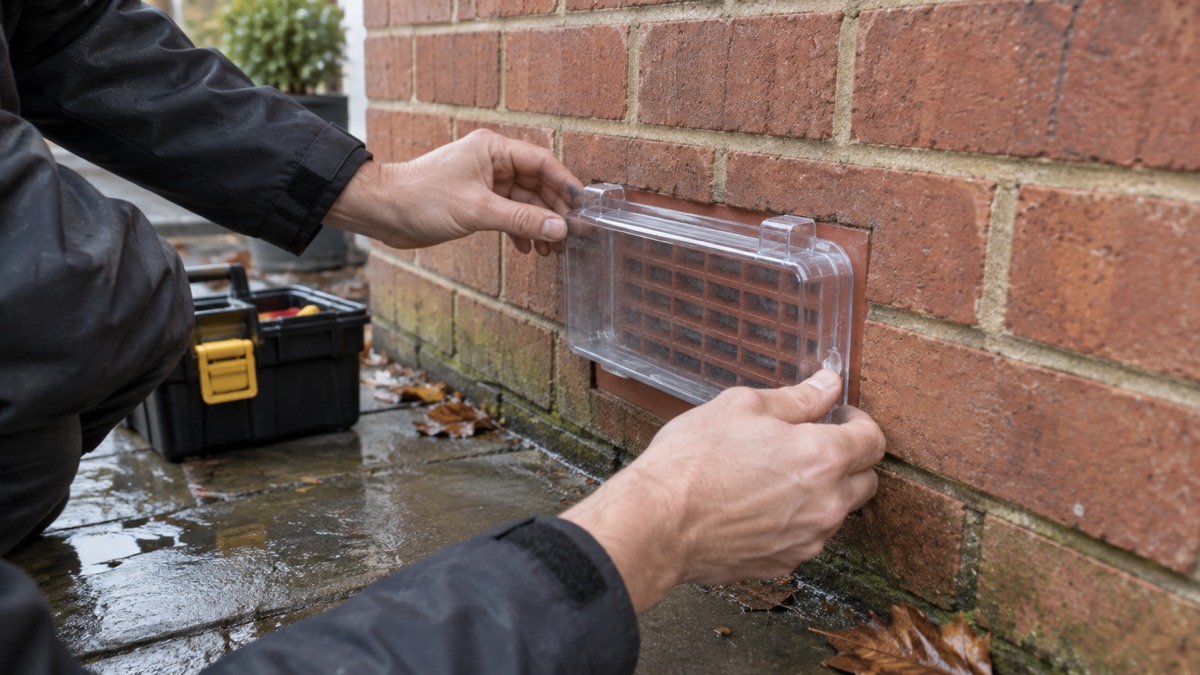
Airbricks are the small ventilated bricks just above ground level that let air circulate under a suspended timber floor and inside wall cavities. In a flood they are also one of the lowest and most direct routes for water into your home: a hole in the wall, deliberately left open, sitting at exactly the height flood water reaches. Airbrick covers exist to close that hole. Official flood guidance lists them alongside flood barriers as products to use when flooding threatens1, and Suffolk's flood booklet puts it plainly: airbrick covers "can stop flood water coming in through your airbricks"2.
You have two broad choices. A temporary cover is something you fit only when a flood warning arrives: a plastic cover clipped or screwed over the brick, or a simple bung pushed into the vent. A permanent solution stays in place all year and either closes by itself when water rises, or is sealed with bungs in seconds when needed. Government guidance on adapting a property to flood risk describes both routes: replace air bricks with self-closing air bricks that close automatically during flooding, or buy watertight covers to put over air bricks3. This page explains each type, how they are fitted, and the one rule that matters most: whatever you seal for a flood must be unsealed afterwards, because a home that cannot breathe develops damp and dries out far more slowly.
Why airbricks let water in, and what to do now
An airbrick is a vent. Its whole purpose is to be open: it lets air move through the underfloor void beneath suspended timber floors and through the cavities in cavity walls, carrying away moisture that would otherwise rot joists and dampen walls. Because it must stay open, it cannot be sealed up as part of the building fabric. That leaves a row of open holes at the base of the wall, usually within a few inches of ground level, and flood water only needs to rise a short way before it pours through them into the floor void.
Once water is in the underfloor space it soaks timber, insulation and services, and it is hard to reach and slow to dry. That is why flood guidance across the UK treats airbricks as a first-line defence. The national Prepare campaign advises using flood protection products, for example flood barriers or air brick covers, when flooding threatens1. Natural Resources Wales goes further during a flood: block water entering through doors and windows, cover airbricks and vents, and block sinks, baths and toilets7. Mid and West Wales Fire and Rescue Service advises blocking doors and airvents with plastic sheeting and sandbags when a flood warning is issued8.
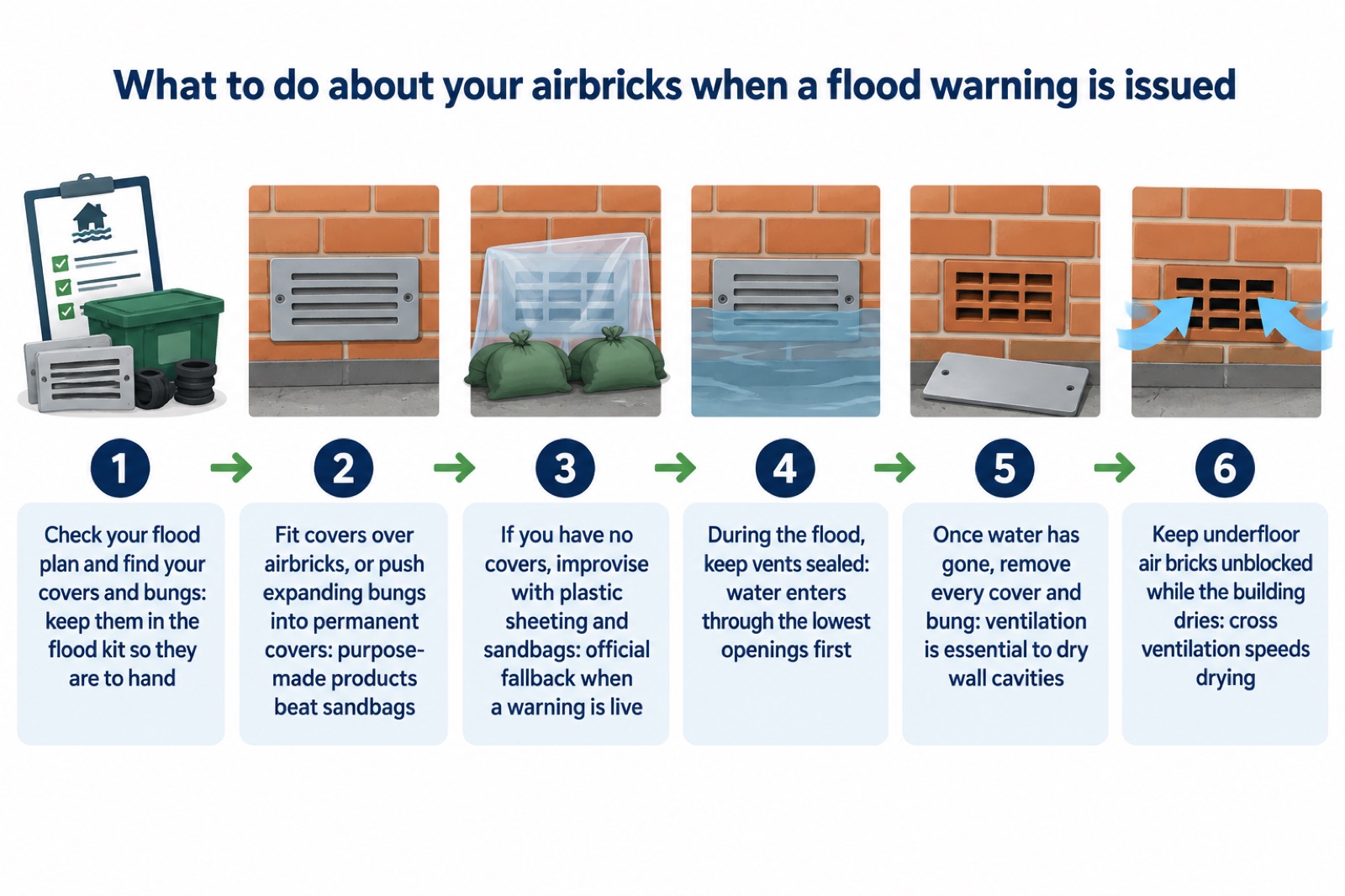
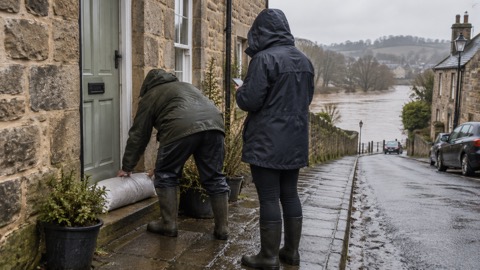
If a flood warning is live and you have no purpose-made cover, the official fallback is improvised: plastic sheeting and sandbags over the vent8, or pillowcases and plastic bags filled with soil as a weight7. Purpose-made products do the job better. Dover's damage limitation guide states that purpose-made flood boards for doors, windows and air bricks "will be more successful than sandbags for minimising floodwater entering a property"5. So the practical order of priority is: buy covers before you need them, fit them when a warning arrives, and improvise only if you have nothing else.
Temporary covers or permanent self-closing airbricks
The first decision is whether you want something you fit each time or something that is always in place. Natural Resources Wales notes that some flood protection products can be in place permanently, while others need to be installed when flooding is expected9. Both approaches protect the same hole; they differ in cost, effort and the risk of not being home when the water comes.
| Temporary cover | Permanent self-closing airbrick | |
|---|---|---|
| When it is fitted | When a flood warning is issued | Once, replacing the existing air brick |
| How it works | Plastic cover clipped or fixed over the airbrick | Closes automatically when flood water reaches it |
| Needs you at home | Yes, to fit it in time | No |
| Ventilation between floods | Normal, cover is off | Normal, vent stays open until water arrives |
| After the flood | Remove the cover | Reopens by itself as water falls |
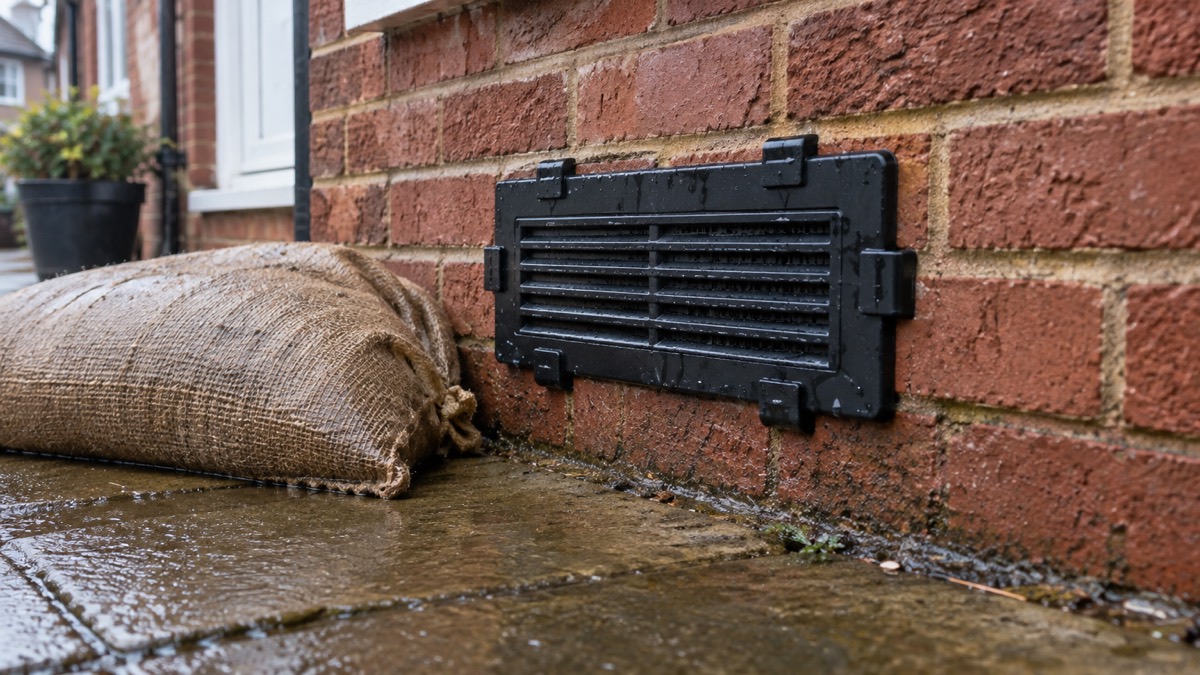
A temporary cover suits households that are usually home, that receive flood warnings in time, and that want a low-cost, reversible measure. The Met Office lists plastic covers to seal airbricks among the flood protection equipment to have ready10. Central Bedfordshire's flood kit list includes air brick covers alongside aquasacs, plastic sheeting, flood barriers, toilet bungs and non-return valves11. Northern Ireland's nidirect guidance says that if your property is at risk of flooding, have some sandbags or floodboards or plastic covers prepared to block doorways and airbricks12.
A permanent self-closing airbrick suits households that flood often, that travel, or that want a measure that cannot be forgotten. It costs more and needs fitting, but it removes the timing risk entirely. London's flash flooding guidance lists sealable air bricks among property flood products alongside flood doors and demountable barriers13, and the national Protect Your Property guidance notes that getting flood protection products, for example flood doors or self closing air bricks, reduces flood damage14.
One honest caveat worth weighing: alternative products such as barriers often provide more effective long term protection, are more easily deployed and have greater reliability when fitted correctly15. Airbrick protection is one part of a wider set of measures, not a complete answer on its own.
Self-closing airbricks close automatically during flooding
A self-closing air brick replaces the existing air brick in the wall. Government guidance describes what it does: self-closing air bricks "close automatically during flooding to stop water entering"3, and the same wording appears in the Prepare Your Property for Flooding publication4. Nothing needs to be fitted, clipped or remembered when a warning arrives, which is their main advantage over every kind of removable cover.
The Scottish Flood Forum's protection guide explains how the mechanism works. The automatic air brick "uses a clever floating ball arrangement which seals the ventilation hole when flood water reaches the air brick", and some manufacturers use a flap valve instead16. In normal conditions the vent is open and air passes through as usual. When water rises to the level of the brick, the float lifts or the flap swings shut, sealing the hole against the water outside. As the water falls again, the vent reopens and ventilation resumes without anyone doing anything.
That automatic behaviour matters most in two situations. The first is rapid onset flooding, when there is little time to deploy manual measures: guidance on flood protection products notes that some need to be installed when flooding is expected, while others can be in place permanently13. The second is being away from home, whether overnight or for a fortnight, when a warning arrives and nobody is there to act on it.
Fitting means replacing a traditional air brick with the new unit, which is a job for someone comfortable with basic masonry work, or for a tradesperson. If you are planning wider work, published resistance measures recommend airbrick covers or automatically closing airbricks alongside options such as flood doors or door barriers, demountable flood boards and non-return valves on drainage pipes17. Devon's Property Flood Resilience funding scheme lists airbrick covers among its recommended products18, so it is worth checking whether any grant support is available in your area before you buy.
Fitting a permanent cover with expanding bungs
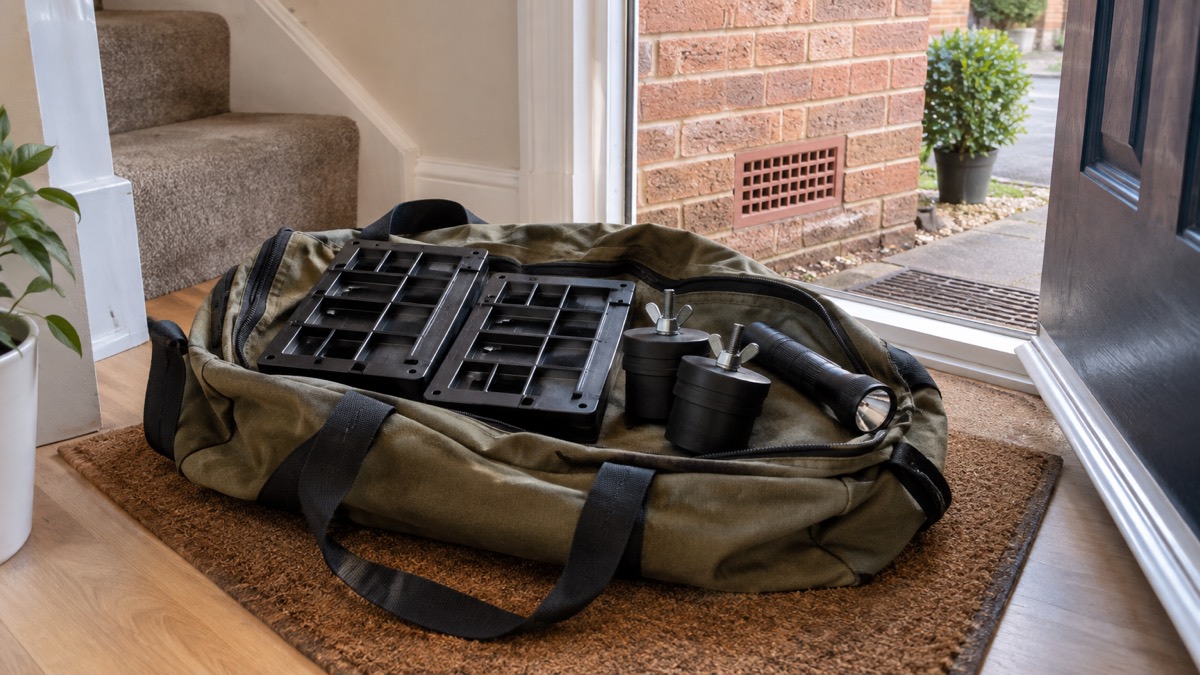
Between the clip-on temporary cover and the fully automatic air brick sits a third design: a permanent cover with expanding bungs. The Scottish Flood Forum describes it as "permanently fitted to walls, can be over painted, with two expanding bungs fitted in times of flooding and removed to allow the property to breathe"16.
The cover itself stays on the wall all year. It is open, so air flows through the airbrick as normal. Near the bottom of the cover are two holes. In dry weather they simply sit there. When flooding threatens, you push the expanding bungs into the holes, sealing the vent against water. When the flood has passed, you pull the bungs out and the property can breathe again.
This design has three practical strengths. It can be painted over, so it blends into the wall rather than sitting on it as an obvious fitting16. It needs no separate storage place, because the cover is always on the wall and the bungs are small enough to keep in a drawer or flood kit. And deployment takes seconds, which matters when a warning arrives with little notice.
The weakness is the same as any manual measure: it depends on someone being there to push the bungs in. If you are away, or asleep, or the flood arrives faster than the warning, an open cover with bungs in a drawer is no protection at all. Weigh that honestly against the automatic option before choosing.
After the flood, treat the bungs like any other cover. Dover's guidance on flood-resilient DIY improvements says to buy air bricks with removable covers and always remove or open the cover after flooding to assist in drying out the property5. Floodboards follow the same rule: Nottinghamshire's Environment Agency leaflet notes they can be washed, stored and used again, and should always be removed once the flood water has gone to help the property dry out19.
Snorkel covers: vents above flood water height
A snorkel cover takes a different approach to the same problem. Instead of sealing the vent during a flood, it moves the opening above the water. The Scottish Flood Forum describes it as "permanently fixed to the wall over the air brick with vents above flood water height, allowing the property to breathe yet preventing the ingress of flood water"16.
The cover fits over the existing airbrick and extends upward, so the actual vent openings sit higher up the wall than the airbrick itself. Flood water can rise past the old brick level and still not reach the openings. Because the vent is never closed, the underfloor space keeps its airflow throughout the flood, which removes the biggest drawback of sealed covers: no damp build-up, and nothing to remember to remove afterwards.
Snorkel covers "come in a variety of different heights"16, so the right choice depends on how high flood water is expected to rise at your property. That is information a flood survey or your local flood history can supply; see checking your home's flood risk for how to find it. If floods in your street stay below the top of your snorkel, it protects; if water regularly rises higher than the snorkel, it does not. Match the height to the realistic worst case, not the average flood.
The trade-off is appearance and permanence. A snorkel is a visible fitting on the wall at all times, unlike a cover that appears only during a flood. Some households accept that readily in exchange for never having to act; others prefer something less noticeable. It is a genuine choice between two ways of solving the same problem, and neither is universally better.
Keeping your home ventilated when there is no flood
Every airbrick measure shares one rule: the vent must be open again once the flood has passed. Dover's damage limitation guide states it directly: "Remove any coverings on airbricks once the flood has passed, as ventilation is essential to dry wall cavities"5. Dorset and Wiltshire Fire and Rescue Service gives the same instruction for improvised protection: open doors and windows to ventilate the property and remove any sandbags across airbricks20.
The reason ventilation matters so much after a flood is the amount of water a building absorbs. Surrey's after-a-flood guidance says to ensure air bricks to under floor spaces are unblocked to give cross ventilation, and to vacuum up loose material and dust regularly as floorboards and walls dry out22. The UK Health Security Agency's flooding and health advice repeats it: keep underfloor air bricks unblocked to boost cross ventilation23. Derbyshire's cleaning-up guidance adds that while drying continues you should keep the property well ventilated with windows open as much as possible, have some heating on at all times, and consider a dehumidifier24. London Fire Brigade advises opening windows and doors as much as you safely can, and says you can speed drying with commercial air movers, dehumidifiers and heaters25.
Between floods, the same logic applies. An airbrick sealed for months on end stops the underfloor void breathing, and moisture that cannot escape eventually shows up as damp floors, rotting timber and musty smells. If you use a temporary cover, store it somewhere findable rather than leaving it screwed on. If you use bungs, keep them in the flood kit, not in the wall. A cover that is easy to put on and easy to take off is safer in the long run than one that quietly stays on.
Sealing micro air vents and smaller gaps
Not every opening at wall level is a standard airbrick. Many homes have smaller vents, weep holes, cable entries and gaps around pipe penetrations, and flood water will find each of them. The same principles apply at smaller scale: seal what you can before a flood, and reopen it afterwards.
For the standard-sized vent, the clip-on cover is the commonest temporary product. The Scottish Flood Forum describes one design with "a preinstalled blue frame and clip on red cover for a water tight seal": the frame is fixed to the wall on top of the air brick using sealant and screws, and in a flood the cover clips onto it16. A variant uses the same idea with a frame permanently left in position and covers fixed to the frame to prevent flood water entering16. The advantage of a frame system over a plain plate is speed and repeatability: the cover locates the same way every time, with no measuring or drilling in the rain.
For smaller gaps, official guidance offers the improvised route. Mid and West Wales Fire and Rescue Service advises blocking doors and airvents with plastic sheeting and sandbags8, and Natural Resources Wales suggests covering airbricks and vents and blocking water inlet pipes with towels or cloths7. Plastic sheeting taped or weighted over a micro vent is a reasonable emergency measure; what it must never become is a permanent seal, for the ventilation reasons above.
If you have many small penetrations, it is worth reading the wider guidance on protecting your home and on stopping water through meter boxes and cable holes, because airbricks are rarely the only route in. Published resistance measures set airbrick covers and automatically closing airbricks alongside other options such as flood doors or door barriers, demountable flood boards and non-return valves on drainage pipes17, so it is worth treating the small gaps as one part of that wider set rather than sealing holes in isolation.
Airbricks as part of wider flood protection for your home
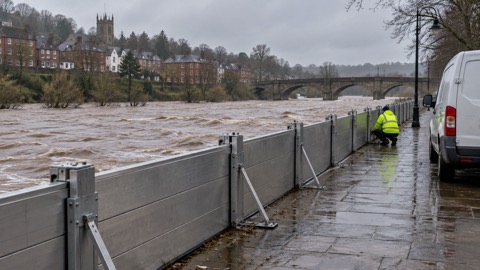
An airbrick cover stops water through one route. A real flood attacks several at once: doors, windows, drains, the floor slab itself. West Yorkshire Prepared lists the options together, such as flood gates or flood sacks, specialist doors and seals for airbricks26. Surrey's preparing-for-flooding guidance says to decide what type of barriers and protection you need to reduce flood water coming into your home, including airbricks, doors and windows27. SEPA's flooding guide for communities notes that installing flood protection products, for example airbrick covers or flood barriers, could help to reduce overall damage and the amount of silt and mud that enters your property28.
The practical way to approach this is a household flood plan that lists, for each route water can enter, what you will do and what you will need. Natural Resources Wales lists flood doors, air bricks and hydrosacks as examples of the products to consider29. Northern Ireland's thunderstorm advice is typical of the official wording: have some sandbags, floodboards, or plastic covers prepared to block doorways and airbricks12. When a warning arrives, the national guidance is to use flood protection products if you have them, for example flood barriers or air brick covers30.
Related measures worth reading alongside this page include door flood barriers, flood doors and windows, sandbags and sandless alternatives, and non-return valves and toilet bungs for the drains. If you are buying products, look for certified ones: kitemarked flood products and PAS 1188 explains what the marks mean. And if you are planning a bigger retrofit, property resilience surveys and professional installation and property flood resilience grants cover getting it done properly and help with the cost.
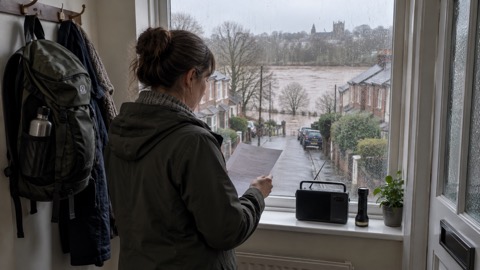
Finally, sign up for flood warnings so you have the time to deploy whatever you choose. Free warnings are available across England, Scotland and Wales, and how to sign up explains the process. A cover in a drawer and a warning you never received is no protection at all.
Sources (30)
- Flooding: be informed about hazards, Prepare campaign (UK government), 2026
- Before, during and after a flood booklet, Suffolk County Council, May 2021
- Adapting your home or business to the risk of flooding, GOV.UK, 1 October 2009
- Prepare your property for flooding, GOV.UK
- Damage limitation guide, Dover District Council, September 2001
- Chimney fire safety, Oxfordshire County Council, 2026
- What to do in a flood, Natural Resources Wales, 2026
- Flooding advice, Mid and West Wales Fire and Rescue Service, 2026
- Preparing for a flood, Natural Resources Wales, 2026
- Protecting your property from flooding, Met Office, 2026
- Emergency kits and grab bags, Central Bedfordshire Council, 2026
- Preparing for a flood, nidirect (Northern Ireland government), 11 September 2025
- How to prepare for flash flooding, Greater London Authority, 2026
- Protect your property, GOV.UK, 2026
- Flooding FAQs | Beta | SEPA | Scottish Environment Protection Agency, Scottish Environment Protection Agency (SEPA)
- Flood Protection Guide, Scottish Flood Forum, 2016
- Getting back into your home following flooding, Surrey County Council, 2026
- Property Flood Resilience funding scheme, 2nd edition, Devon County Council, July 2023
- What to do in a flood leaflet, Nottinghamshire County Council / Environment Agency, November 2010
- Flooding safety, Dorset and Wiltshire Fire and Rescue Service, 20 November 2023
- Carbon monoxide factsheet, Suffolk Fire and Rescue Service, 9 January 2014
- After a flood, Surrey County Council, 2026
- Flooding and health: advice for the public, GOV.UK, 13 March 2024
- Cleaning up after a flood, Derbyshire County Council, 2026
- After a flood: flooding advice, London Fire Brigade, 2026
- Flooding, West Yorkshire Prepared, 2026
- Preparing for flooding, Surrey County Council, 2026
- Flooding guide for communities, Scottish Environment Protection Agency, 2026
- Preparing for a flood, Natural Resources Wales, 2026
- Help during a flood, GOV.UK, 2026
 Flood Warning Checklist
 First Steps After a Flood
 Insurance Claim Records
 Checking Flood Risk by Postcode
 Types of Flooding
 Flood Alerts and Flood Warnings
 Flood Guidance Statement
 Wales Flood Warnings and Maps
 Making a Household Flood Plan
 Protecting Your Home
 Door Flood Barriers
 Sandbags and Alternatives
 Flood Doors and Windows
 Non-Return Valves and Bungs
 Sump and Submersible Pumps