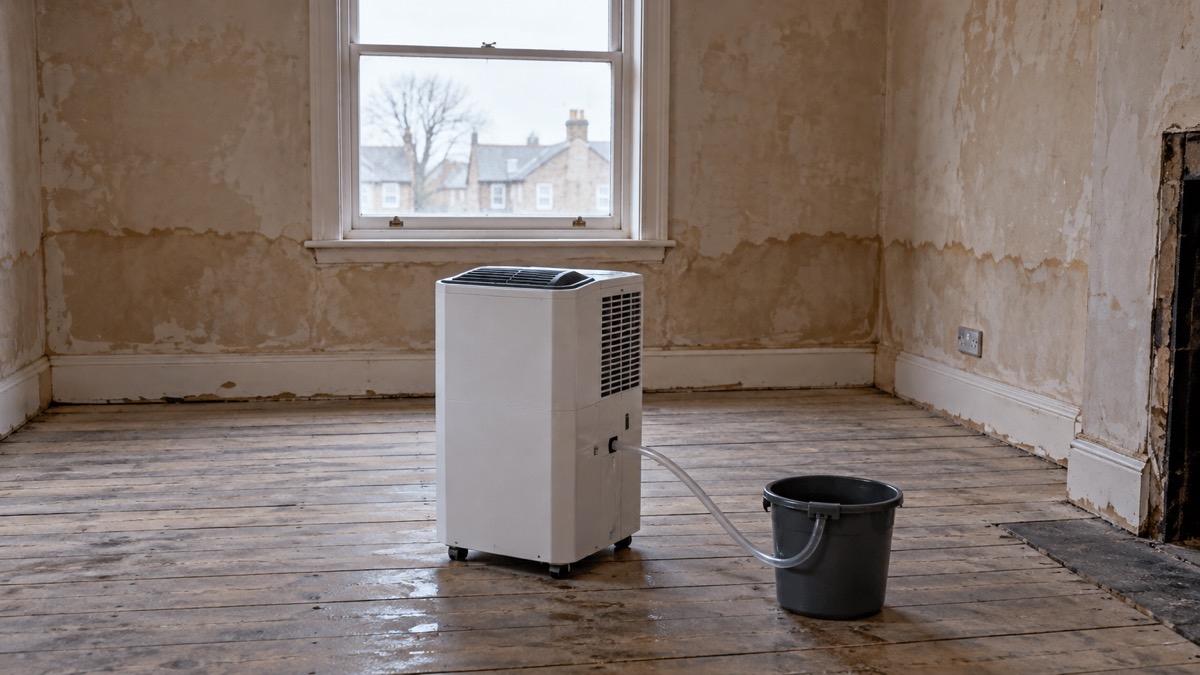
Once the floodwater has gone, a dehumidifier is one of the most useful tools a household has for getting the building dry again. It collects moisture from the air and helps the fabric of the house dry out, but it only works on the air, not on standing water, and it works best alongside heating and ventilation1. Used the wrong way, with windows open or before the water has been pumped out, it wastes time and money.
The single most important rule is this: if you are using a dehumidifier, keep external doors and windows shut2. A dehumidifier pulling in damp air from outside is trying to dry the whole street. Inside the house, though, keep internal doors open so air can circulate3. If you would rather dry the house naturally, do the opposite: open doors and windows as much as possible4.
Expect this to take time. Drying out a flooded home can take several weeks or even months5, and one documented case took between 4 and 5 months with insurance-supplied dehumidifiers before repair work could start6. Plan for steady, measured drying rather than a quick fix, and do not redecorate until damp levels have been checked.
Dehumidifiers help dry a house once floodwater has gone
A dehumidifier is a drying aid, not a clean-up tool. Official guidance is consistent that heating, dehumidifiers and good ventilation can help dry out your home8, and that once floodwater has receded, dehumidifiers can collect moisture from the air and aid drying1. The same guidance is equally clear about the limit: a dehumidifier should not be used to remove floodwater1. Water on the floor is a job for a pump, a bucket or a wet and dry vacuum.
That distinction matters because households often reach for the dehumidifier first. Before it can do anything useful, all standing water must be removed, particularly from the under floor area5. Once the water level outside is lower than inside, begin getting rid of the water with a pump or bucket2. Then shovel out the mud and hose the surfaces down, or use a garden sprayer5. Only then does drying the air make sense.
When you do run one, empty the tank sensibly. Collected water can go down regular drains and sinks, and where possible wear a face mask and eye protection when emptying the tank1. That is a small precaution that costs nothing and keeps you away from dirty water.
Dehumidifiers are not only a flood tool. Fire and rescue services advise that after a fire you can hire dehumidifiers, which will remove water from the atmosphere10, and they are useful for damp left by a storm or by drying washing indoors11. The principle is the same in each case: they take moisture out of the air in an enclosed space.
Keep external doors and windows shut while a dehumidifier runs
This is the instruction households most often get wrong. If you use a dehumidifier to remove water from the air, keep external doors and windows shut2. The reason is straightforward: with windows open, damp air from outside is drawn in, and the dehumidifier works harder trying to dry a greater area3. Keep the doors inside your home open, though, so the air can circulate3.
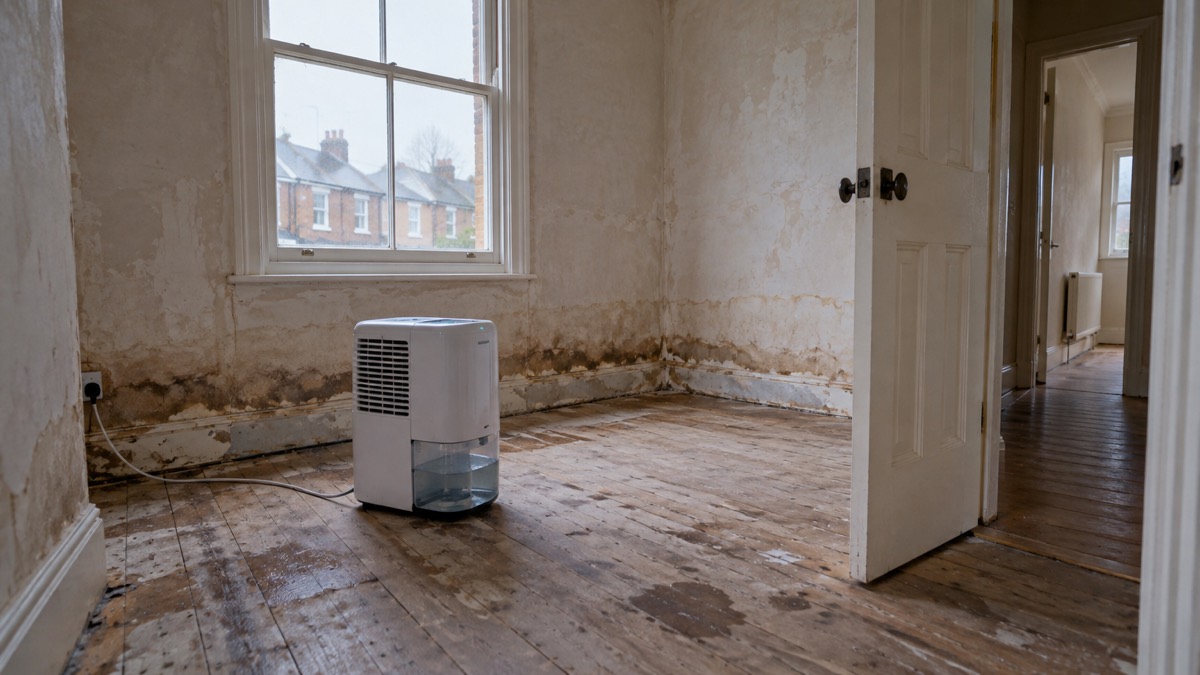
Official guidance from councils and national bodies repeats the same rule in slightly different words. If using dehumidifiers, close external doors and windows12. If you are drying your property using dehumidifiers, close windows and doors13. The Scottish Flood Forum adds that when using dehumidifiers you should close all windows to ensure drying properly occurs14.
The choice between the two methods is the thing to get right. You either dry naturally, with doors and windows open, or you dry mechanically, with a dehumidifier and the building closed up. Mixing the two defeats both.
| Method | Doors and windows | What else helps | Suits |
|---|---|---|---|
| Natural drying | Open as much as possible4 | Good ventilation, heating8 | Mild weather, a well ventilated house, minor damp |
| Dehumidifier drying | External doors and windows shut, internal doors open2 | Heating, fans, air movers15 | A soaked house, damp weather, a property that must dry on a schedule |
Whichever you choose, keep the property safe. If you are using portable indoor heating appliances to dry out indoor spaces, ensure good ventilation1. And if you are drying your home out with heaters or dehumidifiers, ensure there is good ventilation and never use petrol or diesel-powered generators indoors3.
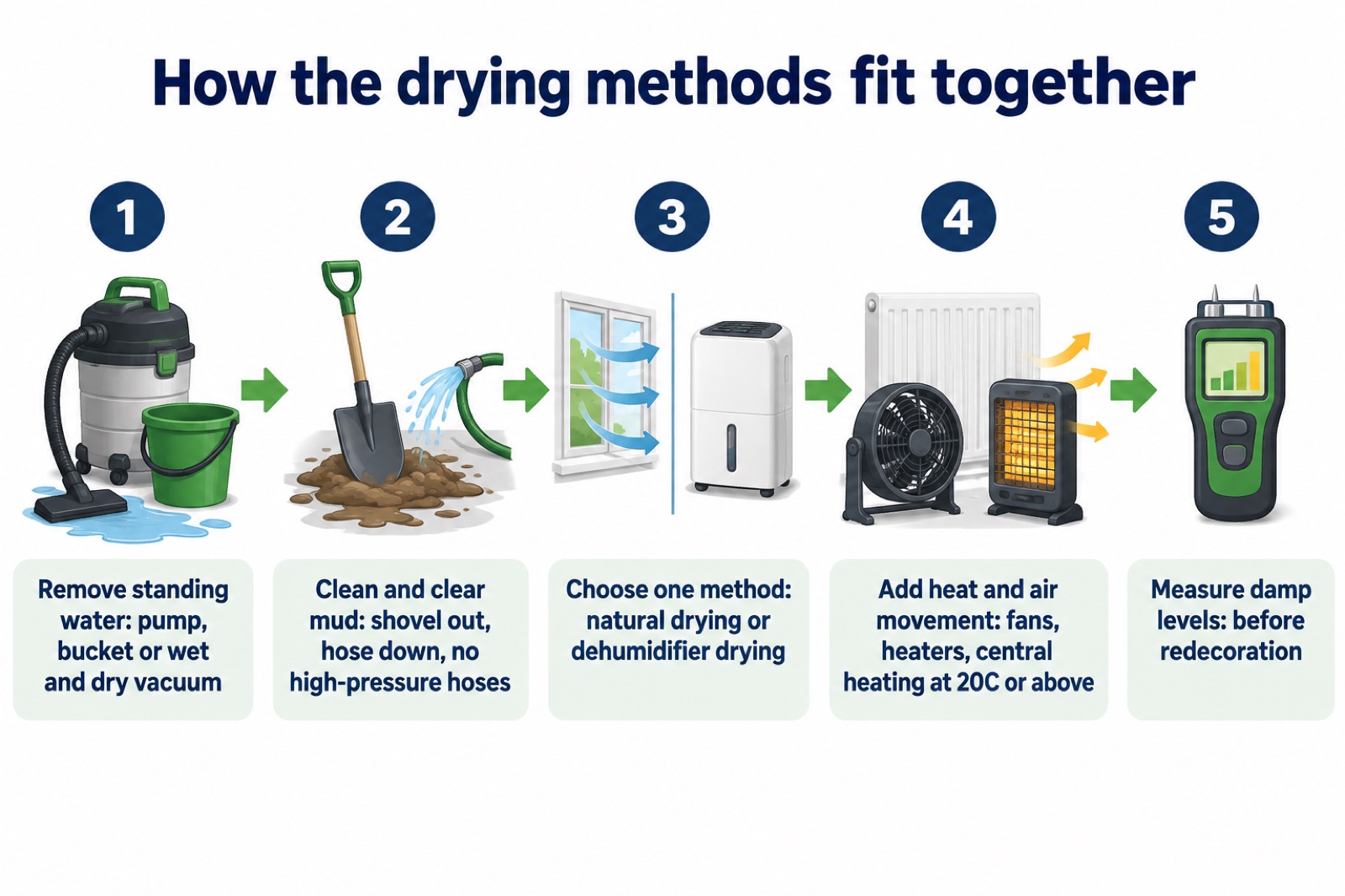
Removing the water first, and when to start drying
The order of operations is what decides whether drying works. Standing water has to go before the air can be dried.
- Wait until the floodwater outside has receded and it is safe to be in the property. Only return home when the emergency services say it is safe16.
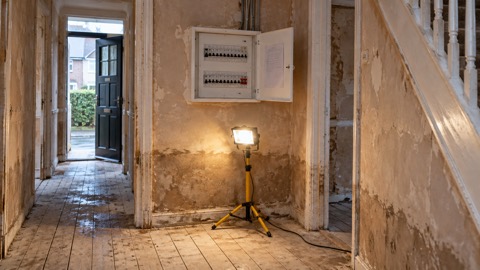
- Do not switch the electricity back on until a qualified person has checked it16. Avoid turning on devices that use gas or electricity, as they may have got wet; a registered electrician should assess wiring, equipment and appliances affected by the flood1.
- Once the water level outside is lower than inside, pump or bucket the water out2. You can hire or buy a pump and generator from a DIY shop2. For more on this, see Pumping Water Out of a Home or Cellar.
- Use a wet and dry vacuum, then shovel out the mud and hose down or use a garden sprayer5. A normal vacuum should not be used on a wet surface, and normal vacuuming should not be used as a method to remove floodwater from the home17.
- Remove flood protection equipment once the floodwater has gone, to help your home dry out18.
- Start heating, ventilation and dehumidifying together8.
A few cleaning cautions belong here because they affect drying. Do not use high-pressure hoses, as they blast contaminated matter into the air; a garden hose is useful for washing down19. Where standing water remains, small amounts of chlorine bleach can be added and then removed20, but this is a cleaning step, not a drying one. For the full sequence, see Cleaning Up Safely After Floodwater.
Using fans and heaters alongside dehumidifiers
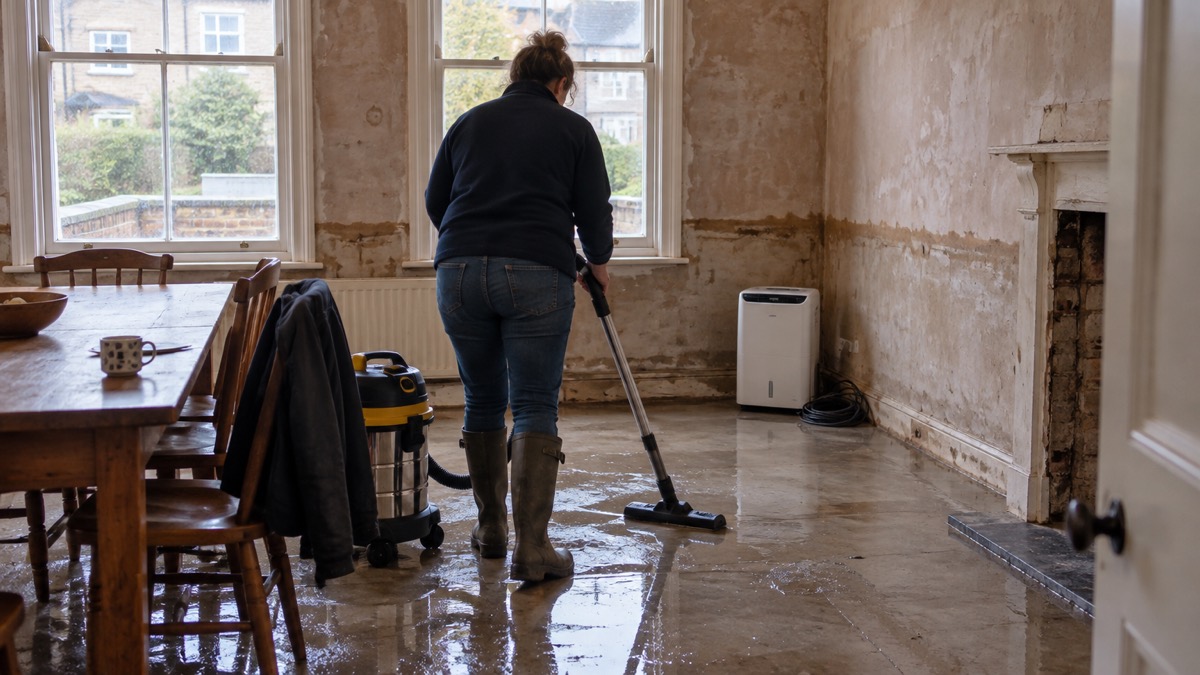
A dehumidifier on its own is slow. Official guidance across the UK recommends combining it with air movement and warmth. Help the drying process by using fans, air conditioning units and dehumidifiers19. Heating and good ventilation will help with the drying process, and you can help this process by using fans, air conditioning units and dehumidifiers7. After cleaning, allow surfaces to dry thoroughly, which also helps destroy germs, using fans, air conditioners, heaters and dehumidifiers if available22.
The London Fire Brigade puts it in terms of speed: open your windows and doors, as much as you safely can, to ventilate your home, and speed the drying process with commercial air movers, dehumidifiers and heaters15. If possible, use fans, industrial heaters and dehumidifiers to aid drying23.
Heat matters as much as air movement. If you have gas or oil central heating and it has been checked by an engineer, turn it on and keep the thermostat between 20 and 22 degrees centigrade for steady drying4. The Scottish Flood Forum advises central heating on at 20C or above if possible14. If you return home before cleaning is complete, try to have some heating on at all times, consider the use of a dehumidifier, keep the property well ventilated with windows open as much as possible, and keep air bricks to under floor spaces unblocked for cross ventilation1.
What a dehumidifier cannot do after a flood
A dehumidifier cannot remove floodwater, cannot make a wet structure safe, and cannot substitute for an electrician. It also cannot dry a house that is still taking on water. Each of these limits has official backing.
- It cannot pump out water. Dehumidifiers should not be used to remove floodwater1. Use a pump or bucket first2.
- It cannot make wet electrics safe. Avoid turning on devices that use gas or electricity as they may have got wet, and call a registered electrician to assess wiring, equipment and appliances1. Do not switch the electricity back on until a qualified person checks it16. See Is It Safe to Turn the Electricity Back On?.
- It cannot replace a generator indoors. Petrol or diesel generators must never be used indoors to dry your home7.
- It cannot deal with sewage on its own. Where sewer water has flooded a home, the water company may offer a free specialist clean-up, whether or not you have home insurance, removing sewage debris, cleaning, disinfecting, decontaminating and fitting dehumidifiers until the area is thoroughly dried24.
- It cannot stop mould by itself. Heating, dehumidifiers and good ventilation can help dry out a home, but small areas of mould can be removed with proprietary mould removal solutions, and if mould persists or is extensive you should contact a specialist cleaner experienced in fungal remediation17. See How Soon Mould Grows and How to Stop It.
Industrial or domestic, insured or not
The choice between a domestic dehumidifier and an industrial one is really a question about how wet the house is and who is paying for the drying.
Your insurer should provide industrial dehumidifiers for your home and regularly measure damp levels to ascertain when the property is dry enough to start redecoration3. Your insurance company should be able to instruct property drying professionals to install dehumidifiers and fans promptly to help dry your home3. The Scottish Flood Forum says the same: use fans plus industrial heaters and dehumidifiers, which will be provided by your insurance company if you are insured25.
If you are not insured, or are managing the drying yourself, dehumidifiers can be hired from hire centres23. A domestic unit will help in a single room, but a whole house that has been under water usually needs the larger equipment and the damp measurements that come with a professional drying job. For the claim side, see Making an Insurance Claim After a Flood.
The timescale is worth setting expectations against. In one documented case, the dehumidifiers supplied by the insurance company took between 4 and 5 months to dry the house sufficiently for repair work to start6. That is not unusual for a badly flooded property, and it is why insurers measure rather than guess.
Drying out with children at home, and after a storm
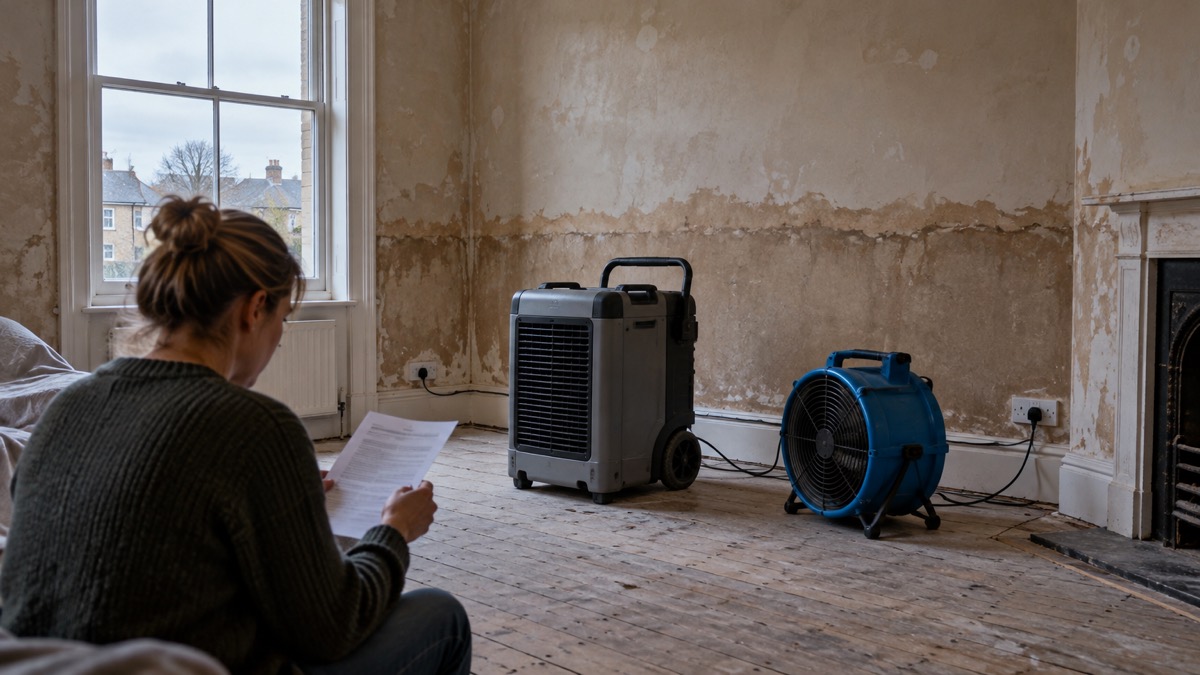
A flooded house is not a normal home, and children need watching around drying equipment. Official guidance for Northern Ireland notes that a dehumidifier may be useful to help with drying out your home quickly24, which sits alongside the general advice to keep children safe during a flood.
If the flooding was sewage, take up the free clean-up offer rather than doing it yourself with children in the house: the water company will remove sewage debris, clean, disinfect, decontaminate and fit dehumidifiers until the area is thoroughly dried24. For health guidance more broadly, see Floodwater and Your Health.
After a thunderstorm, the calculation is smaller. Turn on the dehumidifier: it will not solve serious flood damage, but it can help remove excess moisture from the air to speed up the process of drying out your home21. Check first that the damp is not coming from a damaged roof or wall, and treat the dehumidifier as a way of clearing residual moisture rather than a repair.
Wherever you are in the UK, the drying principles are the same. The Welsh guidance from Natural Resources Wales sets out the natural versus dehumidifier choice plainly4, Scottish guidance from the Scottish Flood Forum and Ready Scotland covers fans, heaters and dehumidifiers14, and Northern Ireland's guidance covers clearing up and keeping children safe2. For the wider recovery picture, start with After a Flood: Returning Home Safely.
Sources (25)
- Cleaning up after flooding, Derbyshire County Council, 2026-10-29
- After a flood: clearing up, nidirect, 2026-05-06
- How to dry your home out after a leak or flood, Which?, 2025-12-01
- What to do after a flood, Natural Resources Wales, 2026-10-29
- After a flood, Surrey County Council, 2026-09-23
- Property flood resilience case studies, Derbyshire County Council, 2024
- How to protect your health when flooding occurs, NHS Inform Scotland, 2026-07-31
- Flooding and health: safely cleaning your home, Wiltshire and Swindon Prepared, 2026-10-25
- Flooding, Runnymede Borough Council, 2026-10-26
- Steps after a fire, North Yorkshire Fire and Rescue Service, 2026-06-17
- Preparing for winter, National Energy Action, 2025-10-14
- Preparing your home for flooding, Cotswold District Council, 2020
- Flood risk in Anglesey: be prepared, Isle of Anglesey County Council, 2013-07
- Ready for flooding, Scottish Flood Forum, 2023-02
- After a flood, London Fire Brigade, 2026-10-25
- Rain and flooding, Ready Scotland, 2026-03-24
- How to recover from flooding, UK Government, 2023-12-19
- Safety in severe weather conditions, Devon and Somerset Fire and Rescue Service, 2026
- Before, during and after a flood, Suffolk County Council, 2021-05
- Be Prepared, Lancaster City Council
- Storm damage: how to protect your home from a thunderstorm, Which?, 2026-10-21
- Cleaning up after a flood: health advice, North Warwickshire Borough Council, 2024
- After a flood: further support, Nottinghamshire County Council, 2026-10-29
- Keeping children safe during a flood, nidirect, 2025-12-09
- Immediately After The Flood - Scottish Flood Forum, Scottish Flood Forum
 Flood Warning Checklist
 First Steps After a Flood
 Insurance Claim Records
 Signing Up for Flood Warnings
 Flood Warnings Without Email
 Who to Report Flooding To
 Reporting a Blocked Gully
 Garden Safety After Sewage
 Council Sandbag Duties
 Filling and Laying Sandbags
 Makeshift Sandbags
 Disposing of Used Sandbags
 Turning Off Utilities
 Walking or Driving in Floodwater
 Turning Electricity Back On