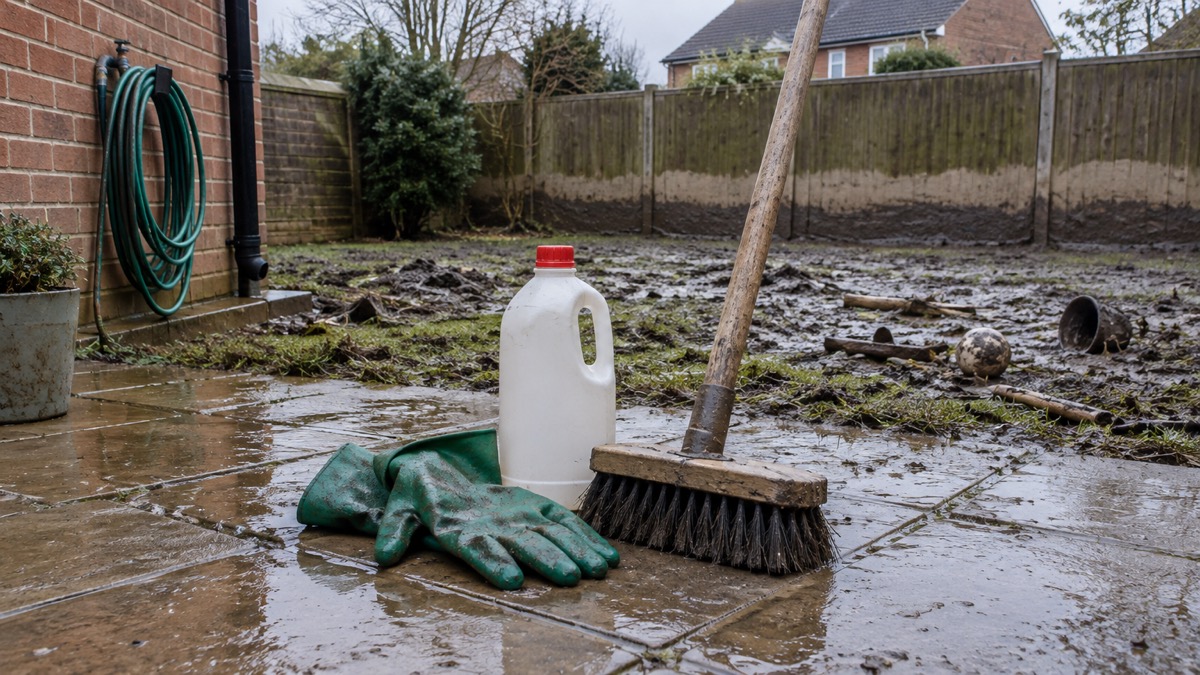
Sewage in the garden is unsettling, but the rules for making it safe again are straightforward. Keep everyone off the affected ground until it has been cleaned. Do not let children or pets onto affected grass or paved areas until they are cleaned1. Once the clean-up is done, hard surfaces such as paths and patios should be washed and disinfected, and kept off for three hours afterwards so the disinfectant can work2.
Lawns and borders recover with sunlight and time rather than disinfectant. Grass is usually safe after about a week, because sunlight and soil help destroy harmful bacteria4. One water company advises that bacteria levels should reduce to normal after 9 days in warm, dry weather or 25 days in cold, wet weather, as the sun's ultraviolet rays kill bacteria5. Where ground has been heavily affected, another company gives longer avoidance periods that vary by season and surface7.
Food is the other question. Do not eat any garden or allotment vegetables that have been covered by flood water; leave undamaged vegetables in the ground for at least another 2 weeks and then only use them after thorough washing and cooking9. Throw out any food that may have been in contact with flood water, including vegetables in your garden10.
Keep children and pets off the garden until it has been cleaned
The first and most important rule is that nobody uses the garden while it is still contaminated. Official guidance is to keep children and pets out of the affected area until the clean-up is complete11. Do not let young children play on affected grass or paved areas until the area has been cleaned down and restored to its normal condition11. Herefordshire Council puts it just as plainly: don't let children or pets onto affected grass or paved areas until cleaned13.
United Utilities adds that you should keep children and pets away from the contaminated area, or any grassed or paved areas, until they are back to normal, and keep them out of the water14. Flood water is likely to be contaminated with sewage, so do not let children play in flood water at all15.
This matters because the risk is invisible. Floodwater can contain harmful bacteria, and children are close to the ground, put their hands in their mouths and pick things up. The same applies to pets, who walk through contaminated ground and then clean themselves.
Once the clean-up is done, the garden does not necessarily become safe the same day. Paved areas need their three hours after disinfection2. Grass needs time for sunlight and soil to work, usually about a week after it has grown and been cut once4. Plan for children to use other spaces until then, and keep pets to cleaned paths or the front of the house.
If your area has a flood warden, get in contact with them to liaise around any issues and concerns16. For the wider picture of returning home safely, see After a Flood: Returning Home Safely.
Protective clothing for clearing up sewage outdoors
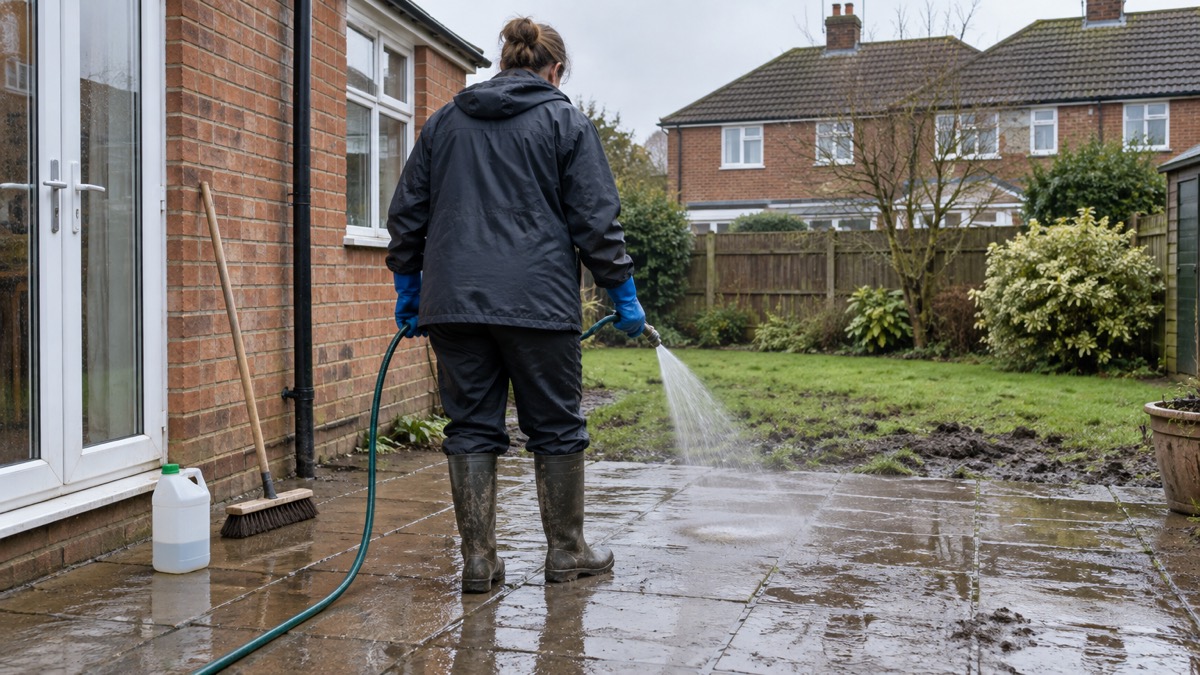
Sewage and floodwater carry harmful bacteria, so the job starts with covering up. Wear protective clothing, like a waterproof jacket and trousers and rubber gloves, and use a face mask17. York Council advises rubber boots, waterproof gloves and an apron18. Lancashire's guidance is gloves and masks when cleaning water, mud and other debris, and to wash any part of the body that comes into contact with infected materials19.
The Scottish Government's ready campaign is blunt: flood water can contain harmful bacteria, so wear protective clothing if you need to clean up20. The personal flood plan published by gov.uk says to wear appropriate waterproof or protective clothing when cleaning up21.
A practical outdoor set-up looks like this:
- Boots: rubber boots that can be washed and dried afterwards18.
- Gloves: waterproof gloves, not fabric gardening gloves17.
- Outer layer: a waterproof jacket and trousers, or a disposable plastic apron over old clothes17.
- Face covering: a mask when cleaning mud and debris19.
- Hands: always wash hands after exposure14.
When you finish, wash the protective clothing separately from other laundry, and wash your hands with warm, soapy water, then rinse and dry thoroughly22. For more on protective kit and cleaning methods, see Cleaning Up Safely After Floodwater.
Cleaning hard surfaces, paths and patios after sewer flooding
Hard surfaces are the part of the garden that can be actively cleaned. You can clean and disinfect patios and driveways, but keep off these areas for three hours after disinfection2. Yorkshire Water gives the same instruction: wash and disinfect hard surfaces like paths and drives, and keep off them for 3 hours to let the disinfectant work3.
Your water company will usually do this for you. After external sewer flooding, Northumbrian Water will wash down and disinfect all hard standing areas, such as paths, patios or yards12. Southern Water says it will disinfect hard surfaces as part of the clean-up but not lawns or borders, as it can kill plants5.
That last point is the reason not to tip disinfectant over the whole garden. Disinfectant is for hard surfaces. On soil and plants it does more harm than good, and the sun and soil do the work instead.
| Surface | What to do | How long to keep off |
|---|---|---|
| Paths, patios, driveways | Wash and disinfect2 | 3 hours after disinfection2 |
| Yards and hard standing | Water company washes and disinfects12 | 3 hours after disinfection2 |
| Lawns and borders | Do not disinfect; let sunlight and soil work5 | About a week after grass grown and cut once4 |
| Soil and sand beds | Avoid use; time varies by season7 | 9 days in summer, 20 days in spring, 20 days in autumn7 |
Lawns, beds and soil: letting sunlight and time do the work
Grass recovers on its own. Sunlight and soil help destroy harmful bugs, so it is usually safe for children to play on grass after a week or so11. After the grass has grown and been cut once there should be no further risk, as sunlight and soil will usually destroy harmful bacteria within a week14. Any excess risk to health should disappear within a number of weeks22.
Water companies give more cautious figures for soil and turf, and they vary by season. One company advises avoiding affected areas for 6 days for turf or clay and 9 days for soil or sand in summer, 13 days for turf or clay and 20 days for soil or sand in spring, and 13 days for turf or clay and 20 days for soil or sand in autumn7. Another gives summer figures of 6 days for turf or clay and 9 days for soil, sand, shingle or bark, and winter figures of 18 days for turf or clay and 11 days for soil, sand, shingle or bark8.
Southern Water's simpler rule is that bacteria levels should reduce to normal after 9 days in warm, dry weather or 25 days in cold, wet weather5.
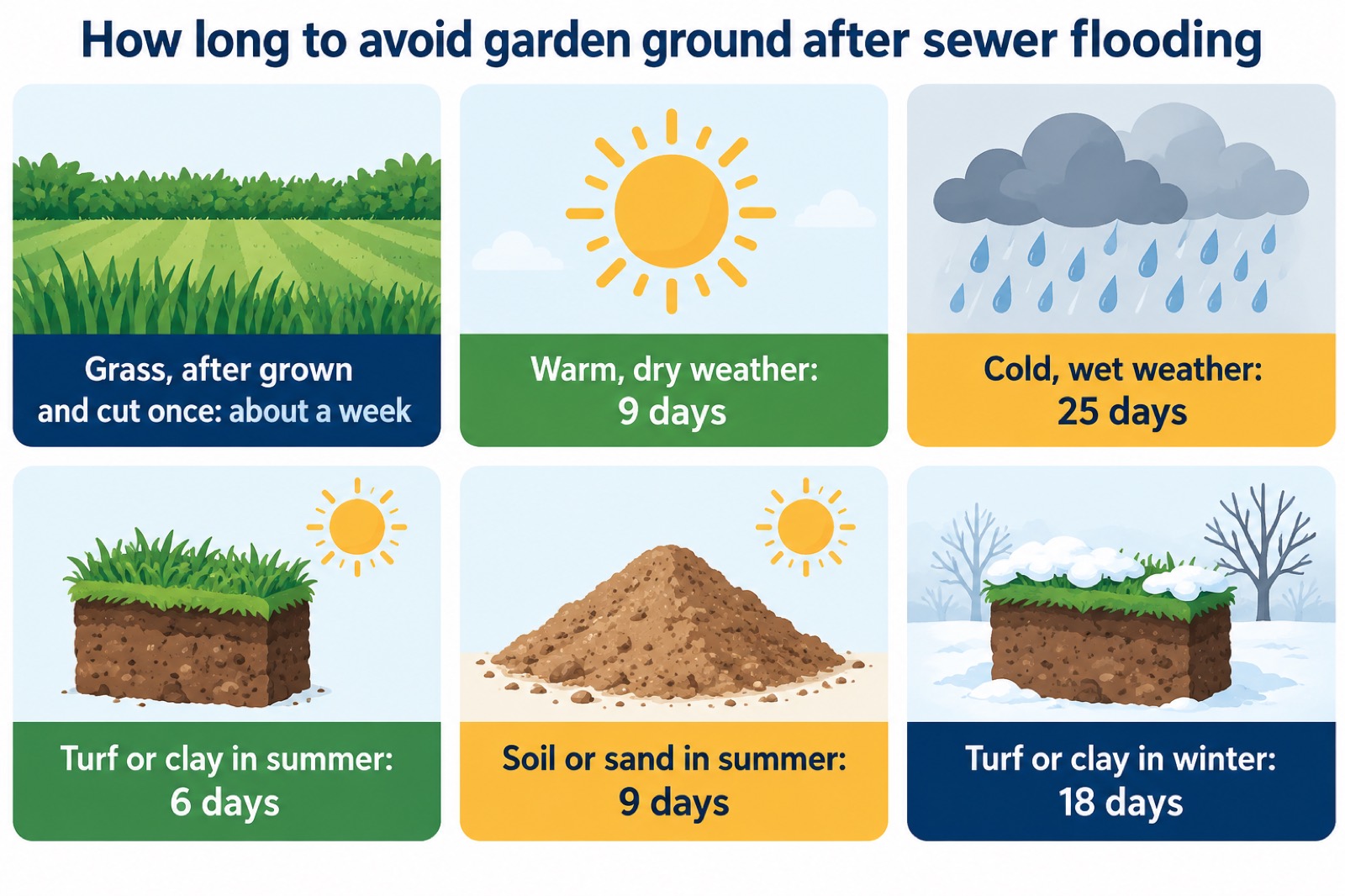
The pattern is clear: warm, dry, sunny weather speeds recovery, and cold, wet weather slows it. If in doubt, wait longer. Keep children and pets off until the ground has had its time, and do not dig over beds while they are still wet with sewage.
Fruit and vegetables touched by floodwater
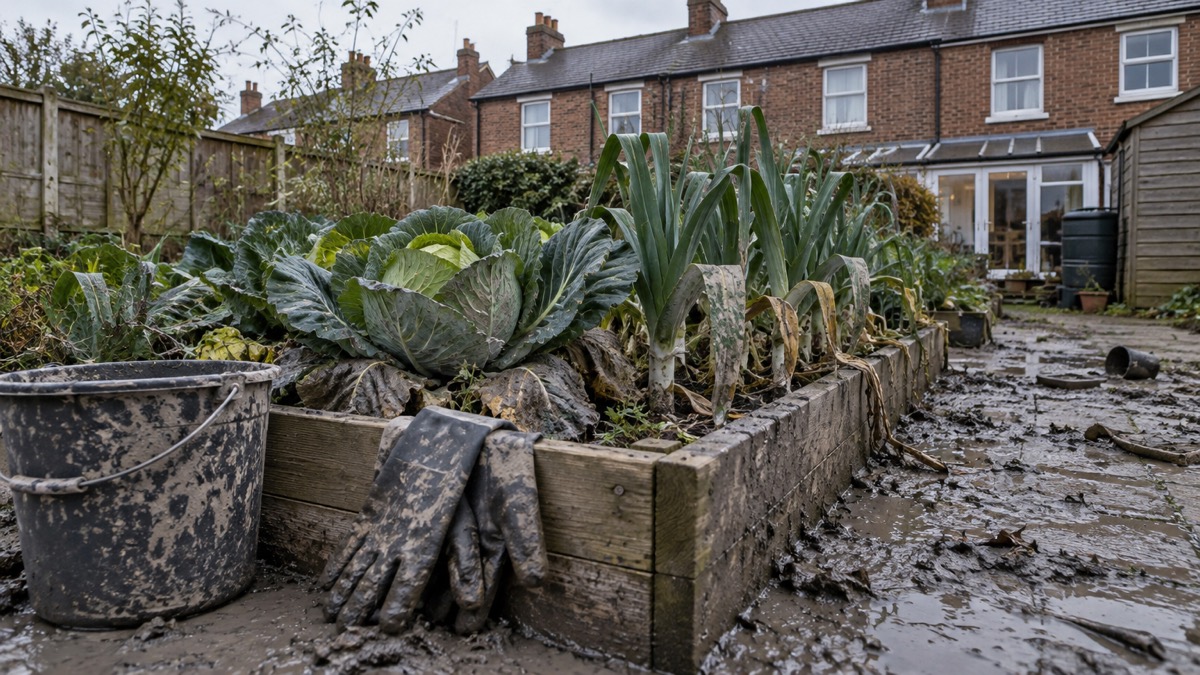
Home-grown food needs the most caution. Floodwater can impact any home-grown fruit and vegetables grown in a garden or an allotment23. Do not eat any garden or allotment vegetables that have been covered by flood water; leave undamaged vegetables in the ground for at least another 2 weeks and then only use them after thorough washing and cooking9. Throw out any food that may have been in contact with flood water, including vegetables in your garden10.
Oxford City Council's guidance adds two useful rules: discard above-ground, flood-touched produce like cabbages, and wait at least six months before harvesting new produce from flooded land24.
In practice:
- Above-ground crops touched by floodwater: discard24.
- Undamaged root crops left in the ground: leave at least another 2 weeks, then wash and cook thoroughly9.
- New crops sown on flooded land: wait at least six months before harvesting24.
- Anything that may have been in contact with floodwater: throw it out10.
Cooking does not make contaminated produce safe to eat raw, and washing alone is not enough for crops that were covered. The safest approach is to discard what was touched and to wait out the period for what was not.
Who to contact about sewer flooding and clean-up
Call your water company as soon as you notice sewage in the garden. For sewer flooding, or if your toilet or sink is backing up during floods, call your local water company25. If there is flooding from sewers you should contact your water company26, and the same applies to flooding from water mains26.
The clean-up is normally free. Southern Water says it offers a free clean-up whether you have home insurance or not, starting straight away in daylight or the next day if dark, aiming to finish within 48 hours5. It aims to reach external sewer flooding within 24 hours, though severe weather may delay this5. For internal sewer flooding it aims to reach the property within four hours and complete the initial clean-up within 12 hours5.
If sewer flooding is inside your home or garden, within your property boundary, call the 24 hour helpline on 0800 328 7648 immediately14.
If you need more advice, contact your local environmental health department19. If your area has a flood warden, get in contact with them to liaise around any issues and concerns16. Follow public health advice on cleaning up after a flood26.
For repeat sewer flooding, report every incident and keep a record. The page on Sewer Flooding: Causes and Who Is Responsible explains how the network is managed, and Who to Report Flooding To covers the other agencies involved.
Sources (26)
- Keeping children safe during a flood, nidirect, 2025-12-09
- What to do if a flood happens, nidirect, 2025-10-24
- Sewer flooding, Yorkshire Water, 2026-10-28
- Flooding checklist for residents, Perth and Kinross Council, 2024-08-01
- My home is flooded with sewer water, Southern Water, 2026-10-29
- My property is flooded, Southern Water, 2026-10-28
- Sewer flooding, Northumbrian Water, 2026-10-28
- What to do during sewer flooding, Thames Water, 2026-10-29
- Flooding before, during and after: frequently asked questions, Nottinghamshire County Council, 2026-10-29
- What to do during sewer flooding, Thames Water, 2026-10-28
- Flooding and health, Public Health Wales, 2026-07-31
- Flooding advice, Belfast City Council, 2026-10-29
- Staying safe in a flood, Herefordshire Council, 2026-10-29
- Sewage flooding your home or garden, United Utilities, 2026-10-28
- Are you ready?, Culham Parish Council, 2025-09
- Recovering from a flood, Wiltshire and Swindon Prepared, 2026-10-25
- After a flood: clearing up, nidirect, 2026-05-06
- Flood advice, City of York Council, 2026-10-29
- Be prepared: flooding guidance, Lancaster City Council, 2026-10-26
- Flooding, Ready Scotland, 2026-03-24
- Personal flood plan, gov.uk, 2023-11-15
- How to recover from flooding, gov.uk, 2023-12-19
- Food safety in the kitchen: flooding, Food Standards Scotland, 2026-10-25
- Clearing up after a flood, Oxford City Council, 2026-10-29
- What to do in a flood, Natural Resources Wales, 2026-10-29
- Flooding responsibilities, Derbyshire County Council, 2026-10-29
 Flood Warning Checklist
 First Steps After a Flood
 Insurance Claim Records
 Signing Up for Flood Warnings
 Flood Warnings Without Email
 Who to Report Flooding To
 Reporting a Blocked Gully
 Council Sandbag Duties
 Filling and Laying Sandbags
 Makeshift Sandbags
 Disposing of Used Sandbags
 Turning Off Utilities
 Walking or Driving in Floodwater
 Turning Electricity Back On
 Appliances After Water Damage