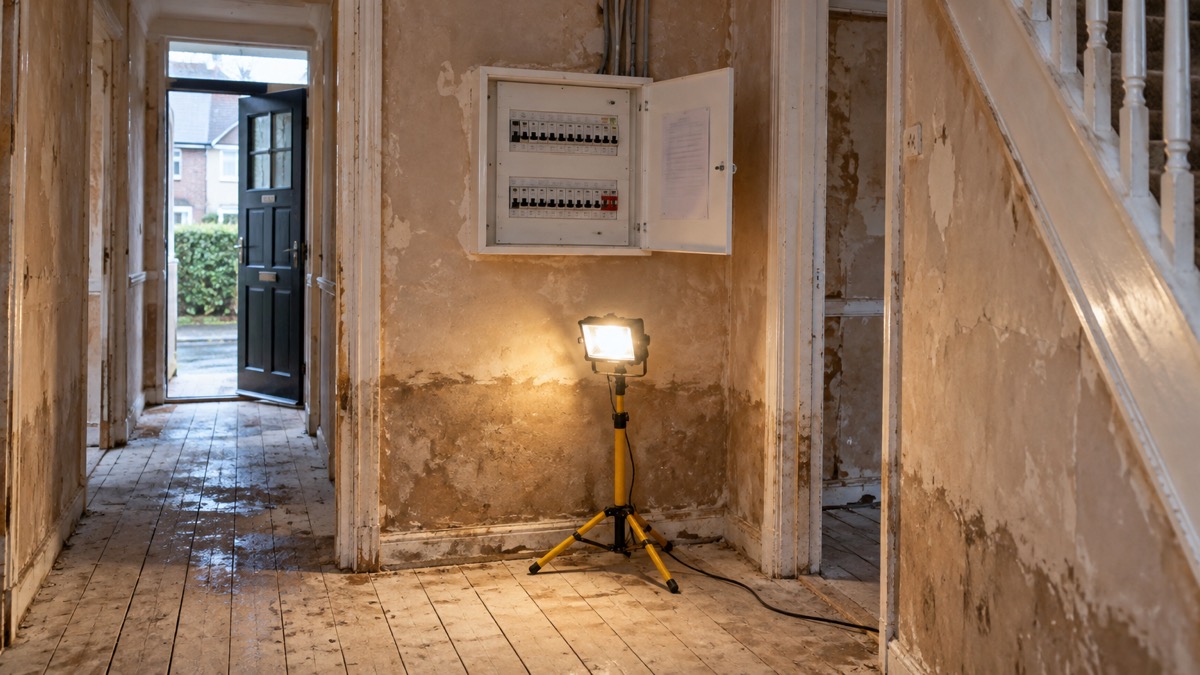
No. Do not turn the electricity back on after a flood until a qualified electrician has checked your home's wiring, sockets and appliances. That is the consistent instruction from official UK flood guidance, from Scotland to Wales to Northern Ireland: wait for an electrician's approval before turning power back on1, and do not switch your electricity back on until a qualified person checks it2.
The reason is simple. Floodwater can reach wiring, sockets and appliances you cannot see, and the moment the supply returns is the moment a hidden fault becomes a shock or a fire. Official guidance warns that there is a risk of electrocution from appliances that have been in contact with floodwater3, and that it is unlikely anything the water has touched can be used again without a thorough check4.
This page sets out what to do now if your supply is still live, where the dangers are, what happens to appliances that got wet, and who is qualified to check your electrics before anything is switched back on. If you are still at the stage of returning to your home, start with After a Flood: Returning Home Safely.
Not until a qualified electrician has checked it
Every official source on this subject says the same thing in slightly different words, and the differences matter less than the agreement. Oxford City Council says to wait for an electrician's approval before turning power back on, and not to use electrical equipment exposed to flood water until it has been checked by a qualified electrician1. The Scottish Government's ready.scot guidance says not to switch your electricity back on until a qualified person checks it2. Lancashire County Council says to get a qualified electrician to check your house before you turn your electricity back on9. Belfast City Council says not to use your electricity mains until it has been checked by a qualified electrician7.
The check covers more than the fuse box. If any electrical wiring has come into contact with flood water, a qualified electrician will need to check the safety of the system, and the safety of appliances10. Runnymede Borough Council advises using a registered electrician to assess the condition and damage to electrical wiring, equipment and appliances that have been affected by the flood5. Herefordshire Council adds that gas and electricity supplies should remain switched off until a qualified professional has checked the systems thoroughly11.
There is no shortcut here, and no appliance that is worth the risk. Guidance from Public Health Wales is blunt about why: do not switch on electrical appliances that have been in contact with floodwater until a qualified electrician has checked them, as there is a risk of electrocution3. The same warning appears in Scottish Borders Council's flooding advice12 and in Nottinghamshire County Council's frequently asked questions6.
A useful way to think about it is that the flood has moved the danger. Before the water arrived, the risk was water getting into the electrics. Afterwards, the risk is the electrics coming back to life while the house is still damp, with salt, silt and debris inside sockets and appliances. That is why the check has to happen before the supply is restored, not after.
Getting the supply switched off safely if it is still on
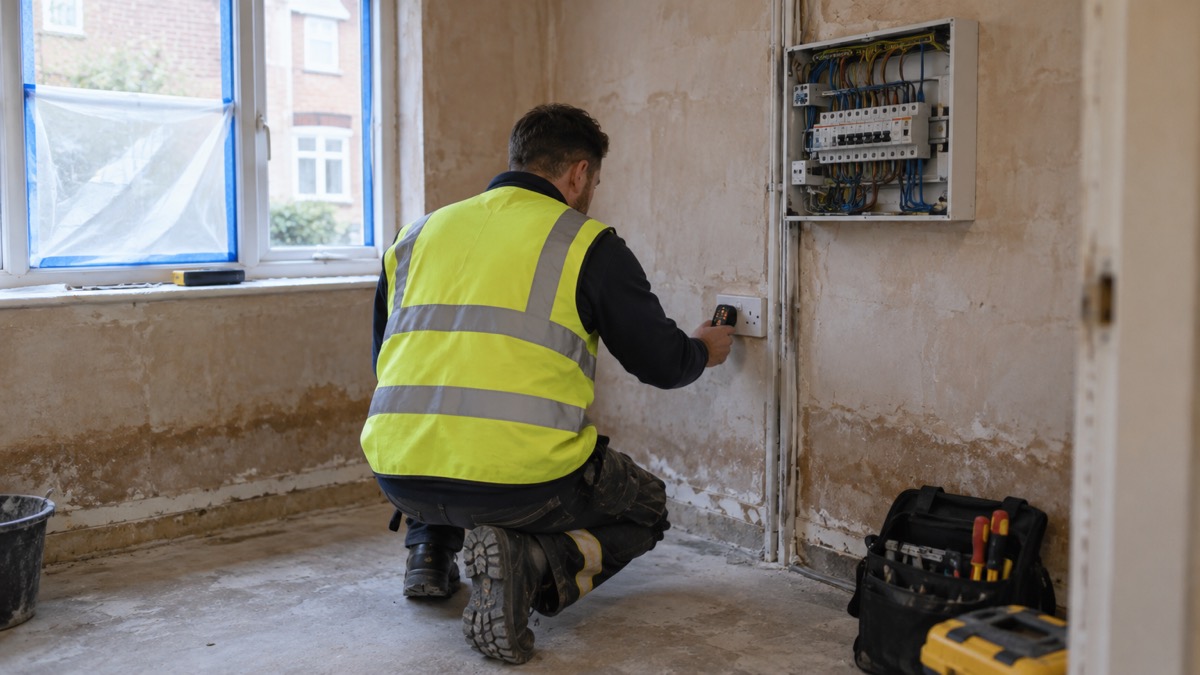
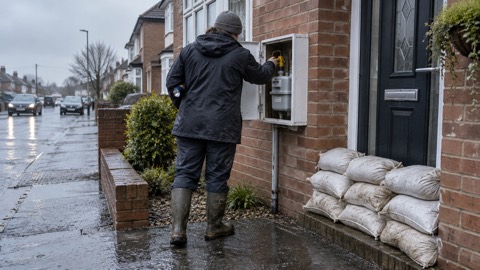
If floodwater has entered your property and the electricity is still on, switch it off at the mains, if it is safe to do so5. The same instruction appears in West Yorkshire Prepared's flooding guidance, which says to turn off gas, electricity and water only if safe to do so13, and in London Assembly guidance for flash flooding, which says to turn off electricity, gas and water if safe to do so14.
The words "if it is safe to do so" carry the whole weight of this section. North Yorkshire Fire and Rescue Service puts it plainly: isolate electrics only if it is safe to do so, but if in any doubt, call the fire and rescue service on 99915. Cornwall Council's fire and rescue guidance says never to attempt to turn off the electricity supply while standing in water16.
If you are evacuating and have time, unplug appliances to prevent electrical shock when the power comes back on, and turn off gas, power and water before you leave17. That single action protects the house while it is empty and protects whoever comes back to it.
If the supply is already off, leave it off. Do not turn on electricity, gas or water without getting professional advice18. Do not switch on any utilities until you have checked with an expert that it is safe to do so8.
For the wider sequence of switching off utilities before water arrives, see Turning Off Gas, Electricity and Water Before a Flood.
Where electricity is dangerous after a flood
The obvious danger is the socket at waist height. The less obvious ones are the ones that catch people out.
- Standing water. Do not touch sources of electricity while standing in floodwater6. This includes extension leads, chargers, lamps and anything plugged in at floor level.
- Downed power lines. Electric currents can pass along downed power lines in flood waters13. Keep well away from any cable in or near water and report it.
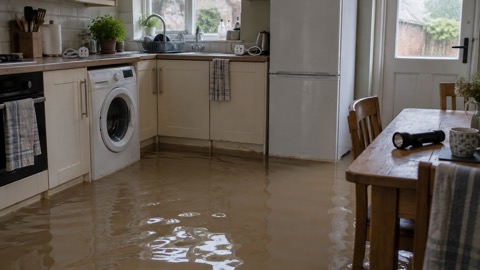
- Wet appliances. It is unlikely anything the water has touched can be used again without a thorough check4. That includes kettles, washing machines, fridges, freezers, chargers and power tools.
- Damp fabric of the building. Wiring inside walls and under floors stays wet long after the surface looks dry, which is why the electrician's check comes before the supply, not after.
- Your own protective kit. Floodwater can be hazardous, so wear rubber boots and gloves in and around the affected property19. That is protection against contamination as well as against shock.
The practical upshot is that a house can look dry and still be unsafe. Plaster, insulation and timber hold moisture, and an electrician checking the system is looking for exactly that. Do not let a dry surface persuade you to switch anything on early.
Appliances and devices that got wet
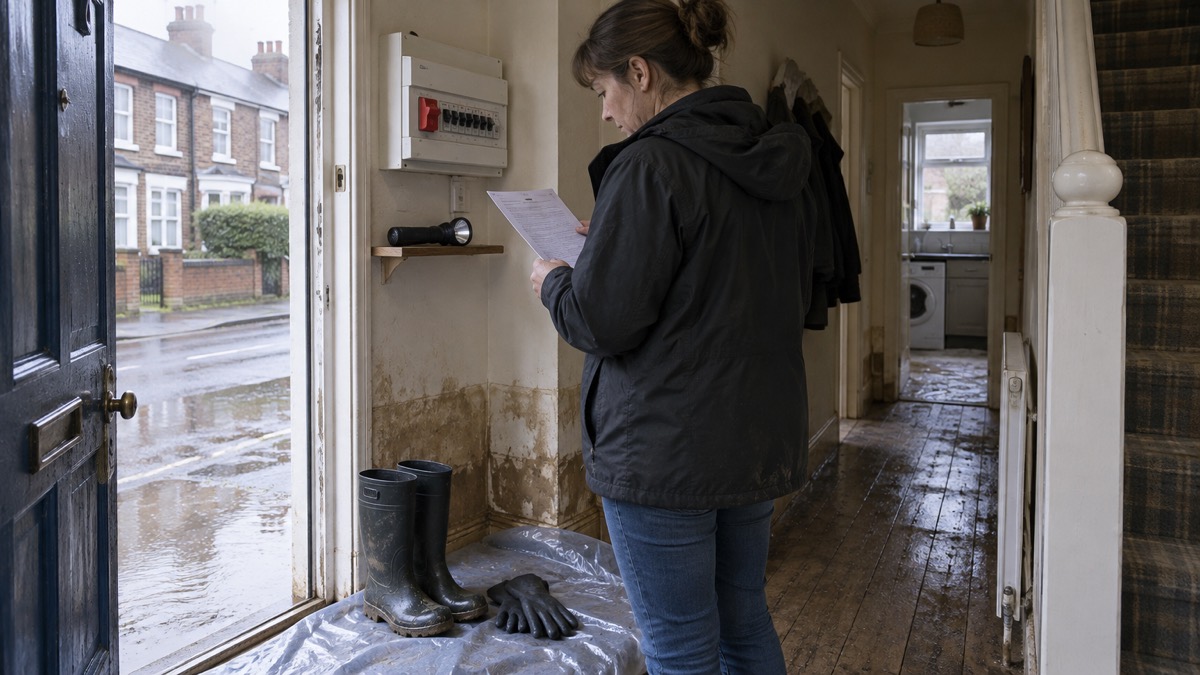
The rule for appliances is the same as the rule for the supply, and it is repeated across official guidance in every nation. Do not switch on electrical appliances that have been in contact with flood water unless a competent electrician has cleaned and checked them6. Get any electrical appliances that have come into contact with floodwater checked by a qualified electrician before using them again20. Do not use mains powered electrical appliances in areas affected by flooding until advised by a registered electrician that it is safe to do so5.
If an appliance has been wet, the sequence is: turn off the electricity at the fuse box, allow the appliance to dry out, and have a qualified professional check it before turning it on21. Make sure all affected appliances have been fully tested before using them again, and get specialist advice from electricians8.
| Appliance or item | What to do | Why |
|---|---|---|
| Fridge, freezer, washing machine, dishwasher | Do not switch on; have it checked and tested by a qualified electrician6 | Water inside the casing or motor can cause shock or fire |
| Kettle, toaster, small kitchen appliances | Do not switch on; have them checked or replace them20 | Mains powered appliances in a flooded area are unsafe until a registered electrician advises otherwise5 |
| Chargers, extension leads, power strips | Unplug and do not reuse until checked17 | They sit at floor level where water reaches first |
| Plug-in heaters and dryers | Do not use until a registered electrician has advised it is safe5 | They combine mains power, heat and damp air |
| Fixed wiring, sockets, consumer unit | Must be checked by a qualified electrician before the supply returns10 | Hidden damp inside walls and back boxes |
Two further points are worth keeping in mind. First, "it looks dry" is not a test. Second, an appliance that powers on is not proof it is safe; the check is about insulation and internal damage, which you cannot see. For a closer look at individual appliances, see Using Electrical Appliances After Water Damage.
If the power is still on or came back on by itself
Sometimes the supply was never cut. Sometimes the network restores it while the house is still wet. Either way, the same rule applies: do not use your electricity mains until it has been checked by a qualified electrician7.
If the power returns and you are in the property, do not start using sockets or appliances. Turn off the electricity at the mains if it is safe to do so5, and if in any doubt, call the fire and rescue service on 99915. Unplug appliances so they cannot shock you when the power comes back on17.
A network power cut is not the same as a safety check. The network may have isolated the street, but the wiring and appliances inside your home may still have been wet. Do not switch on any utilities until you have checked with an expert that it is safe to do so8, and contact your electricity company about restoring the supply22. For electricity enquiries, call 1058.
If your home or business has been flooded, it may also need a safety inspection by the utility companies before you can turn the water, gas and electricity back on23. That inspection is separate from the electrician's check of your own wiring, and both may be needed.
Who can check your electrics: electrician, gas engineer or supplier
Different parts of the system need different people, and it helps to know which is which before you start ringing round.
| What needs checking | Who checks it | What they do |
|---|---|---|
| Wiring, sockets, consumer unit, fixed electrics | A qualified or registered electrician5 | Assess the condition and damage to wiring, equipment and appliances affected by the flood5 |
| Appliances that got wet | A competent electrician6 | Clean, test and confirm they are safe before use6 |
| The electricity supply itself | Your utility supplier or a qualified technician24 | Check the supply before it is switched on24 |
| Gas appliances, boiler, flues | A Gas Safe registered engineer7 | Check the system before gas or gas appliances are turned on7 |
| Water | Your water company or a qualified engineer25 | Check the supply is safe before it is turned back on25 |
The general principle from gov.uk is to get your utilities company or a qualified engineer to check they are safe before turning them back on25. Your personal flood plan should note that you may need gas or electricity engineers to check your supply before turning it back on26. Croydon Council's evacuation checklist advises getting the electrics, central heating and water checked by qualified engineers and any other power suppliers before switching back on27.
On gas specifically, do not turn on gas or gas appliances until your system has been checked by a Gas Safe registered engineer7. Turn off the gas supply to appliances that have been flooded or where vents and flues may have been affected, and contact your utility company if in any doubt28. Be wary of damage to gas appliances long after flooding, including central heating systems, radiators and hot water systems5.
If you are not sure who to call, start with your supplier, then your insurer, then your council. For electricity enquiries, the national number is 1058. For the wider recovery picture, including insurance and support, see After a Flood: Returning Home Safely and Recovery Grants and Help If You Are Not Insured.
Sources (28)
- Clearing up after a flood, Oxford City Council
- Rain and flooding, ready.scot, 2026-03-24
- Flooding and health, Public Health Wales, 2026-07-31
- Wiltshire and Swindon: what to do in a flood, Wiltshire and Swindon Prepared
- Flooding aftercare, Runnymede Borough Council, 2026-10-26
- Flooding before, during and after: frequently asked questions, Nottinghamshire County Council
- Flooding advice, Belfast City Council
- Further support after a flood, Nottinghamshire County Council
- Flooding support, Lancashire County Council
- What to do if a flood happens, nidirect, 2025-10-24
- Staying safe in a flood, Herefordshire Council
- Flooding advice, Scottish Borders Council
- Flooding, West Yorkshire Prepared
- How to prepare for flash flooding, London Assembly
- Stay safe during Storm Babet, North Yorkshire Fire and Rescue Service, 2023-10-19
- Flooding, Cornwall Fire and Rescue Service
- Before, during and after a flood, Suffolk County Council, 2021-05
- What to do after a flood, Natural Resources Wales
- Extreme weather winter guide, London Fire Brigade, 2025-01
- After a flood: clearing up, nidirect, 2026-05-06
- Flooding advice: after a flood, London Fire Brigade
- Flood recovery information, Devon County Council, 2026-01-29
- Protecting your property from flooding, Met Office
- Flooding advice, Mid and West Wales Fire and Rescue Service
- After a flood, GOV.UK
- Personal flood plan, GOV.UK, 2023-11-15
- Flood evacuation checklist, Croydon Council, 2025
- After a flood, Surrey County Council, 2026-09-23
 Flood Warning Checklist
 First Steps After a Flood
 Insurance Claim Records
 Signing Up for Flood Warnings
 Flood Warnings Without Email
 Who to Report Flooding To
 Reporting a Blocked Gully
 Garden Safety After Sewage
 Council Sandbag Duties
 Filling and Laying Sandbags
 Makeshift Sandbags
 Disposing of Used Sandbags
 Turning Off Utilities
 Walking or Driving in Floodwater
 Appliances After Water Damage