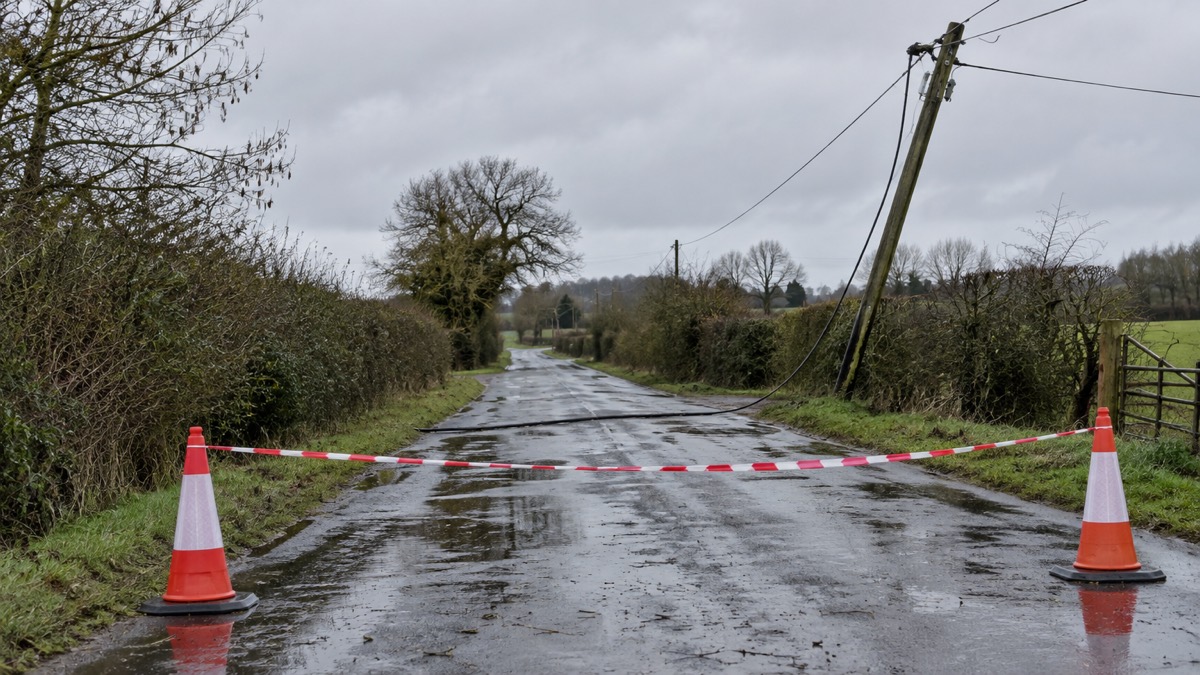
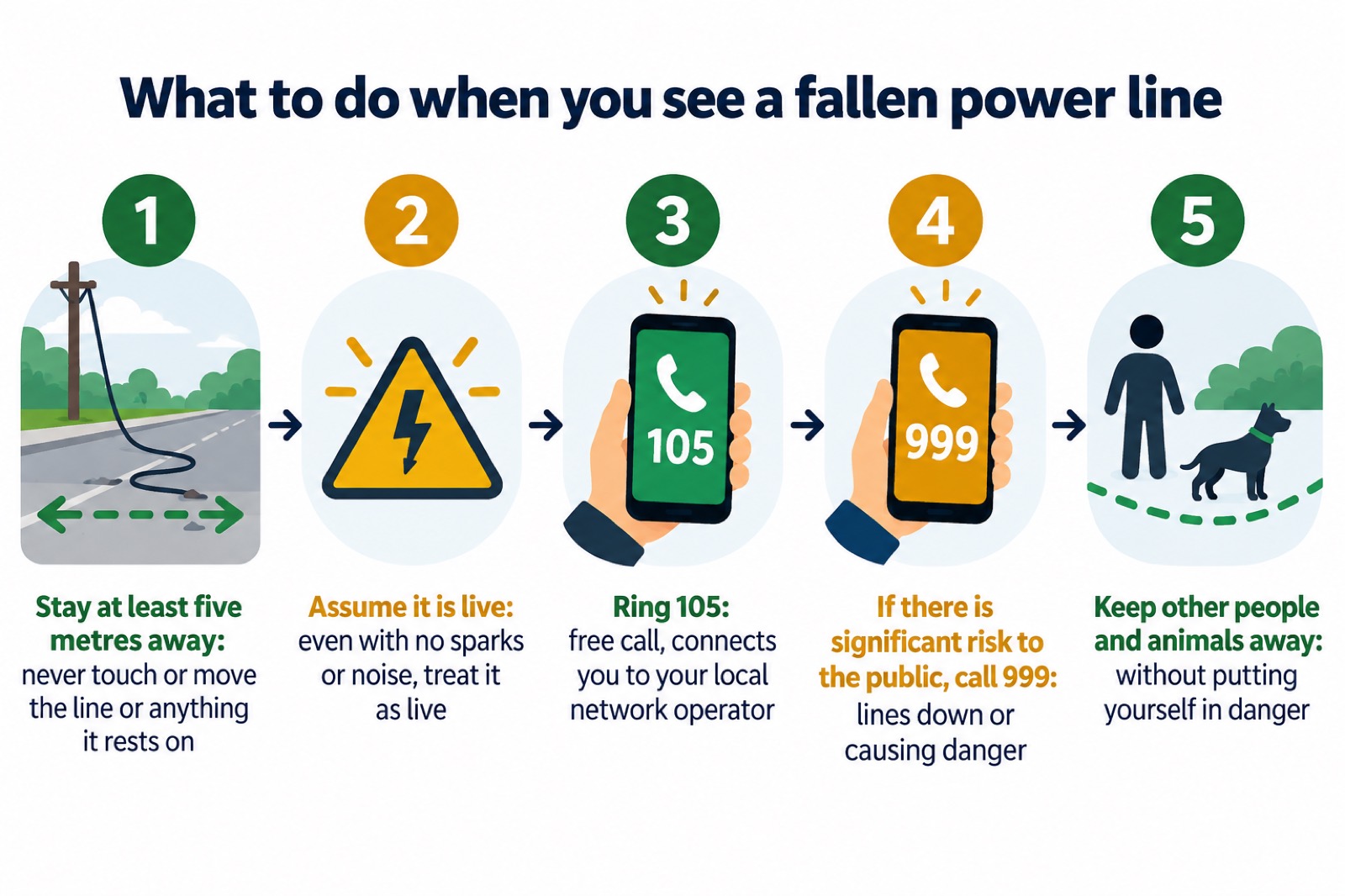
A fallen overhead power line is one of the most dangerous things an ordinary household can come across, and the first rule is simple: stay at least five metres away and never try to touch or move it1. Always treat a fallen line as live, even if it looks dead, and report it straight away by calling 1052. If the line is an immediate risk to people, for example it has fallen across a road, a pavement or a vehicle, call 9993.
Electricity at high voltage can jump gaps through the air with no warning, so a line lying still and silent on the ground can still kill anyone who comes too close4. This page sets out what to do in the order you need it: how far to stand back, who to ring, how to warn others, what to do about trees and storm damage, what to do if a line comes down on your vehicle, and how people working outdoors can avoid contact in the first place.
Stay well back and assume the line is live
The single most important thing to remember is that a fallen line does not need to be sparking, humming or moving to be deadly. Anglesey Council's winter readiness advice is blunt about it: "Always treat them as live and report them right away by calling 105"2. Northern Powergrid, one of the network operators that owns overhead lines, gives a specific distance: "Stay at least five metres away and never attempt to move or touch it"1.
Five metres is a minimum, not a target. The reason distance matters so much is that electricity at high voltage does not need a wire to reach you. The power cut reporting service warns: "Keep as far away from the hazard as possible. Remember, electricity can 'jump' through the air"5. Prepare.gov.uk's storm guidance says the same thing in its own words: "If you see power lines that have been brought down or damaged, keep as far away as possible. Electricity at high voltages can jump gaps with no warning"4. A line lying on wet grass, a fence or a puddle can energise the ground and objects around it, so the safe move is to put as much distance between yourself and the line as you reasonably can, then report it.
If your own electricity has gone off and you suspect a fallen line is the cause, do not go looking for the fault. Northern Ireland's government advice is to stay away from the equipment if the situation is dangerous3, and to leave one light on so you know when power returns7. Your job is to report, not to investigate: the network operator's engineers are trained and equipped to approach damaged equipment safely.
Ring 105 to report a fallen or damaged line
105 is the free, easy-to-remember number introduced by the electricity network operators to report power cuts and damage to the network8. As the Met Office explains, it is "an easy-to-remember number to call that will put you through to the local people who can help during a power cut"8. The National Energy System Operator confirms what it covers: "If you need updates about outages in your area or want to report a power cut or damage to power lines or substations, you can call 105"9. This free number connects you to your local distribution network operator, the company responsible for restoring power, and it is available nationwide9.
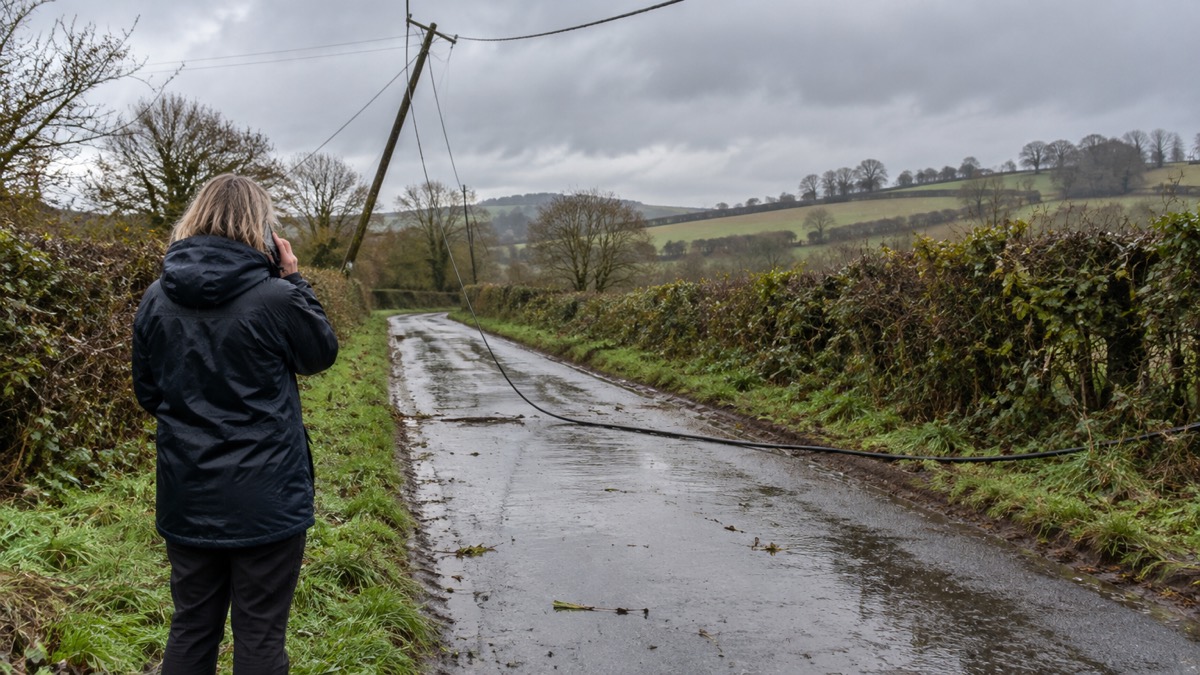
You do not need to know which company runs the network in your area. Calling 105 puts you through to your local operator automatically5. If you do want to know who they are, call 105 or use the online postcode checker to find your distribution network operator9, and the Health and Safety Executive notes that National Grid also provides information on how to find the electricity operator for your area10.
Reporting a fallen line is not the same as reporting an ordinary power cut, but the number is the same, and it is worth doing even if your own lights are still on. A line down in a field or on a quiet lane may not have cut anyone's supply yet, but it is a hazard until it is made safe. NHS Lanarkshire's winter preparedness advice makes the point directly: "You can also call 105 if you spot damage to electricity power lines and substations"11. Ready Scotland's storms guidance adds that 105 is free of charge and lets you both report the problem and get updates on when power will be restored12.
When to call 999 instead of, or as well as, 105
105 is the reporting line. 999 is the emergency line, and a fallen power line can be an emergency. UK Power Networks, a network operator, states the test plainly: "If you see electricity lines that are down or causing significant risk to the public, please call 999"3. A line across a busy road, a line that has caught fire, a line within reach of children or livestock, or a line that has fallen onto a vehicle are all situations where 999 is the right call, and you can ring 105 as well so the network operator knows about the damage.
The London Fire Brigade explains how the call works: "When you dial 999, a BT operator will ask you what service you need"13. 999 is free and can be dialled from a private, public or mobile telephone13. Do not try to contact your local fire station or fire safety team directly in an emergency; ring 99913. If there is a serious immediate risk, you should call the emergency services as well as 10514.
One practical point during storms: if your landline depends on mains power and you have a life-threatening emergency, official guidance is to attempt to call 999 or 112 using a mobile. You might receive overlapping signal from a nearby area that is unaffected, because emergency calls automatically roam onto all available networks15. So a power cut in your area does not stop you reaching the emergency services by mobile.
Warn others and keep people and animals away
A fallen line is a hazard to everyone who comes near it, not just to you, and part of what you should do is keep other people away. The power cut reporting service advises: "Keep other people as far away from the hazard as possible, but don't put yourself in danger"5. That last clause matters: never step closer to the line to warn someone. Shout from a distance, or phone the person if you can.
Think about who is likely to wander into danger:
- Children walking to school or playing outdoors, who may see a fallen wire as something interesting
- Dog walkers, whose pets may run to or over a fallen line before an owner can stop them
- Cyclists and drivers on unlit rural roads at night, who may not see a line across the road
- Neighbours clearing storm damage, who may pick up a wire they assume is a telephone cable
- Livestock and horses in fields where a line has come down
North Wales Fire and Rescue Service warns specifically about cables that are still hanging as well as those on the ground: "Be careful not to touch any electrical/telephone cables that have been blown down or are still hanging"16. A hanging line at head height is just as dangerous as one on the ground, and it is easy to walk into in the dark or in high winds. If you can do so safely from a distance, stay nearby to warn people until help arrives, but never between the hazard and the public at close range.
Never touch or move a line, or anything it is resting on
The warnings on this point are consistent across every official source. Northern Ireland's government advice for strong winds is: "never touch damaged electricity equipment" and "Do not approach any damaged electricity equipment or broken power lines"6. The same advice appears in the Northern Ireland direct guidance on storms and heavy rain7. The reason for repeating it so often is that the instinct to tidy up, to drag a wire off a road or to move a branch, is strong, and it is the instinct that kills.
Anything conductive that a fallen line is touching can carry the current: a fallen tree, a metal fence, a gate, a puddle, the wet ground itself. That is why the advice is not simply "do not touch the wire" but "do not approach". Always look up and never handle anything that may be touching overhead lines1. If a line has come down in your garden, keep your household indoors, keep pets in, and report it from inside by phone.
This also applies to things caught in the overhead network that have not brought it down. A kite, a tent, a balloon or a drone caught on an overhead line should be left well alone and reported to the network operator on 105. Do not climb, use poles or throw objects to try to free them. The line may look undamaged, but anything that puts you or an object within reach of the conductors is a risk, and the operator can deal with it safely.
Trees on power lines and damaged cables after a storm
Fallen trees are the classic cause of downed lines in UK storms, and they bring a specific warning with them. Northern Ireland's government advice states: "Be extra careful around fallen trees, as they often take electricity poles and wires with them as they fall"6. So a tree that looks like ordinary storm debris may have a live wire beneath or tangled within it. Never cut, drag or climb a storm-fallen tree until you are sure no electricity network is involved, and if in any doubt, report it.
The pattern is not theoretical. During Storm Éowyn, the Northern Ireland Fire and Rescue Service issued a direct public warning: "Stay clear of any damaged electricity equipment and report it immediately to NIE Networks on 03457 643 643"17. Storms on this scale put wires on the ground across whole regions, and the danger lasts beyond the weather itself.
After a storm has passed, the risk does not end. The Met Office's storm advice is: "Be careful not to touch any electrical/telephone cables that have been blown down or are still hanging"18, and its thunderstorm guidance adds: "Avoid downed power lines or broken cables" after the storm has gone through19. Prepare.gov.uk repeats the warning about cables blown down or still hanging for the period after a storm4. When you go out to check your property, your car or your street, look up as well as down: hanging cables at head height are the hazard people walk into.
| Where you find it | What to do | Who to call |
|---|---|---|
| Line on the ground or hanging, no one at risk | Stay five metres back, treat as live, report it | 1052 |
| Line across a road, pavement or public place | Keep people away, treat as an emergency | 9993 |
| Line tangled in a fallen tree | Do not touch the tree or the wire, report it | 1051 |
| Kite or object caught in overhead lines | Leave it alone, report it | 1059 |
| Damage to a substation | Report it, but call 999 in an emergency | 105 or 99920 |
If a line falls on your vehicle or machinery
The advice for a vehicle in contact with a live line is very specific and worth knowing before you ever need it. Northern Powergrid's safety guidance is: "If your vehicle touches a power line, stay inside and call 105 immediately"1. The vehicle's tyres and body can insulate you while you remain inside, so the safest place is often the driver's seat, not the road beside the car.
The danger comes when you try to leave. Northern Powergrid warns: "Never touch the vehicle and the ground at the same time, as this could create a deadly electric circuit"1. Stepping out normally, with one hand on the door and one foot on the ground, is exactly the circuit that kills. If fire or another danger forces you out, the safest technique is to jump clear without touching the vehicle and the ground together, then move away, but the first resort is always to stay inside, call 105, or 999 if there is danger to life, and wait for the network operator to confirm the line is dead.
The same rules apply to anyone who stops to help. Do not approach or touch a vehicle that is in contact with a line. Keep other road users back, and phone 105 or 999. The full step-by-step for this situation, including what bystanders should do, is on our page what to do if your vehicle touches an overhead line.
Farms and fields: look out, look up
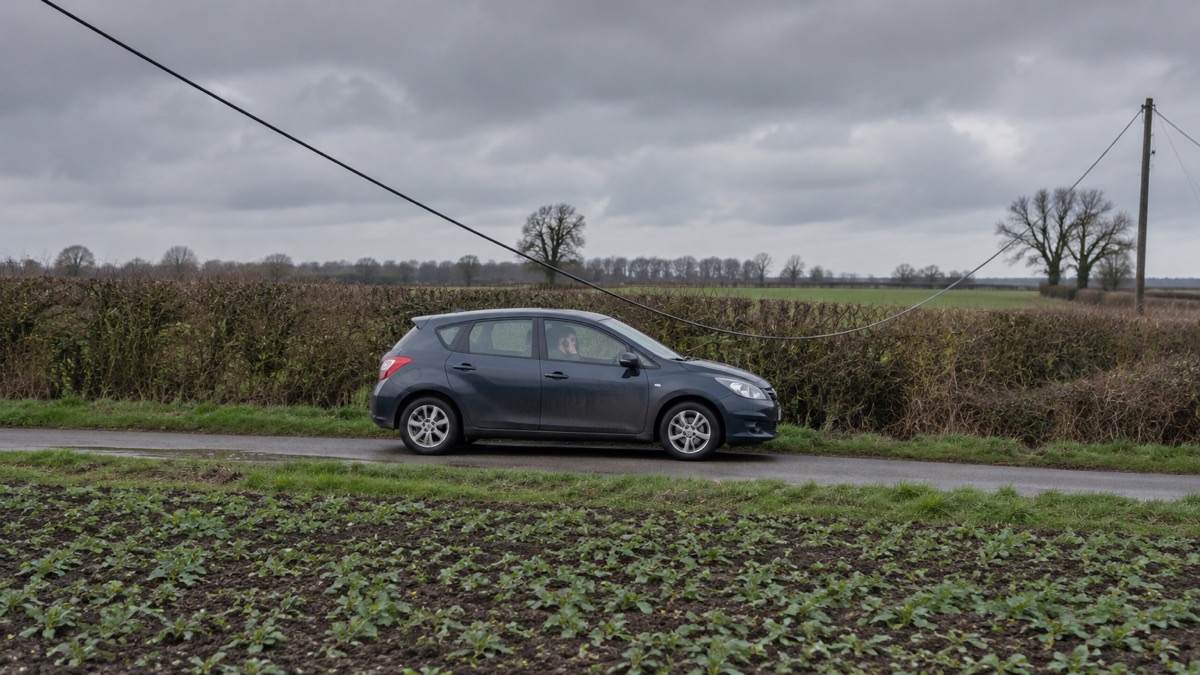
Rural land carries most of Britain's overhead lines, and the people who work in fields face a particular risk from machinery that reaches up: combine harvesters, telehandlers, tipping trailers, irrigation equipment and ladders. The network operators run safety campaigns aimed at exactly this group, and the message is to check what is above you before you move or raise anything tall. Before you head out on the farm, always check for power lines above you: "Look out, look up, look after yourself"21.
For farmers and anyone working near overhead lines, the working habits that matter are:
- Look out and look up before moving tall machinery under or near lines
- Keep people and vehicles at least five metres from any fallen or damaged line1
- If machinery touches a line, stay in the cab and call 105 immediately1
- Never touch the vehicle and the ground at the same time1
- Report damaged poles, wires and equipment rather than moving them6
Livestock add another layer. Animals in a field where a line has come down may wander into it before you notice, and a frightened animal may drag a wire further. Keep livestock away from the area, report the line, and do not enter the field to move animals until the network operator says it is safe. If you rely on electric fencing or field equipment near the damaged line, leave it alone until the fault is cleared.
Northern Ireland: report to NIE Networks on 03457 643643
Northern Ireland has its own electricity network and its own reporting number. The number to report a power cut is 105 in England, Scotland and Wales and 03457 643643 in Northern Ireland22. NIE Networks' customer helpline, 03457 643 643, is the contact for reporting a power cut or a damaged power line7, and Northern Ireland's government guidance is to report anything that looks dangerous to NIE Networks on that number6.
The advice that comes with the number is the same as elsewhere: do not approach damaged electricity equipment or broken power lines, and never touch them6. During Storm Éowyn in January 2025, the Northern Ireland Fire and Rescue Service told the public to stay clear of any damaged electricity equipment and report it immediately to NIE Networks on 03457 643 64317. To report a power cut or damaged equipment, call 03457 643 643 or use the Powercheck app6.
If you are phoning from the Republic of Ireland about a fallen tree or blocked road in Northern Ireland, the number published by the Northern Ireland direct government service is 0300 200 789123. For damaged electricity equipment itself, use NIE Networks on 03457 643 6437. Our page on Northern Ireland: NIE Networks, reporting and help covers the arrangements in more detail.
Save 105 to your phone before a storm
The best time to deal with a fallen line is before you ever see one, and that means having the right numbers ready. Met Office WeatherReady advice is to consider a separate battery charger and to store key information such as the power cut helpline number, 105, on your phone24. Wiltshire and Swindon Prepared make the same point about preparation generally: have the telephone number of your power provider easy to hand, because all utilities have a 24-hour operation call line21.
A short list of things to do before storm season:
- Save 105 in your phone, and 03457 643643 if you live in or travel to Northern Ireland22
- Find out who your local network operator is, using the postcode checker, and bookmark their website9
- Keep a torch and a charged power bank where you can find them in the dark24
- Check Met Office weather warnings when storms are forecast18
- Keep your mobile charged, since 999 and 112 emergency calls can roam onto available networks15
You can also report online rather than by phone. Official guidance is to visit your local network operator's website to report a power cut and track updates when there is a problem, and if you are unable to report online, call 105 for free in England, Wales and Scotland, or 03457 643643 in Northern Ireland15. Surrey County Council gives the same advice for damaged or dangerous electrical equipment: report the problem via the Power Cut website, but call 999 in an emergency20. During a widespread storm the phone lines can be busy, so knowing your operator's website is a genuine alternative.
For the wider picture of what to do when the electricity goes off, see our guide to what to do when the electricity goes off, and for the kit worth having ready, our power cut kit checklist. If someone in your household depends on electricity for medical equipment, the Priority Services Register is worth joining before any storm.
Frequently asked questions
A power line is lying on the ground but there are no sparks. Is it safe to go near?
No. Always treat a fallen line as live even if it looks dead, is not sparking and is not making a noise2. Electricity at high voltage can jump gaps through the air with no warning, so a line that appears switched off can still kill4. Stay at least five metres away, keep everyone else back, and report it straight away by calling 105, or 999 if it is an immediate risk to people1.
How do I find out which company runs the electricity network in my area?
Call 105 and you will be put through to your local network operator automatically, so you do not need to know their name5. If you want to find out who they are, call 105 or use the online postcode checker to find your distribution network operator9. The Health and Safety Executive notes that National Grid also provides information on finding the electricity operator for your area10.
There is damage to a substation near me. How do I report it?
Call 105, which covers damage to power lines and substations as well as power cuts themselves9. Surrey County Council advises reporting damaged or dangerous electrical equipment through the Power Cut website, but calling 999 in an emergency20. If a substation is open, burning or accessible to the public, treat that as an emergency and call 999 rather than waiting on a report line3.
I am calling from the Republic of Ireland about a line down in Northern Ireland. What number do I use?
For a fallen tree or blocked road in Northern Ireland you can phone 0300 200 7891, the number published by the Northern Ireland direct government service23. For damaged electricity equipment, report it to NIE Networks on 03457 643 6437. If there is an immediate danger to life, call 999, which is free and can be dialled from a private, public or mobile telephone13.
Can I report a fallen line online instead of phoning?
Yes. Official guidance is to visit your local network operator's website to report a power cut and track updates, and you can find your operator by entering your postcode15. If you are unable to report online, call 105 for free in England, Wales and Scotland, or 03457 643643 in Northern Ireland15. In an emergency, phone 999 rather than using a website3.
Does 105 still work during a big national power emergency?
Yes. 105 is free and available nationwide, and it connects you to your local distribution network operator, the company responsible for restoring power9. Call 105 or use the online postcode checker to find out who your distribution network operator is9. During a declared national energy emergency using planned Emergency Power Cuts, the 105 number would also activate a special high-capacity service directing you to where you can find your block letter, heard or texted to your mobile15.
How do I get updates about power cuts in my area before they happen?
Store the power cut helpline number, 105, on your phone before a storm, as Met Office WeatherReady advice suggests, along with a separate battery charger24. You can also visit your local network operator's website to report a problem and track updates22. Check Met Office weather warnings ahead of storms so you know when damage to lines is most likely18.
Sources (24)
- Power line safety, Northern Powergrid
- Winter ready, Isle of Anglesey County Council
- How do I get my power turned off urgently, UK Power Networks
- Storms: be informed about hazards, Prepare.gov.uk, 2026-10-19
- Report a power cut, Power Cut 105
- Strong winds weather warning: information and advice, nidirect, 2026-10-24
- Strong winds and heavy rain warning: information and advice, nidirect, 2026-01-27
- What to do in a power cut, Met Office
- Energy outages, National Energy System Operator
- Electricity safety FAQs, Health and Safety Executive
- Winter preparedness, NHS Lanarkshire, 2023-11-23
- Storms and wind, Ready Scotland, 2026-03-24
- Calling 999, London Fire Brigade
- Emergency planning in London, Greater London Authority, 2026-10-26
- Power cuts: be informed about hazards, Prepare.gov.uk, 2026-10-21
- Flooding and high winds, North Wales Fire and Rescue Service
- NIFRS Statement: NIFRS Storm Éowyn Safety Response - Northern Ireland Fire & Rescue Service, Northern Ireland Fire & Rescue Service
- Stay safe in a storm, Met Office
- Stay safe in thunder and lightning, Met Office
- Power, gas and water: what if they fail, Surrey County Council, 2025-12-29
- Failure of national electricity, Wiltshire and Swindon Prepared
- Power cuts: be informed about hazards, Be Ready campaign, 2026-10-21
- Severe weather: storms, flooding and drought, nidirect, 2026-07-06
- Top tips to be WeatherReady, Met Office
 Power Cut Kit Checklist
 What to Keep Charged
 Household Emergency Plan
 Reporting a Power Cut
 What to Do in a Power Cut
 Getting Ready for a Power Cut
 Fridge and Freezer Food
 Keeping Warm Without Electricity
 Central Heating Without Power
 Cold Homes and Health
 Carbon Monoxide Risks
 Staying Safe in the Dark
 Smoke and Carbon Monoxide Alarms
 How Long Until Power Returns
 When the Power Comes Back