When the lights go off, the first thing most households want to know is simple: how long will this last? For the great majority of power cuts, the answer is reassuring. Most power cuts do not last very long1, and many are over within the hour. If your power is not restored within an hour, the advice is to check your local network operator's website for more information and report your power cut2.
The company that restores your electricity is not the supplier on your bills. It is your local distribution network operator, the firm that owns the wires and substations in your area, and it is responsible for fixing power cuts there3. You reach it free of charge by calling 105 in England, Scotland and Wales, or 03457 643 643 in Northern Ireland4. Operators publish restoration standards that give you a realistic expectation: 12 hours for interruptions outside severe weather, 24 hours in a category 1 storm and 48 hours in a category 2 storm3.
This page explains how to find your estimated restoration time, how to track the fault live on your operator's map or app, why estimates change, and what to do when the neighbours have power back and you do not.
Most cuts are over quickly, but some can last days
The length of a power cut depends almost entirely on what caused it. Cuts are often caused by bad weather damaging power lines or a temporary distribution issue7. A single fault on one section of cable, a blown fuse or a tripped recloser can be cleared or bypassed quickly, which is why most power cuts do not last very long1. A storm that brings down lines across a whole region produces dozens of faults at once, and each crew can only be in one place, so restoration is measured in days rather than hours.
The government's preparedness guidance is clear about the range of possibilities: while most cuts are brief, more widespread and longer outages could potentially last several days with regional or, although unlikely, national impacts4. That is the scenario to prepare for, not the everyday one. Wales's resilience guidance similarly notes that should there be a sudden loss of electricity, the network operator would be able to reconfigure its network to stabilise the grid and reconnect most customers8.
For everyday planning, two figures matter to an ordinary household. First, if your electricity is off for less than four hours, it is unlikely to have an impact on the safety of your food5, so a short cut needs no special action beyond keeping fridge and freezer doors shut. Second, if you rely on a landline, be aware that newer internet-based landlines need mains power: your communication provider must provide a free back-up battery unit, meaning the landline would work for at least an hour during a power cut, and many batteries now last much longer9. If your landline will not work during a power cut, your landline provider might offer you a free solution, such as a back-up battery unit, for a minimum of one hour, that would enable you to call the emergency services if you needed to10.
Finding your estimated restoration time

Your operator's website is where an estimated restoration time appears, and it is the place to look before ringing anyone. If your power is not restored within an hour, check your local network operator's website for more information and report your power cut2. Most operators run a live fault map: you enter your postcode, and any known fault affecting your area appears with an estimate of when supply will be returned. The same information is usually available through the operator's phone line and, for some operators, through its app.
Treat the estimate as a working figure, not a promise. Operators publish it when a fault is confirmed and revise it as crews reach the site and see what the fault actually is. A fault that looks like a blown fuse on the map can turn out to be a broken underground cable needing an excavation, and the estimate will move accordingly. During storms, when many faults are open at once, estimates are revised repeatedly through the day as work is completed and priorities shift.
Two practical habits make tracking easier. Keep your mobile phone charged and any battery packs you may have11, so a cut does not leave you unable to check the map at all. And leave one light on, so you know when power is restored12. A single lamp left switched on is the simplest restoration indicator there is.
If you are on the Priority Services Register, expect less notice than usual in an emergency. Distribution Network Operators may receive as little as 30 minutes' notice of an instruction for them to implement a power cut, so it will not be possible to give the advance warning normally given for a planned outage2. Households that need extra help can read about the Priority Services Register and extra help from network operators during long outages.
Who restores your power: your local network operator
The electricity system has three layers, and knowing them explains who you deal with. Electricity is distributed to 14 Distribution Network Operators (DNOs) across the country13. A simple way of thinking of this is that the transmission networks are the motorways and the DNOs are the A and B roads that branch off to more localised areas13. The DNOs are the infrastructure that we see bringing the electricity into our homes13. Your energy supplier sells you the electricity; your DNO delivers it and fixes the network when it fails.
Your local network operator is responsible for fixing power cuts in your area3. To reach it, call 105 for free, which puts you through to your electricity network operator14. The free number connects you to your local distribution network operator, who is responsible for restoring power15. You can also report a cut directly to your local network operator using its website14.
Operators work to published restoration standards, and these are the figures to hold in your head:
| Situation | Restoration standard |
|---|---|
| Interruptions outside severe weather | 12 hours3 |
| Severe storm, category 1 | 24 hours3 |
| Severe storm, category 2 | 48 hours3 |
| More than 5,000 homes affected by a single fault, normal weather | 24 hours16 |
These standards matter because compensation is tied to them. You will automatically be paid by your local network operator if you do not have power for a certain number of hours3. In normal weather, if you are without power for 12 hours or more you can claim £95 as a domestic customer, plus £40 for each additional 12 hours, up to a total of £36016. Payment is normally sent within 10 working days of the operator becoming aware of the failure, or up to 3 months in severe weather16. Our page on reporting a loss of electricity explains how to make a claim.
Power Track: live faults and restoration times for SSEN customers
If you live in the SSEN Distribution network area, covering parts of northern Scotland and central southern England, the operator's Power Track service is the quickest way to follow your cut. Visiting the Power Track website gives you details of power cuts and restoration times, and you can also report power cuts and network damage there17. It tracks faults as they are worked on and shows planned interruptions as well as unplanned ones17.
Power Track has one feature that matters to electric vehicle owners: it can find the nearest EV charge point if you have an electric vehicle that needs charging during a power cut17. If your home charge point is dead but the car needs charge, the service points you to the nearest working public charger rather than leaving you to guess.
For everyone else, Power Track gathers its fault services in one place: it gives details of power cuts and restoration times, lets you report power cuts and network damage, tracks faults in your area, follows planned interruptions, and finds the nearest EV charge point if you have an electric vehicle that needs charging during a power cut17. SSEN also publishes leaflets on planned power cuts, with downloadable guidance dated 15 July 2026, so households in its area can read in advance how planned interruptions are notified and carried out.
Powercheck and reporting in Northern Ireland
Northern Ireland's electricity network is separate from Great Britain's, run by Northern Ireland Electricity Networks rather than one of the 14 DNOs. You can get information about electricity supply, including an updated list of areas affected by power cuts, on the NIE Networks website18. That list is the Northern Ireland equivalent of a fault map: check it before ringing, because it may already show your area and an estimated restoration time.
To report a power cut or a damaged power line in Northern Ireland, ring the NIE Networks Customer Helpline on 03457 643 64319. The same number is given in the government's emergency preparedness guidance, which states that the power cut reporting number is 105 in England, Scotland and Wales and 03457 643 643 in Northern Ireland4. You can also report a power cut online through Powercheck, NIE Networks' real-time fault information service20, though it does not currently provide information on planned network outages21.
NIE Networks' standards state that it will restore your electricity within 24 hours of a power cut7. Its compensation rules also differ from Great Britain's: for planned power cuts, if you do not get three days' notice you are entitled to claim £25 per home, and you must claim within one month of the day of the power interruption7. Our page on Northern Ireland: NIE Networks, reporting and help covers the arrangements there in full.
Why your street may not show on the map
A fault map only shows faults the operator knows about, and that is why your street can be dark while nothing appears for your postcode. The most common reason is that the cut affects your home alone. If your neighbours still have power but your home does not, it is likely there is a problem with the fuses or trip switches in your home22. Before assuming a network fault, check your consumer unit: a tripped switch takes a minute to reset and saves a phone call. Our page on how to check whether it is just your trip switches walks you through it.
The second reason is that nobody has reported the cut yet. Operators detect many faults automatically, but low-voltage faults affecting a handful of homes often are not, and the record is only opened when someone rings 105 or reports online. That is why the advice is to report the cut rather than assume the operator knows: report it directly to your local network operator using their website, or call 105 for free14.
The third reason is the disappearing pin. When the operator marks a fault as restored, the pin leaves the map, but the repair does not always reach every home on the affected section. If the pin for your area has gone and your power is still off, check your trip switch2, as a cut affecting your home alone is likely to be a problem with the fuses or trip switches in your property rather than the network. Leave a light on so you know the moment power is restored12.
Planned power cuts: how to follow them
Not every cut is a surprise. If your DNO cuts off your power for a pre-planned reason, such as for engineering work, it has to give you two days' notice, usually via a letter7. Planned interruptions let the operator maintain and upgrade the network safely, and because they are scheduled, you can prepare for them properly: charge phones and battery packs in advance, plan meals that need no cooking, and know in advance exactly when supply will go and return.
The notice letter is worth keeping rather than binning. It states the date, the start time and the expected duration, and it gives the reference to quote if the cut overruns. If you do not get the notice you are entitled to, compensation follows: in Northern Ireland, £25 per home if you do not get three days' notice, claimed within one month7; in Great Britain, equivalent rules apply through your operator's guaranteed standards.
During the interruption itself, the same habits apply as for any cut. Leave one light on so you know when the power cut has been fixed12. Keep a supply of candles as official severe weather guidance for Northern Ireland advises19, but treat them as a last resort behind torches, and never leave them unattended. Our page on planned interruptions sets out how to prepare for one, and emergency lighting at home compares what to keep ready.
Emergency power cuts: at least three hours
Emergency power cuts are a different thing from ordinary faults. They are only implemented to protect the electricity network from more damage, which would be more disruptive to customers for a much longer period2. They happen when the balance between electricity supply and demand breaks down, and the system operator instructs DNOs to disconnect blocks of customers in a controlled rotation. Distribution Network Operators are legally required to implement power cuts when instructed by the National Energy System Operator, and are not allowed to protect customers from them unless a site is classified as protected under government and NESO rules2.
Before any disconnection, gentler measures come first. System operators might reduce voltage to manage demand without affecting supply, or, in more severe situations, temporarily disconnect some consumers through a controlled process23. Voltage reduction is why your lights may dim during a strained period without going off: the network is being managed at a lower voltage rather than cut. Most households notice nothing.
If disconnection does happen, the shape of it is a rota. If there is an energy shortage, you could be switched off for around three hours6. If the shortage is likely to last a few days, an emergency power cut rota will be published; enter your postcode to see when you will have a power cut the next day and a timetable of risk for days after, and keep checking the rota every evening6. During these cuts, you will only be charged for the amount of electricity you use2, so a rota disconnection does not mean an unexpected bill.
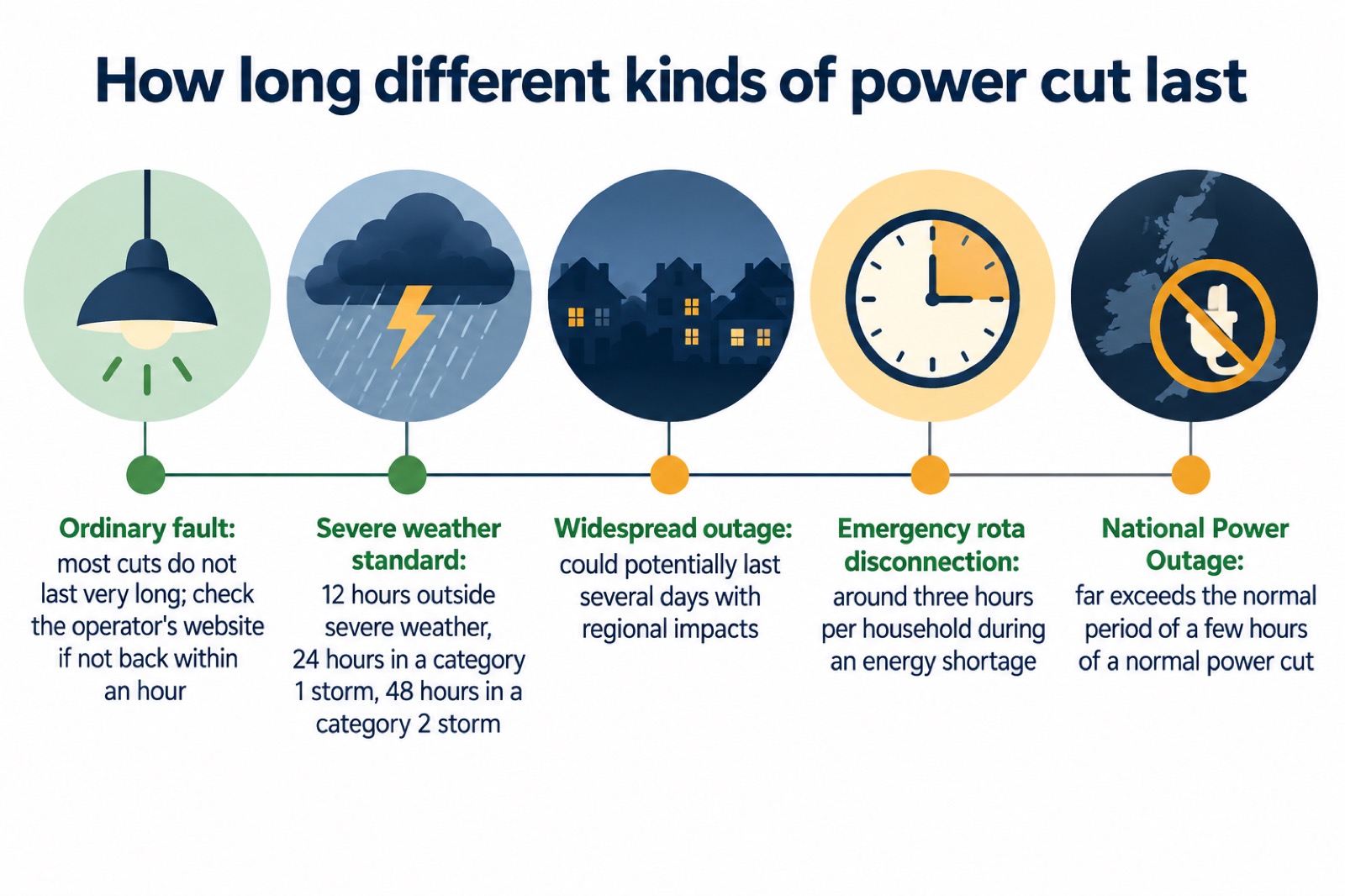
A National Power Outage, the unlikely worst case, would far exceed the normal period of a few hours that you would normally experience in a power cut24. That scenario has its own page on a nationwide blackout, and the rota system is covered in rota disconnections and finding your block letter.
Reporting a power cut or damage to the network
Reporting a cut does two things: it opens the fault record that puts your street on the map, and it starts the clock on any compensation you may later be owed. If your electricity supply is cut off because of an unplanned power cut, you can report it directly to your local network operator using its website, or call 105 for free, which puts you through to your electricity network operator14. Community resilience guidance is equally direct: please call 10525.
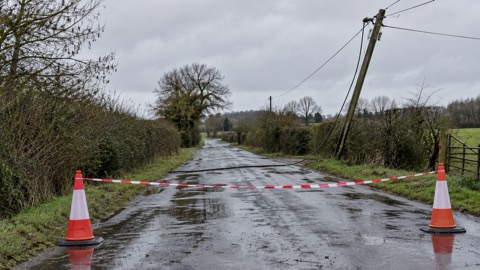
Damage to the network is more urgent than a loss of supply. If you spot damaged or dangerous electrical equipment, including during or after a power cut, report the problem via the Power Cut website, but call 999 in an emergency26. A fallen overhead line may still be live even when the whole area is dark, so keep well away, keep others away, and never assume a line is dead. Our page on fallen overhead lines explains what to do, and reporting a damaged or open substation covers substations.
Keep the numbers you need written down where you can find them in the dark, because a power cut can take your broadband and, with an internet-based landline, your phone with it. The numbers that matter:
- 105, free, for power cuts in England, Scotland and Wales14
- 03457 643 643, the NIE Networks Customer Helpline in Northern Ireland19
- 999, for damage to the network that is an emergency26
Our emergency numbers to keep at home checklist covers the full list, and what to keep charged helps make sure a dead phone does not stop you reporting the cut at all.
While you wait: what to do and what to avoid
Waiting for restoration is easier with a plan. Leave one light on so you know when the power cut has been fixed12. Keep fridge and freezer doors closed: if the electricity is off for less than four hours, it is unlikely to have an impact on the safety of your food5, and closed doors extend that window. Our pages on what to do when the electricity goes off, fridge and freezer food and keeping warm without electricity cover the practical steps in detail.
Keep your mobile phone charged and any battery packs you may have11, so you can keep checking the fault map and receive restoration updates. If your landline is an older analogue line it will usually keep working during a cut, but if it will not, your provider might offer a free back-up solution lasting at least an hour so you can still call the emergency services10. Vulnerable customers with an analogue landline can get a free back-up battery unit, meaning the landline would work for at least an hour during a power cut, and many batteries now last much longer27.
When the supply finally returns, leave a light on so you know when power is restored12. Our page on when the supply returns gives the full checklist, and should you unplug appliances when the lights go out answers the question most people ask mid-cut.
Sources (27)
- Generators and power cuts, Wiltshire and Swindon Prepared
- Emergency power cuts: FAQ, Northern Powergrid, March 2025
- Plan for a power cut, Ofgem
- Be informed about hazards: power cuts, UK government Prepare Campaign, 21 October 2026
- Food safety in the kitchen: power cuts, Food Standards Scotland
- What are electricity rota loads, Wiltshire and Swindon Prepared
- How to find out if there's a power cut, Which?
- Resilience and risks in Wales, Welsh Government, 7 September 2026
- Future of landline calls, Ofcom, 26 August 2026
- Power cuts, UK government Prepare Campaign, 21 October 2026
- Staying safe in the snow, North Yorkshire Fire and Rescue Service, 9 March 2023
- Stay safe in lightning, Met Office
- How the power system works in the UK, Wiltshire and Swindon Prepared
- Check if you can get payment for a power cut, Ofgem
- Energy outages, National Energy System Operator
- England and Wales energy domestic consumer advice, Ofgem, November 2024
- Storm Gerrit 11am update, SSEN, 28 December 2023
- Strong winds weather warning information and advice, nidirect, 24 October 2026
- Strong winds and heavy rain warning information and advice, nidirect, 27 January 2026
- Be ready for emergencies, UK government Prepare Campaign, 21 October 2026
- Thunderstorms weather warning advice and information, nidirect, 30 August 2026
- What to do in a power cut, Met Office
- What are system notices, National Energy System Operator
- What is a National Power Outage, Wiltshire and Swindon Prepared
- Adverse weather events, Llangattock Community Council
- Power, gas and water: what if they fail, Surrey County Council, 29 December 2025
- Phone and broadband outages, UK government Prepare Campaign, 12 October 2026
 Power Cut Kit Checklist
 What to Keep Charged
 Household Emergency Plan
 Reporting a Power Cut
 What to Do in a Power Cut
 Getting Ready for a Power Cut
 Fridge and Freezer Food
 Keeping Warm Without Electricity
 Central Heating Without Power
 Cold Homes and Health
 Carbon Monoxide Risks
 Staying Safe in the Dark
 Smoke and Carbon Monoxide Alarms
 When the Power Comes Back
 Fallen Overhead Lines