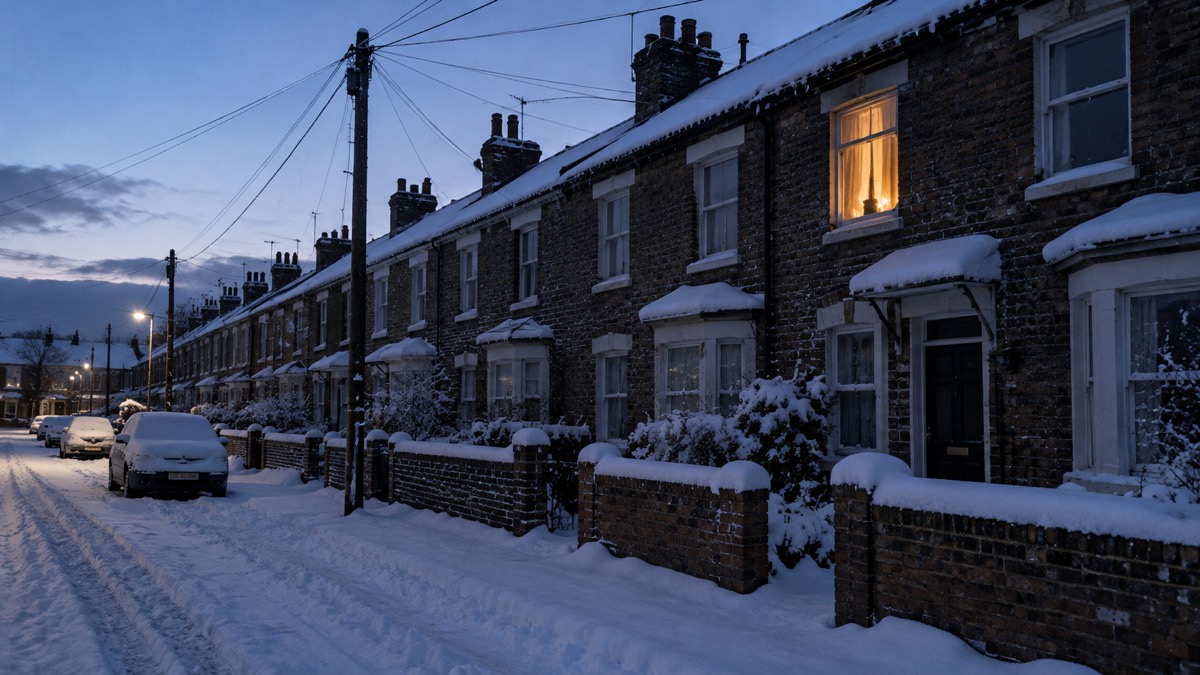
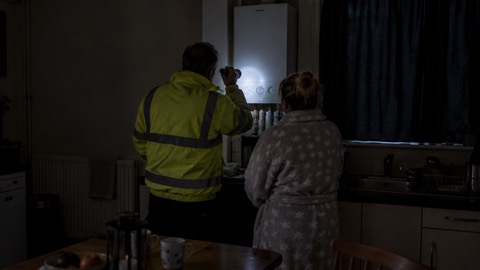
When the electricity goes off in cold weather, your heating almost certainly goes with it. Boilers, storage heaters, panel heaters and heat pumps all need electricity to run, even gas central heating needs it for the pump and controls, so a winter power cut can leave a house cooling within hours. The good news is that the things that work need no power at all: layered clothing, blankets, closed doors, a hot water bottle and one warm room to live in.
The government's power cut guidance is blunt about the basics: keep warm using blankets and layered clothing, keep the doors of unused rooms closed, and close the curtains to keep the heat in1. The Met Office adds the number that matters: heat your home to at least 18°C in the rooms you regularly use, if you can, and if you cannot heat everything, heat the living room through the day and the bedroom just before bed2. Everything else on this page is how to do that safely, and what not to do, because power cuts bring a rise in house fires started by candles and portable heaters3.
Keep the heat in: layers, blankets and closed doors
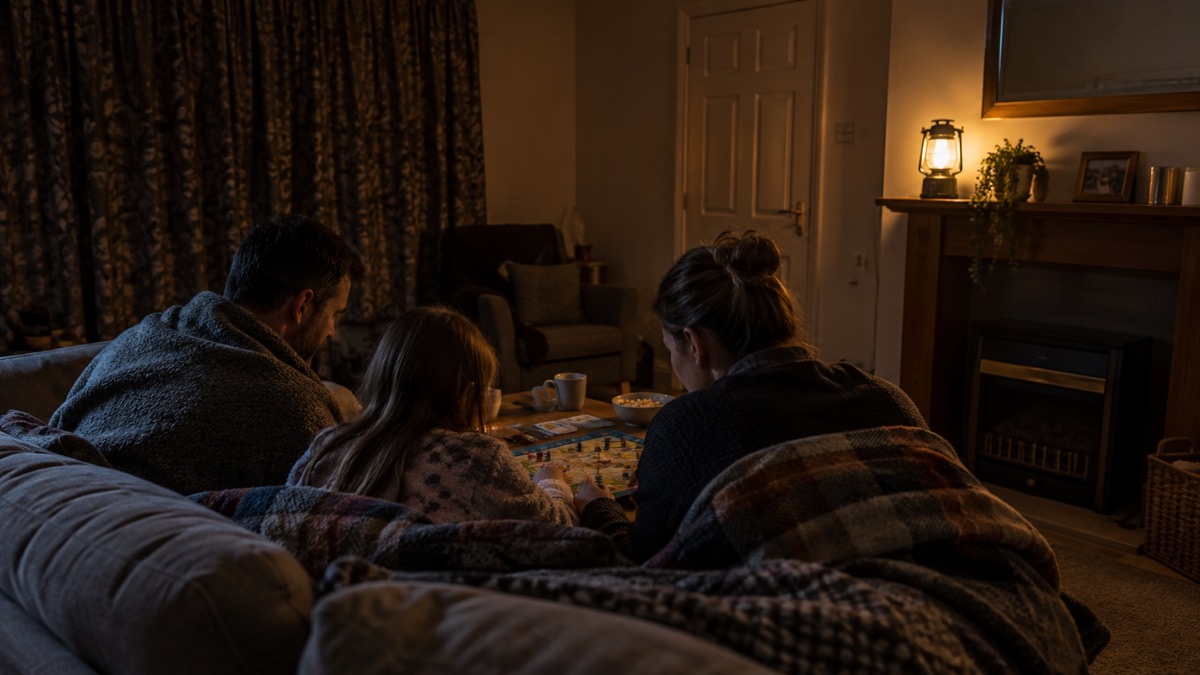
The first job in a power cut is not to make new heat but to stop the heat you already have from leaking away. A house that was warm when the supply failed holds its warmth for hours if you close it up, and your own body heat becomes the main heater for the room you are sitting in.
Start with clothing. The government's power cut advice for people most at risk of cold is to keep warm with blankets and layered clothing, and to keep doors of unused rooms closed and curtains drawn to hold the heat in1. West Midlands Ambulance Service NHS Foundation Trust advises wearing several layers of clothing, plus a hat, gloves and a scarf, and keeping dry, because damp clothing loses body heat far faster7. That advice is written for outdoors, but the principle of layers and keeping dry applies indoors too, especially if you are sitting still for long stretches, which is what most of a power cut involves.
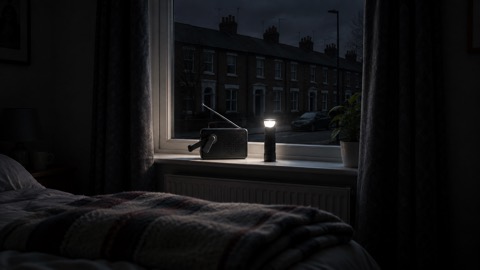
Then close the house down. Keep the doors of unused rooms closed and close the curtains to keep heat in the rooms you use most1. Anglesey Council's winter readiness advice adds keeping extra blankets nearby and closing shutters, blinds or curtains8. The Met Office's snow safety advice repeats the same instruction for a power cut: wrap up warm and close internal doors to keep the heat in9. Internal doors matter as much as curtains: an open doorway lets warm air drain into cold hallways and upstairs rooms you are not using.
A few practical points make this work better:
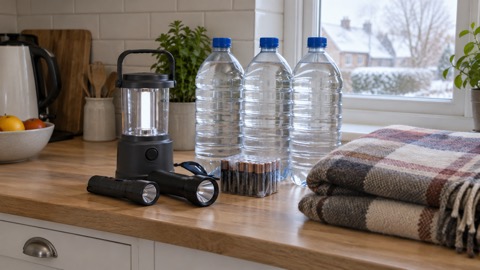
- Keep blankets and warm clothing to hand before winter, not buried in a loft. North Yorkshire Fire and Rescue Service's advice for being cut off by snow is simply to have blankets and warm clothing to hand10.
- If your heating runs on electricity, plan for cold evenings with extra layers and blankets as a matter of course through winter, as Wiltshire and Swindon Local Resilience Forum advises11.
- If a power cut is planned, pre-heat your home beforehand and prepare to stay in one pre-warmed room with extra layers of blankets and clothing ready, advice the NHS issued for families of technology-dependent children but that works for any household12.
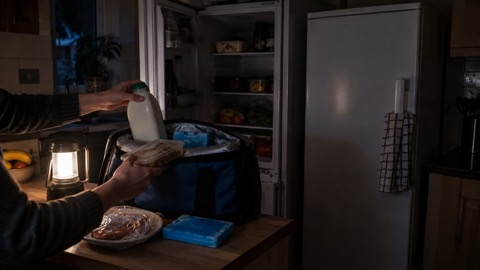
- Keep fridges and freezers shut with a blanket over them: they stay cold for many hours, and the blanket does double duty as insulation13.
One thing not to do: do not treat candles as a heat source. A candle gives light, not useful warmth for a room, and an open flame in a dark house is a hazard in itself. Use torches and lanterns for light instead, as covered in our guide to emergency lighting.
Heat one room to at least 18°C and live in it
If the power is off for hours, trying to keep a whole house warm wastes both heat and fuel. The advice from every official source is the same: pick one room, keep that room warm, and live in it.
The Met Office's winter home guidance gives the target: heat your home to at least 18°C in the rooms you regularly use, if you can, and if you cannot heat all the rooms you use, heat the living room throughout the day and your bedroom just before you go to bed, closing curtains and shutting doors to keep the heat in the rooms you use most2. Readiness Scotland puts the same figure slightly differently, advising a temperature that is comfortable for you, at least 18°C in the rooms you regularly use if you can14. NHS Scotland's Keep Safe Keep Well winter campaign advises that if you cannot maintain an even temperature in all rooms, keep one room warm and use that room during the cold weather15.
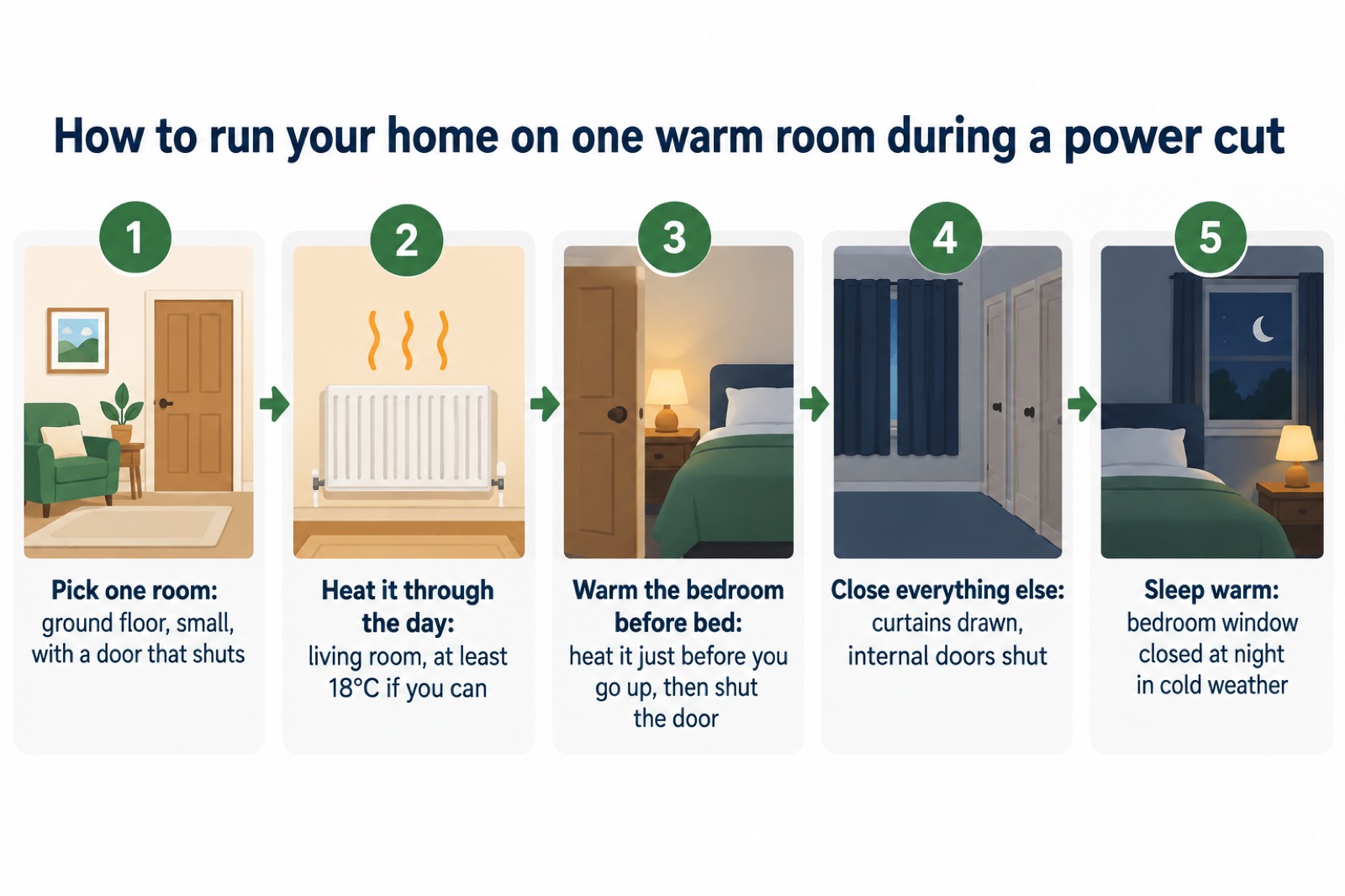
Wiltshire and Swindon Local Resilience Forum's gas outage advice makes the reasoning explicit: think about only keeping one room warm rather than trying to heat the whole house, because it saves you trying to heat everything while keeping you nice and warm in one room16. A smaller room with the door shut also holds body heat better: several people in a closed room raise its temperature noticeably without any heater at all.
Two details from the Met Office are worth acting on. First, keep your bedroom window closed at night when the weather is cold2. It is tempting to crack a window for air, but in a power cut that window becomes a heat drain for the room you will spend eight or more hours in. Second, if you have thermostatically controlled heating that still works, leave it on permanently and set it at a minimum temperature, as community council advice for adverse weather in Wales recommends17. That keeps the fabric of the house above freezing and protects the pipes.
If you are cut off by snow rather than a fault, the Met Office adds a pipe protection tip: open kitchen and bathroom cabinet doors to let warmer air circulate around the plumbing and prevent frozen pipes9. A burst pipe on top of a power cut is a far worse night than a cold one.
Hot water bottles: hot, not boiling, and never more than two-thirds full
A hot water bottle is the most useful piece of heating kit most households already own. It needs no electricity, it is safe when used properly, and it delivers warmth directly to the person who needs it rather than to the whole room. It is also one of the commonest causes of burns seen by NHS services, so the rules matter.
NHS guidance on burns and scalds, published by Just One Norfolk, sets out the rule everyone should know. Do not overfill it: about two-thirds full is enough4. Filling it with boiling water is one of the things listed as degrading a hot water bottle over time4. Expel the air before screwing the stopper in, check the stopper is tight, and use a cover or a towel between the bottle and skin.
"Don't overfill it - about two-thirds full is enough."
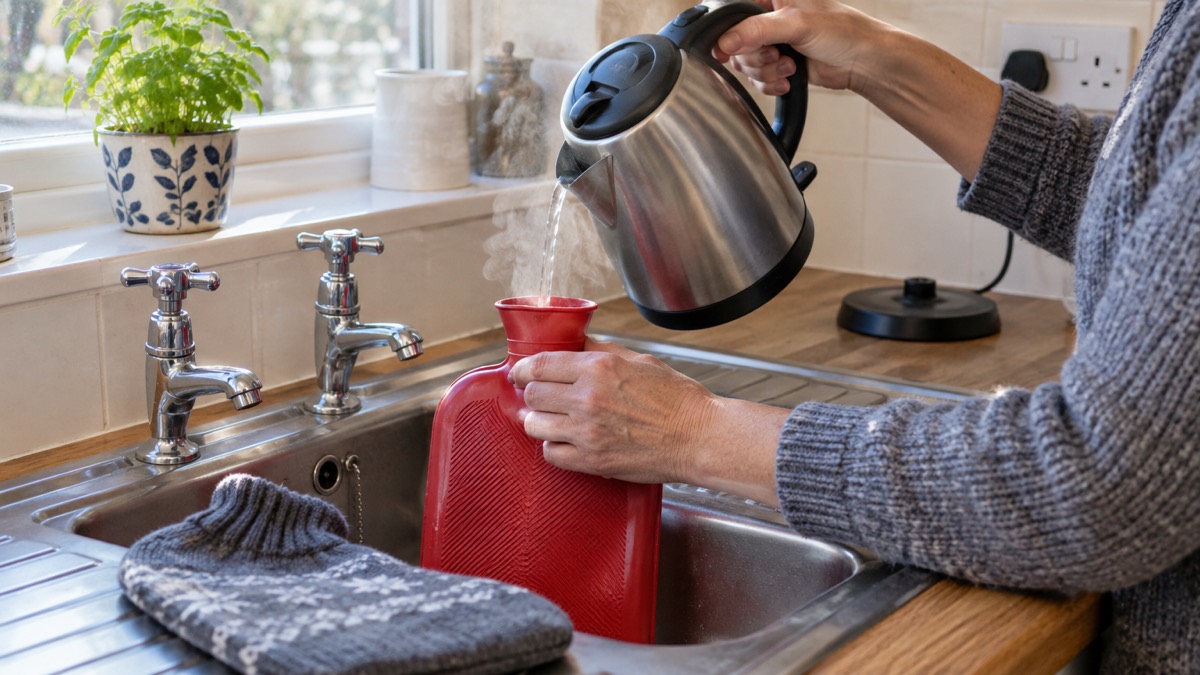
The other rule is about who is under the bottle. NHS guidance for families of technology-dependent children is explicit: do not use heated products, such as hot water bottles, with children who cannot move off them if they get too hot or are starting to burn12. That applies to anyone who cannot easily move away: a person who is asleep, very frail, sedated, or with reduced sensation. For everyone else, sit with the bottle against you rather than lying on top of it, and take it out of the bed before you settle for the night.
Check a bottle before you use it, especially one that has been stored since last winter. Cracks, perishing rubber and worn seams are how bottles fail. Replace it rather than risking it. Our page on hot water bottles and electric blankets covers combining the two, and our page on children and hot water bottles goes into more detail for families.
Babies and children: warm without burns or overheating
Babies and young children are among the groups most likely to become ill if they get too cold in a power cut18, so keeping them warm matters. But they are also the group most at risk of burns from the things adults use to get warm, so the way you keep them warm matters just as much.
For warmth, the same basics apply as for adults, scaled down: layers, blankets and a closed room. NHS first aid guidance for a child who has had an accident notes the importance of not letting the child get too cold, using a coat or blanket to keep them warm if necessary19. If a child is being treated for a burn or scald, Just One Norfolk advises keeping them warm with a blanket, taking care not to rub it against the burnt area4.
For feeding, prepare before the cut. Northern Ireland direct guidance on preparing for storms and heavy rain advises that if you have a baby at home, you keep a supply of pre-prepared formula baby milk if used, and prepare a flask of hot water to heat bottles and baby food20. The same guidance notes it is always safer to make up a fresh feed, and when that is not possible, feeds should never be stored for longer than 24 hours21.
The hard rule is the one above: no hot water bottles or other heated products with a child who cannot move off them12. A baby in a cot cannot push a bottle away. Warm the cot with the bottle before the baby goes in, then take the bottle out. Dress a baby in one more layer than you would wear yourself, and check their chest or back rather than their hands for temperature.
Who the cold hits hardest
Cold in a power cut is not an equal risk. The government's power cut guidance names the groups most likely to become ill if they get too cold: older adults, babies and young children, and people with long-term health problems18. West Midlands Ambulance Service NHS Foundation Trust gives the fuller list of who is particularly at risk in cold weather: people aged 65 and older, babies and children under 5, people on a low income, people with a long-term health condition, people with a disability, pregnant women, and people with a mental health condition7.
UK Health Security Agency guidance for care professionals adds people in lower income households to the list22, and its guidance for adult social care managers notes that cold weather puts people at greater risk of ill-health and even death primarily because it increases the probability of complications from existing disease and of injury due to falls23. Norfolk and Waveney Integrated Care Board adds a power cut specific group: people who rely on electrical medical equipment or refrigerated medicines, for whom winter outages have a significant impact24.
| Group | Why the cold hits harder | Source |
|---|---|---|
| People aged 65 and older | Most likely to become ill if too cold; complications from existing disease | 18 |
| Babies and children under 5 | Cannot regulate temperature as adults do; cannot move off heated products | 18 |
| People with long-term conditions | Cold raises blood pressure and clotting risk | 18 |
| People on a low income | Less able to heat their homes at all | 7 |
| People with a disability or mobility issues | May not be able to move away from cold or from heaters | 7 |
| People using medical equipment or refrigerated medicine | Outages cut the equipment, not just the heating | 24 |
If someone in your household falls into these groups, two things help before winter. First, join the Priority Services Register, which network operators keep for people who need extra help during outages. Second, check on neighbours and relatives in these groups when the power goes: our neighbours checklist covers what to ask. Households relying on medical equipment should also read our page on medical equipment that needs electricity.
What cold does to the body: why 18°C is not a comfort number
The 18°C figure in official advice is not about comfort. It is a health threshold, and the reasons behind it explain why a power cut in cold weather is treated as a health event, not just an inconvenience.
The Met Office's winter guidance explains the mechanism: the cold thickens blood and increases blood pressure, and breathing in cold air can increase the risk of chest infections2. UK Health Security Agency guidance for care professionals goes further: exposure to cold can increase the risk of blood clots forming in the body, which in turn increases the risk of heart attacks and strokes22. This is why deaths during the winter months are significantly higher than at other times of the year, as UKHSA's guidance for adult social care managers states23.
That same guidance sets out the range of harm. Direct cold exposure can result in death or severe illness due to hypothermia, although deaths where hypothermia is the primary cause are rare23. The bigger danger for most people is indirect: cold weather increases the probability of complications from existing disease, such as heart and lung conditions, and of injury due to falls23. Longer term, cold housing carries an increased risk of mental health conditions such as depression and anxiety23.
What this means in a power cut is practical:
- Keep the room you are living in at 18°C or above if you possibly can2.
- Keep moving now and then, and have warm drinks. NHS frostbite first aid advice includes having a warm drink or water26, and warm drinks help the body maintain its core temperature.
- Do not sit still in a cold room for hours in one thin layer; layers and blankets are the whole point1.
- If someone with a heart or lung condition starts to feel unwell in the cold, seek medical help rather than waiting for the power to return.
Our page on cold homes and health covers hypothermia, its warning signs and who is most at risk in more detail.
Portable gas heaters: ventilation, leaks and where they must never go
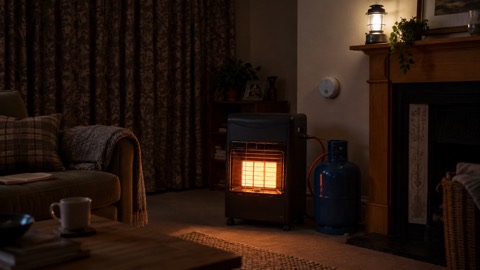
A portable gas heater is the one common device that heats a room well without electricity. The Northern Ireland Fire and Rescue Service describes their appeal plainly: these heaters can be moved anywhere and heat the room they are in quickly, though they require changing gas cylinders, which can be a hassle and also poses fire risks27. If you use one during a power cut, the fire and rescue services have a consistent set of rules, and they exist because gas heaters cause both fires and carbon monoxide poisoning.
The placement rules come first. North Yorkshire Fire and Rescue Service states that portable gas heaters must not be used in bedrooms and should only be used in well ventilated rooms5. Devon and Somerset Fire and Rescue Service adds that standard portable heaters, gas and electric, must not be used in showers or bathrooms6. The Scottish Fire and Rescue Service's power cut guidance adds two more: never move a bottled gas or oil heater when it is lit, and switch off portable heaters when you go out, are not in the room, or go to bed3.
Ventilation and cylinder handling are where gas heaters most often go wrong. The Northern Ireland Fire and Rescue Service advises ensuring good ventilation in the room where the heater is being used, changing cylinders in the open air if possible, not using the heater if you suspect a leak, and having the heater serviced regularly by a qualified engineer28. The Scottish Fire and Rescue Service explains why: accidents from portable gas heaters happen due to gas leaks during appliance assembly or cylinder or cartridge changes, and it adds a rule that matters for escape: never change a cylinder on a stairway or other escape route29.
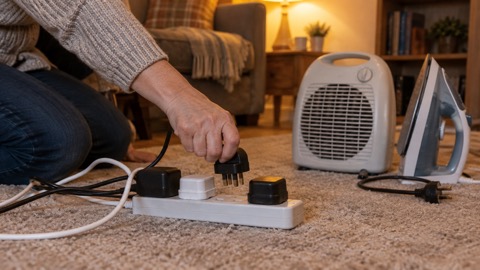
The remaining rules apply to any portable heater, gas or electric. Never leave one unattended, particularly when children or pets are nearby, and switch it off before going to sleep or leaving the property. Do not sit or stand too close, as clothing may catch fire. Do not dry clothes on it. Do not place it where it could be easily knocked over, and do not use flammable adhesives, cleaning fluids or aerosol sprays near it28. Plug electric heaters directly into a socket rather than an extension lead, keep at least one metre between the heater and combustible materials such as furniture, bedding or curtains, and buy heaters that conform to safety standards from reputable retailers28.
Open fires and gas appliances: a check before winter, ventilation always
If you have an open fire or a wood burner, a power cut is when it earns its place in the house. It heats without electricity and it keeps working when nothing else does. But it needs the same two things it always needs: a chimney that has been swept and checked, and enough ventilation.
West Midlands Ambulance Service NHS Foundation Trust advises that if you have an open fire, you make sure it is properly ventilated7. The same source gives the job to do before winter: check your heating and cooking appliances are safe by contacting a Gas Safe registered engineer to make sure they are working properly7. That check matters most in a power cut, because a boiler that has sat unused or a fire that has not been swept is at its most dangerous on the night you finally rely on it.
The Met Office's snow safety advice adds a bedtime rule for anyone cut off in cold weather: turn off electrical heaters and put out your fire before going to bed to avoid fire risk9. An open fire left to burn down unattended is one of the classic starts of a chimney fire. If you use the fire through a long outage, use a fireguard, keep the same one metre clearance for anything that can burn that you would give a portable heater, and never dry clothes over it.
Never install, repair or service gas appliances yourself, as London Fire Brigade advises25. If you smell gas or suspect a leak, do not use the appliance, and get a Gas Safe registered engineer to check it7.
Electric heaters: what to do when the power comes back
Most households will reach for an electric heater the moment the supply returns, and that is the moment to think about two things: where it goes, and what else is still switched on.
During the cut itself, the Met Office's power cut guidance is to switch off appliances such as irons, ovens, electric fires and fryers, because they could pose a hazard if the power comes back on when you are not there13. An electric fire left switched on at the wall returns to full heat the instant the supply is restored, possibly in a room you have since filled with blankets, or left, or gone to sleep in. Our page on what to do when the electricity goes off covers the full switch off routine, and our page on when the supply returns covers switching back on safely.
Once the power is back and you are using the heater, the Met Office's winter home guidance gives the standing rules: keep electric heaters away from curtains and furniture, do not use them for drying clothes, and always unplug them when you go out or go to bed2. Devon and Somerset Fire and Rescue Service adds: if you think the wiring is damaged, do not use the heater, get it checked by a qualified electrician6. And plug it into a wall socket, not an extension lead, because extension leads can easily be overloaded and cause fires5.
Devon and Somerset Fire and Rescue Service also warns about where heaters come from: heaters should be bought from a reputable supplier, and the service is aware of cheap but highly dangerous plug-in heaters bought online with fake safety marks30. A heater bought for emergencies should be registered when you purchase it, so you will be made aware of any product recalls or safety information released later27. If it has been stored for years, check it is not subject to a recall or repair before you use it5.
How most heater fires start, and how to avoid them
The pattern behind most heater fires is consistent across every fire and rescue service that has written about it, and it is the same in a power cut as on any cold night. London Fire Brigade states it plainly: fires typically start when bedding, blankets or clothes are placed too close to heaters25. Devon and Somerset Fire and Rescue Service gives the fuller list: most fires caused by heaters come from sitting too close to them, placing heaters near curtains and furniture, or using them to dry washing6. Devon and Somerset's home safety partnerships guidance repeats the same causes30.
In a power cut those causes line up exactly with what people do: they bring a heater into a room they have filled with blankets, they drape wet washing over it because the tumble dryer is dead, and they sit closer to it than they should because the room is cold. The Scottish Fire and Rescue Service confirms the result: during a power cut, its firefighters can be called to fires started by candles or portable heaters3.
The avoidance rules follow directly from the causes:
- Keep heaters well away from bedding, blankets, curtains and furniture, and never use them for drying clothes25.
- Keep at least one metre between the heater and anything that can burn28.
- Do not sit or stand too close, because clothing can catch fire28.
- Do not place a heater where it could be knocked over, and never move a gas or oil heater while it is lit3.
- Switch heaters off before going to bed, before going out, and whenever you leave the room3.
- Plug electric heaters into a wall socket, not an extension lead5.
Two further points from Devon and Somerset Fire and Rescue Service are easy to miss. Portable heaters can become a trip hazard, making escape more difficult in a fire30, so placement is an escape issue as well as a fire issue. And people with mobility issues are especially at risk of tripping or falling onto a heater, so where heaters are placed matters most in households where someone is unsteady on their feet25.
Where to get help and more to read
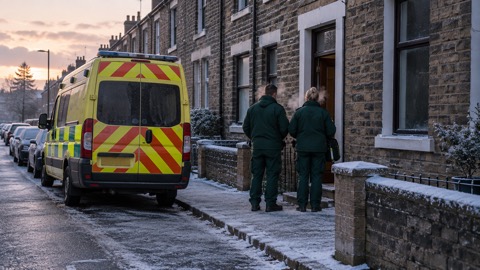
If the power is off, report it by ringing 105, the free national power cut number, which you can read about on our page on reporting a loss of electricity. If you or someone you look after is in one of the groups the cold hits hardest, join the Priority Services Register before winter, and read about extra help from network operators during long outages. For the wider picture of getting ready, see getting your home ready for a loss of supply and the power cut kit checklist.
Related pages on this site: how to keep warm in one room, will gas central heating work without electricity, can you heat a room with a gas hob, staying safe in the dark, and how long until the electricity comes back.
Sources (30)
- Power cuts: be informed about hazards, Prepare (UK government campaign), 2026
- Keeping your home warm in winter, Met Office, 2026
- Power cuts: safety at home, Scottish Fire and Rescue Service, 2025
- Burns and scalds, Just One Norfolk (NHS), 2026
- Heating your home safely, North Yorkshire Fire and Rescue Service, 2026
- Heater safety in the home, Devon and Somerset Fire and Rescue Service, 2026
- Cold weather advice, West Midlands Ambulance Service NHS Foundation Trust, 2026
- Winter ready, Isle of Anglesey County Council, 2026
- Stay safe in snow, Met Office, 2026
- Staying safe in the snow, North Yorkshire Fire and Rescue Service, 2023
- How to prepare for the loss of electricity, Wiltshire and Swindon Local Resilience Forum, 2026
- Parental letter re power shortages, NHS North West Children's ODN Hub, 2022
- What to do in a power cut, Met Office, 2026
- Cold, snow and ice, Readiness Scotland (Scottish Government campaign), 2026
- Keep Safe Keep Well Winter Safety Campaign 2024-2025, NHS Scotland, 2024
- What you might need in a gas outage, Wiltshire and Swindon Local Resilience Forum, 2026
- Adverse weather events, Llangattock Community Council, 2026
- Power cuts: be informed about hazards, Be Ready (UK government campaign), 2026
- What to do if your child has an accident, NHS, 2025
- Strong winds weather warning information and advice, nidirect (Northern Ireland government), 2026
- Strong winds and heavy rain warning information and advice, nidirect (Northern Ireland government), 2026
- Supporting vulnerable people: guidance for care professionals, UK Health Security Agency, 2025
- Supporting vulnerable people before and during cold weather for adult social care managers, UK Health Security Agency, 2025
- Be prepared for winter emergencies, NHS Norfolk and Waveney Integrated Care Board, 2026
- Portable heaters, gas fires and open fires, London Fire Brigade, 2026
- Frostbite, NHS, 2025
- Heater safety news, Devon and Somerset Fire and Rescue Service, 2024
- Home fire safety: portable heaters, Northern Ireland Fire and Rescue Service, 2026
- Heating and gas safety at home, Scottish Fire and Rescue Service, 2024
- Home safety partnerships, Devon and Somerset Fire and Rescue Service, 2026
 Power Cut Kit Checklist
 What to Keep Charged
 Household Emergency Plan
 Reporting a Power Cut
 What to Do in a Power Cut
 Getting Ready for a Power Cut
 Fridge and Freezer Food
 Central Heating Without Power
 Cold Homes and Health
 Carbon Monoxide Risks
 Staying Safe in the Dark
 Smoke and Carbon Monoxide Alarms
 How Long Until Power Returns
 When the Power Comes Back
 Fallen Overhead Lines