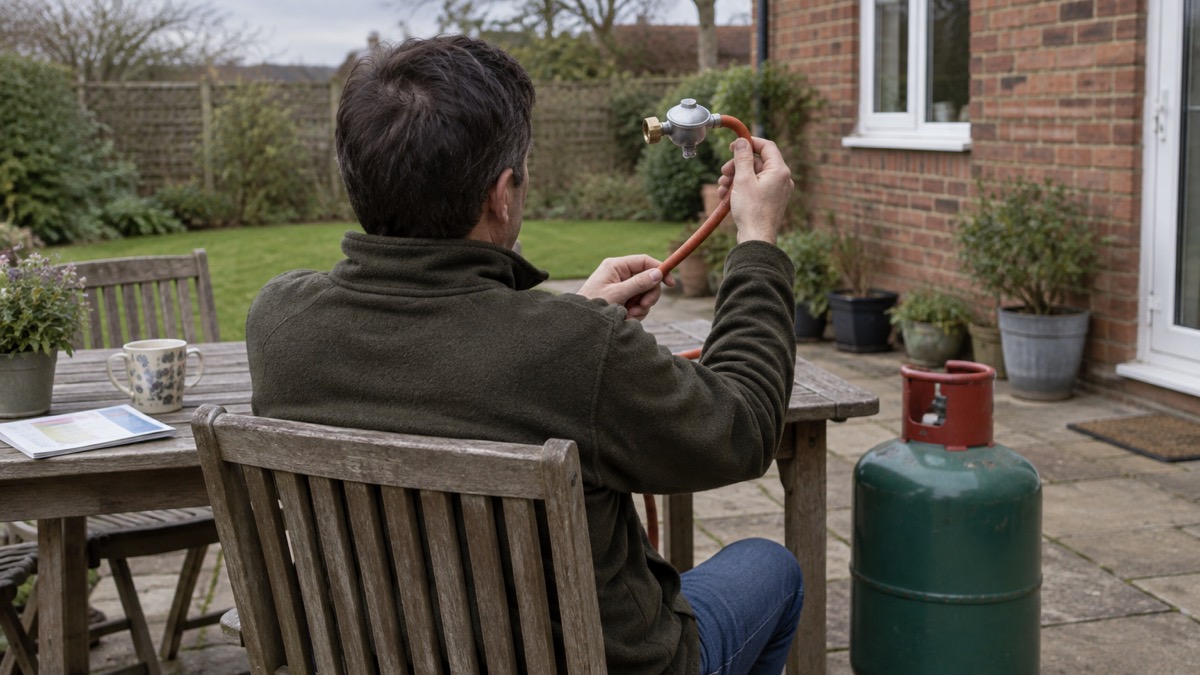
If you can smell gas from a bottle, a heater or a stove, open the doors and windows, leave the area, and call the free 24-hour national gas emergency number, 0800 111 999, whether the smell is inside or outside the property1. That number is answered around the clock and is the same one to use whether you are at home, in a caravan or anywhere else in the UK2. Do not look for the leak with a flame, do not switch electrical items on or off, and do not smoke.
Bottled gas, properly called Liquefied Petroleum Gas or LPG, is what fuels cabinet heaters and many camping stoves when the mains gas or electricity is off. It works well, but it is stored under pressure and is highly flammable, and even a small leak can release a large volume of gas that collects near the floor and can ignite at a distance from the leak itself3. This page sets out the safety rules that fire and rescue services and official guidance give for gas bottles at home: where to store them, how to check the hose and regulator, how to carry them, and what to do when something goes wrong. For the wider picture of heating and cooking without mains power, see Heating and Cooking Without Mains Power or Gas.
If you smell gas: what to do straight away
The advice from every official source is the same and it is simple. If you smell gas in your home, call the free 24-hour national gas emergency number, 0800 111 999, whether the smell is inside or outside the property1. The National Energy System Operator puts it plainly:
"If you smell gas or suspect a leak, call 0800 111 999 immediately."2
Do not operate light switches, do not use matches or lighters, and do not use a fan to blow the gas away. Do not turn on any electrical equipment. Leave the area and call for help before doing anything else.
If the smell is coming from a heater or a cylinder rather than from the mains supply, the same number applies. Buckinghamshire Council repeats the national advice: if you smell gas in your home, call the free 24-hour national gas emergency number8. Northumberland Council likewise says that if you smell gas or suspect a gas leak, call the National Gas Emergency Service immediately on 0800 111 9999.
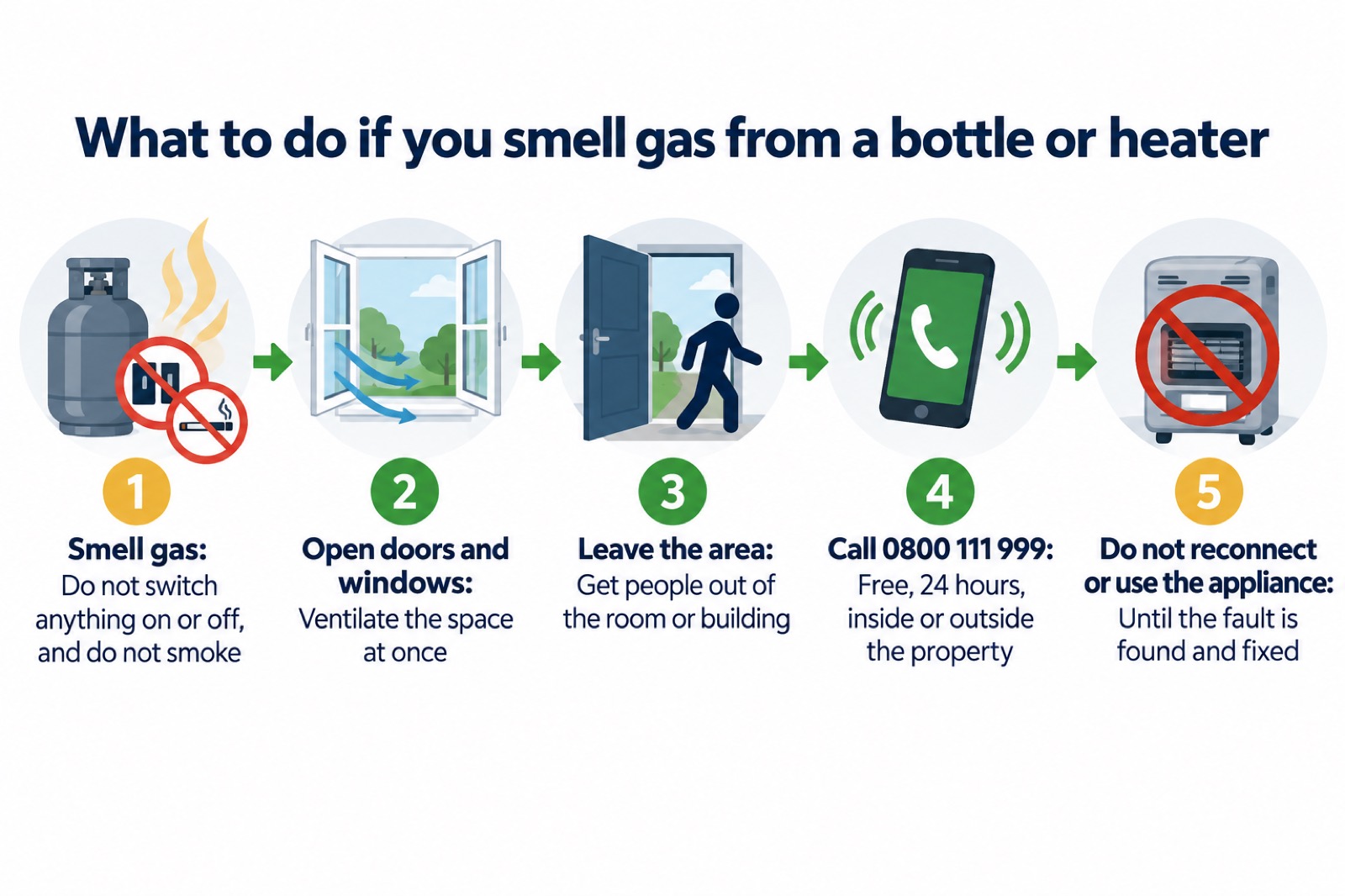
If the leak turns out to be in the heater's own hose or fittings, fire and rescue guidance is to take the heater and cylinder into the open air and not use them until the faulty part has been replaced5. The section on checking hoses below covers how to find that kind of leak safely.
The Flogas Gold butane cylinder recall: what owners should do
In December 2024 the Office for Product Safety and Standards recalled Flogas Gold Butane Gas Cylinders. The affected bottles are the gold and red butane cylinders in 4.5 kg, 7 kg and 13 kg sizes7. The recall notice states:
"The product has been recalled from end users and withdrawn from the market."7
If you have one of these cylinders, the official safety notice tells you exactly what to do: stop using the butane gas bottles immediately, do not connect the gas, and if it is already connected, disconnect it immediately7. Where possible keep the cylinder stored outdoors; if you must store it indoors, keep it away from sources of heat until collection is arranged7. Contact Flogas for collection and a free replacement. The bottles were sold through retailers such as B&Q, B&M, Homebase, other local sellers and gas dealers, so check any bottle you bought from those outlets7. The same recall is published on GOV.UK under notification 2411-0181, which repeats that the product has been recalled from end users and withdrawn from the market10.
This recall is also a reminder of a wider rule from North Yorkshire Fire and Rescue Service: if your heater has not been used for several years, or has been stored away for emergencies, check that it is not subject to a product recall or repair before you bring it back into service11. A bottle or heater bought years ago and left in a shed may have been recalled since. Recalls are published on the GOV.UK product safety pages, and the same check applies to other emergency kit: Hunter Price hot water bottles were recalled as a precautionary safety measure because certain batches could pose a burns risk12.
Gas bottles must always stand upright
A gas cylinder is designed to work in one position: upright. Fire and rescue guidance is that spare cylinders must be stored upright5, and Manchester Fire and Rescue Service says to store spare cylinders upright and outside whenever possible13. The same rule applies when the cylinder is in use. Warwickshire County Council's fire safety advice is that all portable heaters should always be secured in position to prevent them accidentally being knocked over when in use14. A cabinet heater with a bottle inside it should sit on a level floor where it cannot be bumped.
There are two reasons for this. First, the regulator and valve are designed to draw gas from the top of the cylinder, and the liquid gas sits below; a bottle on its side can let liquid reach the valve. Second, a knocked-over heater is the most common way a gas appliance causes a fire. Scottish Fire and Rescue Service warns never to place heaters where they are likely to be knocked over15. Keep the heater away from doorways, thoroughfares and anywhere children or pets move around, and keep the area around it clear of combustible items16.
The upright rule follows the cylinder wherever it goes. Humberside Fire and Rescue Service's caravan guidance says to keep gas bottles outside the caravan in a secure, upright position, and to turn them off when not in use17. Cheshire Fire and Rescue Service adds, for households where clutter is a concern, that if cylinders are needed for medical use, such as oxygen cylinders, they should be stored upright and outside where possible18. Devon and Somerset Fire and Rescue Service gives the same instruction for medical oxygen: stored in an upright position, out of direct sunlight, in a dry, well-ventilated area away from heat sources, and never alongside paint, oil, grease or other combustible materials19.
Where gas bottles must never go: basements, stairs and meter cupboards
Several fire and rescue services give the same short list of places where gas cylinders must never be stored, and it is worth knowing by heart. Never store them in basements, under stairs, or in cupboards containing electric meters or equipment13. London Fire Brigade gives the same prohibition for propane and oxygen cylinders20, and Mid and West Wales Fire and Rescue Service adds one more location: never store spare cylinders near drains5.
The reason is the way LPG behaves, and the government's outdoor fire safety guidance explains the danger of the understairs cupboard in particular:
"Never store gas cylinders under the stairs, if there is a fire they might explode and block your escape route."21
There are also places where bottled gas heaters are simply not allowed. Scottish Fire and Rescue Service's power cut guidance is blunt: never use portable gas cylinder heaters in high rise flats4. Highland Council tells its council tenants never to use paraffin or bottled gas heaters, as these are not allowed in council homes22. If you rent, check your tenancy agreement and your landlord's rules before buying a gas heater, because the prohibition is common in social housing and in flats.
Storing cylinders outside: shade, ventilation and frost
The positive side of the storage advice is just as consistent. North Yorkshire Fire and Rescue Service says to store gas, paraffin and LPG cylinders safely outside the home and out of direct sunlight, and not on balconies11. Devon and Somerset Fire and Rescue Service says to store gas cylinders for gas heaters outside and away from direct sunlight and frost, and not to store more gas cylinders than you need6, advice it repeats for gas barbecues23. Cheshire Fire and Rescue Service's hoarding guidance puts it simply: avoid storing gas cylinders in the home18.
A good storage spot has all of these features:
- Outdoors, not in the house, garage or shed if you can avoid it11
- Out of direct sunlight, in shade for the hottest part of the day6
- Away from frost, so not somewhere that freezes hard in winter6
- Well ventilated, so any small leak disperses rather than gathers19
- Upright and secure, so bottles cannot fall or be knocked over17
- Away from heat sources, including boilers, dryers and sunny walls19
- Only as many as you need, with no long-term stockpile of spares6
The "no more than you need" rule matters for prepping households in particular. It is tempting to keep several full bottles for a long outage, but the fire and rescue advice is to hold only what your appliances will realistically use6. One spare bottle for the heater, stored correctly, is the prepared approach; a row of them in the porch is a hazard. Cylinders also carry the gas under pressure hazard symbol, one of the standard hazard symbols found on household items, which is your reminder that the contents are under pressure even when the appliance is disconnected24.
Check the hose, regulator and connections before every use
Most gas accidents with portable heaters happen at one moment: when someone is assembling the appliance or changing the cylinder or cartridge. Mid and West Wales Fire and Rescue Service states that accidents most frequently occur as a result of gas leaking when people are assembling appliances or changing cylinders or cartridges5, and Scottish Fire and Rescue Service says the same15. That makes the minutes before you light a heater the most important minutes of all.
Oxfordshire County Council's advice for caravan, mobile home and campsite visitors applies equally at home: check gas and electrical equipment, including hobs, heaters and gas bottles, before use, and make sure connections are secure and undamaged25. For a cabinet heater that means the regulator, the clip-on or screw-on fitting where it meets the bottle, and the flexible hose that carries gas to the burner. Look along the hose for cracks and perishing, check the regulator body for damage, and confirm every connection is tight before opening the valve.
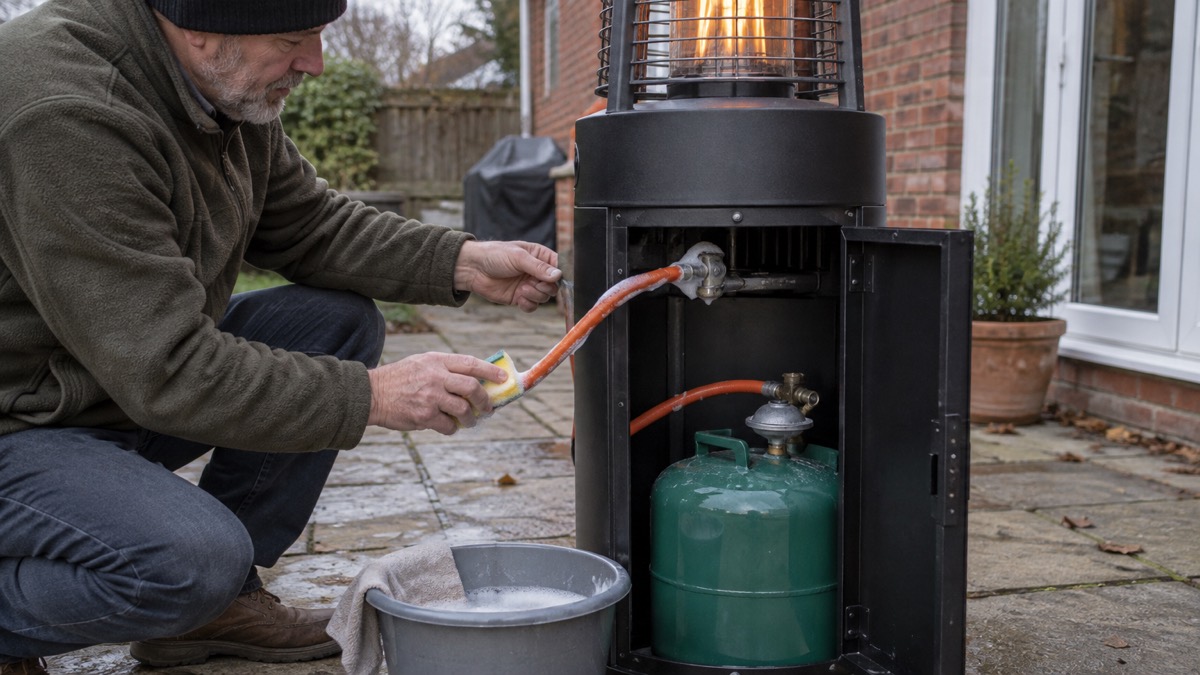
To find a suspected leak, Mid and West Wales Fire and Rescue Service gives a simple method:
"Search for any suspected gas leak by brushing soapy water onto the flexible hose and fittings. If a leak is found, take the heater and cylinder into open air and do not use them until the faulty part has been replaced."5
Bubbles forming anywhere on the hose or at a joint show gas escaping. Never check with a naked flame. If the heater has been unused for a season or more, this check is not optional: hoses perish in storage, and a heater that was sound when it went into the shed may not be sound when it comes out. Beyond your own checks, have the heater serviced regularly. Dorset and Wiltshire Fire and Rescue Service extends the principle to fixed gas systems on boats, which must be installed to accepted standards and in accordance with the appliance manufacturer's instructions, with appliances and flues routinely serviced and maintained26; the same logic of correct installation and regular servicing applies to any gas appliance.
When to stop using a cylinder or heater straight away
Some situations call for stopping immediately, not investigating. The first is the recall above: a recalled Flogas Gold butane cylinder must be disconnected and taken out of use at once7. The second is any leak you cannot trace and fix by replacing the faulty part; the heater and cylinder go outside and stay out of use until the part is replaced5. The third is damage: a dented cylinder, a cracked regulator or a hose with visible perishing takes the appliance out of service until the part is replaced.
The place you live can rule the heater out entirely. Never use portable gas cylinder heaters in high rise flats4, and bottled gas heaters are not allowed in Highland Council homes and many other council and rented properties22. If you live in a flat above the ground floor, check before you rely on a gas heater in an outage, and look at Keeping One Room Warm When the Heating Fails for alternatives.
Ventilation matters while the heater runs, too. The Northern Ireland Fire and Rescue Service says to ensure good ventilation in the room where the heater is being used16, and Mid and West Wales Fire and Rescue Service notes that LPG and paraffin portable heaters are a major cause of condensation, so keep a window open a little5. A cabinet heater is for a room you are awake in, with some airflow, not a sealed bedroom overnight. For the different heater types side by side, see Portable Heaters: Electric, Gas and Paraffin Types Explained and Using a Portable Heater Safely at Home.
Hot weather, heat sources and changing cylinders
Cylinders and heat do not mix, in either direction. The storage rules already keep bottles out of direct sunlight and away from frost6; the handling rules keep them away from anything burning. North Yorkshire Fire and Rescue Service says to change cylinders for portable heaters in a well-ventilated place, away from sources of heat and ignition11. Humberside Fire and Rescue Service says to change cylinders outdoors if possible, or in a well-ventilated area27. The Northern Ireland Fire and Rescue Service says the same: change cylinders in the open air if possible16.
That rule covers every source of ignition in the moment: lit heaters, cookers, candles, cigarettes and anything with a flame or a spark. Mid and West Wales Fire and Rescue Service adds one more prohibition: never change a cylinder on a stairway or other escape route5.
The same caution applies to anything near the heater once it is lit. The Northern Ireland Fire and Rescue Service says not to have combustible items close to portable heaters or open fires and stoves16. On a caravan site, that means the barbecue and the campfire as well: keep gas bottles outside the caravan, turned off unless designed to stay on continuously, and only change the bottle when it is completely empty17. Welsh caravan fire safety guidance from Mid and West Wales Fire and Rescue Service gives the same advice28. For cooking outdoors in an emergency, see Barbecues in an Emergency: Outdoor Use Only.
Carrying gas bottles in a car or van
Transporting a cylinder is a short, routine job that still deserves care. Keep the bottle upright throughout the journey, secured so it cannot roll or tip over, and close the valve before the bottle goes in the vehicle. Carry it in the boot or load area rather than the passenger compartment if your vehicle allows, so that any small trace of gas is away from where you sit and from anything electrical.
If you smell gas while driving, the priority is ventilation. Stop the engine and do not move the vehicle until the source of the leakage has been found and the vehicle has been declared safe by a competent person. Where possible, maximise ventilation by fully opening all doors, windows and vents, and do not turn on any electrical equipment. Keep well away from cigarettes, vapes and anything that could ignite the gas, and call the Calor Emergency Line on 03457 444 999 for further instructions.
The same precautions apply on the way back from an exchange as on the way there. Do not leave a cylinder loose on a seat, and do not carry more bottles than the trip requires. For the smaller cartridges used by camping stoves, which have their own valve types and cold weather behaviour, see Gas Cartridges: Valve Types, Cold Weather and Storage.
LPG cylinders and dual-fuel generators
Some households keep a dual-fuel generator that can run on LPG as well as petrol, and the same cylinders and the same safety rules apply. Portable gas heaters use Liquefied Petroleum Gas, such as butane or propane3, and an LPG-fed generator draws from the same kind of bottle. Everything on this page still holds: the cylinder stands upright, outdoors and out of sunlight when stored6; it is never kept in a basement, under the stairs or beside electric meters13; and the hose and connections are checked before every use25.
If you are considering backup power for an outage, read Backup Power at Home: A Household Guide for the full picture of what generators, power stations and battery lighting can and cannot do for a household, and Power Cuts: A Household Guide for what to do when the electricity goes off.
Turning the gas back on after a fire or an emergency
One rule catches many households out after an incident. Essex Prepared's recovery guidance for households recovering from an emergency states:
"If you turned gas off, it must be turned on again by a professional for safety reasons."29
That applies whether you turned off a gas cylinder valve, an appliance or a supply during a fire, a flood or an evacuation. Once the immediate danger has passed, do not reopen the valves yourself. A professional needs to check the system before it is put back under pressure, because heat, water or impact can damage valves, hoses and regulators in ways that are not visible from the outside. If a cylinder or heater has been through a fire, treat it as out of use until it has been checked.
The same recovery period is the time to re-check everything in this page: the hose and fittings with soapy water5, the storage position of any spare bottles13, and whether any of your kit has been recalled since you last used it11. For the wider steps of getting a household back to normal after an emergency, see Home Emergencies: Fire, Carbon Monoxide, Gas Leaks and Burst Pipes and Gas and Heating Failures: A Household Guide.
Sources (29)
- Are You Ready booklet, Culham Parish Council, September 2025
- Energy outages, National Energy System Operator, 2026
- Staying warm: portable heaters, Cheshire Fire and Rescue Service, 26 May 2026
- Power cuts at home, Scottish Fire and Rescue Service, 25 October 2026
- Portable heaters, Mid and West Wales Fire and Rescue Service, 29 October 2026
- Storing fuel safely, Devon and Somerset Fire and Rescue Service, 2026
- Product recall: Flogas Gold Butane Gas Cylinder, London Borough of Bromley, 10 December 2024
- Gas supply issues, Buckinghamshire Council, 29 October 2026
- Information about specific safety concerns, Northumberland County Council, 21 May 2026
- Product recall: Flogas Gold butane gas cylinder, PSD notification 2411-0181, Office for Product Safety and Standards, 3 December 2024
- Heating your home, North Yorkshire Fire and Rescue Service, 9 March 2026
- Product recall: Hunter Price licensed hot water bottles, Office for Product Safety and Standards, 24 November 2023
- Portable heaters, Manchester Fire and Rescue Service, 29 October 2026
- Electric blankets and portable heaters safety, Warwickshire County Council, 29 October 2026
- Heating and gas at home, Scottish Fire and Rescue Service, 21 November 2024
- Home fire safety, Northern Ireland Fire and Rescue Service, 14 October 2026
- Caravan, motor home and campervan safety, Humberside Fire and Rescue Service, 29 October 2026
- Hoarding and fire safety, Cheshire Fire and Rescue Service, 14 October 2026
- Specialist health equipment, Devon and Somerset Fire and Rescue Service, 2026
- Portable heaters, gas fires and open fires, London Fire Brigade, 25 October 2026
- Fire safety outdoors, HM Government, 25 May 2022
- Keeping your home safe and secure, The Highland Council, 12 August 2025
- Barbecue safety, Devon and Somerset Fire and Rescue Service, 2026
- Chemical safety in the home, nidirect, 14 April 2026
- Help prevent wildfires, Oxfordshire County Council, 2026
- Fire risk on boats, Dorset and Wiltshire Fire and Rescue Service, 24 May 2022
- Barbecue safety, Humberside Fire and Rescue Service, 29 October 2026
- Cyngor ar ddiogelwch carafanau, Mid and West Wales Fire and Rescue Service, 29 October 2026
- Step 3: recovering from an emergency, Essex Prepared, 29 October 2026
 Before-Winter Heating Checks
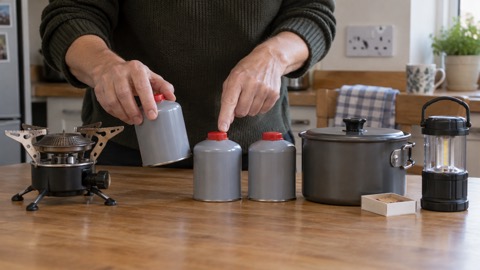 Backup Stove Kit Checklist
 Wood Burner Lighting Kit
 Keeping One Room Warm
 Clothing and Bedding for Cold
 Stopping Draughts
 Hot Water Bottle Safety
 Wheat Bags and Fire Risk
 Electric Blanket Safety
 Portable Heater Types
 Portable Heater Safety
 Wood Burners in a Power Cut
 Using a Wood Burner Safely
 Open Fires and Fire Guards
 Firewood and Seasoning Logs