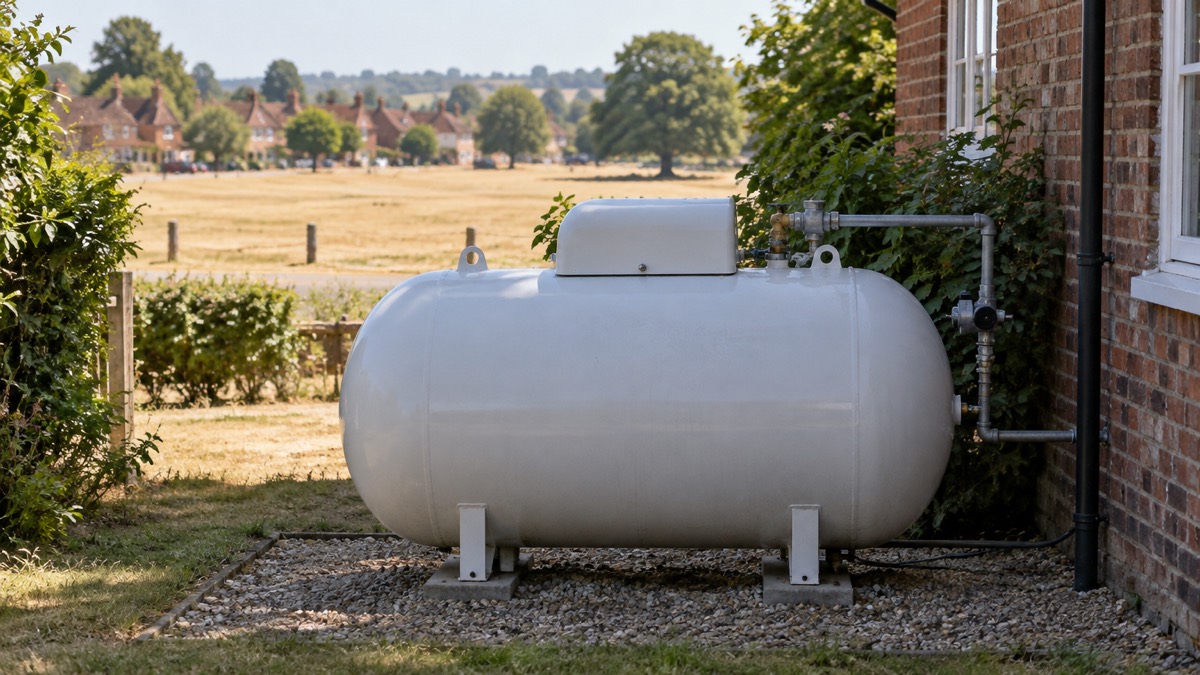
An LPG tank or cylinder is built to sit outside in all weathers, and a normal UK summer is not, on its own, a reason to worry. What changes in a heatwave is the world around it: dry grass, a garden full of things that burn, and the temptation to move cylinders somewhere more convenient. The fire and rescue services are consistent on the basics. Store gas cylinders outside and away from direct sunlight and frost, and do not store more gas cylinders than you need1. Keep them upright, and keep the area around them clear of anything that burns3.
LPG is stored under pressure and is highly flammable. Even a small leak can release a large volume of gas, which is heavier than air, collects near the floor or ground, and can be ignited at a considerable distance from the source of the leak4. That is why the advice is about siting and ventilation rather than about temperature alone. A cylinder that is upright, outdoors, shaded and connected properly is doing what it was designed to do.
If you smell gas, do not wait to work out why. Turn off the main cylinder valve if you can reach it safely, keep away from naked flames and do not switch any electrical equipment or switches on or off, open windows and doors, and leave the property6. Then contact your supplier, and contact National Gas if gas is escaping into a building8. The rest of this page sets out where a tank or cylinder should and should not go, what to do when wildfire risk is high, and who to call.
Shade, upright and clear: siting your tank or cylinders
The core instruction from fire and rescue services is short. Store gas cylinders outside and away from direct sunlight and frost, and do not store more gas cylinders than you need1. The same wording appears in guidance for gas heaters and for gas barbecues, so it applies to the cylinder on the patio as much as to the one feeding a cabinet heater3. Shade matters because it keeps the cylinder out of the strongest sun; it does not mean building a box around it.
Ventilation is the other half of siting. The Health and Safety Executive advises that any facilities using LPG have adequate ventilation at both high and low level, and that you check it is not blocked, for example by fixed grilles covered with newspaper or rags in cold weather to stop draughts14. That advice is written for appliances, but the principle carries to any store or housing around a cylinder: air must be able to move. Never seal a cylinder into a tight cupboard or wrap it in insulation to keep the sun off.
Keep the ground around the cylinder clear. Fire services advise keeping combustible items away from heaters and open fires, and not stacking items to a height where they become unstable3. Around an LPG tank, that means dry grass, stacked wood, cardboard, garden waste and anything else that would carry a flame. If you have a fixed tank, the tank itself should be installed at ground level with pipework properly protected, in line with legal and safety standards and home insurance requirements15.
Where LPG cylinders must never be stored in hot weather
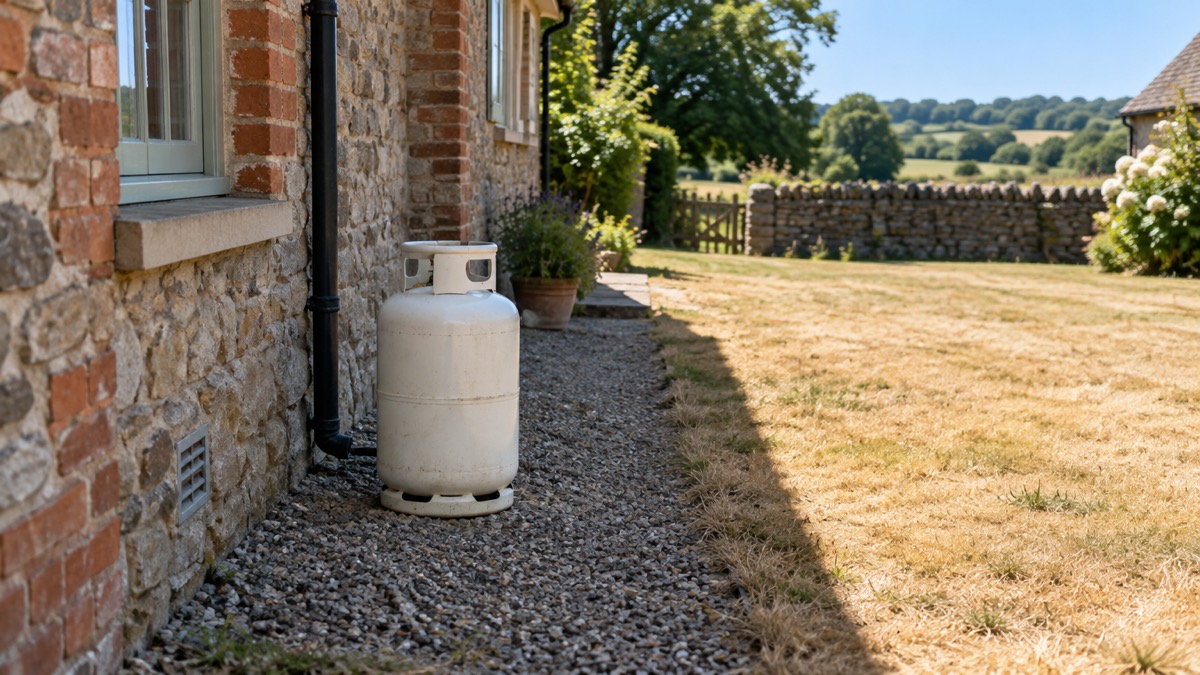
The list of places a cylinder must not go is short and firm. Never store cylinders in basements, under stairs, or in cupboards containing electric meters or equipment9. Spare cylinders should be kept outside whenever possible, and never in a cellar, near drains, under the stairs, or in a cupboard containing meters or electrical equipment; they must be kept upright16. Fire services also advise against storing gas cylinders in your home at all3.
The reason is the behaviour of the gas. LPG is heavier than air, so a leak in a low, enclosed space collects rather than disperses, and an ignition source some distance away can set it off4. A basement, a stair cupboard or a meter box is exactly the kind of place where gas can pool. Outdoors, even a still, hot day gives it somewhere to go.
Two further points matter in summer. First, do not store more cylinders than you need1. A stockpile is more gas to manage and more to move if you have to leave. Second, if anyone in the household uses oxygen cylinders, those have their own rules: store them upright, out of direct sunlight, in a well ventilated, dry area away from heat sources, and never in the same place as paint, oil, grease, domestic heating gases or other combustible materials17. Keep medical oxygen and LPG well apart.
Wildfire risk and your LPG tank: what to do when an emergency alert is sent
In August 2026 the UK Government sent an emergency alert at 7:01pm on 14 August to England and Wales warning of a very high national wildfire risk and advising against any fire-starting activity18. If you receive an alert like that and you have an LPG tank or cylinders, the actions are the same ones you should already have taken, done now rather than later.
- Check that cylinders are upright, outdoors and out of direct sunlight, and that nothing that burns is stacked against them1.
- Move garden waste, wood, cardboard and anything else combustible away from the tank and from the walls of the house.
- Know how to isolate your LPG supply before you need to. Fire services advise knowing how to safely isolate any fuel, electrics and LPG installations, because it will be useful in an emergency19.
- Make sure the correct size and type of gas bottle is being used for any appliance, so connections are sound20.
- Have an emergency plan, and be ready to leave if you are told to21.
A regulator that fails can result in a fire or explosion if LPG accumulates and an ignition source is present, so a damaged or ageing regulator is not something to leave11. If in doubt about a regulator, contact your LPG supplier11. For the wider picture on fire risk in dry weather, see Wildfires and Grass Fires: Risk and Prevention and Protecting Your Home and Garden From a Wildfire. If you are near a fire, What to Do If You See or Are Near a Wildfire sets out the steps.
If you smell gas or see a leak in the heat
Smell is the warning that matters. If you suspect a leak, turn off all appliances and the main cylinder valve, open all doors and windows, and do not smoke or turn on any electrical switches or appliances until you have been given the all clear7. If you smell gas, open a window if you can and leave the property immediately21. Do not switch any electrical equipment or switches on or off, and keep naked flames and ignition sources away6.
You can check a suspected leak on a portable appliance by brushing soapy water onto the flexible hose and fittings. If a leak is found, take the heater and cylinder into open air and do not use them until the faulty part has been replaced1. Make sure the gas pipe connection is secure, and if you suspect a leak, turn off the main cylinder valve9.
LPG equipment can be particularly vulnerable: blocked or partially blocked burners can lead to higher carbon monoxide levels and flame failure, and LPG can leak from damage to hoses14. In hot weather, hoses that have hardened or cracked in the sun are worth a look, and any appliance that has been stored away since last winter should be checked before use. Never use a gas appliance you are unsure about; have it inspected and repaired by a competent gas engineer6.
Barbecues, spare cylinders and hot weather
Summer is when cylinders get moved about, and most of the risk comes from where they end up. Change cylinders outdoors if possible, or in a well ventilated area22. When you have finished cooking, turn off the gas cylinder before you turn off the barbecue controls, so that any gas in the pipework is used up23. Store gas cylinders outside and away from direct sunlight and frost, and do not store more than you need13.
Never use barbecues or gas stoves inside tents, awnings, caravans or mobile homes: this poses a serious carbon monoxide risk as well as a fire risk24. Never take portable or disposable barbecues, grills or charcoal fuel burners into your home or any confined space such as a tent, houseboat or caravan. An extinguished barbecue can continue to produce carbon monoxide for many hours after it has been extinguished, and carbon monoxide can travel through walls25. Never use disposable barbecues, camping stoves, camping heaters, lanterns or charcoal grills indoors26.
Disposable barbecues bring their own summer problem. Do not put a used disposable barbecue in a standard rubbish bin, because it poses a fire risk27. Some councils have restricted their sale during periods of high wildfire risk, and the August 2026 alert advised against any fire-starting activity18. For more on cooking outdoors safely, see Barbecues and Wildfire Risk in Dry Weather.
| Situation | What to do | Why |
|---|---|---|
| Changing a cylinder | Outdoors if possible, or in a well ventilated area22 | Gas can escape as you disconnect |
| Finished cooking | Cylinder off first, then barbecue controls23 | Uses up gas left in the pipework |
| Storing spares | Outside, upright, out of direct sunlight1 | Gas is heavier than air and collects |
| Used disposable barbecue | Not in a standard bin27 | Fire risk from residual heat |
| Barbecue or stove indoors | Never, including in a tent or caravan24 | Carbon monoxide risk, even after it is out |
Who to contact about your LPG supply and safety
For questions about your cylinder, regulator or supply, your LPG supplier is the first call. If in doubt about a regulator, contact your LPG supplier11, and if you have any safety concerns or questions, contact your gas supplier6. For a suspected gas leak, contact National Gas8. The Health and Safety Executive gas safety advice line is 0800 300 36312.
For the appliances themselves, contact a Gas Safe registered engineer to check that your heating and cooking appliances are working properly and are safe28. Gas Safe is the register of professional engineers29. If you have a fixed oil or LPG tank, your fuel supplier is also the contact for leaks and tank problems30.
Arrangements differ slightly across the UK. In Wales, the fire and rescue services publish their own summer safety advice, and the public health body for Wales covers weather and health27. In Scotland, the Scottish Fire and Rescue Service covers heating and gas safety at home31. In Northern Ireland, the Northern Ireland Fire and Rescue Service and nidirect publish home fire safety and summer safety advice32. The storage principles are the same everywhere: outside, upright, shaded, ventilated and clear of anything that burns.
If a heatwave or wildfire forces you to leave home, take your emergency plan with you and know how to isolate your supply before you go19. For the wider household picture, see Heatwaves and Drought: A Household Guide and Gas and Heating Failures: A Household Guide.
Sources (32)
- Gas heaters, Devon and Somerset Fire and Rescue Service, 2026
- Heating your home, North Yorkshire Fire and Rescue Service, 2026
- Storing fuel, Devon and Somerset Fire and Rescue Service, 2026
- Portable heaters, Cheshire Fire and Rescue Service, 2026
- Portable heaters, Greater Manchester Fire and Rescue Service, 2026
- Mobile gas heater safety, Liquid Gas UK, 2026
- Caravan safety advice, Mid and West Wales Fire and Rescue Service, 2026
- Help during a flood, GOV.UK, 2026
- Camping and caravanning, Devon and Somerset Fire and Rescue Service, 2026
- Portable heaters, Greater Manchester Fire and Rescue Service, 2026
- LPG cylinder regulator FAQ, Liquid Gas UK, 2026
- Carbon monoxide, Cornwall Council, 2026
- Barbecues, Devon and Somerset Fire and Rescue Service, 2026
- Carbon monoxide, Health and Safety Executive, 2026
- Tank care and security, UK and Ireland Fuel Distributors Association, 2026
- Portable heaters, Mid and West Wales Fire and Rescue Service, 2026
- Specialist health equipment, Devon and Somerset Fire and Rescue Service, 2026
- Emergency alert, 14 August 2026, GOV.UK, 2026
- Boat fire safety, North Yorkshire Fire and Rescue Service, 2026
- Gas safety FAQs, Health and Safety Executive, 2026
- Preparing yourself for emergencies, London Resilience Partnership, 2026
- Barbecue safety, Humberside Fire and Rescue Service, 2026
- Fire and summer safety advice, nidirect, 2026
- Help prevent wildfires, Oxfordshire County Council, 2026
- Carbon monoxide safety, London Fire Brigade, 2026
- Barbecues, Northamptonshire Fire and Rescue Service, 2026
- Stay safe this summer, Cornwall Council, 2026
- Cold weather advice, West Midlands Ambulance Service, 2026
- Weather and health, Public Health Wales, 2026
- Oil storage and leaks, Wessex Water, 2026
- Heating and gas, Scottish Fire and Rescue Service, 2026
- Home fire safety, Northern Ireland Fire and Rescue Service, 2026
 Baby and Child Hot Weather
 Hot Weather Preparation
 Flood Warning Checklist
 Baby's Room Temperature
 Child Dehydration Signs
 Fans in Very Hot Weather
 Signing Up for Heat Alerts
 Heat Rash
 Calling 999 for Heat Illness
 How Much Water to Drink
 Keeping Cool in a Power Cut
 Medicines and Heat Risk
 New Build Overheating
 Checking On Older Neighbours
 Staying Cool in Pregnancy