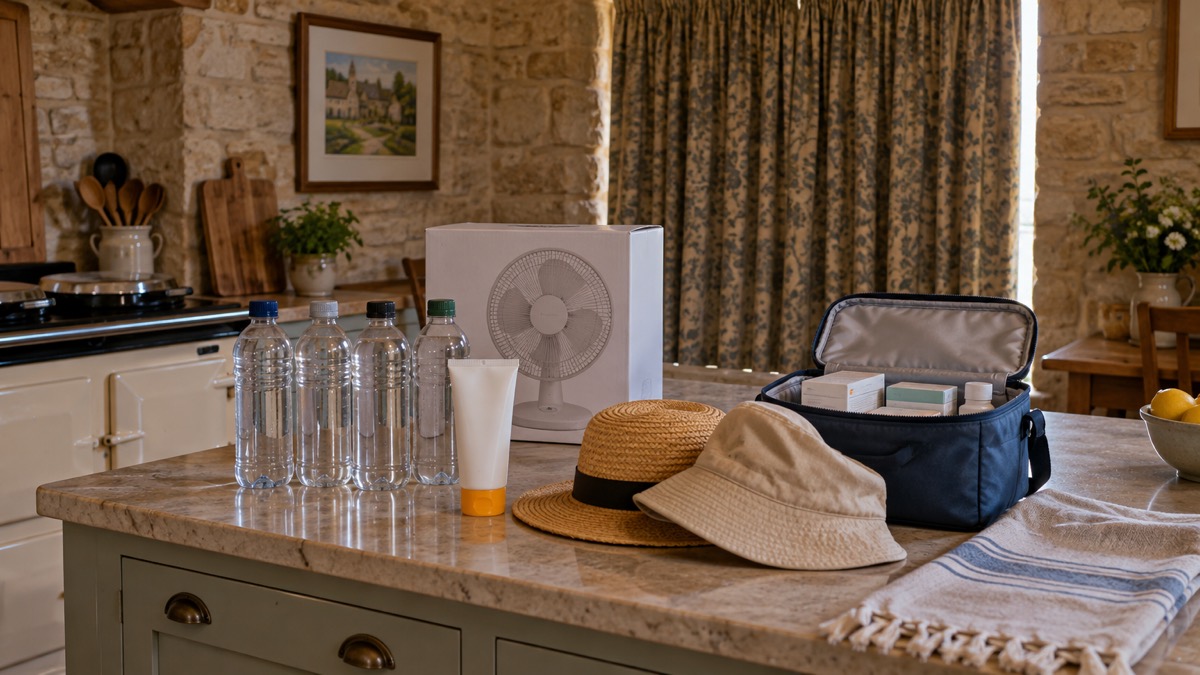
Hot weather is easier to get through if the things you need are already in the house. Before a hot spell arrives, check the forecast, make sure you have enough to drink and enough of your medicines, and move your medicines somewhere cool. The government's heatwave guidance puts the drinking rule simply: drink fluids regularly through the day, especially if you are physically active, and drink enough that your pee is a pale straw colour1.
Most medicines should be kept below 25°C, somewhere cool, dry and out of direct sunlight, and away from windowsills2. Some need the fridge, and the packaging will say so4. Heat can spoil tablets, inhalers, patches, insulin and EpiPens, so they may not work as well5. That is why the storage check belongs on the list before the hot weather, not in the middle of it.
This page is a checklist you can print and work through. It covers what to have ready, how much to drink and what to avoid, how to store medicines safely, where medicines must never be left, and how to get rid of ones that are out of date. It is written for England, with notes where Scotland, Wales and Northern Ireland differ.
The heatwave checklist: what to get ready before hot weather
Work through this list in the days before hot weather is forecast, and again at the start of summer. Each item is something you will want to have done before the heat arrives, not during it.
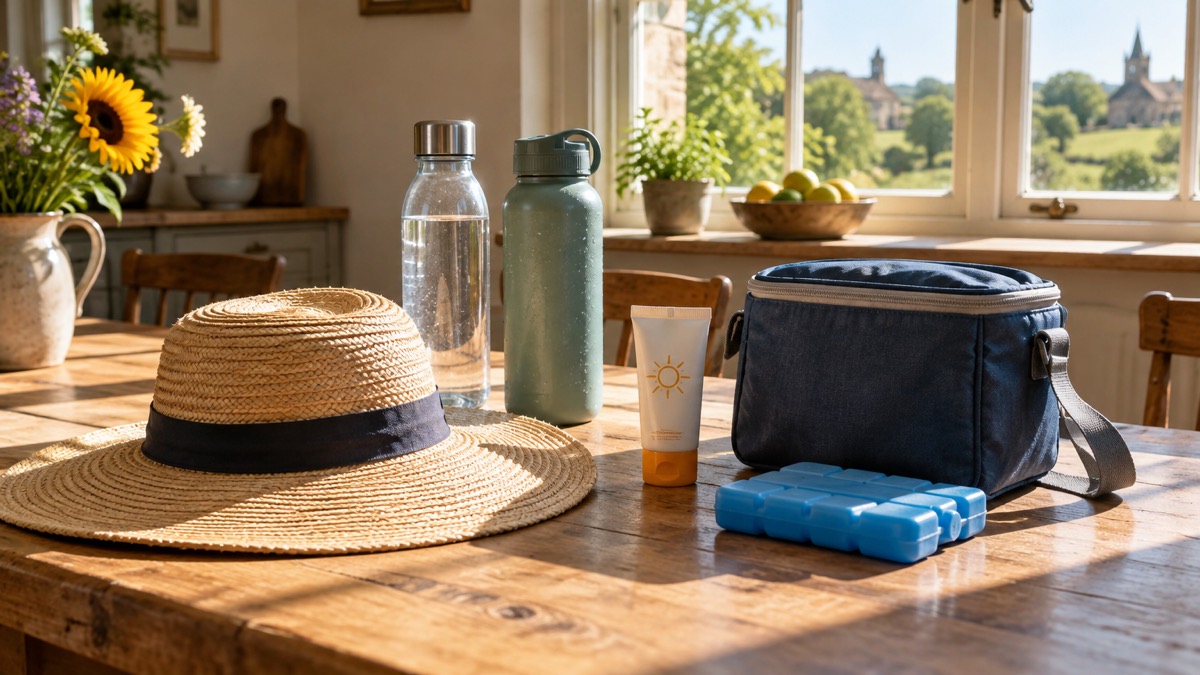
The reason to do this early is that hot weather affects health most when people are not prepared, and it can also deplete water supplies14. A household that has water, medicines and a plan in place before the heat arrives has far less to do when the hot weather is expected2.
Drink enough that your pee is a pale straw colour
The single most useful check on hydration is the colour of your urine. Official guidance is consistent: drink fluids regularly through the day, especially if you are physically active, and drink enough that your pee is a pale straw colour1. NHS Inform suggests using a urine colour chart to check for signs of dehydration, with pale straw as the target15. The same rule appears in guidance for people supporting vulnerable adults, who should drink enough that their urine is a pale straw colour16.
What to drink matters as much as how much. Water, diluted squash or lower fat milk are good choices, and you should limit fruit juice, smoothies and sugary soft drinks17. Water or diluted sugar-free squash are good choices18. The National Heatwave Plan for England advises having plenty of cold drinks and avoiding excess alcohol, caffeine and hot drinks19.
- Good choices: water, diluted squash, lower fat milk17
- Limit: fruit juice, smoothies and sugary soft drinks, which can dehydrate the body further17
- Avoid excess: alcohol, caffeine and hot drinks19
- On journeys: take a refillable bottle and extra water17
- If you drink alcohol: alternate alcoholic drinks with water17
If you are fasting during a heatwave, drink enough to hydrate adequately before you fast and follow guidance on keeping cool; people with underlying health conditions should seek medical advice before fasting1. If you are already showing signs of heat exhaustion, drink cool water, a sports or rehydration drink, or eat cold and water-rich foods like iced lollies21. Our pages on dehydration and how much to drink go further.
Keep most medicines below 25°C
Most medicines should be kept below 25°C, so store them somewhere cool, dry, out of direct sunlight and away from windowsills2. Lancashire County Council's heat advice puts it the same way: keep medicines below 25°C or in the refrigerator, and read the storage instructions on the packaging2. NHS Inform adds that you should continue taking all of your prescribed medicines unless a medical professional advises otherwise, and speak to your pharmacist if you have questions15.
| Where medicines are kept | What the guidance says |
|---|---|
| General rule | Most medicines below 25°C2 |
| Fridge | Only if the packaging says so, or if clearly marked as needing refrigeration4 |
| Room temperature medicines | In regulated rooms, not exposed to temperature swings like conservatories on hot or cold days4 |
| Places to avoid | Near heat or humidity: kitchens, bathrooms, sinks or radiators4 |
| In the car | Never in a parked car or a hot bag; use a cool bag if needed5 |
Some medicines need the fridge. These include insulin and some liquid medicines, and they can be damaged if they get too warm5. Hospital guidance is clear that medicines which need to be stored in the fridge will be clearly marked as needing refrigeration4. Do not move a medicine into the fridge on a hunch: check the packaging first, and ask your pharmacist if it is unclear.
Some medicines also affect how your body manages heat. Read the leaflet that comes with your medication, or speak to your health care practitioner20. Our page on medicines that raise the risk of illness in the heat explains more.
Medicines and children: storing them safely in the heat
Medicines should be stored safely out of reach of children, preferably in a locked cupboard, and kept in their original packaging with the product information and instructions for use6. If a medicine is stored in the fridge, keep it in a childproof medicine box6. Always follow the directions on packets and leaflets, never exceed the stated dose, keep medicines out of the sight and reach of children in a high lockable cupboard in a cool dry place, and check expiry dates regularly22.
Light, temperature and moisture can affect some medicines23. Heat can spoil some medicines, which means they may not work as well, and this can affect tablets, inhalers, patches, insulin and EpiPens5. Some medications need to be stored at a stable temperature and should not get too hot; the information should be on the packaging, or ask your pharmacist24.
If a child is very hot, sponge or spray them with cool water or use cold packs around the neck and armpits; wrapping them in a cool, wet sheet with a fan on them can help cool them safely20. That is about cooling the child, not the medicine, but both belong in the same hot-weather routine. Our baby and child hot weather checklist covers the wider picture.
Where medicines must never be left on a hot day
The most important rule is the simplest: when travelling, do not leave medicines in a parked car or a hot bag, and use a cool bag if needed5. A car in summer heat gets far hotter than the air outside, and medicines left in one can be spoiled before you notice.
At home, keep medicines out of the places that swing in temperature. Room temperature medicines should be in regulated rooms and not exposed to temperature fluctuations, like conservatories on hot or cold days4. Avoid storage near sources of heat or humidity like kitchens, bathrooms, sinks or radiators4. A high cupboard in a cool, dry room is the usual answer.
That warning is about people and animals, but it comes from the same hot-weather guidance that covers medicines, and the same rule applies to anything heat-sensitive: a closed vehicle is not a safe place to leave it.
Getting rid of out-of-date medicines
Do not use a medicine past its use-by date, and do not put it in the bin. Take it to your pharmacy, where it can be disposed of safely22. Northern Ireland guidance says the same: return unused or out-of-date medicines to your pharmacy6. A Public Health Agency guide for Northern Ireland encourages those with quantities of out-of-date or no longer used prescribed medicines to dispose of them safely by returning them to their GP practice or local pharmacy26.
- Check the date on every medicine you keep at home, and check regularly22
- Do not use or bin anything past its use-by date22
- Return it to a pharmacy, or to your GP practice or local pharmacy for larger quantities26
- Ask the pharmacist if you are unsure whether a medicine is still usable23
Clearing out old medicines before summer has a second benefit: it makes room in the cool cupboard for the medicines you actually need, and it means you are not hunting through expired boxes when you are unwell in the heat.
Keeping informed, and where to get help
Listen to the news and check your local weather forecast so you know when hot weather is expected1. Keep up to date with the latest weather forecast and any extreme heat warnings7. The Met Office runs the Heat-Health Watch scheme, which local authorities point people to for what to do in a heatwave25. Our page on heat-health alerts explains the levels and how to sign up.
If you are worried about your health in the heat, NHS 111 can advise on which service you need6. For signs of heat exhaustion, drink cool water or a rehydration drink and cool down21; our page on heat exhaustion and heatstroke sets out the signs and when to call 999. If you are supporting an older neighbour, our guide to checking on older and vulnerable neighbours has a simple routine.
For the wider picture, start with our heatwaves and drought household guide, and for the kit that helps in any emergency, see our emergency kit page.
Sources (26)
- Beat the Heat: staying safe in hot weather, GOV.UK, 2026-07-21
- How to keep cool this summer, Lancashire County Council, 2026-10-29
- Staying well in hot weather, Berkshire Healthcare NHS Foundation Trust, 2026-10-29
- Storing medicines at home, United Lincolnshire Hospitals NHS Trust, 2026
- Weather safety - Oxfordshire Falls, Oxford Health NHS Foundation Trust
- Chemical safety in the home, nidirect, 2026-04-14
- Tips for keeping older people cool, Met Office, 2026-10-29
- Severe weather planning, Derbyshire County Council, 2026-10-29
- Heatwave, Lancashire Prepared, 2026-10-29
- Beat the Heat: keep cool at home checklist, GOV.UK, 2026-07-21
- Stay cool and safe in hot weather, Somerset Council, 2026-07-08
- 10 things you should do now to prepare for summer, Met Office, 2026-10-25
- Hot and sunny weather | Cumberland Council, Cumberland Council
- Severe weather: storms, flooding and drought, nidirect, 2026-07-06
- How to stay safe in hot weather, NHS Inform, 2026-06-11
- Supporting vulnerable people before and during hot weather: social care managers - GOV.UK, UK Health Security Agency (GOV.UK)
- Beat the Heat: staying safe in hot weather (resources), GOV.UK, 2026-07-21
- Dehydration, NHS, 2026-05-01
- Heatwaves | Birmingham Women's and Children's, Birmingham Women's and Children's NHS Foundation Trust
- Keeping cool in heat waves, Oxfordshire County Council, 2026
- Heatwave advice, Guy's and St Thomas' NHS Foundation Trust, 2026-06
- Which NHS service?, NHS Somerset, 2026-01-13
- Self-care advice, NHS Birmingham and Solihull ICB, 2026-09-18
- Advice for vulnerable people, NHS Norfolk and Suffolk ICB, 2026-05-29
- Types of emergencies, Surrey County Council, 2026-10-28
- Your Health Guide Winter 2025, Public Health Agency (Northern Ireland), 2025-12
 Baby and Child Hot Weather
 Flood Warning Checklist
 First Steps After a Flood