Dehydration means your body is losing more fluid than you are taking in, and in hot weather it can happen faster than you notice. The NHS lists the main signs in adults and children as feeling thirsty, a headache, dark yellow and strong-smelling pee, peeing less often than usual, feeling dizzy or lightheaded, feeling tired, a dry mouth, lips and tongue, and sunken eyes1. If it is not treated, dehydration can get worse and become a serious problem2.
The good news is that preventing it is straightforward. Drink cold drinks regularly through the day, even if you do not feel thirsty, and choose water or diluted fruit juice rather than alcohol, caffeine or sugary drinks3. Babies, children and older adults are more at risk than healthy adults1, so a hot spell is the time to keep an eye on the people around you as well as yourself.
This page sets out the signs to look for in adults, children and babies, what to do if someone is already dehydrated, when to call NHS 111 or 999, and how to keep the whole household drinking enough through a heatwave. It sits alongside our wider advice on heatwaves and drought, including how to keep your home cool in hot weather and heat exhaustion and heatstroke.
The signs of dehydration in adults and children
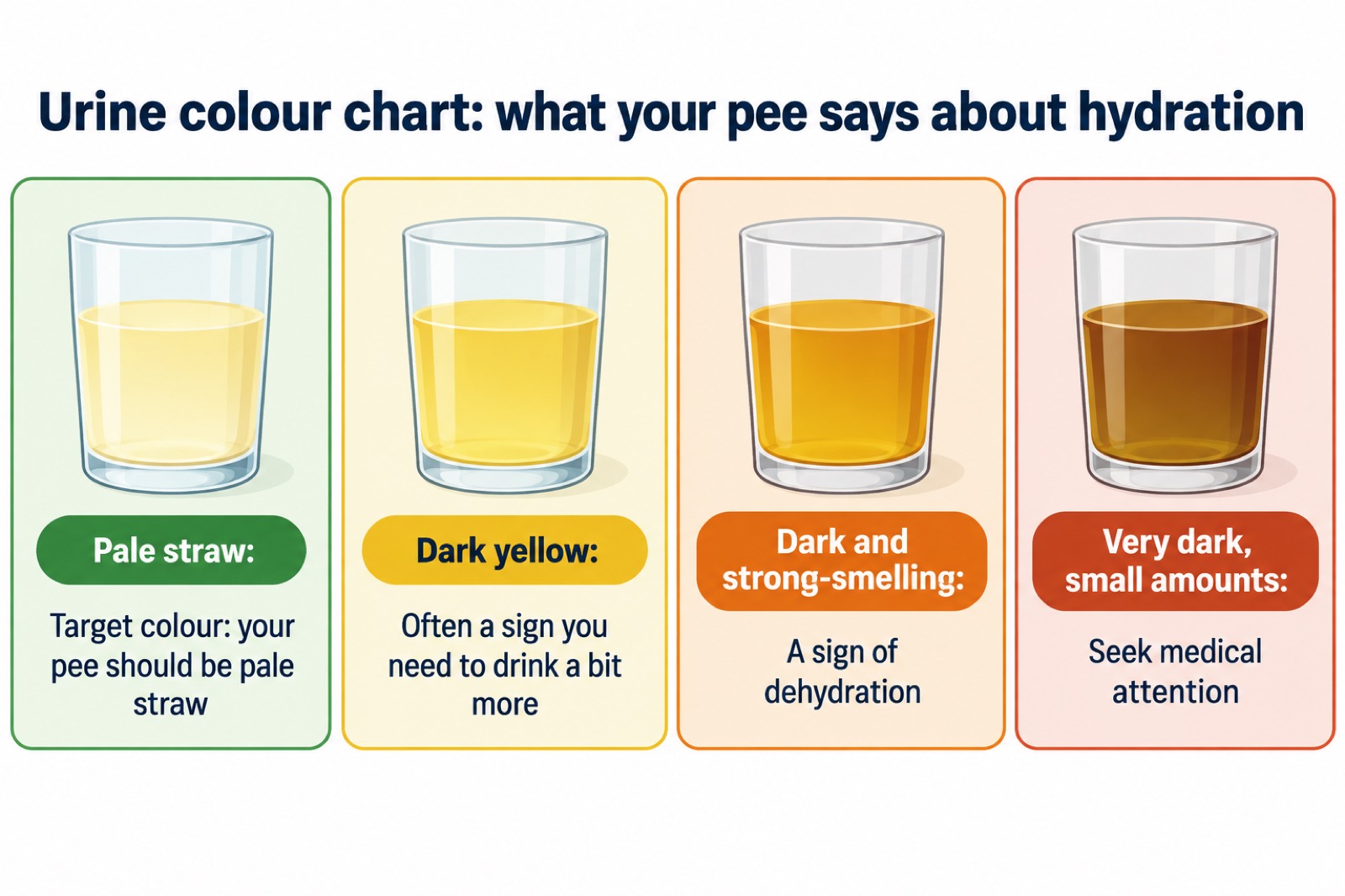
The NHS lists the same core signs of dehydration for adults and children: feeling thirsty, a headache and feeling light-headed, dark yellow and strong-smelling pee, peeing less often than usual, feeling dizzy or lightheaded, feeling tired, a dry mouth, lips and tongue, and sunken eyes1. NHS summer safety advice repeats the same list2. A simple check you can do yourself is the urine colour test: NHS inform in Scotland advises using the urine colour chart to check for signs of dehydration, and your pee should be a pale straw colour6. Dark urine is one of the earliest and most reliable signals that you need to drink more.
Not every sign is obvious, and some are easy to put down to something else. Dehydration can make you feel tired, light-headed or unsteady, which matters if you are going up and down stairs or walking outside on hot paving7. In older people the symptoms are the same as in younger adults and children, but official advice for vulnerable people warns that many of the symptoms are not exclusive and can be easily mistaken for symptoms of pre-existing conditions8. Drowsiness, confusion or disorientation in an older relative during a heatwave should always raise the thought of dehydration, not just of their usual condition. The fuller list of signs in older people includes dryness of the mouth, lips and tongue, sunken eyes, dry inelastic skin, dizziness and low blood pressure8.
Dehydration happens when the body loses more water and salt than it takes in4, and the NHS lists the common causes: having diabetes, being sick or having diarrhoea, being in the sun or a hot environment too long, drinking too much alcohol, sweating a lot after exercising, having a high temperature, taking medicines that make you pee more (diuretics), and relying on other people to get you drinks1. That last cause matters for anyone caring for a person who cannot easily fetch a drink themselves.
Signs of dehydration in babies and young children
Babies and young children are more at risk of dehydration than healthy adults1, and in very hot weather their health can be seriously affected by dehydration, heat exhaustion and heatstroke, and sunburn2. The most common risk from heat for children is dehydration, not having enough water in the body, along with sunburn9.
In babies specifically, the NHS says to look for a sunken soft spot (fontanelle) on top of their head, few or no tears when they cry, fewer wet nappies than usual, and being drowsy or irritable1. NHS summer safety advice gives the same list4. The sunken fontanelle is the sign most specific to babies: the soft spot on the top of the head dips inward when a baby has lost too much fluid, and it is visible and feelable without any equipment.
In older babies and young children, the signs include feeling thirsty, weeing less, feeling lightheaded, and being tired and irritable, and they may also have sunken eyes, a dry mouth, and dry lips and tongue4. For children and young people who use nappies, government guidance for schools and early years settings notes that dark urine or dry nappies may indicate dehydration and the need for more fluids9. A dry nappy at a usual change time, or a nappy that is much lighter than normal, is the child-equivalent of the dark urine check in adults.
If your child seems unwell and you are worried, contact NHS 111 or your GP. If they lose consciousness or have a fit, phone 999 immediately10. We cover keeping little ones safe in the heat in more detail on our page on keeping babies and young children safe in hot weather, and the signs of dehydration in children on is my child drinking enough?.
What to do if someone is dehydrated
The NHS advice is simple: drink fluids if you have symptoms of dehydration. If you feel sick, start with small sips and then gradually drink more. Avoid caffeinated drinks and alcohol, as both will dehydrate you1. Water or diluted sugar-free squash are good choices, and you should drink enough during the day so that your pee is a pale colour. Drink more when there is a higher risk of dehydrating, such as being sick, sweating due to hot weather or exercise, or having diarrhoea1.
To reduce the risk in the first place, drink fluids regularly rather than waiting until you feel thirsty. Heatwave guidance from the NHS is blunt on this point: drink regularly even if you do not feel thirsty, and water or fruit juice are best11. This is especially important for older people, because the kidneys become less active over time and become less efficient at producing the hormone that tells us we are becoming dehydrated and thirsty8. An older person can be significantly dehydrated before they feel any urge to drink at all, which is why carers and neighbours should offer drinks rather than wait to be asked.
Some practical points that follow from official advice:
- Keep a drink within reach. If someone is on the floor for a long time after a fall, they could become dehydrated, and NHS inform advises that if you have a glass or bottle of water within reach, take small sips from it12.
- Assistive technology can help. Warwickshire County Council lists a hydration monitor among the aids that remind people to drink13, useful for someone who lives alone or has memory problems.
- Oral re-hydration salts, available from pharmacies, help restore the body's natural balance of minerals and fluid after dehydration caused by fever, diarrhoea or vomiting14.
- Check on elderly neighbours daily during hot weather, as the elderly and very young are most at risk for dehydration15.
If someone is being sick or has diarrhoea, the same rules apply with more urgency. Illnesses such as cryptosporidiosis, with profuse watery diarrhoea, stomach pains, nausea or vomiting, lead to dehydration and the loss of important sugars and minerals from the body, so it is important to drink plenty of fluids16.
When to call NHS 111, ask for an urgent GP appointment or call 999
Most dehydration can be corrected by drinking, but some signs need urgent medical help. The NHS says certain signs can indicate serious dehydration that needs urgent treatment, and advises calling 111 or getting help from 111 online. Call 111 if you need advice for a child under 5 years old1. NHS 111 is the route for urgent health advice, help with symptoms, or access to out-of-hours GP services, by phone or online17.
Call 999 or go to A&E if someone shows signs of dehydration together with any of the following: blue, grey, pale or blotchy skin, lips or tongue (on brown or black skin this may be easier to see on the palms of the hands or soles of the feet), skin that feels cold, difficulty breathing or taking lots of quick breaths, confusion, or being sleepier than normal or difficult to wake. The NHS warns these could be signs of shock, which is a serious complication of dehydration1.
| Where to get help | When to use it |
|---|---|
| Pharmacist | Advice and support if you are worried about your health18 |
| GP or urgent GP appointment | You or your child feel very unwell, or symptoms do not settle19 |
| NHS 111 (phone or online) | Urgent health advice, help with symptoms, or access to out-of-hours GP services1 |
| 999 | In an emergency, or if someone's life is in danger1 |
The same escalation applies to heat illness, which untreated dehydration can lead to. If you are concerned about heat exhaustion symptoms, or they are worsening, seek medical advice by contacting NHS 111. In an emergency, or if you think someone has heatstroke, dial 99920. The same advice appears in the government's Beat the Heat guidance5 and in NHS guidance on heatstroke and heat illness in Scotland21. We set out the full decision on our page when to call 999 or NHS 111 for heat illness.
For sickness bugs, NHS inform on norovirus says to phone 111 if you are worried about a baby under 12 months, if a child stops feeding, if there are signs of dehydration, if fluid cannot be kept down, with bloody diarrhoea, or if diarrhoea lasts more than 7 days or vomiting more than 2 days22.
Who is most at risk in hot weather
Dehydration does not hit everyone equally. NHS inform lists the people most at risk in hot temperatures: people aged 65 or over, children aged 5 and under, babies, people with underlying health conditions, pregnant people, people with a serious mental health condition, people already ill and dehydrated, people taking alcohol or drugs, active people spending a lot of time outside, people working in a manual job outdoors, homeless people, people who live alone and are unable to care for themselves, people with mobility problems, and people on certain medications6. Government drought and heat guidance adds people with serious chronic conditions, people with serious mental health problems or on certain medications, and people who are physically active outdoors23.
Guy's and St Thomas' heatwave advice names the underlying conditions that matter most: heart, breathing or mobility problems, dementia, diabetes and kidney disease3. Public Health Wales adds that those who may find it hard to keep cool include babies and young children, the bed bound and those with drug and alcohol addictions24. Pregnant women are also at higher risk of becoming seriously unwell in hot weather25.
Two groups deserve particular attention. The first is older people: the Met Office advises looking out for those who may struggle to keep themselves cool and hydrated, noting that older people, those with underlying conditions and those who live alone are particularly at risk26. The second is people who rely on others for drinks, which the NHS lists among the causes of dehydration1. A person with mobility problems, or someone living with dementia, may simply not be able to act on thirst even when they feel it.
If you have elderly neighbours, check on them daily during hot weather15. Our page on how to check on older and vulnerable neighbours in the heat gives a practical routine, and who is most at risk in hot weather covers the full list. If you take regular medicines, see our page on medicines that raise the risk of illness in the heat.
Drink plenty of fluids through a heatwave
The core habit is regular drinking. Guy's and St Thomas' heatwave advice says to prevent dehydration by drinking cold drinks regularly, such as water and diluted fruit juice, while avoiding caffeine (tea, coffee and cola), drinks high in sugar, and excess alcohol3. The government's Beat the Heat guidance adds that water and diluted squash or lower fat milks are good choices, while fruit juice, smoothies and soft drinks can be high in sugar5. NHS heatwave guidance from West Suffolk puts it plainly: drink regularly even if you do not feel thirsty, and water or fruit juice are best11.
What you eat helps too. Official advice is to eat as you normally would, but to try to eat more cold food, particularly salads and fruit, which contain water11. Central and East Northamptonshire ICB suggests eating cold foods, particularly salads and fruit with a high-water content, alongside having plenty of cold drinks27.
A simple daily routine for a hot spell:
- Start drinking early in the day, before you feel thirsty11.
- Keep water or diluted sugar-free squash within reach wherever you are sitting1.
- Check your pee colour at least once: it should be a pale straw colour6.
- Eat meals as normal, favouring salads and fruit with a high-water content11.
- Drink more if you are sweating heavily, exercising, or unwell1.
- Offer drinks to anyone in the household who cannot easily fetch their own1.
For anyone with diabetes, the advice is firmer still: drink plenty of water and sugar-free soft drinks, because becoming dehydrated increases the risk of dangerously high blood sugar levels in both type 1 and type 2 diabetics8. How much to drink depends on your size, activity and the temperature, which we cover separately on how much water to drink in hot weather.
Alcohol, tea and coffee: what to cut back on
Alcohol is the clearest thing to limit. Somerset Council's heat-health alert advice says to limit tea, coffee and alcohol, because alcohol speeds up dehydration10. Flintshire County Council's extreme weather advice says to limit intake of alcoholic beverages because alcohol causes dehydration28. The Scottish Government's Ready Scotland campaign says to limit the amount of alcohol you drink, as it can cause dehydration29. When you are already dehydrated, the NHS advises avoiding caffeinated drinks and alcohol because both will dehydrate you further1.
Caffeine in tea, coffee and cola is the second thing to watch. Guy's and St Thomas' advise avoiding caffeine, drinks high in sugar and excess alcohol to prevent dehydration3, and Central and East Northamptonshire ICB advises avoiding excess alcohol, caffeine and hot drinks, in favour of plenty of cold drinks27. Sugary, alcoholic and caffeinated drinks can all make you dehydrated, which is why official advice singles out water as the drink to rely on during hot weather, especially for the elderly or people with health conditions such as diabetes27.
None of this means a heatwave requires total abstinence from your usual cup of tea. The consistent official wording is to limit and avoid excess. The practical approach is to make water or diluted squash your default drink through the hottest part of the day, keep tea and coffee to moderate amounts, and treat alcohol as something to cut back sharply on hot days, particularly if you are already showing signs of dehydration such as dark urine or dizziness.
Cut down activity in the heat
Physical activity drives fluid loss through sweat, so hot weather is the time to change when and how hard you do things. NHS inform on heatstroke and heat illness advises planning activities like dog walking for cooler times of the day, such as morning or evening21. If you work outdoors or exercise through the middle of the day, you are on the list of people most at risk in hot temperatures6.
If you have mild heat-related symptoms, cramp in the arms, legs or stomach, mild confusion, weakness or problems sleeping, the official advice is to rest for several hours, keep cool and drink water or fruit juice. Seek medical advice if they get worse or do not go away11. For painful muscular spasms, particularly in the legs, arms or abdomen, which often follow sustained exercise during very hot weather, rest immediately in a cool place and drink plenty30. Lancashire County Council's keeping cool advice adds drinking some water or fruit juice to rehydrate30.
The reason rest matters is that the signs of heat stress worsen with physical activity, and if left untreated can lead to heat exhaustion or heatstroke9. Pushing through symptoms on a hot afternoon is how a manageable problem becomes an emergency. Move tasks to the morning or evening, sit out the hottest hours somewhere cool, and treat cramps or confusion as an instruction to stop, not a nuisance to ignore. Our page on heat exhaustion and heatstroke covers what to do if symptoms progress.
Untreated dehydration can lead to heat exhaustion and heatstroke
Dehydration is not just uncomfortable; it is the first step on a path that ends in emergencies. Lancaster City Council's preparedness guidance warns that dehydration can lead to heat exhaustion or heatstroke, both of which require urgent treatment31. The Met Office lists the main health risks of hot weather and heatwaves as not having enough water (dehydration), overheating, and heat exhaustion and heatstroke26. Ready Scotland gives the same warning: hot weather can lead to dehydration and heat related illnesses, such as heat stroke29.
The symptoms of heat exhaustion include headaches, dizziness, nausea and vomiting, muscle weakness or cramps, pale skin, and a high temperature. The advice is to move somewhere cool and drink plenty of water or fruit juice, and take a lukewarm shower or sponge down with cold water31. In children, the symptoms vary but include one or more of tiredness, dizziness, headache, nausea, vomiting, excessive sweating and pale, clammy skin9.
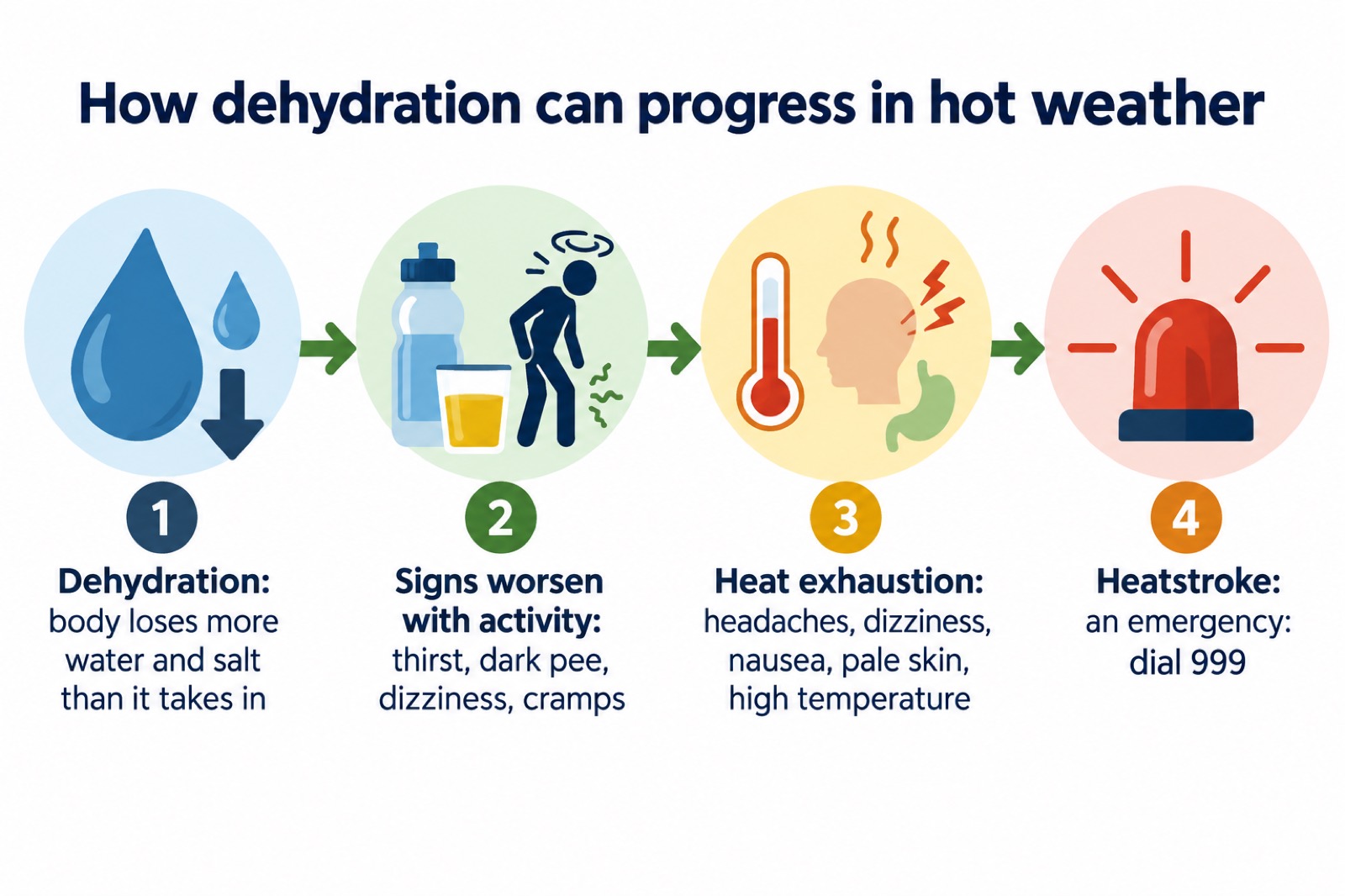
The progression is not inevitable. Every stage has a remedy: drinking regularly prevents the dehydration, rest and cooling reverse the exhaustion, and recognising heatstroke early gets help fast. If you are concerned about symptoms, or they are worsening, contact NHS 111. In an emergency, or if you think someone has heatstroke, dial 99920. The Greater London Authority repeats this advice for Londoners during hot weather20.
Sources (31)
- Dehydration, NHS, 2026-05-01
- Summer safety, Cheshire and Wirral Partnership NHS Foundation Trust, 2026-10-29
- Heatwave advice, Guy's and St Thomas' NHS Foundation Trust, 2026-06
- Safety in summer, NHS (Healthier Together), 2026-10-29
- Beat the heat: staying safe in hot weather, UK Government, 2026-07-21
- How to stay safe in hot weather, NHS inform, 2026-06-11
- Weather safety, Oxford Health NHS Foundation Trust, 2026-09-18
- Advice for vulnerable people, Norfolk and Suffolk NHS Integrated Care Board, 2026-05-29
- Looking after children and those in early years settings before and during hot weather, UK Government, 2024-12-19
- Stay cool and safe in hot weather, Somerset Council, 2026-07-08
- Heatwave guidance, West Suffolk NHS Foundation Trust, 2020-04-22
- What to do if you fall, NHS inform, 2026-04-30
- Assistive technology, Warwickshire County Council, 2026-10-29
- Self care advice, Birmingham and Solihull NHS Integrated Care Board, 2026-10-28
- Are You Ready booklet, Culham Parish Council, 2025-09
- Cryptosporidium: public advice, UK Government, 2023-11-01
- Wellbeing and safety, Surrey County Council, 2026-10-28
- Keeping warm and well: staying safe in cold weather, UK Government, 2026-04-28
- Flu, NHS, 2026-02-03
- Coping with hot weather in London, Greater London Authority, 2026-10-25
- Heatstroke and heat illness, NHS inform, 2026-07-15
- Norovirus, NHS inform, 2026-10-13
- Droughts, UK Government (Prepare campaign), 2026-10-19
- Weather and health, Public Health Wales, 2026-07-16
- Hot and sunny weather, Cumberland Council, 2026
- Tips for keeping older people cool, Met Office, 2026-10-29
- Hot weather advice, Central and East Northamptonshire NHS Integrated Care Board, 2026-08-04
- Extreme weather, Flintshire County Council, 2026-10-29
- Hot weather, Scottish Government (Ready Scotland), 2026-03-24
- How to keep cool this summer, Lancashire County Council, 2026-10-29
- Be Prepared, Lancaster City Council, 2026-10-26
 Baby and Child Hot Weather
 Hot Weather Preparation
 Flood Warning Checklist
 Air Pollution and Hay Fever
 Babies and Children in Heat
 Blue-Green Algae Risks
 Evaporative Coolers and Fans
 Electric Fans Guide
 Heat Exhaustion and Heatstroke
 UK Heatwave Definition
 Who Is at Risk in Hot Weather
 Portable Air Conditioners Guide
 Why UK Summers Are Hotter
 Sun Safety and Sunscreen
 Swimming Outdoors Safely