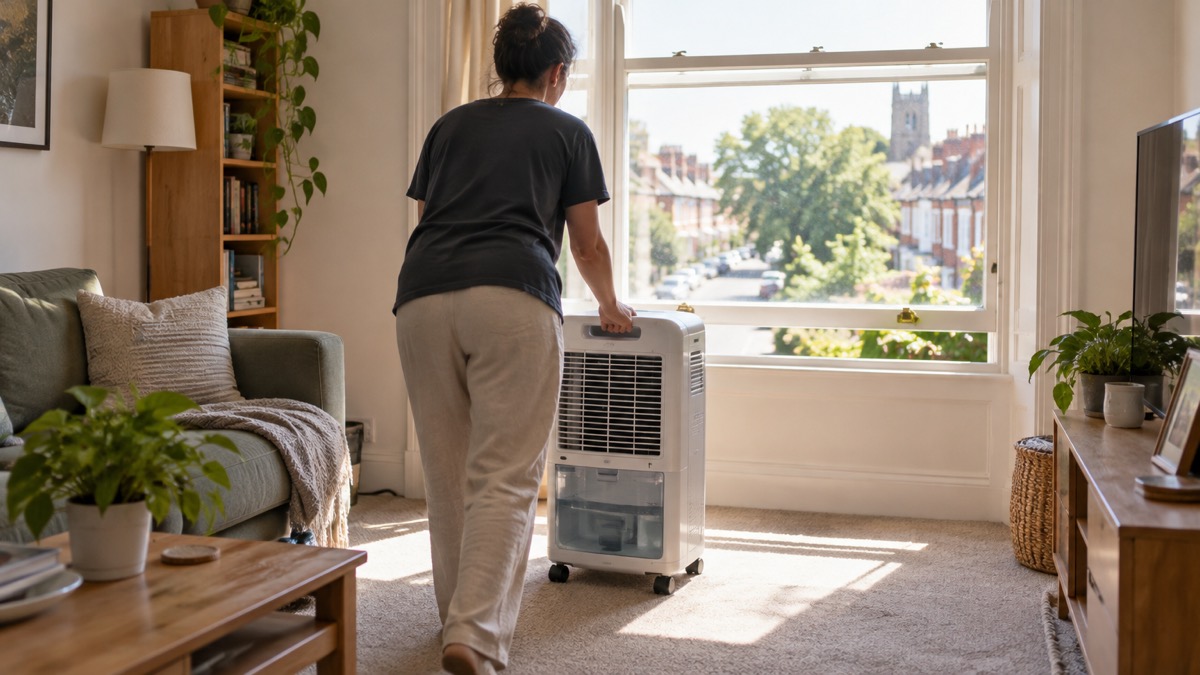
Evaporative coolers and misting fans sit in the shops each summer promising cool air for less money than an air conditioner, and in the right conditions they deliver. In the wrong conditions, which in the UK means humid heat, they do very little cooling and add moisture to your rooms instead. Knowing which is which is the whole of this page.
The principle is simple: turning water into vapour takes heat out of the air. The NHS heatwave advice for England uses the same principle at its smallest, telling households to "keep indoor plants and bowls of water in the house as evaporation helps cool the air"1. An evaporative cooler is that idea with a fan and a water tank behind it. A misting fan sprays fine droplets into the air to do the same thing faster.
The catch is that air can only hold so much water. When the air is already humid, evaporation slows to almost nothing, and the machine mostly just moves air around, like a plain fan. Official UK heatwave guidance is consistent about what to do with fans: use them while the air temperature is below 35°C, and above that they may not prevent heat-related illness and can worsen dehydration1. That rule applies to evaporative coolers and misting fans too, because both are fans at heart.
How evaporative cooling works, and why it needs dry air
Every drop of water that evaporates takes heat with it. That is why sweat cools your skin, why a bowl of water in a room takes the edge off the heat, and why the NHS heatwave plan recommends exactly that1. An evaporative cooler, sometimes sold as an "air cooler", passes air over a damp pad or through a fine water spray. Water evaporates into that air, and the air leaving the machine is cooler than the air going in.
Two things follow from this, and both shape how you use one.
First, the water has to go somewhere. It becomes vapour in your room's air, which raises the humidity. That is why an evaporative cooler should never run in a sealed room: it needs a steady flow of fresh, drier air coming in so the moist air can leave. Official ventilation advice for homes is to open windows when it is safe and possible, and to use extractor fans where fitted5. With an evaporative cooler, open a window on the far side of the room as well as near the machine, so air passes through rather than pooling.
Second, the cooling depends on how much water the air can still absorb. Dry air absorbs a lot, so the cooling is real. Air that is already close to saturated absorbs almost none, so the machine stops cooling and becomes a fan with a damp pad in front of it. UK heatwaves vary: some bring dry continental air, where an evaporative cooler earns its keep, and some bring humid air, where it does not. Watch how the room feels. If the air turns muggy and the temperature barely moves, the humidity is the reason.
High humidity: why an evaporative cooler does little
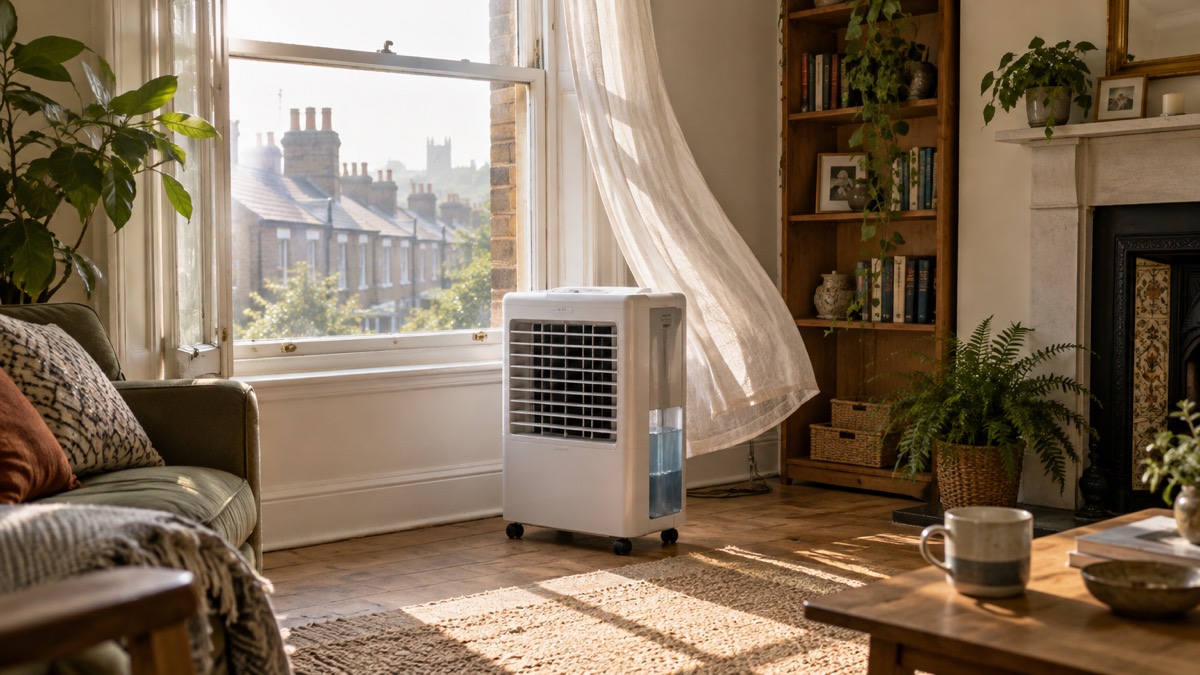
Humidity is the amount of water vapour already in the air, and it is the single fact that decides whether an evaporative cooler is worth running. The machine cools by adding vapour to the air. When the air is dry there is room for that vapour, and the heat used to create it leaves the room feeling cooler. When the air is humid there is little room left, evaporation slows, and the cooling effect shrinks towards nothing.
You can feel this without a meter. Humid heat feels muggy and heavy, sweat sits on your skin instead of drying, and washing takes longer to dry indoors. Dry heat feels lighter, sweat evaporates quickly, and a damp towel dries fast. On a dry day an evaporative cooler or a misting fan will noticeably cool the air around you. On a muggy day the same machine will make the room feel damper for little or no temperature drop.
The machines that do the opposite job make the contrast clear. Dehumidifiers exist to pull water out of the air: refrigerant models draw air over cold coils so the moisture condenses into a tank, and desiccant models use an absorbent material that is then heated to release the water it has caught6. If your problem in hot weather is damp, muggy air, a dehumidifier addresses it directly and an evaporative cooler makes it worse. Households sometimes run both and cancel each other out; choose based on whether the air is dry or damp.
A practical test costs nothing. Dampen the back of your hand and hold it in the room's air. If the water evaporates quickly, the air is dry enough for evaporative cooling to work. If it sits there, the air is humid, and a plain fan, shade and closed curtains will do more for you that day.
Misting fans: cooling in hot, dry conditions
A misting fan takes evaporative cooling to its most direct form. Instead of waiting for air to pass over a damp pad, it sprays a fine mist of water droplets into the air, where each droplet evaporates and cools the air immediately around you. In hot, dry conditions this can feel like standing near cool, moving air, and it works by the same principle: water turning into vapour draws heat out of the air1.
Misting fans come as handheld or small desk units with a built-in water reservoir, and as larger patio units that connect to a hose. The small ones give a personal cooling effect: they help the person sitting in the mist, not the whole room. The larger ones can cool a seating area outdoors on a dry day.
The same humidity rule applies, more sharply. A misting fan in dry air cools well. A misting fan in humid air mostly deposits water on you and the furniture, because the droplets cannot fully evaporate. Outdoors this matters less, since the breeze carries moisture away. Indoors it matters a lot, which leads to the next section.
Where a misting fan must be used: outdoors or in well-ventilated rooms

A misting fan puts water into the air deliberately. Outdoors, that is fine: the moisture disperses. Indoors, in a closed room, the humidity climbs with every minute the fan runs, and the cooling effect fades as it climbs. The room ends up warmer-feeling and damper than before.
So the rule is: outdoors on a balcony, patio or in the garden, or indoors only in a room with a real through-flow of air. Official guidance on ventilation is to open windows when it is safe and possible, and to open doors as well so air can move through the home7. Derbyshire's summer cooling advice puts ventilation at the centre of keeping cool indoors8. If you can feel a draught moving through the room, a misting fan can work there. If the air is still, take it outside.
Two further cautions. Water and electricity do not mix, so keep the fan's power connection dry and follow the maker's instructions for outdoor use. And a fine mist settling on floors makes them slippery, so place the fan where people are not walking through the spray.
Evaporative cooler, misting fan, fan or air conditioner: how each behaves
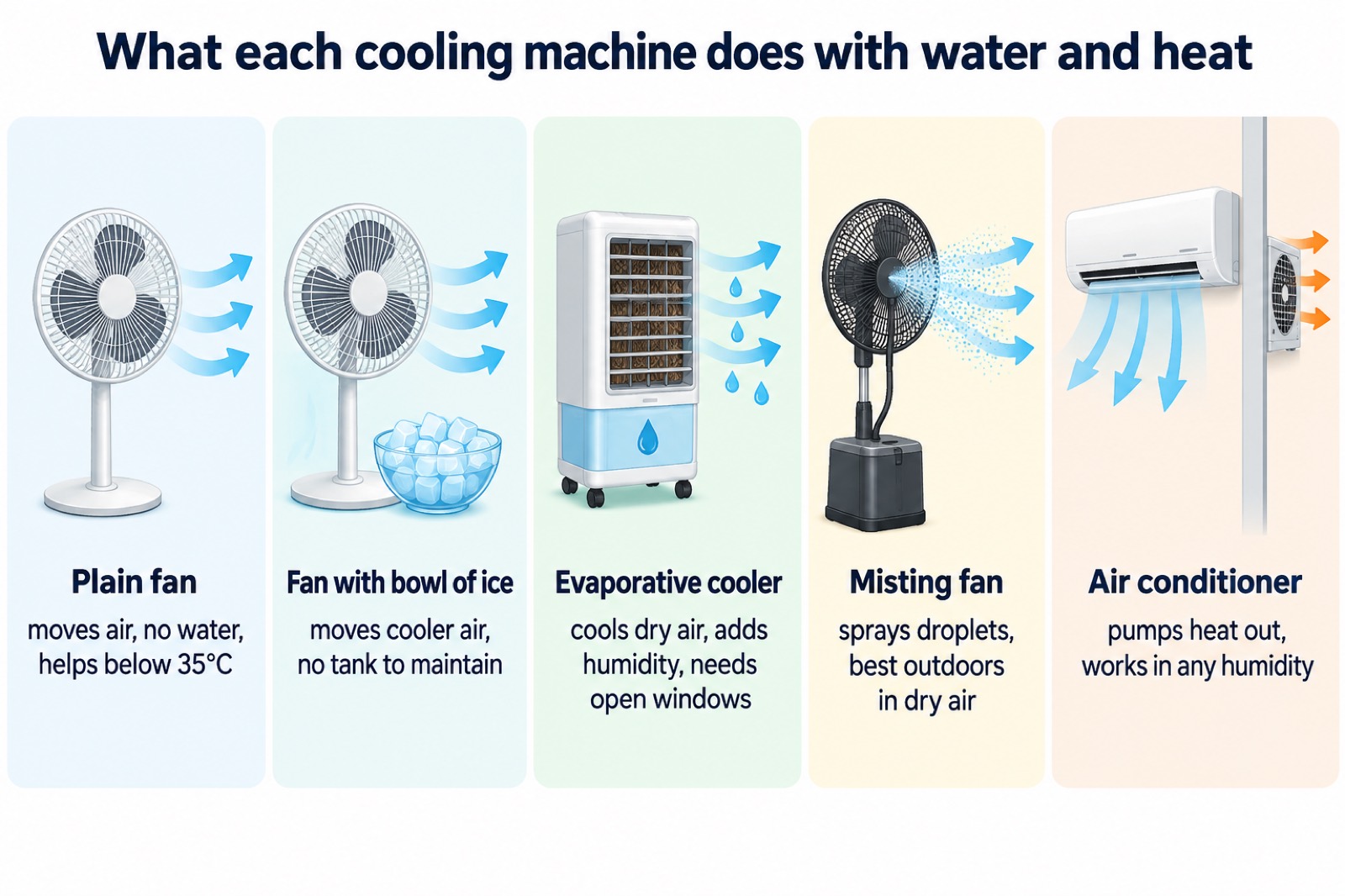
These four machines are often confused in shops and searches, and they behave very differently in UK conditions. The table sets them side by side.
| Machine | How it cools | Works in humid air? | Adds moisture to the room? | Where it suits |
|---|---|---|---|---|
| Plain electric fan | Moves air over your skin, helping sweat evaporate | Yes, but less effectively above 35°C1 | No | Most UK rooms, most days2 |
| Evaporative (air) cooler | Water evaporating into dry air | Poorly, cooling shrinks as humidity rises | Yes, needs air flowing through | Dry heat, rooms with open windows |
| Misting fan | Fine water spray evaporating in the air | Poorly, droplets settle instead of evaporating | Yes, quickly | Outdoors, or well-ventilated rooms |
| Air conditioner | Pumps heat out of the room | Yes, whatever the humidity | No, it dries the air | Any room, the reliable option |
Official hot weather advice treats fans and air conditioning units together as the powered options: "Use fans and air conditioning units if they are available for you"9. Evaporative coolers and misting fans are not in that official list, because their performance depends on conditions the advice cannot promise.
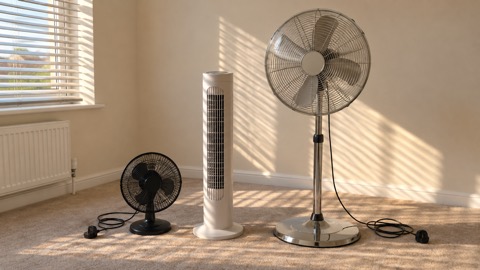
The fan line deserves its own care. Every official source agrees on the 35°C boundary: fans help below it, and above it they may not prevent heat-related illness and can worsen dehydration, so do not aim one directly at the body and keep drinking2. Oxfordshire's guidance is blunt about the upper end: above 35 degrees "you will just be moving hot air around"13. Some councils go further and note that electric fans do not cool the air at all, they just move it14. For more on choosing one, see our page on electric fans and the comparison of a fan or air conditioner.
A cheap middle path appears in official advice too: "Use portable electric fans with a bowl of ice"15. The ice cools the air the fan moves, without adding a tank of standing water to maintain.
Standing water and tank hygiene: keeping the machine safe
Every evaporative cooler and misting fan holds a tank or reservoir of water, and warm standing water needs attention. Water left to sit in a warm room can go stale, develop odours, and grow biofilm inside the tank and pads. The machine then blows that air at you, which is the opposite of what you bought it for.
The habits that prevent this are simple:
- Empty the tank whenever the machine is not in use, rather than leaving water in it between heatwaves.
- Rinse the tank and pad with clean water before storing, and let them dry.
- Use clean water from the tap each time you fill it.
- Check the maker's instructions for the cleaning schedule and method for your model.
Official guidance on water storage tanks and cisterns gives the same starting point for any tank in the home: "Check the instructions supplied with the tank as this should contain details of how to maintain and clean the tank"4. The Drinking Water Inspectorate also says that if you are unsure how to clean a storage tank or cistern, "you can contact your local water company for advice or use a WaterSafe registered plumber who can carry out this task for you"4. That advice is written for household storage tanks, but the principle, follow the maker's instructions and get help if unsure, applies to the tank in a cooler.
One related point from the product safety record: dehumidifiers, which hold a water tank of their own, have been subject to a UK product recall notice16. Whatever cooling or drying appliance you buy, register it with the maker so you hear about any safety action.
When neither will help: humid heat, and what to do instead
On a hot and humid day, an evaporative cooler and a misting fan will both disappoint you, and a plain fan is working near its own limit too. This is the day to fall back on the official heatwave playbook, which does not depend on any appliance.
Shade and curtains come first. Berkshire healthcare advice is to cool the room with a fan or a through-draught, use curtains, blinds or shutters on windows, and open windows in the morning and evening when the air outside is cooler17. Our page on stopping the sun heating your rooms covers this in detail.
Then change rooms, or change location. Official advice is to move to a cooler place, ideally below 26°C, and social care guidance for vulnerable people asks services to maintain a cool room or area below 26°C for exactly this reason3. It may be cooler outside in the shade, or in a public building such as a place of worship, a library or a supermarket18. Many areas now map these cool spaces during heatwaves.
Finally, know the warning signs. If someone feels dizzy, confused or very unwell in the heat, the official first aid is to move them to a cooler place, remove unnecessary clothing, give cool water or a rehydration drink, and apply cool water by spray or sponge, with cold packs wrapped in a cloth under the armpits or on the neck2. For children, cool them as rapidly as possible by sponging or spraying with cool water, or wrapping them in a cool, wet sheet, assisting the cooling with a fan19. See our pages on heat exhaustion and heatstroke and when to call 999.
Sources (19)
- Heatwaves, Birmingham Women's and Children's NHS, NHS, 2026
- Beat the Heat: staying safe in hot weather, GOV.UK, 2026
- Supporting vulnerable people before and during hot weather, GOV.UK, 2024
- Water storage tanks and cisterns, Drinking Water Inspectorate, Drinking Water Inspectorate, 2026
- Indoor air pollution, NHS inform Scotland, NHS inform, 2026
- How to dry your home out after a leak or flood, Which?, Which?, 2025
- Flooding and health - Public Health Wales, Public Health Wales
- Keeping cool in summer, Derbyshire County Council, Derbyshire County Council, 2026
- Heatwave advice, Guy's and St Thomas' NHS, NHS, 2026
- Hot weather advice, St Helens and Knowsley NHS, NHS, 2026
- Stay cool and safe in hot weather, Somerset Council, Somerset Council, 2026
- Falls guidance at home, Oxford Health NHS, NHS, 2026
- Keeping cool in heat waves, Oxfordshire County Council, Oxfordshire County Council, 2026
- Extreme weather, Flintshire County Council, Flintshire County Council, 2026
- Beat the Heat, Oxfordshire public health, Oxfordshire County Council, 2026
- Product recall: Ebac Limited air dehumidifiers, GOV.UK, 2026
- Staying well in hot weather, Berkshire Healthcare NHS, NHS, 2026
- Hot weather, Prepare Campaign, GOV.UK, 2026
- Looking after children in hot weather, GOV.UK, GOV.UK, 2024
 Baby and Child Hot Weather
 Hot Weather Preparation
 Flood Warning Checklist
 Air Pollution and Hay Fever
 Babies and Children in Heat
 Blue-Green Algae Risks
 Dehydration Signs and Prevention
 Electric Fans Guide
 Heat Exhaustion and Heatstroke
 UK Heatwave Definition
 Who Is at Risk in Hot Weather
 Portable Air Conditioners Guide
 Why UK Summers Are Hotter
 Sun Safety and Sunscreen
 Swimming Outdoors Safely