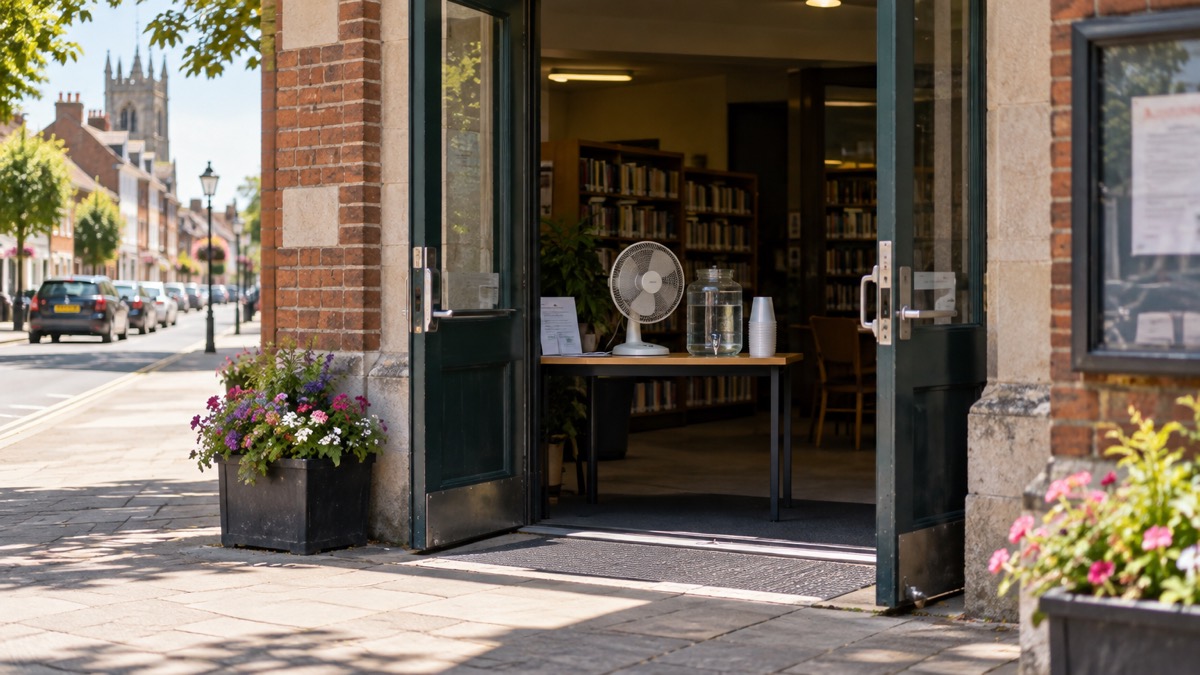
When the heat builds and your home will not cool down, the fastest relief is often not better curtains or a stronger fan but a change of address for a few hours. Cool spaces are free indoor places, usually libraries, community venues and faith buildings, where anyone can walk in, sit down, rest and get water without paying or explaining themselves. In London the Mayor's Cool Spaces map lists them across the capital and is live from 1 June to 30 September each year1. Outside London the name varies, but the idea is the same, and many councils promote libraries and other public buildings as places to rest during hot weather2.
This page explains what a cool space is, how to find one near you, what you get when you arrive, and where the limits are. It also covers what to do if your area has few or no listed spaces, and how a venue you know could join the scheme. If you want the wider picture of coping with hot weather, start with our guide to heatwaves and drought.
What a cool space actually is
The Mayor of London's office defines cool spaces plainly: "Cool spaces are indoor spaces for Londoners to shelter from the sun, cool down, rest and take respite on hot days"1. Manchester City Council describes the same offer from the other direction: the spaces are not specialist cooling centres, but places that offer "shelter from the sun, free water, a place to cool down and resting areas"3. In practice that means an ordinary public building, kept at a comfortable temperature, with a chair you can sit in for as long as you need.
The point of the scheme is simple. On a hot day, a home that faces the sun can become hotter than the street outside, and the UK Health Security Agency's keep cool at home checklist advises that "it may be cooler outside in the shade or in a public building (such as places of worship, local libraries, or supermarkets)" and that a visit is a legitimate way of cooling down if you can travel there safely without putting yourself at more risk from the heat4. A cool space is that public building, identified in advance and listed on a map so you do not have to guess which library or church hall will let you sit down.
Two things follow from the definition. First, a cool space is a resting place, not a treatment centre: the Mayor's office is clear the scheme is "not designed to support vulnerable individuals on hot days, or a medical care substitute if someone is unwell from overheating"1. Second, the scheme is deliberately ordinary. You do not need a referral, a membership card or a reason. That is what separates a cool space from a one-off emergency measure: it is there on every hot day, not only during a declared emergency.
Finding a cool space near you on the map
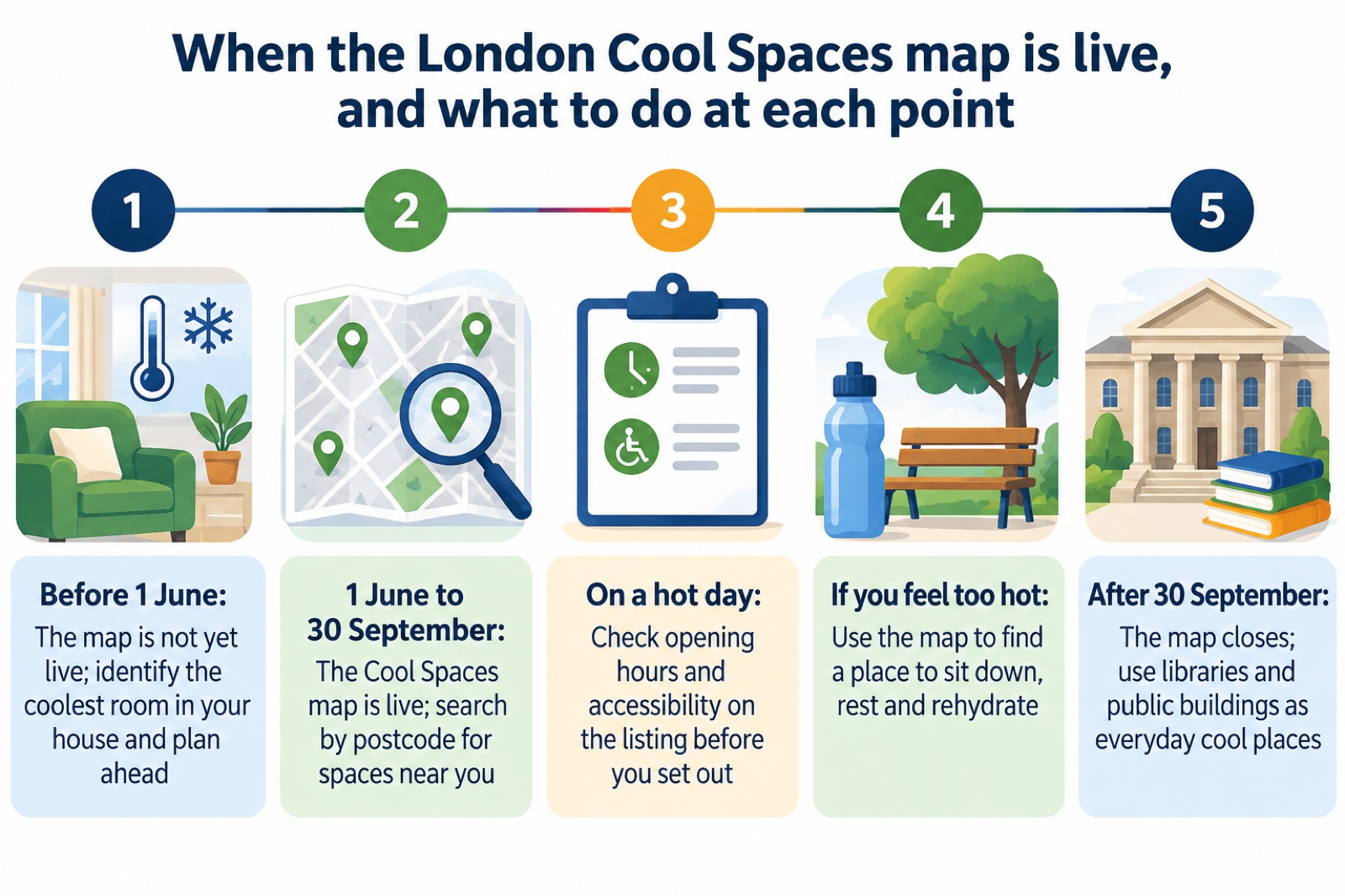
If you are in London, start with the Mayor's Cool Spaces map. The Greater London Authority's hot weather advice is direct about when to use it: "If you are out and about in the city and start to feel too hot, the Mayor's Cool Spaces map will help you find a welcoming place to sit down, rest and rehydrate"5. The same advice applies if you are at home and cannot cool the place down. The GLA also recommends the map as part of the response to heat exhaustion: move to a cooler place such as a room with air conditioning or somewhere in the shade, and you can use the Cool Spaces map to find somewhere close by6. If someone does develop symptoms, our page on heat exhaustion and heatstroke sets out the signs and what to do.
Islington Council's cool spaces map shows how these maps work in practice, and it is a good model for what to look for in any scheme. You can:
- Search by postcode or location to find nearby cool spaces2
- Filter the results by type of space2
- See at a glance whether a space is wheelchair accessible2
- Click on a space to see its name, address, opening hours and facilities2

Islington's map also shows more than indoor venues. It lists outdoor shaded areas and parks, and things that help you stay cool, like public water fountains2. The London-wide map does the same, signposting outdoor spaces with shade, shaded seating, drinking water and toilets, though the Mayor's office adds an honest caveat: those outdoor spaces "may still be very hot during hot weather"1. Treat the outdoor listings as a way to plan a route between indoor stops, not as destinations in themselves during the hottest hours.
The same map-based approach works for the winter equivalents, which are worth knowing about because they show the pattern councils use. Cumberland Council's Warm Spots can be found by searching the map, typing into the search box, selecting the day of the week, or using the links listed below the map7. On Anglesey, the council directs people to search warm spaces on Medrwn Mon's Connect Anglesey website for the list of areas offering the service8. If your council runs a cool spaces or heat scheme, expect it to look similar: a map or list on the council website, searchable by where you live.
What you get when you arrive: water, seating and toilets
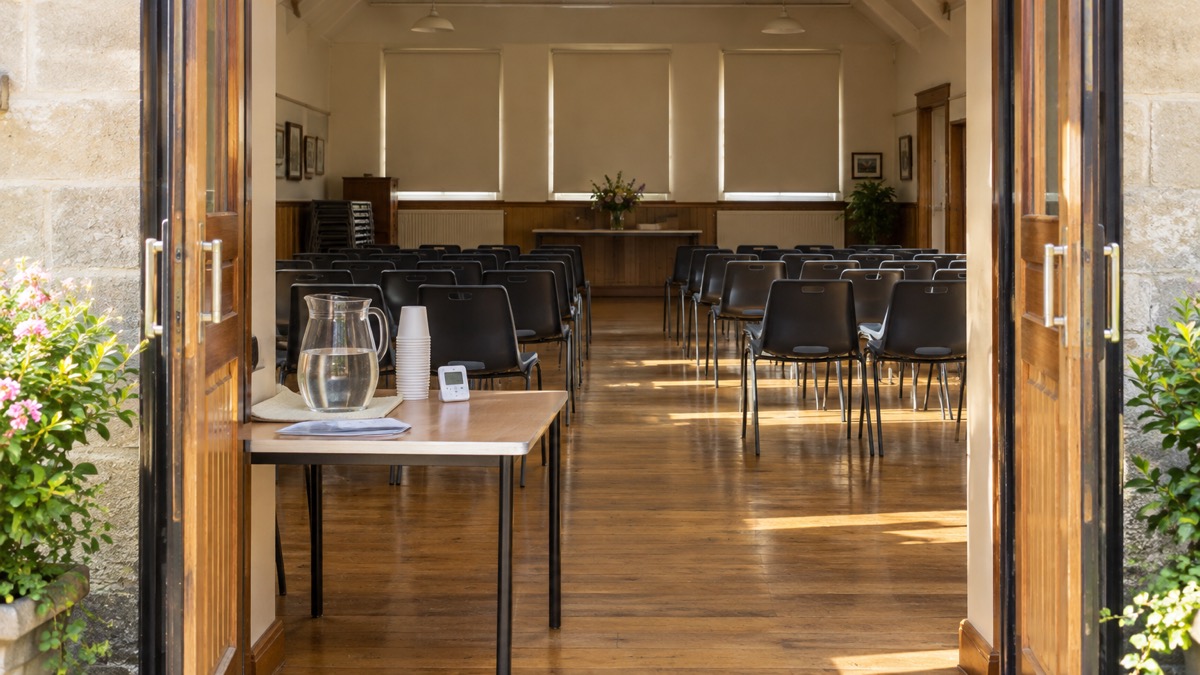
A cool space is not a bare room. Islington's scheme criteria set a floor for what every listed space must provide, and they are worth quoting in full because they tell you what to expect anywhere the scheme runs properly: spaces must be "open to everyone during set hours (ideally 10am to 5pm), at least two days a week (ideally five days a week); free to access; wheelchair accessible (must say if not); staff are there to help; free places to sit and rest; toilet on site or very close by"2.
| What you get | What it means in practice | Who guarantees it |
|---|---|---|
| Somewhere to sit and rest | Free seating, no purchase or membership needed | Islington scheme criteria2 |
| Free drinking water | Available on request; ask a staff member if it is not visible | Manchester libraries3 |
| A toilet | On site or very close by | Islington scheme criteria2 |
| Staff to help | Someone on hand if you need directions or assistance | Islington scheme criteria2 |
| Wheelchair access | Required, or clearly stated on the map if a space is not accessible | Islington scheme criteria2 |
Water deserves a special mention, because staying hydrated is the single most important thing you can do in the heat. Devon and Somerset Fire and Rescue Service advises finding alternative ways to keep cool, "such as staying in the shade, drinking plenty of water and avoiding strenuous activity during the hottest part of the day"10. Manchester's libraries make that easy: they are friendly locations with easy access to drinking water, and you can ask a staff member for help in getting free water3. If you are refilling a bottle rather than drinking on the spot, the public water fountains shown on the London and Islington maps are the most reliable free refill points1. Our page on how much water to drink in hot weather covers the amounts, and dehydration signs and prevention covers what happens if you fall behind.
One caution while you are out and about: do not cool off in open water. A parish council resilience booklet warns that water may look calm on the surface but there may be strong undercurrents, and that water a few feet below the surface can be icy cold even in hot weather and can quickly cause severe cramp and hypothermia11. If you are tempted to swim, read our guide to swimming safely in rivers, lakes and the sea first.
Libraries, leisure centres and supermarkets: everyday cool places
You do not need a formal scheme to find somewhere cool. The UK Health Security Agency's checklist names the categories directly: places of worship, local libraries and supermarkets are all public buildings that may be cooler than your home, and worth a visit if you can get there safely4. Several councils add leisure centres to the list, and some run them as part of formal schemes.
Bexley Council shows how a borough does this with its own buildings. It promotes a list of libraries and community venues as cooler spaces, including Central Library, Crayford Library, Erith Library, St Augustine's Church Hall and Slade Green food bank, Thamesmead Library at The Nest, and Welling Library, all open during normal opening hours as "a comfortable place to rest during hot weather"12. No special arrangement is needed: these are ordinary libraries doing what libraries do, recognised as cooler places.
Manchester goes further. Its libraries have been providing the cool spaces offer since 1 June 2025, and the council is explicit that this is "not just in cases of extreme heat, but on days when people simply need to stay out of the sun"3. That is the most useful framing of the whole idea: you do not have to wait for an alert or a record-breaking temperature before you use one.
The winter equivalents show how deep this pattern now runs, and they are a useful fallback if your area has no summer scheme. Across Norfolk and Suffolk, community centres, libraries, churches, village halls and voluntary organisations may operate warm hubs providing "a safe, heated place to spend time, meet others and access local support"13. Surrey County Council lists over 100 Warm Welcome venues, described as places to get warm, have a free hot drink and socialise with others14. Cumberland's Warm Spots are "safe and friendly public places where people of all ages can go to comfortably spend time reading, studying, chatting with others and meeting new people in their community"7. On Anglesey, Môn Actif leisure centres offer a warm space and free showers during centre opening hours8. The venues and the seasons differ, but the network of public buildings is the same, so if your council has a warm spaces map, the venues on it are a reasonable shortlist of buildings that may also be cooler in summer.
Opening hours, cost and who can use a cool space
Cool spaces are built on an open-door principle. Islington's are "free to use and open to everyone, offering somewhere to sit and rest, free drinking water and toilets"2. There is no means test, no age limit and no need to explain yourself. The scheme criteria ask venues to be open during set hours, ideally 10am to 5pm, at least two days a week and ideally five days a week2, so a listed space is a reliable daytime option rather than a one-off.

Two timing points matter. First, the London-wide map is seasonal: all spaces appear on the Cool Spaces map, "which is live 1 June - 30 September"1. If you search for it in April or October you may find it empty or closed, which does not mean the venues have stopped being cool, only that the map is not running. Second, always check the individual listing before you set out. Islington's map shows each space's opening hours when you click on it2, and Bexley's library cool spaces are open only during normal library opening hours12. A space that is open two days a week will not help you on the other five if you have not checked.
Accessibility is part of the standard, not an afterthought. Islington requires listed spaces to be wheelchair accessible, and where a space is not, the map must say so2. The Scottish Government's guidance for disabled people and carers gives a fuller checklist of what an accessible meeting place may have: step-free access, accessible toilets, safe routes for wheelchair users or people with limited mobility, access to public transport, or a quieter or low-sensory environment15. If any of these matter to your household, check the listing or phone ahead before travelling in the heat, since a journey that goes wrong can leave you stranded in the hottest part of the day.
Where a cool space cannot help you
The limits of the scheme are stated firmly by the councils that run it. Manchester City Council says cool spaces "are not meant to provide medical care or support to vulnerable people"3. The Mayor of London's office says the same: the spaces are "not designed to support vulnerable individuals on hot days, or a medical care substitute if someone is unwell from overheating"1. A cool space is a chair, water and a cooler room. It is not a clinic, and the staff there are not treating anyone.
That matters most for two groups. If someone is already unwell from the heat, the answer is medical help, not a cool space: move them to a cooler environment and follow the advice on when to call 999 or NHS 111 for heat illness. If someone is vulnerable, whether older, living with an underlying condition or living alone, the Met Office advises: "Help to protect the vulnerable people that you know, including older people, those with underlying conditions and those who live alone. They may need support to keep cool and hydrated"16. Our pages on who is most at risk in hot weather and how to check on older and vulnerable neighbours set out how to do that.
For people who need a genuinely cool environment, the standard used in care settings is a useful benchmark. Government guidance for social care managers asks them to "ensure that there is a cool room or area (able to be maintained below 26°C) where people can go to cool down"17, and NHS guidance in Wales uses the same threshold, moving patients and clients so each spends time in a cool room or area below 26°C18. Berkshire Healthcare NHS Foundation Trust gives the same figure for the general public: move to a cooler place, like a room with air conditioning or somewhere in the shade, which should ideally be cooler than 26°C19. A cool space aims for that kind of temperature, but a listed space cannot promise it, which is another reason it is a resting place rather than a care setting.
The same social care guidance carries a warning worth repeating to any household: "Small, closed spaces such as stationary cars can get dangerously hot very quickly. Make sure that those you care for are not left alone in stationary cars or other closed spaces"17. If you are driving someone to a cool space, do not leave them in the car while you check the venue is open.
Why your area may have few or no cool spaces
Coverage is uneven, and the Mayor's own office says so: "Some London areas might be less well-covered, as the project relies on organisation submissions"1. The London scheme is not a council-run network of buildings. Spaces are suggested by boroughs, community groups, faith-based or cultural organisations and others, then validated based on the information provided1. If no organisation in your neighbourhood has put a venue forward, the map will show a gap, however hot your street gets.
Outside London the picture is thinner still, because there is no national cool spaces scheme. What exists is a patchwork: Manchester's library offer3, Bexley's promoted library list12, and councils that simply signpost public buildings on their hot weather pages. There is no single register of summer schemes, so whether your area has one depends on whether your council or a local organisation has set something up and whether venues have put themselves forward. If nothing appears on your council's hot weather pages, contact the council directly: it is the body that coordinates local help, and it can tell you what public buildings are open and whether any community venues are taking part.
If your area has nothing listed, you still have options, and the official advice supports all of them:
- Visit a public building. The UK Health Security Agency names places of worship, local libraries and supermarkets as cooler places to consider visiting4.
- Make your coolest room work. NI Direct advises staying inside the coolest rooms in your house as much as possible, probably the rooms that get little sun during the day20. Derbyshire9 and Essex Prepared21 both advise identifying the coolest room in the house in advance so you know where to go.
- Keep the heat out. The NHS in central east England advises closing curtains on rooms that face the sun, and notes it may be cooler outdoors than indoors22. Warwickshire adds bowls of water and indoor plants to help keep the air cooler23.
- Plan around the peak. Stay in the shade, drink plenty of water and avoid strenuous activity during the hottest part of the day10.
Our guide to keeping your home cool in hot weather develops all of these, and the hot weather preparation checklist turns them into steps you can take before the next hot spell.
Registering a venue as a cool space
If you run or know a venue that could be one, the schemes are actively looking for submissions. In London, you can register a site with the Cool Spaces form; submissions are reviewed and successful ones are included in future map updates1. Islington asks the same of its own organisations: "If you're a local organisation, community group or faith venue, you can help us by adding your venue as a cool space"2.
What registration involves, and what you get back:
- Eligibility: local organisations, community groups and faith venues can add their venue2.
- The form: register the site with the Cool spaces form; submissions are reviewed and successful ones are included in future map updates1.
- Ongoing checks: Islington reviews submissions regularly and contacts listed organisations once a year to confirm they still want to take part2.
- The standard: set opening hours, free access, wheelchair accessibility or a clear statement that a space is not accessible, staff to help, free seating and a toilet on site or very close by2.
The winter campaigns show what registration can bring a venue. Derbyshire notes that registering a warm space for free brings awareness via the national campaign, the media, digital channels and an online map, help attracting volunteers, connecting with other venues, and updates, tips and resources via the campaign newsletter24. A venue that joins a summer scheme gets the same kind of thing: a place on a map people actually search on hot days.
The Welsh NHS heat-health advice note for health and social care partners also shows what venues can do to make themselves genuinely cooler before they list themselves: environmental improvements may include "checking that windows can be easily shaded and opened, increasing shading outdoors, insulating buildings and painting with reflective paint, maintaining cooling ventilation and air conditioning systems, creating cool rooms inside buildings, and making sure temperatures can be easily measured"18. A community hall that does that work first will be a better cool space than one that simply opens its doors.
If a heatwave becomes an emergency
Cool spaces are an everyday measure, not an emergency one, and it helps to know where the line sits. In a wider emergency, the help changes character. West Yorkshire Prepared notes that emergency rest centres "can provide short-term shelter, warmth, food and refreshment" and that these are usually in local venues such as a leisure or community building25. Those are opened by councils and partner agencies in response to a specific incident, not listed on a summer map, and they are for people who cannot stay in their homes.
If heat is making your home unbearable but no emergency has been declared, the same everyday measures apply: use a cool space or another public building during the day, keep your coolest room usable, check on anyone vulnerable, and seek medical help if anyone becomes unwell. If your household needs extra help because of age, disability or medical dependence, our guide to extra help in an emergency sets out the registers and services that exist, and community resilience for neighbours and local groups covers how a street can organise its own response, which is exactly how many cool and warm spaces got started.
Sources (25)
- Cool Spaces, Greater London Authority
- Cool spaces, Islington Council
- Cool spaces to beat the heat in Manchester, Manchester City Council
- Beat the heat: keep cool at home checklist, UK Health Security Agency
- Coping with hot weather in London, Greater London Authority
- Coping with hot weather in London | London City Hall, London City Hall (London.gov.uk)
- Find and register Warm Spots, Cumberland Council
- Winter ready, Isle of Anglesey County Council
- Keeping cool in summer, Derbyshire County Council
- How to stay safe during a heatwave, Devon and Somerset Fire and Rescue Service
- Are You Ready booklet, Culham Parish Council, September 2025
- Stay safe during hot weather, London Borough of Bexley
- Stay warm and nourished, NHS Norfolk and Suffolk Integrated Care Board
- Keeping safe in winter weather, Surrey County Council
- Disabled people and carers, Ready Scotland
- Stay safe in extreme heat, Met Office
- Supporting vulnerable people before and during hot weather: social care managers, UK Health Security Agency, 19 December 2024
- Heat Health Risk: Advice Note for Wales Health and Social Care System Partners, Public Health Wales, 3 July 2023
- Staying well in hot weather, Berkshire Healthcare NHS Foundation Trust
- Hot weather advice, nidirect, Northern Ireland
- Summer preparedness, Essex Prepared
- Hot weather advice, NHS Central and East North London Integrated Care Board
- Staying well in summer, Warwickshire County Council
- Warm spaces, Derbyshire County Council
- Pets and animals in an emergency, West Yorkshire Prepared
 Adverse Weather and Health Plan
 Heat-Health Alerts Explained