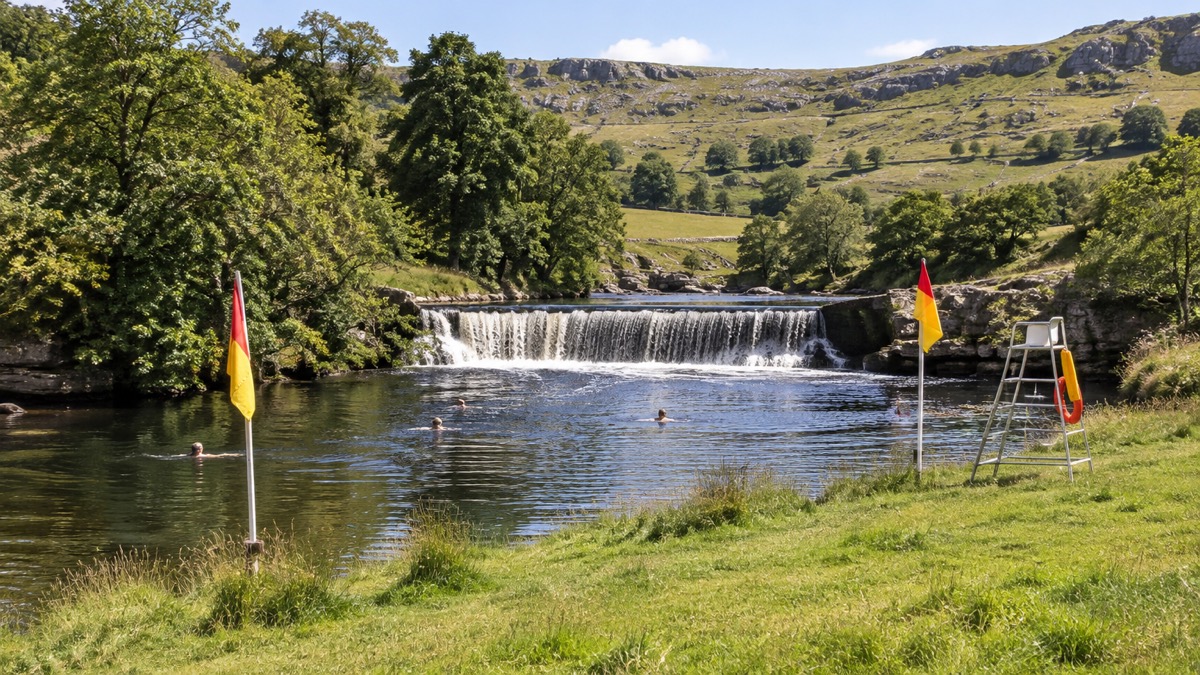
When the weather is hot, cooling off in open water is one of the most natural things in the world to want to do, and one of the most dangerous ways to do it. Fire and rescue services across the UK give the same core advice: whether you are heading to the pool, the beach or an open water beauty spot, choose a lifeguarded venue1. If you are at the coast, pick a lifeguarded beach and swim between the red and yellow flags2. If you see someone in trouble in the water, do not go in after them: call 999 and ask for the Fire Service if you are inland, or the Coastguard if you are at the coast2.
The reason for that advice is stark. Half of all people who drown never intended to enter the water3, and most accidental drownings in the UK happen not at the seaside but in inland waterways: rivers, canals, lakes, reservoirs and quarries4. Open water in Britain is often much colder than it looks, and entering it suddenly can trigger cold water shock, which puts even strong swimmers in trouble5. This page sets out what the fire and rescue services and the NHS say about each of these risks, and what to do about them, in the order you need it.
Is it safe to swim in open water? Choose a lifeguarded site
Open water swimming is not unsafe in itself, but the conditions that make it safe are specific, and a hot day is not one of them. The Met Office's water safety code is blunt about the first rule: whether you are heading to the pool, the beach or an open water beauty spot, choose a lifeguarded venue1. The NHS summer safety advice for children says the same thing in the same words: if you are looking for a place to cool off, always find a lifeguarded swimming site8.
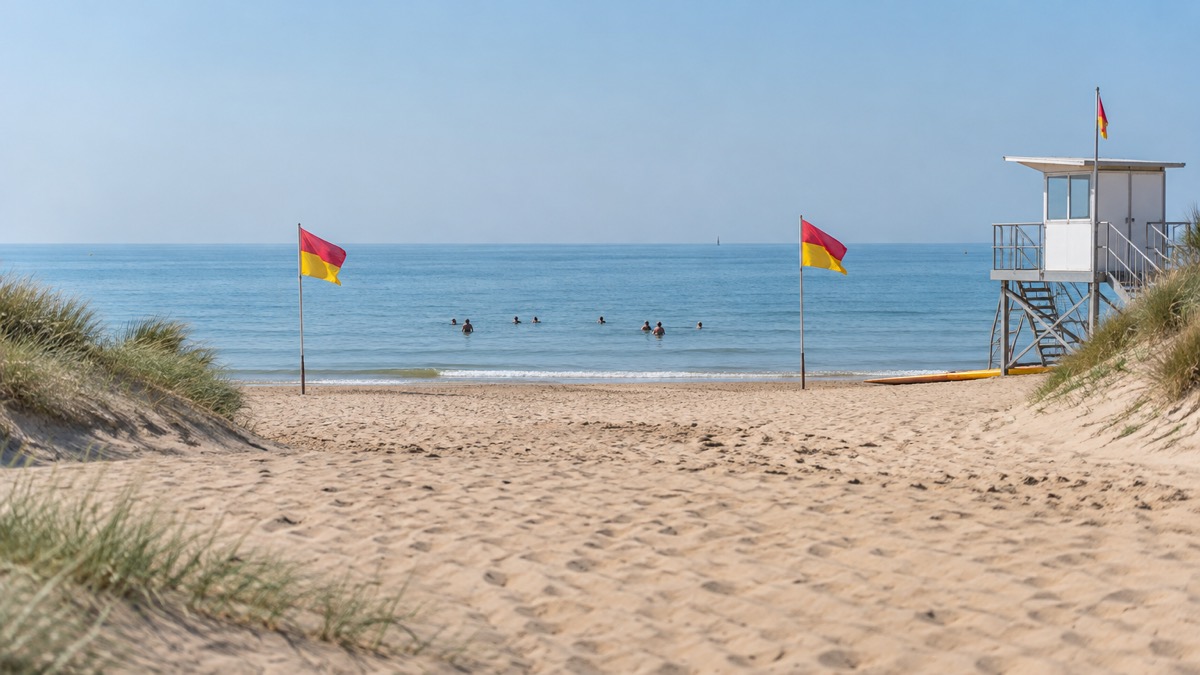
At the coast, that means a lifeguarded beach, and swimming between the red and yellow flags that mark the patrolled swimming zone2. The Northern Ireland Fire and Rescue Service advises that in the summer you should head to a lifeguarded beach and swim between the red and yellow flags9, and Devon and Somerset Fire and Rescue Service adds that it is safer to go to a lifeguarded beach and swim between the red and yellow flags than to swim anywhere unsupervised10.
Inland, the advice is more restrictive. North Yorkshire Fire and Rescue Service suggests joining a club and gaining from the experience of others, choosing a safe place to swim, and inland avoiding swimming near locks and weirs2. The North East Ambulance Service goes further for households simply looking to cool down: avoid swimming in rivers, lakes and reservoirs altogether, never jump into water to cool down, and choose supervised locations such as lifeguarded beaches11. Rivers, quarries and reservoirs have no lifeguards at all12.
If you do swim at the coast, swim parallel to the beach and close to the shore, avoid swimming near rocks, piers and breakwaters, and be aware that distances over water can be deceptive13. Inland, the same caution applies to what is under the surface: hidden currents can make swimming back to shore difficult, exits can be steep and slippery, water can be deeper than it looks, and there may be hidden rubbish or metal such as shopping trolleys and broken glass12.
Cold water shock: why open water is riskier than a pool
A swimming pool is warm, clear, shallow at one end and watched by a lifeguard. Open water is none of those things, and the biggest single difference is temperature. The Greater London Authority's hot weather advice warns that open water can be much colder than it looks, which can lead to cold water shock7. The NHS says the same: water at open water and inland sites is often much colder than it looks, and cold water can affect your ability to swim and self-rescue8.
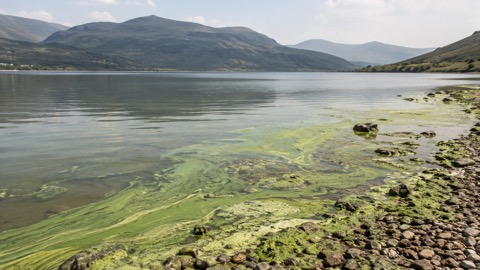
Cold water shock is a physical response by your body when you enter cold water. Oxfordshire's fire and community safety advice explains that it can affect your breathing, reduce your muscle ability and even lead to a heart attack3. Mid and West Wales Fire and Rescue Service describes the wider hazards plainly: open water is very cold and could cause cold water shock or hypothermia, with hidden currents, difficult exits such as steep slimy banks, depth that is hard to estimate, hidden debris, no lifeguards in rivers, quarries or reservoirs, and possible pollution causing illness12.
The critical instruction, repeated by fire services across all four nations, is never to dive or jump straight in. North Yorkshire Fire and Rescue Service warns that diving or jumping straight into open water can cause potentially fatal cold water shock even on the warmest day, and will restrict your ability to swim2. Manchester Fire and Rescue Service puts it more bluntly still:
Forestry and Land Scotland adds a practical point for anyone swimming in Scotland in particular: open water there is very cold even in summer, so if you will be in the water for more than a few minutes consider a wetsuit, and enter slowly to let your body adjust to the cold14.
Float to Live: what to do if you fall into cold water
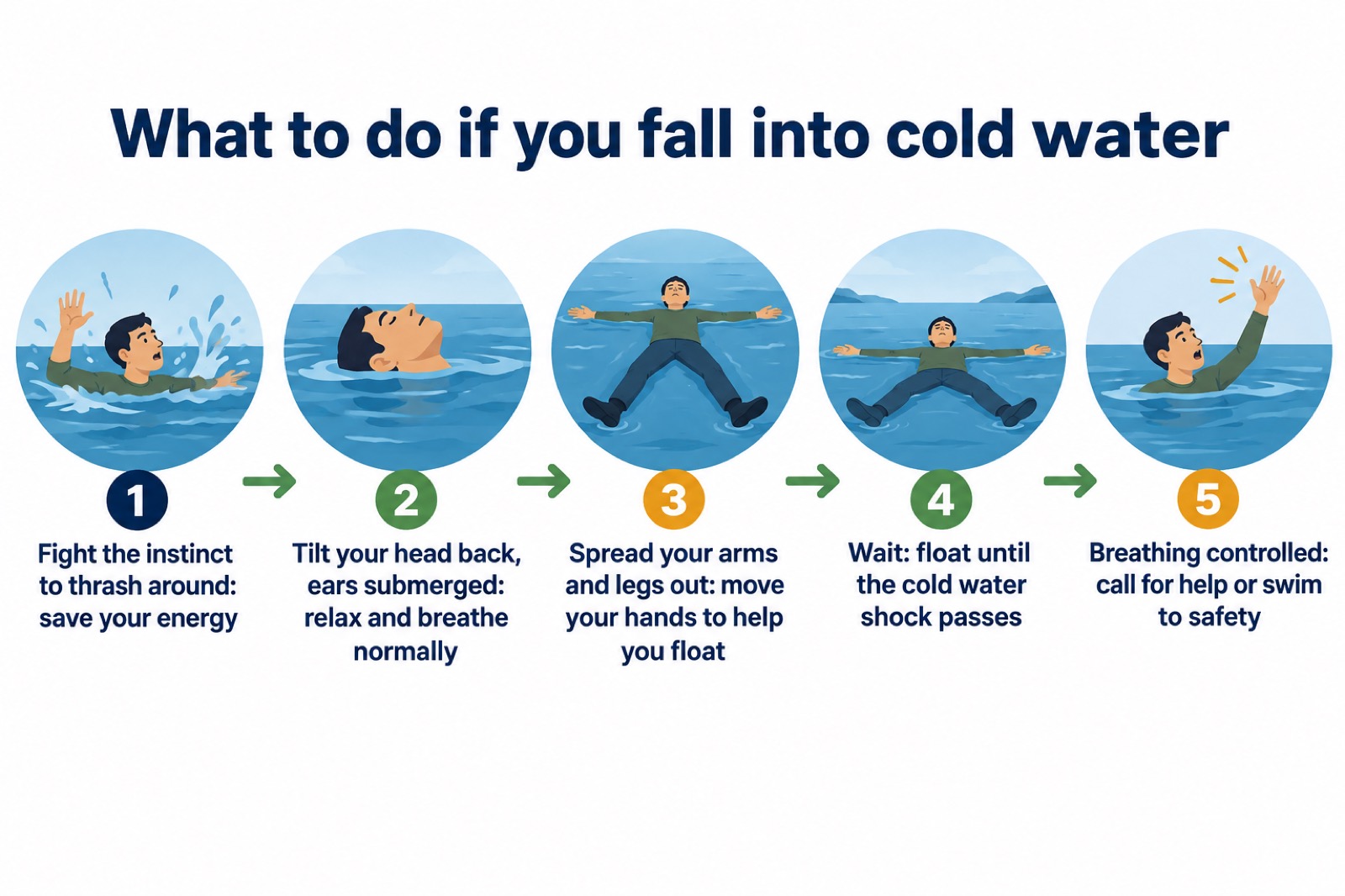
If you unexpectedly enter cold water, the advice from Devon and Somerset Fire and Rescue Service is to Float to Live17. The technique is simple, and every part of it is about fighting the instinct that kills people: the urge to thrash around and swim hard for the shore.
North Yorkshire Fire and Rescue Service sets out the steps: if you start to struggle in the water, save energy and fight the instinct to thrash around; tilt your head back with your ears submerged; relax and breathe normally; move your hands to help you float; spread your arms and legs out; and once your breathing is under control, call for help or swim to safety2. North Wales Fire and Rescue Service gives the same sequence4. Oxfordshire's advice is shorter: if you find yourself unexpectedly in the water, extend your arms and legs out and float on your back until the effects of cold water shock pass3.
Dorset and Wiltshire Fire and Rescue Service explains why floating works where swimming hard does not: if you just float until the cold water shock has passed, you will have a far better chance of staying alive18. London Fire Brigade describes what the shock itself feels like:
"If you fall into the water suddenly you can get "cold water shock"."
Once your breathing is controlled, London Fire Brigade's survival and rescue advice is to keep calm, then call for help or swim for safety if you are able19. The RNLI's Float to Live guidance, which fire services including Manchester link to directly, is the same message20.
Beach flags and warning signs: what they tell you
At a lifeguarded beach, the flags are the safety system, and it is worth learning what they mean before you need them. Devon and Somerset Fire and Rescue Service advises paying attention to warning signs and learning what the different coloured flags at the beach mean18. North Yorkshire Fire and Rescue Service made the same call ahead of Drowning Prevention Week: if you are visiting open water, please pay attention to warning signs and flags5.
The flag that matters most is the red one. Manchester Fire and Rescue Service's beach safety advice is unambiguous:
"Red flags - it's dangerous to bathe or swim so don't go into the water."
The red and yellow flags mark the lifeguarded swimming zone, and that is where you swim2. Beyond the flags, the same beach safety advice applies everywhere: swim parallel to the beach and close to the shore, avoid rocks, piers and breakwaters, be aware that distances can be deceptive, and remember that inflatables can easily be blown out to sea13. Northern Ireland's fire and summer safety advice adds a warning about what lies beneath: there may be hidden depths, debris and currents22.
| Flag or sign | What it means | What to do |
|---|---|---|
| Red and yellow flags | The lifeguarded swimming zone | Swim here, between the flags2 |
| Red flag | It is dangerous to bathe or swim | Do not go into the water21 |
| Warning signs at inland water | Local hazards such as weirs, cold water, no lifeguards | Read them before you go near the water18 |
Most drownings happen inland, and to people who never meant to swim
The picture most people have of drowning, a swimmer getting into difficulty far from shore at the seaside, is not where most of the risk lies. North Wales Fire and Rescue Service states that most accidental drownings in the UK occur in inland waterways like rivers, canals, lakes, reservoirs and quarries4. Suffolk Fire and Rescue Service says the same23.
The second fact is more surprising still. Half of all people who drown never intended to enter the water, according to Oxfordshire's fire and community safety advice3. South Wales Fire and Rescue Service gives the same figure, 50% of people who drown never intended on entering the water24, and Devon and Somerset Fire and Rescue Service says more than half25. North Yorkshire Fire and Rescue Service, ahead of Drowning Prevention Week, put the figure at 40% of people who accidentally drown having no intention of entering the water16. The documents differ on the exact share, but every one of them agrees on the pattern: a large proportion of drownings involve people who never planned to be in the water.
North Wales Fire and Rescue Service identifies the causes: most people who drown had no intention of entering the water, such as people walking, with the causes being slips, trips and falls, so stick to proper pathways and keep clear of the edge4. This is why the advice about walking and running near water matters as much as the advice about swimming. North Yorkshire Fire and Rescue Service asks people to take care if they walk or run near open water, especially if it has been raining, as this can make bank sides extra slippery16.
Jumping into water carries its own risks even for confident swimmers, because water depths can change and there could be hidden debris. North Wales Fire and Rescue Service warns that every year people need rescuing, suffer serious injuries or die jumping into the unknown4.
Alcohol, drugs and swimming alone
Two rules cover most of the remaining risk to adults. The first: never enter the water after drinking alcohol. The Greater London Authority's hot weather advice states this directly7, and Mid and West Wales Fire and Rescue Service devotes a whole campaign to alcohol and the dangers of water12. Alcohol affects judgement, balance and the body's response to cold, which is exactly the combination cold water shock exploits.
The second: never swim alone. Mid and West Wales Fire and Rescue Service advises never swimming on your own, so that someone is available to look for help if you get into danger in open water, and that children should always be accompanied by an adult26. South Wales Fire and Rescue Service frames it as the SAFE approach: never enter the water alone, stay with friends or family, and keep children under close supervision24.
For swimmers who want to go further, Forestry and Land Scotland has practical advice on being seen: wear a bright swim cap and consider towing a small, bright float to help others see you, and try to swim with a friend or in a group14.
Teaching children to float and keeping them safe near water
Children are at particular risk near water in hot weather, and the advice has two halves: supervision now, and teaching for later.
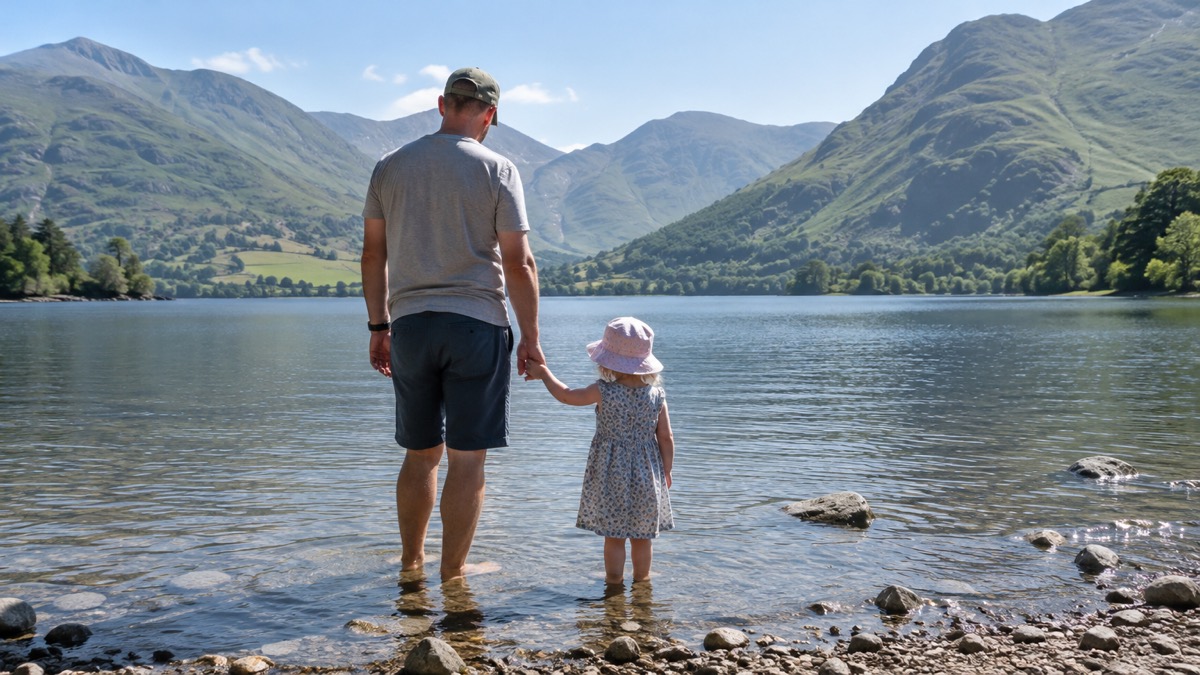
On supervision, the rules are absolute. Children should always be supervised by an adult27, and drowning can happen fast and silently, so supervise children in and around water at all times16. North Yorkshire Fire and Rescue Service tells parents to keep little children at arm's length and to tell children not to go out of sight2. The NHS advice for children adds that you should make sure you know where your children are at all times near water, that they understand the risks, what you say they can do and what you do not want them to do, and what to do in an emergency13.
On teaching, Dorset and Wiltshire Fire and Rescue Service gives the single most useful skill: teach your child to float on their back if they fall in or get into trouble in water28. The NHS adds that as soon as children are old enough, teach them about water safety and to swim, and make sure your outside space is secure so your child cannot get to ponds or other drowning hazards29.
Garden ponds and other water at home deserve their own warning. Parents and guardians should keep little children at arm's length around water, reiterate the dangers of water to children and teenagers, and tell children not to go out of sight3. Every child, regardless of their ability to swim, should be supervised at all times in or around water, and children should swim within designated areas4. Teach older children how to stay safe in and around water, remind them not to go swimming alone and explain the dangers of swimming in open water5.
At the coast with children, the NHS advises swimming only in designated, supervised areas, swimming between the red and yellow flags, and being mindful of undercurrents and hazards29. Never leave a child unattended near water, and be mindful of winds and currents when using inflatables29.
Paddleboards, inflatables and wind
Paddleboards and inflatables are where a light offshore breeze becomes an emergency. The Met Office's water safety code advises anyone heading to the beach to check the wind speed at that location, and to consider leaving inflatable gear at home, because some activities and equipment are not well suited to strong winds1. Devon and Somerset Fire and Rescue Service warns that inflatables can easily be blown out to sea13.
The NHS advice for children is never to leave a child unattended near water and to be mindful of winds and currents when using inflatables29. If an inflatable or paddleboard is blown away from the shore, do not swim after it. Treat it as someone in trouble at the coast: call 999 and ask for the Coastguard2.
The same open water hazards apply to paddleboards as to swimmers: hidden currents, difficult exits such as steep and slippery banks, water deeper than it looks, hidden rubbish or metal, possible contamination, and no lifeguards in rivers, quarries or reservoirs12. If you are on the water rather than in it, Forestry and Land Scotland's advice on being seen applies doubly: a bright float and swimming with a friend or in a group14.
Never go into the water to rescue someone or a dog
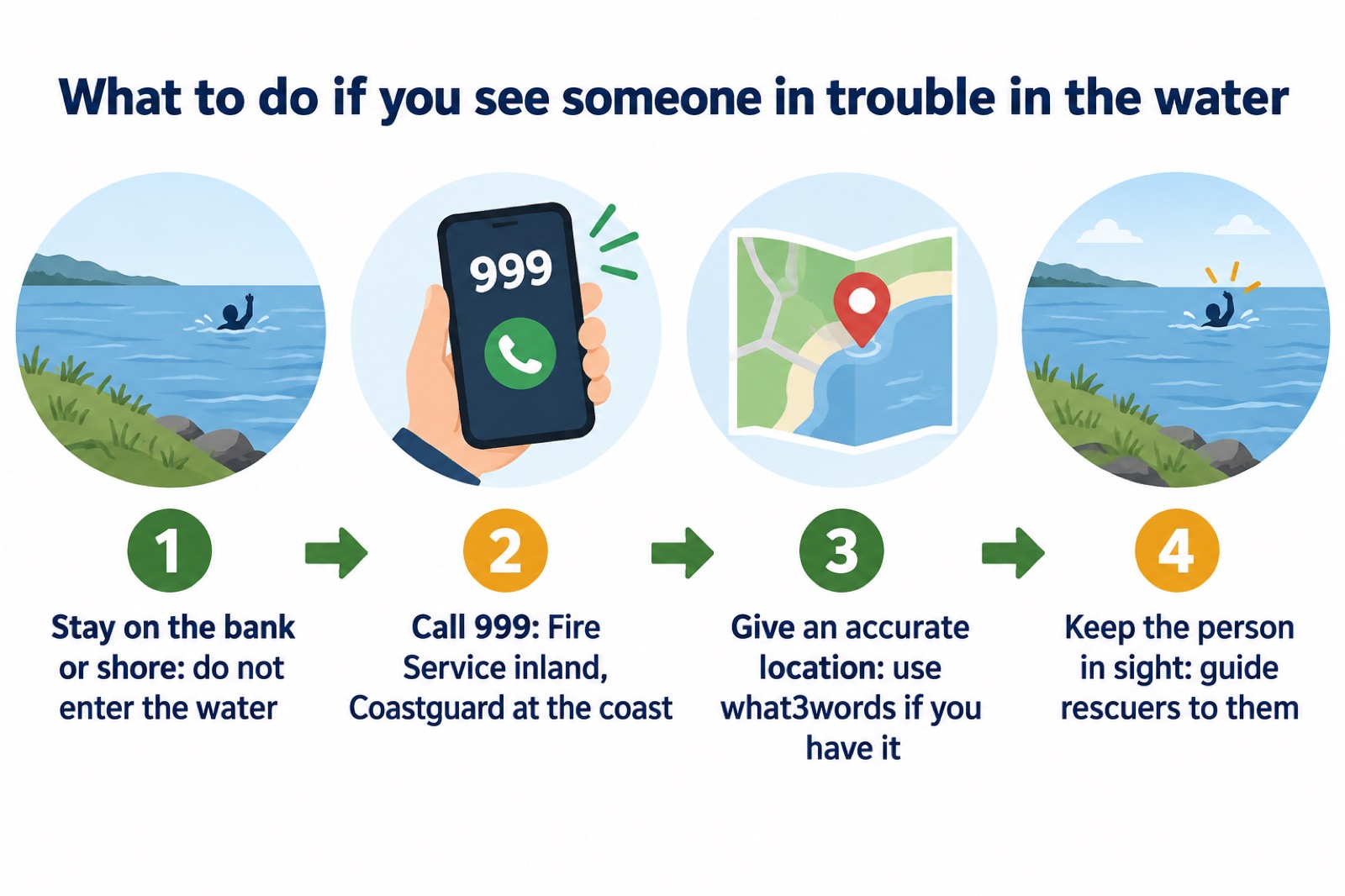
This is the rule that saves the most lives, and it is the hardest one to follow when someone you love is in the water. Every fire and rescue service in this field says the same thing. Devon and Somerset Fire and Rescue Service: never enter the water to attempt a rescue17. Suffolk Fire and Rescue Service: never enter the water to attempt a rescue23. Devon and Somerset's water safety guidance explains why going in makes things worse: you are putting yourself in danger and making it harder to rescue everyone13.
The Northern Ireland Fire and Rescue Service gives the reason in terms of cold water shock: never enter the water to try and save someone, because if you go into the water you are likely to suffer from cold water shock, which will leave you unable to help, even if you are a strong swimmer9. Dorset and Wiltshire Fire and Rescue Service says the same: never go into the water to try to save someone, because you could experience cold water shock which will leave you unable to help, even if you are a strong swimmer18.
Dogs are the other trigger. Manchester Fire and Rescue Service asks dog owners directly: never enter the water to rescue your dog, because who will rescue you?20. Devon and Somerset Fire and Rescue Service extends this to all animals: please never try to enter water or climb heights to rescue an animal yourself25. Most dogs will scramble out on their own; a person who goes in after one often cannot.
Calling for help: 999 or 112, Fire and Rescue or Coastguard
If someone is in trouble in the water, the action is to stay on the bank or the shore and phone for professional help. The number is 999, and which service you ask for depends on where you are. North Yorkshire Fire and Rescue Service: call 999 and ask for the Fire Service if inland, and the Coastguard if you are at the coast2. Devon and Somerset Fire and Rescue Service13, Manchester Fire and Rescue Service30, Mid and West Wales Fire and Rescue Service12 and Suffolk Fire and Rescue Service23 all give the identical instruction.
Two things make that call work. The first is an accurate location. Surrey County Council's water safety advice says to give as accurate a location as possible27. Rivers, canals and beaches often have no street address, which is why London Fire Brigade recommends the free what3words app, which can help you pinpoint your location, and suggests downloading it now, before you need it19.
The second is staying where you can see the person in the water, so you can guide the rescuers to them, while keeping yourself clear of the edge4.
Keeping cool without the risk
None of this means you have to stay indoors in a heatwave. It means choosing the supervised option, and there are plenty of them. A swimming pool, a lifeguarded beach between the red and yellow flags, or a supervised open water venue all give you the water without the unwatched hazards1. For more on managing the heat itself, see our guides on keeping your home cool in hot weather, heat exhaustion and heatstroke, and how much water to drink in hot weather.
The North East Ambulance Service's hot weather advice covers the basics for the whole day: drink plenty of water throughout the day, take regular breaks in the shade, wear sunscreen and reapply it regularly, wear light loose-fitting clothing, avoid strenuous activity during the hottest part of the day, and check in on older relatives, neighbours and vulnerable people11. If you are heading to open water rather than a pool, the same service's water safety list is the one to follow: avoid swimming in rivers, lakes and reservoirs, never jump into water to cool down, supervise children closely at all times, avoid alcohol when near water, choose supervised locations such as lifeguarded beaches, and talk to children and young people about the dangers of open water11.
The Northern Ireland Fire and Rescue Service reported that throughout the UK there had been a significant increase in accidental drownings and water-related rescues in the summer of 2021, as a result of people being caught unaware of the dangers31. Being aware of them is most of the work: cold water shock, no lifeguards, alcohol, unsupervised children, and the instinct to go in after someone. Choose the lifeguarded option, enter slowly if you swim at all, keep children at arm's length, and keep 999 and what3words ready.
Sources (31)
- Water Safety Code, Met Office, Met Office
- Water Safety Campaign, North Yorkshire Fire and Rescue Service, North Yorkshire Fire and Rescue Service, 2026-08-18
- Stay Safe This Summer, Oxfordshire Fire and Rescue Service, Oxfordshire County Council, 2026
- Water Safety, North Wales Fire and Rescue Service, North Wales Fire and Rescue Service, 2026-10-29
- Fire Service Shares Summer Safety Advice as Temperatures Rise, North Yorkshire Fire and Rescue Service, North Yorkshire Fire and Rescue Service, 2026-06-26
- Stay Safe This Summer, North Yorkshire Fire and Rescue Service, North Yorkshire Fire and Rescue Service, 2024-05-01
- Coping with Hot Weather in London, Greater London Authority, Greater London Authority, 2026-10-25
- Summer Safety, NHS Coventry and Warwickshire Partnership, NHS, 2026-10-29
- Staying Safe: Other Safety, Northern Ireland Fire and Rescue Service, Northern Ireland Fire and Rescue Service, 2026-10-22
- Be Water Aware, Dorset and Wiltshire Fire and Rescue Service, Dorset and Wiltshire Fire and Rescue Service, 2026-07-24
- Summer Safety Advice, North East Ambulance Service NHS Foundation Trust, North East Ambulance Service, 2026-10-29
- Alcohol and the Dangers of Water, Mid and West Wales Fire and Rescue Service, Mid and West Wales Fire and Rescue Service, 2026-10-29
- Water Safety Outdoors, Dorset and Wiltshire Fire and Rescue Service, Dorset and Wiltshire Fire and Rescue Service, 2025-08-20
- Visiting Safely: Water Safety, Forestry and Land Scotland, Forestry and Land Scotland, 2026-10-29
- NIFRS Simple Steps to Stay Safe This Summer, Northern Ireland Fire and Rescue Service, Northern Ireland Fire and Rescue Service, 2025-06-23
- Be Water Aware Ahead of Drowning Prevention Week, North Yorkshire Fire and Rescue Service, North Yorkshire Fire and Rescue Service, 2026-06-11
- How to Stay Safe During a Heatwave, Devon and Somerset Fire and Rescue Service, Devon and Somerset Fire and Rescue Service, 2026-06-23
- Water Safety Outdoors, Devon and Somerset Fire and Rescue Service, Devon and Somerset Fire and Rescue Service, 2026
- Survival and Rescue, London Fire Brigade, London Fire Brigade, 2026-10-25
- Water Safety, Manchester Fire and Rescue Service, Manchester Fire and Rescue Service, 2026-10-29
- Beach Safety, Manchester Fire and Rescue Service, Manchester Fire and Rescue Service, 2026-10-29
- Fire and Summer Safety Advice, nidirect, Northern Ireland Direct, 2026-07-03
- Warm Weather Safety, Suffolk Fire and Rescue Service, Suffolk County Council, 2026-10-29
- Water Safety, South Wales Fire and Rescue Service, South Wales Fire and Rescue Service, 2026-07-29
- Top Causes of Rescues and How to Avoid Them, Devon and Somerset Fire and Rescue Service, Devon and Somerset Fire and Rescue Service, 2026
- Alcohol a Pheryglon Dŵr, Mid and West Wales Fire and Rescue Service, Mid and West Wales Fire and Rescue Service, 2026-10-29
- Outdoors: Water, Surrey Fire and Rescue Service, Surrey County Council, 2026-10-28
- Back to School Safely, Dorset and Wiltshire Fire and Rescue Service, Dorset and Wiltshire Fire and Rescue Service, 2025-08-20
- Staying Safe Over the Summer, Healthier Together NHS, NHS, 2026-10-29
- Safe4Summer Water Safety, Manchester Fire and Rescue Service, Manchester Fire and Rescue Service, 2026-10-29
- Be Safe in the Water During Heatwave, Northern Ireland Fire and Rescue Service, Northern Ireland Fire and Rescue Service, 2021-07-21
 Baby and Child Hot Weather
 Hot Weather Preparation
 Flood Warning Checklist
 Air Pollution and Hay Fever
 Babies and Children in Heat
 Blue-Green Algae Risks
 Dehydration Signs and Prevention
 Evaporative Coolers and Fans
 Electric Fans Guide
 Heat Exhaustion and Heatstroke
 UK Heatwave Definition
 Who Is at Risk in Hot Weather
 Portable Air Conditioners Guide
 Why UK Summers Are Hotter
 Sun Safety and Sunscreen