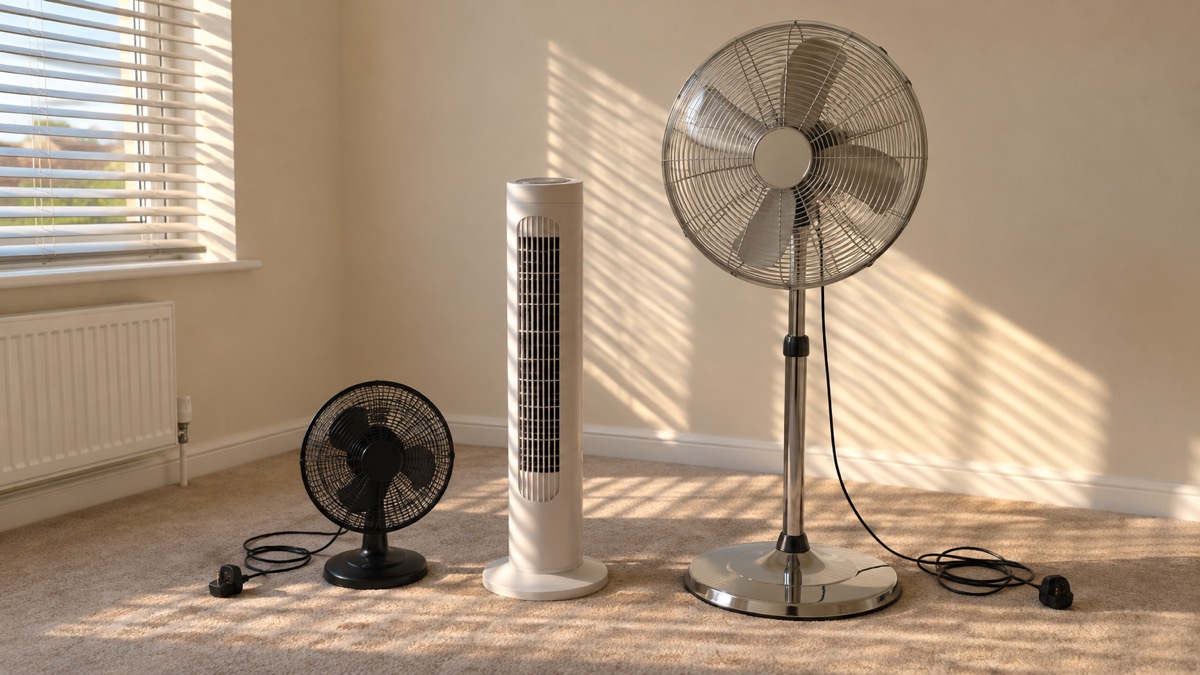
An electric fan is the first thing most UK households reach for when hot weather arrives, and for most of the conditions we normally get, it is the right choice. The government's heatwave advice is clear on the limit, though: use electric fans if the air temperature is below 35°C, and do not aim the fan directly at your body, because that can lead to dehydration1. Above 35°C, NHS guidance warns that fans may not prevent heat-related illness and can cause excess dehydration, because you are largely just moving hot air around yourself2.
So the short answer to "which fan should I buy?" has two parts. First, buy a fan that suits the room and the people using it: a small desk or battery fan for one person, a larger pedestal, tower or floor fan for a whole room, or a fixed ceiling fan or ventilation system if you want a permanent solution3. Second, buy it safely, from a reputable retailer, with the right UK plug and fuse, and use it only while you are awake and in the room. Fire and rescue services are blunt about this: avoid leaving your fan on when asleep, because if a fault occurs, it could be fatal4.
This page sets out what fans can and cannot do, how the main types differ, what they cost to run compared with other cooling appliances, and how to use, charge and buy one safely. It sits alongside our wider advice on keeping your home cool in hot weather and on heat exhaustion and heatstroke.
The 35°C rule: when a fan helps and when it makes things worse
A fan does not cool air. It moves air across your skin, which helps sweat evaporate and carries heat away from your body. That works well when the air itself is cooler than you are, which is why every major piece of UK heat-health advice draws the same line at 35°C.
The government's "Beat the Heat" guidance says to use electric fans if the air temperature is below 35°C, but not to aim the fan directly at your body, as this can lead to dehydration1. NHS heatwave guidance for Birmingham and Solihull goes further on the upper limit: at temperatures above 35°C fans may not prevent heat-related illness, and fans can cause excess dehydration. For anyone sick and confined to bed, it advises placing the fan at a distance rather than aiming it directly at the body, and having regular drinks2. Somerset Council puts the same point plainly: at temperatures above 35°C fans become less effective and can worsen dehydration, so do not point a fan directly at yourself6.
Several councils state the rule as a simple do and do not. Oxfordshire's public health advice says to use air fans only if the temperature is below 35 degrees, because higher than that you will just be moving hot air around, and it repeats the warning not to aim the fan at your body to avoid dehydration7. Its printable heatwave leaflet is firmer still: do not use fans if it is hotter than 35°C3. Flintshire Council's extreme weather advice adds the underlying reason: electric fans do not cool, they just blow hot air around, so if you do not have air conditioning you should stay on the lowest floor away from the sunshine8.
The practical version of the rule for an ordinary household:
- Below 35°C: use the fan, positioned so air moves past you rather than blasting one spot on your skin, and keep drinking water.
- At or above 35°C: treat the fan as a back-up, not your main defence. Move to the coolest room, keep out of the sun, drink regularly, and consider a cool space near you if your home cannot be cooled.
If you want the detail on that threshold, we cover it separately in are electric fans safe when it is very hot?. If someone in the household becomes unwell, our page on heat exhaustion and heatstroke explains the signs and what to do.
Who can rely on a fan, and who needs more
The 35°C limit matters most for the people a heatwave harms first. Public Health Wales lists older people, especially those over 65, among the groups most at risk in hot weather9. The government's guidance for social care managers, written for people looking after vulnerable adults, gives the same instruction in both directions: use electric fans if the air temperature is below 35°C, and do not use fans if it is hotter than 35°C, as they can raise body temperatures10. That is the clearest statement of the rule anywhere in official guidance, and it is worth following in any household with a frail or bed-bound person.
Oxford Health NHS Foundation Trust, in guidance on preventing falls at home during hot weather, likewise advises using a fan if the temperature is below 35°C11. The reason a fan is still recommended for these groups below the threshold is that air movement helps the body shed heat and can make a warm room feel more bearable, which matters for people who cannot easily move to a cooler room or get out of the sun.
Preparation matters as much as the fan itself. Devon County Council advises households to check essential equipment such as fridges, freezers and fans before hot weather arrives, to make sure they are working properly5. A fan that has sat in a cupboard since last summer may have a damaged cable, a stiff bearing or a build-up of dust, all of which matter for both performance and fire safety. London Fire Brigade says that if you use a fan, make sure it has been well maintained and follow the manufacturer's instructions for safe and ongoing use4.
For households that include someone at higher risk, our pages on who is most at risk in hot weather, on medicines that raise the risk of illness in the heat and on how to check on older and vulnerable neighbours go into more detail.
Types of electric fan: what each one does
UK guidance does not rank fan types, but it does distinguish between them, and the differences between types come down to where the air goes, how much space the fan takes up, and whether it needs a socket. Here is how the main kinds compare in practice.
| Type | What it does | Where it suits | Power |
|---|---|---|---|
| Desk fan | Moves air across one person at close range | A home office, a bedside table, one seated person | Mains, some models rechargeable |
| Pedestal fan | Same head as a desk fan on an adjustable stand, so you can aim air at head height or across a room | Living rooms and bedrooms, larger areas | Mains |
| Tower fan | A tall slim unit that pushes air out along its height, with speed settings on the base | Rooms where floor space is tight, households that want nothing at head height to trip over | Mains |
| Floor fan | A large head low down, moving a lot of air across a room | Big rooms, moving cooler air from one room to another | Mains |
| Hand-held battery fan | A small personal fan you hold or stand on a desk | Travel, commuting, a power cut, one person at a time | Built-in rechargeable battery |
| Ceiling fan or ventilation system | A permanent fitting that circulates air through the whole room | Households wanting a fixed, always-available solution | Wired in |
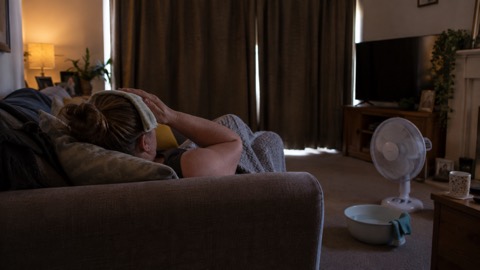
Oxfordshire's heatwave advice suggests using portable electric fans with a bowl of ice for a cooling effect, or installing a permanent ceiling fan or ventilation system if you want something built in3. Placing a bowl of ice in front of a portable fan is the one trick in official guidance that makes moved air cooler than the room, and it works with any fan that blows outwards rather than around itself.
Choosing between them is mostly about circumstance rather than one being better:
- One person, one spot: a desk fan or hand-held battery fan is enough, and the battery version keeps working through a power cut.
- A whole room, especially overnight use while awake: a pedestal or tower fan moves more air and can be aimed away from bodies, which suits the dehydration warning.
- A household that struggles with heat every year: a fixed ceiling fan or ventilation system removes the cable, the trip hazard and the storage problem.
If you are weighing a fan against something stronger, our comparison of electric fans and portable air conditioners and our guide to cordless rechargeable fans versus mains fans go deeper.
What a fan costs to run: power use in context
A fan's running cost depends on its wattage and the speed setting you use, and fans are small users of electricity compared with the appliances people often buy instead. Electrical Safety First publishes a wattage guide for household appliances, and the contrast is stark12:
| Appliance | Typical power use |
|---|---|
| Electric blanket | Up to 120 watts (typically 80 to 120W)12 |
| Laptop | Up to 100 watts12 |
| Fridge freezer (standard) | 150 watts12 |
| Portable air conditioner | Up to 2000 watts12 |
| Fan heater | Typically 2000 to 3000W12 |
The point the table makes is that cooling a person with moving air is a much smaller job, in electrical terms, than cooling a room with a portable air conditioner, which draws up to 2000 watts12. A fan heater, at typically 2000 to 3000W, is in a different league again12. If you are deciding between a fan and a portable air conditioner, the running cost difference follows directly from these figures, and our portable air conditioner guide covers what those machines need in addition, including venting hot air out of a window.
Two practical points follow from the way fans use power. First, a lower speed setting uses less power than a higher one, so the setting you choose matters as much as the fan you buy. Second, where you plug in matters for safety rather than cost: Warwickshire County Council's fire safety guidance advises avoiding extension leads as a permanent solution and giving high-energy consuming devices their own dedicated circuit13. A fan is not in the high-energy class of a space heater or air conditioner, but the same principle of plugging directly into a wall socket rather than daisy-chaining extension leads is good practice for any appliance that runs for hours.
Where to buy a fan safely
The single most important buying rule, repeated across the fire and rescue services, is to buy electrical products from a reputable retailer. London Fire Brigade warns that online marketplaces are not held to the same standards as high street shops, and that you could be at risk from sub-standard products that pose a risk of electric shock and fire4. The Northern Ireland Fire and Rescue Service, after two house fire fatalities in a single day, issued the same advice: only buy from reputable retailers, and ensure electrical equipment and chargers comply with the required safety standards14.
Buy your fan from a reputable retailer or directly from a known manufacturer, rather than from third-party online sellers, as unverified products may not meet UK safety standards15. Electrical safety guidance adds that online marketplaces are not held to the same standards as high street shops, and sub-standard products bought there can pose a risk of electric shock and fire.
The reason for this advice is not theoretical. UK product safety notices show a pattern of electrical items sold through online marketplaces later being recalled:
- A rechargeable radiator fan sold via Amazon, eBay, Temu, B&Q, Debenhams, The Range and TikTok Shop was recalled in November 2025, because if the product is charged or left unattended in standby mode, a fault may occur leading to thermal runaway and the product catching fire16.
- An electric rechargeable hand warmer sold via Amazon and eBay was subject to a product safety report in February 2025, and the listing was removed by the online marketplaces17.
- An electric heated blanket sold by Online Home Shop was recalled in April 2023 after notification by Local Authority Trading Standards18.
None of these is a domestic room fan, but the rechargeable radiator fan case is close enough to be instructive: a fan-type product with a rechargeable battery, sold through major marketplaces, that could catch fire when charged or left on standby16. The lesson for a household buying any fan, especially a rechargeable one, is to check the government's product safety alerts, reports and recalls pages before and after purchase, and to be cautious of third-party sellers on marketplaces whose listings can disappear once a problem emerges17.
Plug and fuse: what a UK fan should have
A fan sold for the UK market should come with a standard three-pin plug fitted with the correct fuse. The principle comes from fire safety guidance on electrical appliances: Warwickshire County Council states that electric heaters must be fitted with the correct fuse, which should be stated in the manufacturer's guide19. The same rule of thumb applies to any plug-in appliance, including fans: the fuse rating the manufacturer specifies is the one that protects the appliance, and substituting a higher-rated fuse removes that protection.
When your fan arrives, check:
- The plug is a moulded or properly fitted UK three-pin plug, not a travel adapter attached to a foreign plug.
- The fuse in the plug matches the rating stated in the manufacturer's guide19.
- The cable is undamaged, with no cracks, splits or exposed conductors.
If you buy from a reputable UK retailer, all of this should already be true. It is the marketplace-sourced fan, shipped from a seller you cannot easily contact, where each of these checks earns its place. Our wider home emergencies guide covers what to do if an electrical item does go wrong.
Safe use: never overnight, never while you are out
The fire and rescue services are unanimous that electrical appliances should not run unattended, and a fan that runs for hours on a hot night is exactly the case they worry about. London Fire Brigade's extreme weather summer guide states it directly:
"It might be tempting, but avoid leaving your fan on when asleep, if a fault occurs, it could be fatal."
London Fire Brigade, extreme weather summer guide4
The same guide adds the maintenance point: if you use a fan, make sure it has been well maintained and follow the manufacturer's instructions for safe and ongoing use4. Manchester Fire and Rescue Service's flat fire safety advice generalises the rule: never leave appliances on when sleeping or when you go out20. The Northern Ireland Fire and Rescue Service's guidance for older people adds a charging rule that matters for battery fans: do not over-charge devices and always unplug them before going to bed at night21. North Yorkshire Fire and Rescue Service's bedtime routine advice is the same: never leave electrical items charging overnight22.
For rechargeable fans and the power banks that charge them, treat the battery with respect. A Bromley Council safety notice describing recalled Belkin power banks notes that they are portable power banks with lithium-ion battery cells23. Do not over-charge devices, and always unplug them before going to bed at night. Our backup power guide covers choosing and caring for power banks and rechargeable devices in more detail.
Fans with blades and young children
Bladed fans, whether desk, pedestal or floor models, need a bit of thought in a household with small children. Electrical Safety First's advice for new parents is to keep appliance cables out of the reach of children24. A fan cable trailing from a socket to a table or across a floor is both a trip hazard and something a small child can pull, bringing the fan down. Place the fan on a stable surface beyond reach, route the cable so it cannot be tugged, and prefer a model with a fine mesh guard over the blades. Our page on keeping babies and young children safe in hot weather covers the wider picture, including safe room temperatures.
When a fan is not enough
There are conditions where a fan stops being the answer and you should move to other measures. The first is the 35°C threshold itself: above it, fans may not prevent heat-related illness and can cause excess dehydration2, and Oxfordshire's advice is simply not to use them3. The second is a power cut, when a mains fan stops with the supply: the Met Office's advice to carry a small hand-held battery fan is the practical answer there25, and our page on how to keep cool during a power cut in hot weather covers the rest of what helps.
Between those limits, the strongest single upgrade to a fan costs nothing: Oxfordshire's heatwave advice is to use portable electric fans with a bowl of ice, which chills the air the fan moves3. Beyond that, the measures that matter are the ones that stop rooms heating up in the first place, which our guide on how to keep your home cool in hot weather and our page on stopping the sun heating your rooms through the windows set out. If your home regularly becomes uncomfortable in hot weather, it is worth knowing why new build homes overheat and considering whether a portable air conditioner or an evaporative cooler suits your circumstances better.
Finally, know when heat has stopped being a comfort problem and become a medical one. The signs of heat exhaustion and heatstroke, and when to call 999 or NHS 111, are covered in our dedicated pages.
Sources (25)
- Beat the Heat: staying safe in hot weather, UK Health Security Agency, 2026-07-21
- Heatwaves, Birmingham and Solihull NHS, 2026-10-29
- Beat the Heat leaflet, Oxfordshire County Council, 2026
- Extreme weather summer guide, London Fire Brigade, 2024-05
- Staying well in hot weather, Devon County Council, 2026-07-02
- Stay cool and safe in hot weather, Somerset Council, 2026-07-08
- Keeping cool in heat waves, Oxfordshire County Council, 2026
- Extreme weather, Flintshire County Council, 2026-10-29
- Hot weather, Public Health Wales, 2026-05-27
- Supporting vulnerable people before and during hot weather: social care managers, UK Health Security Agency, 2024-12-19
- Guidance at home, Oxford Health NHS Foundation Trust, 2026-09-15
- Ratings of electrical appliances, Electrical Safety First, 2026-10-25
- Electrical fire safety, Warwickshire County Council, 2026-10-29
- NIFRS issues safety plea following two house fire fatalities in one day, Northern Ireland Fire and Rescue Service, 2025-12-12
- Electrical safety: vaping, Manchester Fire and Rescue Service, 2026-10-29
- Product recall: Valiant Radiator Fan, Office for Product Safety and Standards, 2025-11-07
- Product safety report: Electric Rechargeable Hand Warmer, Office for Product Safety and Standards, 2025-02-11
- Product recall: Online Home Shop electric heated blankets, Office for Product Safety and Standards, 2023-04-04
- Electric blankets and portable heaters safety, Warwickshire County Council, 2026-10-29
- Fire safety advice in your flat, Manchester Fire and Rescue Service, 2026-10-29
- Reduce fire risks for older people, Northern Ireland Fire and Rescue Service, 2026
- Bedtime routine and escape plan, North Yorkshire Fire and Rescue Service, 2026-03-27
- Belkin power bank safety notice, London Borough of Bromley, 2025-12-08
- Safety advice for new parents, Electrical Safety First, 2026-10-25
- Stay safe in extreme heat, Met Office, 2026-10-29
 Baby and Child Hot Weather
 Hot Weather Preparation
 Flood Warning Checklist
 Air Pollution and Hay Fever
 Babies and Children in Heat
 Blue-Green Algae Risks
 Dehydration Signs and Prevention
 Evaporative Coolers and Fans
 Heat Exhaustion and Heatstroke
 UK Heatwave Definition
 Who Is at Risk in Hot Weather
 Portable Air Conditioners Guide
 Why UK Summers Are Hotter
 Sun Safety and Sunscreen
 Swimming Outdoors Safely