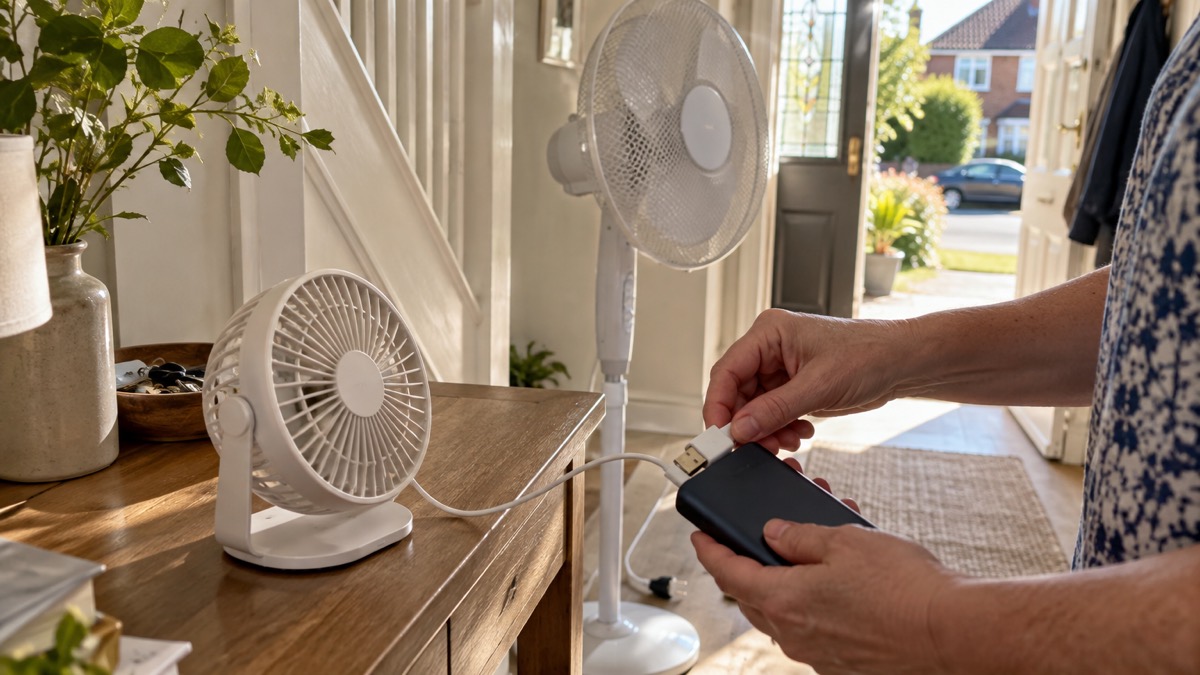
A fan is a simple way to make a hot room more bearable, but it is not a cooling machine. It moves air over your skin, which helps you lose heat, and it does nothing to lower the temperature of the room itself. That is why official health guidance puts a firm limit on when a fan helps: below 35°C, an electric fan may give some relief, but above 35°C fans become less effective and can worsen dehydration1. The UK Health Security Agency's heatwave guidance goes further, warning that above 35°C fans may not prevent heat-related illness and can cause excess dehydration2.
So the first decision is not which fan to buy but whether a fan is the right tool for the room you are in. If your room stays below 35°C, a fan is useful, and the choice between a cordless rechargeable model and a mains-powered one comes down to how you will use it: a mains fan runs as long as the power does, while a rechargeable fan keeps going through a power cut but only for as long as its battery allows. If your room climbs above 35°C, the priority shifts to shading, ventilation and drinking water, and a fan should be switched off or used only with great care.
This page sets out how each type behaves, how to keep cool when the power fails, what run time and charging really mean, and how to use and store a fan safely. It is written for an ordinary UK household, and it treats the 35°C figure as the line that decides most of the answers.
Above 35°C a fan is likely to heat you up rather than cool you down
The 35°C threshold appears across a wide range of official UK guidance, and it is the single most important fact on this page. Somerset Council's heat health advice states that at temperatures above 35°C fans become less effective and can worsen dehydration, and tells people not to point a fan directly at themselves1. The UK Health Security Agency's heatwave guidance says that above 35°C fans may not prevent heat-related illness and can cause excess dehydration, and advises placing the fan at a distance from people rather than aiming it at the body, with regular drinks, especially for sick people confined to bed2. The government's Beat the Heat guidance says to use electric fans if the air temperature is below 35°C, but not to aim the fan directly at your body as this can lead to dehydration3.
Oxfordshire County Council's heatwave leaflet is blunter still: "Do not use fans if it's hotter than 35°C"7. Government guidance for social care managers says not to use fans if it is hotter than 35°C, as they can raise body temperatures8. The reasoning is simple: a fan does not cool the air, it moves it. Once the air is hotter than your skin, moving more of it across your body can add heat rather than remove it, and the airflow increases fluid loss from skin and breath.
"at temperatures above 35°C fans become less effective and can worsen dehydration. Do not point a fan directly at yoursel"
What this means in practice is that you need to know roughly how hot your room is. A cheap room thermometer takes the guesswork out of it. If the room is below 35°C, a fan is a reasonable comfort measure. If it is at or above 35°C, switch the fan off, close curtains and blinds against the sun, open windows for a through draught where it is cooler outside, and drink regularly. The heat exhaustion and heatstroke page explains the signs to watch for, and the fans safe temperature page goes further into the threshold itself.
Rechargeable fan or mains fan: how each one behaves
Both types move air in the same way. The difference is where the energy comes from and what happens when the mains supply stops.
A mains fan plugs into a socket and runs for as long as the power is on. It has no battery to flatten, no charging routine and no stored energy to manage, which makes it the simpler choice for everyday hot weather. Its limitation is obvious: in a power cut it stops immediately. A rechargeable fan carries its own battery, so it keeps running when the mains fails, but only for the run time its battery allows, and it needs charging before the heat arrives.
| Feature | Mains fan | Rechargeable fan |
|---|---|---|
| Power source | Mains socket | Internal battery, charged from the mains or a compatible power bank |
| Runs in a power cut | No | Yes, for the battery's run time |
| Needs charging before use | No | Yes, and regularly if stored |
| Fire and battery risk | Low, but still needs maintenance and correct use | Battery can fail; follow the maker's charging instructions |
| Best suited to | Rooms that stay below 35°C with reliable power | Households that lose power, or want airflow in a room without a socket |
Whichever you choose, the safety advice is the same in one respect: London Fire Brigade says that if you use a fan, make sure it has been well maintained and follow the manufacturer's instructions for safe and ongoing use4. Electrical Safety First notes that electric fans typically consume 15 to 100 watts of electricity depending on type and speed, which is a useful reminder that a fan is a low-power device and a modest power bank can run a small one for a while5. For a fuller comparison of fan types, see Electric Fans: Types and How to Choose One.
Keeping cool in a power cut
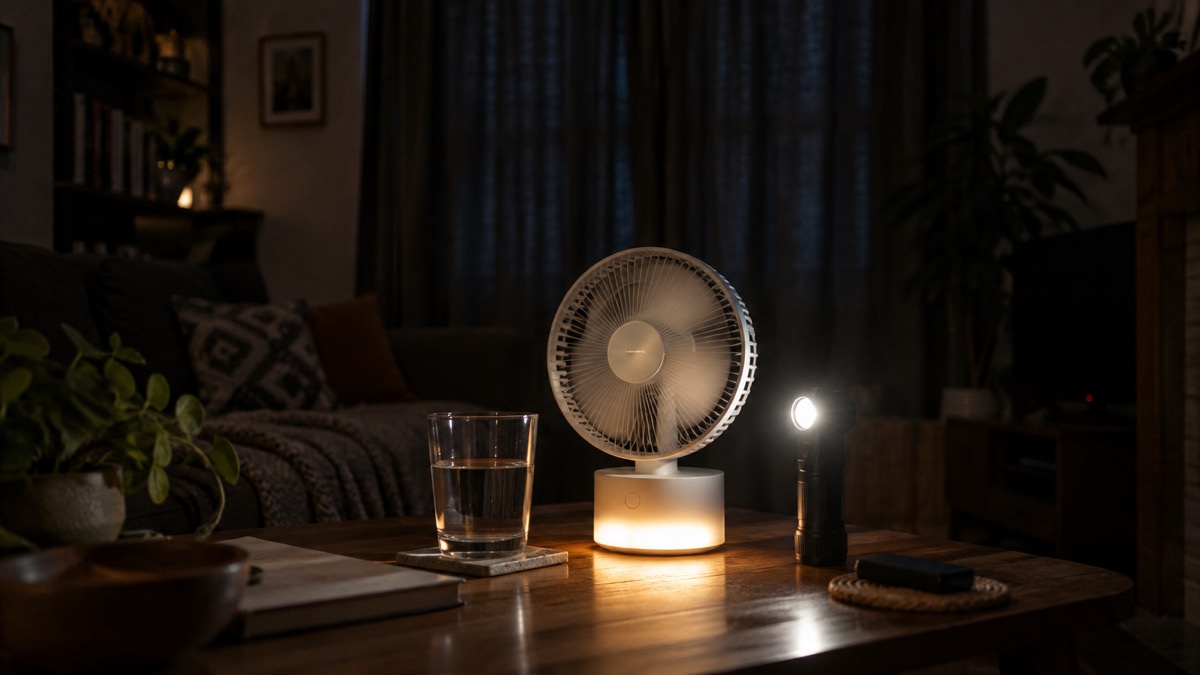
A power cut in hot weather is uncomfortable rather than dangerous for most healthy adults, but it removes the fans, the fridge and often the hot water at the moment you need them. The first principle is to keep the heat out and the air moving. Derbyshire County Council advises ensuring adequate ventilation9. Berkshire Healthcare NHS Trust suggests cooling the room down with a fan, or opening windows and doors to let a draught flow, using curtains, blinds or shutters on your windows, opening windows in the morning and evening, turning your heating off, and turning off any appliances you do not need10.
A rechargeable fan earns its place here. The Met Office advises taking a small hand-held battery fan when travelling in extreme heat11, and the same logic applies at home: a battery fan keeps working when the socket does not. Northern Ireland's nidirect service notes that electric fans may provide some relief, and adds two useful points for a power cut: turn off non-essential lights and electrical equipment, as they generate heat, and keep indoor plants and bowls of water in the house, as these can cool the air12. Oxfordshire County Council suggests using portable electric fans with a bowl of ice, or installing a permanent ceiling fan or ventilation system7.
If the power cut is prolonged, the how to keep cool during a power cut page sets out a fuller routine, and the power cuts section covers the wider household plan. For most people the practical steps are:
- Move to the coolest room in the house, usually on the lowest floor and away from south-facing windows.
- Close curtains and blinds on sun-facing windows during the day, and open windows at night when it is cooler outside.
- Use a battery fan on a low setting rather than a high one, to make the battery last.
- Drink regularly, and check on anyone who lives alone or is unwell.
Run time and charging
Run time is the number that decides whether a rechargeable fan is worth having. It depends on the battery's capacity, the fan's speed setting and the fan's power draw, and it is the figure to check before you buy. A fan running on its lowest setting will last considerably longer than the same fan on its highest, and a small hand-held fan will generally outlast a large floor model on the same charge.
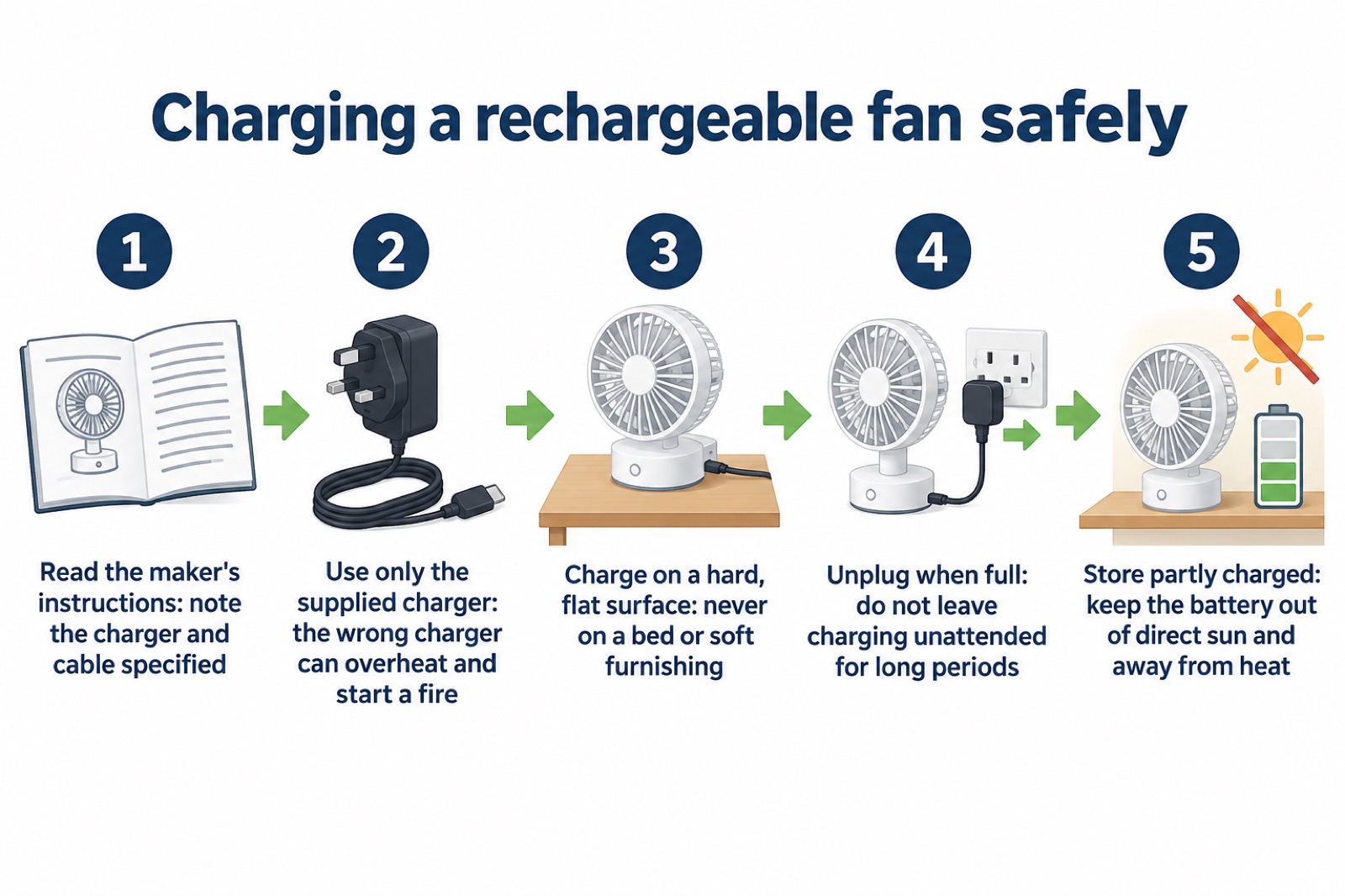
Charging is where most problems arise. Manchester Fire and Rescue Service is clear: only use the charger that came with the battery, because using the wrong charger can lead to the battery overheating and a fire starting6. West Yorkshire Fire and Rescue Service gives the same advice: always use the charger supplied with the device, or a replacement recommended by the manufacturer, because using the wrong charger can cause overheating and increase the risk of fire13. Charge a fan on a hard, flat surface, not on a bed or sofa, and unplug it when it is full.
A power bank can extend a fan's run time if the fan is designed to charge from one. Electrical Safety First describes a power bank as a battery, circuitry and one or more charging ports, often USB or USB-C14. That means a power bank is a small stored-energy device in its own right, and the same charging discipline applies: use the cable and charger the maker specifies, and do not leave a power bank charging unattended for long periods. Which? notes that power stations can be charged with solar panels but will take a while to charge15, which is worth knowing if you are relying on one for a multi-day outage.
Safe use and storage
The fire risks around fans are small but real, and they cluster around three things: the battery, the charger and the way the fan is positioned. Manchester Fire and Rescue Service says rechargeable batteries are generally safe when used correctly, but misuse can lead to serious fire risks6. West Yorkshire Fire and Rescue Service repeats the point13. The most serious recent example is a product recall: the Valiant Radiator Fan, a white rechargeable radiator fan with a black settings control screen, was recalled because the battery may fail during charging or while in normal use, leading to thermal runaway, and owners were told to dispose of it safely via their local household waste disposal site, checking first with the local centre if they accept this type of battery16.
Position matters too. Electrical Safety First warns that a fan balanced on the edge of a surface, or with items attached to it, is a hazard, and says always to place your fan on a flat stable surface17. The same organisation has warned about a social media cooling hack that involves attaching frozen towels to a fan: water can come into contact with the motor, increasing the risk of electric shock and damaging the fan completely17. If you want the cooling effect of evaporation, use a bowl of ice near the fan rather than anything attached to it.
Storage between summers matters as well. Keep a rechargeable fan and its charger dry, out of direct sunlight and away from heat, and check the battery and cable for damage before the first hot spell of the year. If a fan has been recalled, stop using it and follow the recall notice. The emergency kit section explains how a fan and a power bank fit into a wider household kit, and the backup power section covers charging options in more depth.
Where to get help in a heatwave
Most people ride out a hot spell with shade, water and a fan, but some need help. The UK Health Security Agency's heatwave guidance says to be alert and call a doctor or social services if someone is unwell or further help is needed2. If you are worried about heat-related symptoms, call NHS 111 or speak to your local pharmacist3. For a life-threatening emergency, call 999; the when to call 999 or NHS 111 for heat illness page sets out the signs that decide it.
If you are supporting an older or vulnerable person, government guidance for social care managers is a useful summary of what to do: use electric fans only if the air temperature is below 35°C, and do not use them above that because they can raise body temperature8. Pair any fan with regular drinks, and check on the person during the hottest part of the day. The who is most at risk in hot weather page explains who needs the most attention, and how to check on older and vulnerable neighbours in the heat gives a practical routine.
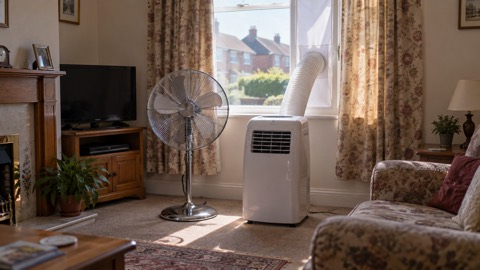
For households that need extra support, the extra help in an emergency section covers older, disabled and medically dependent households, including the Priority Services Register. If a heatwave coincides with a power cut, the power cuts section explains what to expect and who to contact. And if you are choosing between a fan and a more powerful cooling appliance, the electric fan or portable air conditioner comparison sets the two side by side.
Sources (17)
- Stay cool and safe in hot weather, Somerset Council, 2026-07-08
- Heatwaves, UK Health Security Agency, 2026-10-29
- Beat the Heat: staying safe in hot weather, GOV.UK, 2026-07-21
- Extreme weather summer guide, London Fire Brigade, 2024-05
- Electric fans, Electrical Safety First, 2026-10-26
- Battery safety, Manchester Fire and Rescue Service, 2026-10-29
- Beat the Heat, Oxfordshire County Council, 2026
- Supporting vulnerable people before and during hot weather: social care managers, GOV.UK, 2024-12-19
- Keeping cool, Derbyshire County Council, 2026-10-29
- Staying well in hot weather, Berkshire Healthcare NHS Foundation Trust, 2026-10-29
- Stay safe in extreme heat, Met Office, 2026-10-29
- Heat exhaustion and heatstroke, nidirect, 2025-12-02
- Battery safety, West Yorkshire Fire and Rescue Service, 2026-10-29
- Power banks, Electrical Safety First, 2026-10-26
- Emergency kit packing list, Which?, 2026-09-30
- Product recall: Valiant Radiator Fan, GOV.UK, 2025-11-07
- Warning over TikTok fan cooling hack that could risk electric shock, Electrical Safety First, 2026-10-25
 Fan vs Air Conditioner
 Portable vs Split Air Con