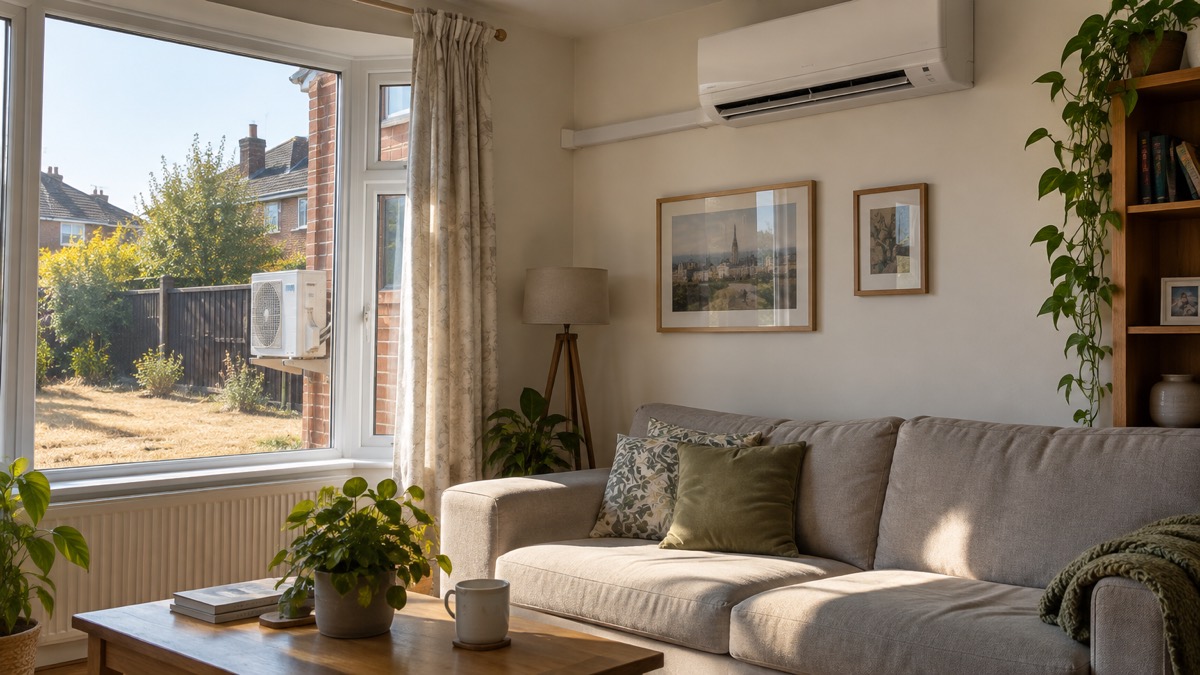
If you are weighing up a portable air conditioner against a fixed split system, the choice comes down to three things: whether you can have work done on the building, how much power you can spare, and how much noise and space you can live with. A portable unit is a single box on wheels that you vent out of a window and plug into a wall socket. A split system has an indoor unit fixed to a wall and an outdoor unit, connected by pipework, and it needs a qualified engineer to install it.
Neither will run in a power cut. That matters more than it used to, because hot summers are now something households plan for rather than endure. Official hot weather advice is to use fans and air conditioning units if they are available for you, and to move to a cooler place, such as a room with air conditioning or somewhere in the shade, ideally cooler than 26°C1. Everything else is about how you get there.
This page sets out how each type cools a room, what a portable unit needs at the window, why a split needs an engineer, what each draws from the mains, and what to do when the power fails and neither will run.
| Portable air conditioner | Split system | |
|---|---|---|
| Typical power draw | 900 to 2000W, up to 2000 watts3 | Check the maker's datasheet for the model |
| Current | Up to 9.3 amps3 | Check the maker's datasheet for the model |
| Installation | None beyond the window vent | Qualified and competent installer needed4 |
| Where the heat goes | Out of the window through a hose | Outside via the outdoor unit |
| Portability | One room at a time, on wheels | Fixed to the room it serves |
| Works in a power cut | No | No |
Portable or split air conditioner: how each one cools a room
Both types work on the same principle: they move heat from inside the room to somewhere else. A split system does this with a refrigerant circuit running between an indoor unit and an outdoor unit, so the heat ends up outside the building. A portable unit does the same job inside one box, but the heat it removes has to go somewhere, and that somewhere is out of your window through a flexible hose.
That difference shapes everything else. A split system cools quietly because the noisy part, the compressor, sits outside. A portable unit carries its compressor with it, so you hear it in the room. A split system is fixed, so it cools the room it serves and stays there. A portable unit can be wheeled from bedroom to living room, but only one room at a time, and only where you can vent it.
Official guidance on keeping cool treats air conditioning as one option among several. NHS advice for hot weather says to cool the room down with a fan, or open windows and doors to let a draught flow, to use curtains, blinds or shutters on your windows, to open windows in the morning and evening, and to turn your heating off and use air conditioning if you have it2. In other words, air conditioning is a supplement to shading and ventilation, not a substitute for them.
Where a room has no air conditioning at all, official extreme weather advice is blunt: stay on the lowest floor away from the sunshine, and remember that electric fans do not cool, they just blow hot air around7. That is the gap an air conditioner fills. It is the only one of the common home cooling options that actually lowers the temperature of the air in the room, rather than moving it about.
For a fuller look at the portable type on its own, see Portable Air Conditioners: How They Work and How to Choose. If you are still deciding whether any machine is worth it, Electric Fan or Portable Air Conditioner: Which Suits Your Home? sets the two side by side.
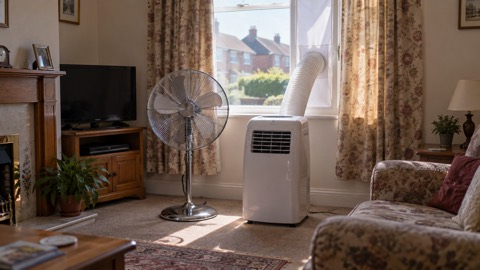
How a portable unit vents hot air through a window
A portable air conditioner collects heat from the room and pushes it out through a hose. If that hose vents into the same room, you are heating the room with the heat you just removed, plus the heat of the motor. So the hose has to go out of a window, and the window opening around it needs to be closed off as far as possible so the hot air does not simply blow back in.
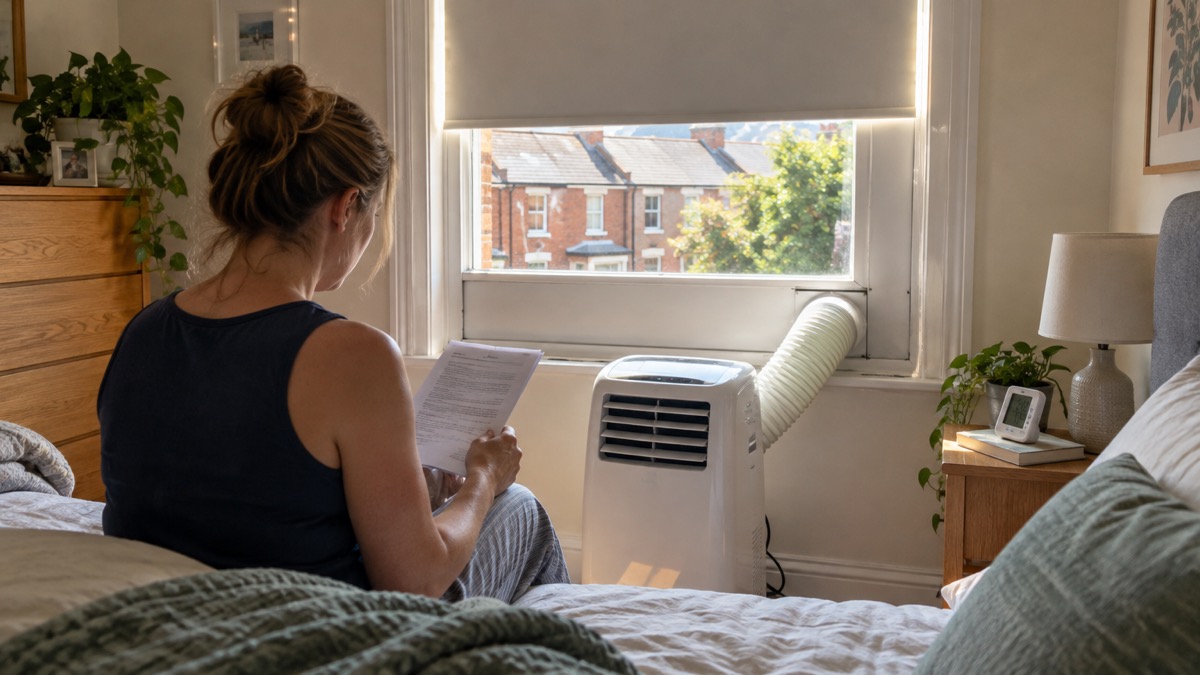
For an air conditioner the principle is to get the exhaust going out and a little fresh air coming in, not a wide open window that lets the summer heat straight back into the room you are trying to cool. The maker of one portable unit lists its duct options as a single air outlet duct, dual exhaust air ducts, or dual exhaust air ducts with a window vent board5. Whichever you use, keep following the keep-the-heat-out advice even with air-conditioning, as this reduces the cooling required and uses less electricity9.
Practical points that decide whether a portable unit works:
- Seal the gap. A window kit, a purpose-made fabric or plastic panel with a hole for the hose, stops hot outside air flooding in around the exhaust.
- Keep the hose short and straight. A long, kinked hose traps heat and cuts efficiency.
- Site the unit on a flat, stable surface. Fire services advise placing any portable heater on a flat, stable surface at least three feet from flammable materials such as curtains, furniture, bedding or clothing9. The same caution applies to a hot exhaust hose near curtains.
- Do not block the air intake or outlet. The unit needs clear space around it to breathe.
For the window side of this in more detail, see Window Kits for Portable Air Conditioners. If your main problem is solar gain through glass rather than air temperature, How to Stop the Sun Heating Your Rooms Through the Windows covers shading first, which is cheaper and works whether or not the power is on.
Installing a split system needs a qualified engineer
A split system is a fixed installation. It involves pipework through a wall, an outdoor unit mounted on a bracket or a wall, and an electrical connection. That is not a DIY job, and official guidance is clear that electrical work should be done by someone competent.
Where electrical work is required, for example fitting an outdoor socket, you should use a qualified and competent installer4. For work that falls under building regulations, choose someone registered with a competent person scheme who can self-certify that their work complies10. The Health and Safety Executive's guidance on electrical safety at work makes the same point in domestic terms: you must ensure that your electrical installation and equipment is safe, and electrical installations must be installed by someone who has the necessary training, skills and experience to carry out the work safely11.
If your home has a gas supply involved in any part of the work, the rules are stricter still. A Gas Safe registered engineer must fit and check a gas appliance, and a non-registered engineer may not fit it10. That does not usually apply to an air conditioner, but it is worth knowing if a quote bundles in other work.
The practical consequences for a household are cost, disruption and permission. A split system means a site visit, a survey, a day or more of installation, and a hole in an external wall. If you rent, official guidance on home installations says permission may be required under the terms of your tenancy agreement, and that unauthorised installations could affect building safety, insurance arrangements, your rights as a tenant or property management requirements4. Ask your landlord or letting agent in writing before you commit.
Running costs and power draw during a heatwave
The figure that decides your electricity use is the wattage. Electrical Safety First's guidance on appliance ratings lists portable air conditioners at up to 2000 watts, typically 900 to 2000W, with the higher the BTUs the higher the power, and up to 9.3 amps3. A split system's draw depends on its size and efficiency, and the maker's datasheet for the model you are considering is the place to check.
A portable unit drawing close to 2000 watts is a heavy load for a domestic circuit. That is why the plug matters as much as the machine. Fire and rescue services advise avoiding extension cords or power strips with portable heaters, and plugging directly into a wall outlet to reduce the risk of overheating and electrical fires9. The same caution applies to any high-draw appliance, including an air conditioner.
Running costs also depend on how you use it. Cooling one room with the door shut and the curtains drawn asks far less of the machine than trying to cool a whole house with doors open. Set the unit to a sensible temperature rather than the lowest setting, and switch it off when you leave the room.
Noise, space and condensation in each type
A split system's noisiest part sits outside, so indoors it is close to silent. A portable unit carries its compressor in the room with you, which is why it is noticeably louder, and why it is a poor companion in a bedroom at night. If noise is your main concern, that single difference may decide it.
Space works the other way. A split system takes a wall panel indoors and a bracket outdoors, and nothing on the floor. A portable unit needs floor space, clear space around it for air to circulate, and a window it can reach with its hose. In a small flat, that floor space is often the binding constraint.
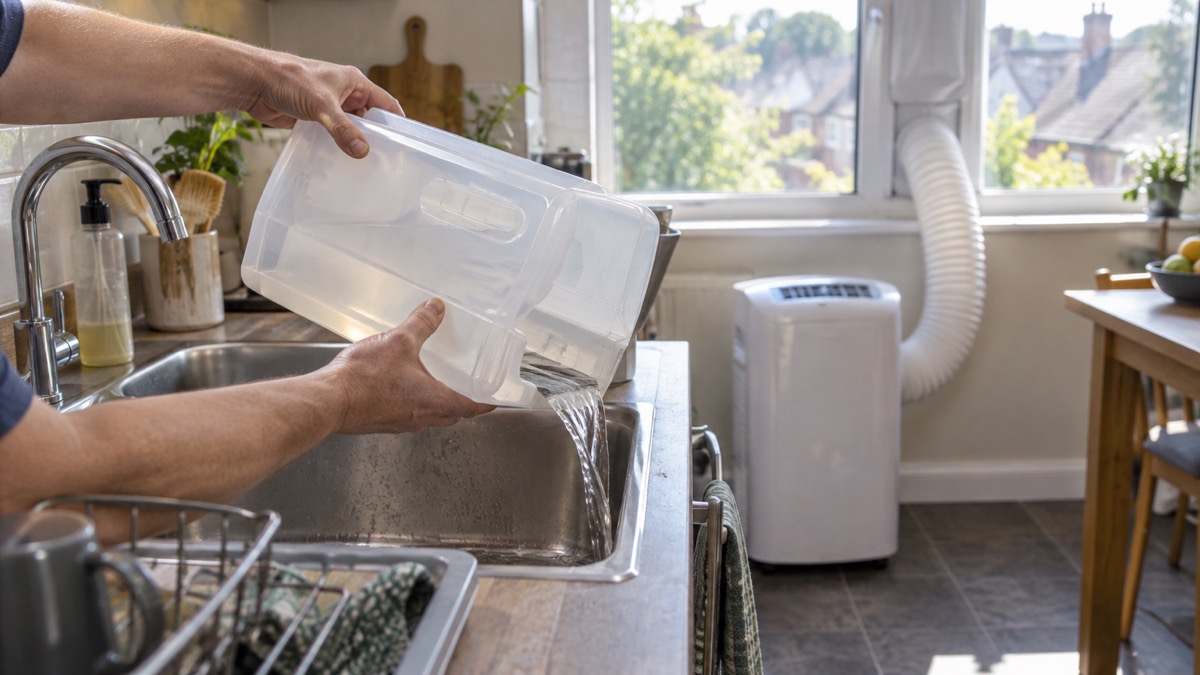
Condensation is the portable unit's other practical burden. An air conditioner removes moisture from the air as it cools, and a portable unit collects that water in a tank or drains it through a hose. In humid weather the tank fills faster. The maker's manual will say how the tank is emptied and whether the unit cuts out when it is full. Empty it before it overflows, and never tip a running unit.
On heat and moisture generally, official guidance for keeping a home cool includes using curtains, blinds or shutters on windows and opening windows in the morning and evening when the air is cooler2. In Northern Ireland the advice adds a specific caution: open windows at night when the air is cooler, but close ground floor windows when you leave the house or go to bed12. That applies to the window you have open for your exhaust hose too.
Keeping cool during a power cut when neither will run
Neither a portable nor a split air conditioner will run without mains power. Most power cuts do not last very long11, but a summer outage during a heatwave is uncomfortable and, for some people, risky. Plan for it before it happens.
The first thing to accept is that a fan is not a substitute for air conditioning in a sealed hot room. Official extreme weather advice is explicit: electric fans do not cool, they just blow hot air around7. What a fan can do is move air across your skin and, if you put a bowl of ice in front of it, blow slightly cooler air. Official guidance suggests using portable electric fans with a bowl of ice, or installing a permanent ceiling fan or ventilation system13.
A plan for a hot power cut:
- Pick a cool room in advance. The lowest floor away from direct sunshine is the official recommendation when there is no air conditioning7.
- Keep the heat out. Close curtains, blinds or shutters on sun-facing windows during the day2.
- Open windows at the right time. Open them in the morning and evening when the air is cooler, and close ground floor windows when you leave the house or go to bed12.
- Use a battery-powered or wind-up radio to follow what is happening, trying both digital and FM stations14.
- Have water within reach and drink regularly, rather than waiting until you are thirsty.
For the wider picture on outages, Power Cuts: A Household Guide covers what to do before, during and after, and Backup Power at Home: A Household Guide explains what a home battery or generator can and cannot do. Note that a generator is not a substitute for an air conditioner's mains supply unless it is sized and connected properly, and connecting backup power to your home's wiring is a job for a qualified electrician.
Where to get help during extreme heat
Heat illness escalates quickly, and the difference between heat exhaustion and heatstroke is the difference between cooling someone down at home and calling 999. NHS advice is to get help from NHS 111 now if you or someone else has symptoms of heat exhaustion that you are struggling to treat, or if you need advice8. In Wales, the same advice is available through NHS 111 Wales15.
If someone has heat exhaustion, the official first aid steps are to move them to a cool place, remove unnecessary clothing like a jacket or socks, get them to drink a sports or rehydration drink or cool water, and cool their skin by spraying or sponging with cool water and fanning, or with cold packs wrapped in a cloth under the armpits or on the neck15. If heatstroke is suspected, cool the person down as quickly as possible while waiting for help, using whatever is available: water, ice packs, a fan, or a cool wet sheet16.
An ambulance may arrive in a rapid response vehicle, a cycle response unit in city centres and on beaches in the summer, or a car, and the service may also send a single-crewed response vehicle with an emergency care practitioner, paramedic or emergency medical technician, the air ambulance, or an emergency doctor17. Help is on its way, so keep cooling the person while you wait.
For people who may need support, official advice is to contact your local authority if you are concerned about someone18. If you live in a home more likely to overheat, contact your local council, your letting agency or Citizen's Advice to find out what help and support they can provide19. A call to an older neighbour, and help moving to the coolest room, is often the most useful thing anyone does during a heatwave. For more, see How to Check On Older and Vulnerable Neighbours in the Heat and Who Is Most at Risk in Hot Weather.
Sources (19)
- Heatwave advice, Guy's and St Thomas' NHS Foundation Trust, 2026
- Staying well in hot weather, Berkshire Healthcare NHS Foundation Trust, 2026
- Ratings of electrical appliances, Electrical Safety First, 2026
- Plug-in solar panels safety advice for residents and homeowners, London Fire Brigade, 2026
- Portable heaters, Cheshire Fire and Rescue Service, 2026
- Electrical safety, Greater Manchester Fire and Rescue Service, 2026
- Extreme weather, Flintshire County Council, 2026
- Heat exhaustion and heatstroke, NHS, 2026
- Safe home heating, Warwickshire County Council, 2026
- Oil storage regulations and safety, GOV.UK, 2026
- Electricity, Health and Safety Executive, 2026
- Hot weather advice, nidirect, 2026
- Beat the heat, Oxfordshire County Council, 2026
- Emergency plan, Ready Scotland, 2026
- Heat exhaustion and heatstroke, NHS 111 Wales, 2026
- Stay cool and safe in hot weather, Somerset Council, 2026
- Using 999, East of England Ambulance Service, 2026
- Staying well in hot weather, Devon County Council, 2026
- Hot weather, Prepare, 2026
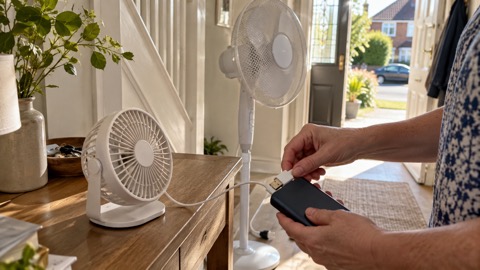 Cordless vs Mains Fan
 Fan vs Air Conditioner