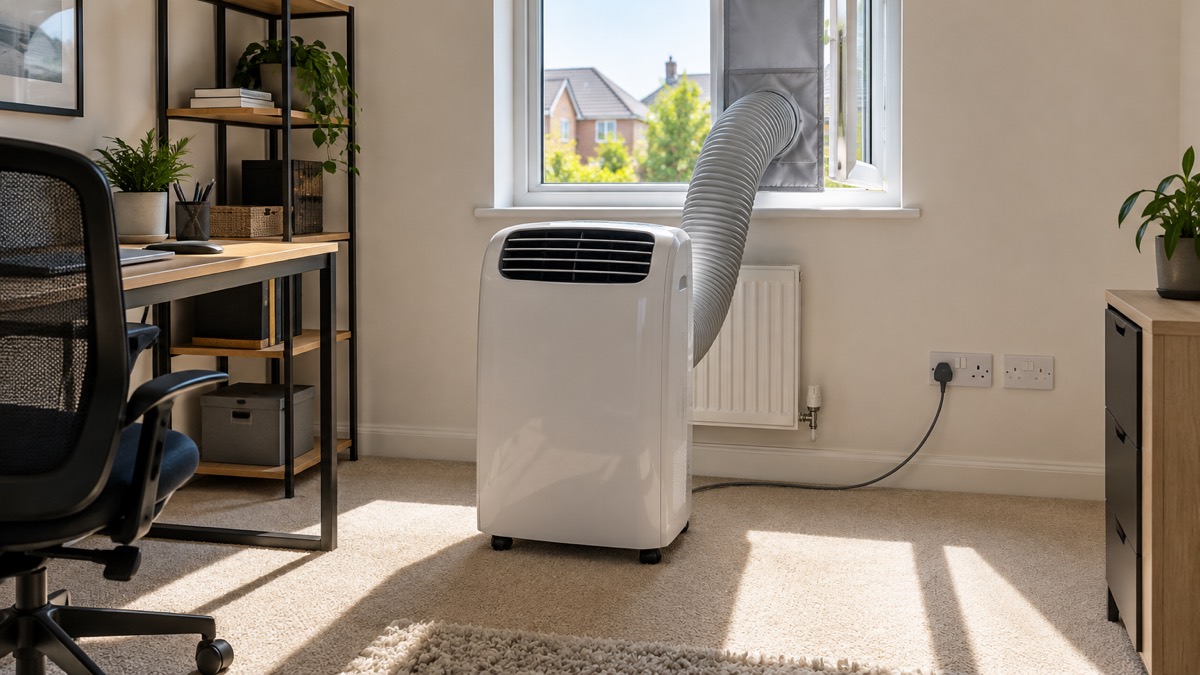
A portable air conditioner is the one household appliance that can actually lower the temperature of a room rather than just move air around, and in a UK heatwave that difference matters, especially for bedrooms and for people who struggle in the heat. But it is also one of the most power-hungry things you can plug into an ordinary wall socket. Electrical Safety First lists portable air conditioners as drawing typically 900 to 2000 watts, and up to 9.3 amps, with the simple rule that the higher the BTU rating, the higher the power it uses1.
That power figure shapes almost every practical decision in this article: which socket you plug into, what else you can run at the same time, and why the unit needs a hose to a window to work at all. The good news is that the running rules are straightforward, and the sections below set out what the makers and the official advice say about each of them.
This page covers how a portable unit gets its heat outside, what the two types of window kit do, how much power to expect and how to manage it safely, and how a portable air conditioner fits alongside the other ways of keeping a home cool covered in our heatwaves and drought guide.
How a portable air conditioner gets rid of its heat
An air conditioner does not destroy heat, it moves it. The unit takes heat and moisture out of the air in your room and then has to dump that heat somewhere, and in a portable unit that "somewhere" is outside, through a hose. That is why every portable air conditioner comes with a venting hose and some way of sealing the end of that hose into a window opening. Without a route outside, the unit would simply pump the heat it removes straight back into the room, along with the extra heat its own motor generates.
The window kit is not an optional accessory, it is what makes the cooling work. Meaco, describing its MC Series Pro 9000 CH, puts it plainly:
"The use of a window kit prevents warm air from outside entering the room, making the cooling more efficient."5
That is the second half of the job. The hose carries hot air out, and the kit seals the rest of the window opening so warm outside air cannot flow back in around it. A badly sealed window means the unit runs harder for a cooler room that never quite arrives.
This is also where a portable air conditioner differs from the cheaper options. A fan moves air but adds a small amount of heat; an electric fan or an evaporative cooler can take the edge off but cannot bring a room's temperature down on a 30-degree afternoon. A portable air conditioner can, provided the window is sealed and the power supply is up to the job. Our comparison page on electric fans versus portable air conditioners sets the two side by side.
Power use: up to 2000 watts and 9.3 amps
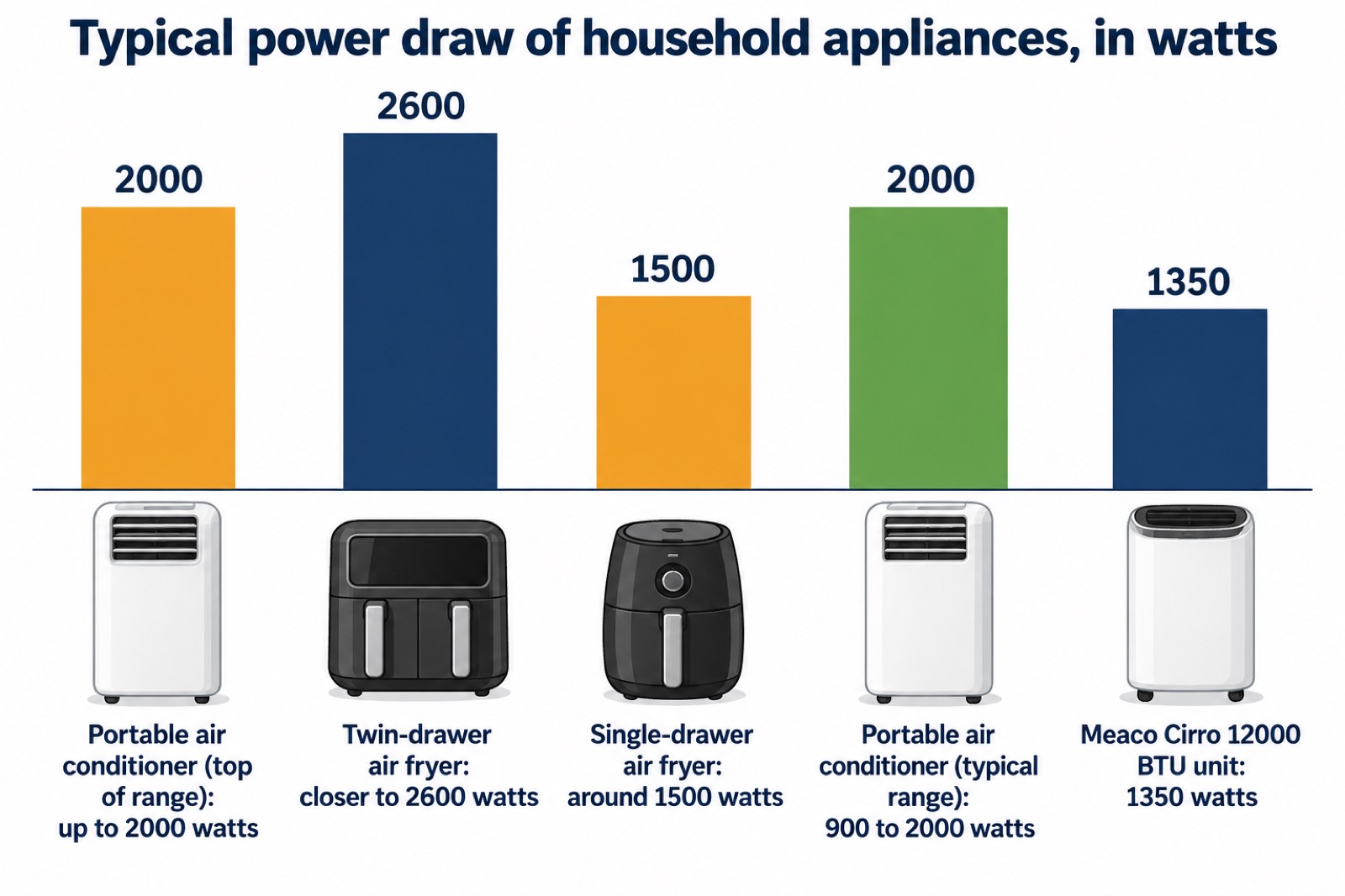
The headline numbers come from Electrical Safety First, which rates portable air conditioners at typically 900 to 2000 watts, with a current draw of up to 9.3 amps1. For comparison on the same list, a single-drawer air fryer tends to be around 1500 watts and a twin-drawer version closer to 2600 watts1, so a portable air conditioner sits in the same league as the kitchen appliances you already know are heavy users.
Where a unit sits in that 900 to 2000 watt range depends on its cooling capacity. Electrical Safety First states the relationship directly: the higher the BTUs, the higher the power1. Meaco's own figures bear this out. Its Cirro 12000 BTU portable air conditioner and heater is listed by the maker at 1350 watts of power consumption2, comfortably inside the typical range for a unit near the top of the household size scale.
What does that mean in practice? It means a portable air conditioner is not something you run alongside the kettle, the washing machine and the tumble dryer on the same circuit without thinking. It also means it is a poor candidate for anything other than a wall socket, which is the subject of the next section. And it means that if you are choosing between sizes, the running load is part of the choice, not just the price of the unit: a bigger BTU number cools a bigger space but pulls more power the whole time it is on1.
Can you run one on an ordinary home socket?
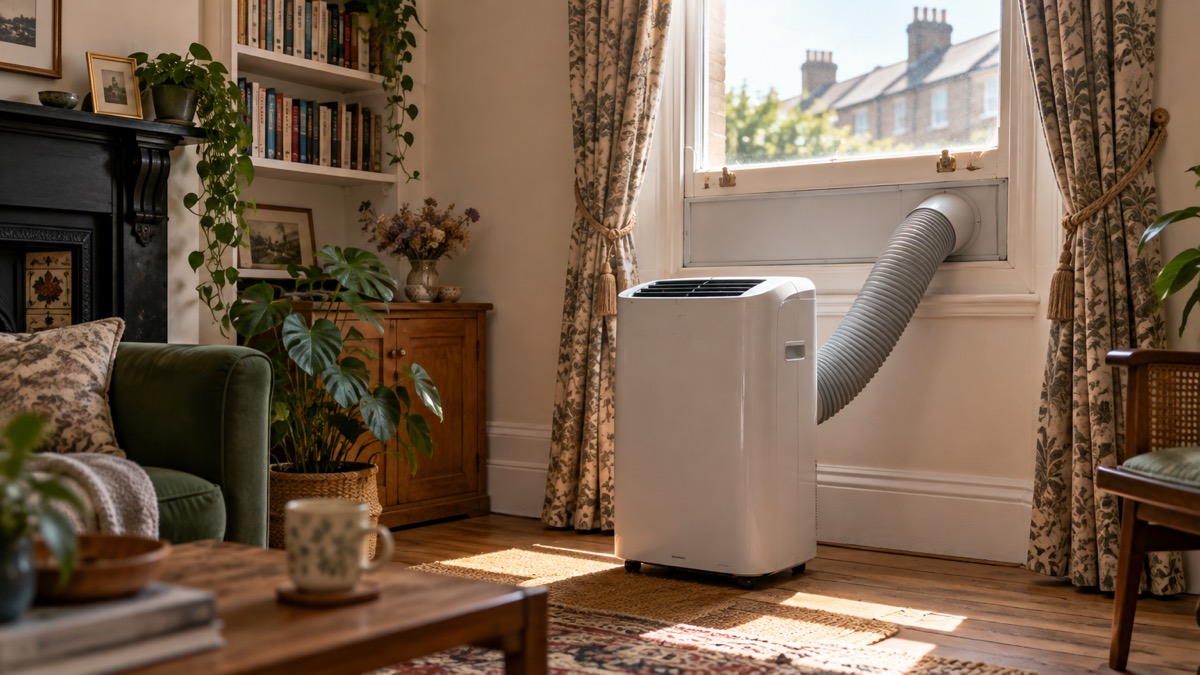
Yes, and that is exactly how you should run it, but only one appliance per socket and never through an extension lead. This is the clearest and most consistent piece of official advice on this page, and it comes from fire and rescue services across all four nations.
The Northern Ireland Fire and Rescue Service recommends that you "plug the heater directly into a socket rather than an extension lead and unplug when not in use"6. North Yorkshire Fire and Rescue Service is blunter about why: "Plug electric heaters into a wall socket not an extension lead - they can easily be overloaded and cause fires"3. Warwickshire's fire safety advice says the same for portable heaters: avoid extension cords or power strips and plug directly into a wall outlet to reduce the risk of overheating and electrical fires7. A portable air conditioner pulling up to 2000 watts1 deserves exactly the same treatment.
The reason is simple. Extension leads and multi-way adaptors are usually rated well below what a high-draw appliance demands, and the overload shows up as heat in the lead and the plug, which is how electrical fires start. Manchester Fire and Rescue Service warns that electric heaters should be plugged into a wall socket and not an extension lead, because extension leads can be overloaded and cause fires8.
If you genuinely have no free socket, there is a limit to what is acceptable. Devon and Somerset Fire and Rescue Service advise: "Do not overload sockets - use one plug in each socket. If you have to, use a fused adaptor and keep the total output to no more than 13 amps"9. A unit drawing up to 9.3 amps1 takes up most of that allowance on its own, so even a fused adaptor leaves almost no room for anything else.
Sharing a socket with other appliances
Do not. Devon and Somerset Fire and Rescue Service's seasonal safety advice recommends that anything which produces a form of heat, such as a toaster, air fryer or kettle, should have its own wall socket, not an extension lead10. Cheshire Fire and Rescue Service likewise advises avoiding overloading sockets when using multiple small appliances11. A portable air conditioner belongs firmly in that heat-producing category.
If you want to check your own set-up, Warwickshire's fire safety pages point to a socket overload calculator that lets you plug in typical household appliances to see the effect on the load and get tips on avoiding overloads12. It is a quick way to see why the air conditioner and the kettle should take turns rather than run together.
Choosing a cooling capacity: what BTU means for your bills and your sockets
BTU (British Thermal Unit) is the measure of how much heat a unit can shift, and it is the main sizing decision when buying. The pack's figures give you three real examples from one maker's range: the MeacoCool MC Series Pro 9000 CH at 9000 BTU5, the MC Series Pro 10000 CH at 10000 BTU2, and the Cirro at 12000 BTU2. The names carry the capacity, which is common across the market.
The key relationship to hold onto is Electrical Safety First's: the higher the BTUs, the higher the power1. Bigger rooms need bigger BTU numbers, but every step up in capacity is a step up in the load on your socket and in the heat your wiring has to carry safely. The Cirro's 1350 watts2 shows that even a 12000 BTU unit can sit in the middle of the typical range rather than at its top, so check the maker's stated power consumption for the specific model rather than assuming the worst case.
Several of these units do more than cool. The MeacoCool MC Series Pro models in the pack are air conditioner, heater and dehumidifier in one2, which is worth knowing if you want one appliance that earns its place across the year rather than only in a heatwave. A unit that heats as well as cools is still a high-draw appliance in either mode, so the socket rules in this article apply year-round. If you are weighing this kind of combined unit against a fixed system, our page on portable versus fixed split air conditioners compares the two approaches.
| Model | Cooling capacity | Stated power consumption | Also does |
|---|---|---|---|
| MeacoCool MC Series Pro 9000 CH | 9000 BTU5 | Not stated on the page cited | Not stated on the page cited |
| MeacoCool MC Series Pro 10000 CH | 10000 BTU2 | Not stated on the page cited | Not stated on the page cited |
| Cirro 12000 BTU Portable Air Conditioner & Heater | 12000 BTU2 | 1350 watts2 | Heats2 |
Window kits: how the hot air gets outside
Every portable air conditioner needs its hose to reach open air, and the window kit is the standard way to do it without leaving a window wide open to the heat you are trying to keep out. Meaco's MC Series Pro units come with two kits in the box: one standard window kit and one flexible window kit2. Understanding the difference between them is the second practical decision after sizing.
The standard kit: three plates totalling 170 cm
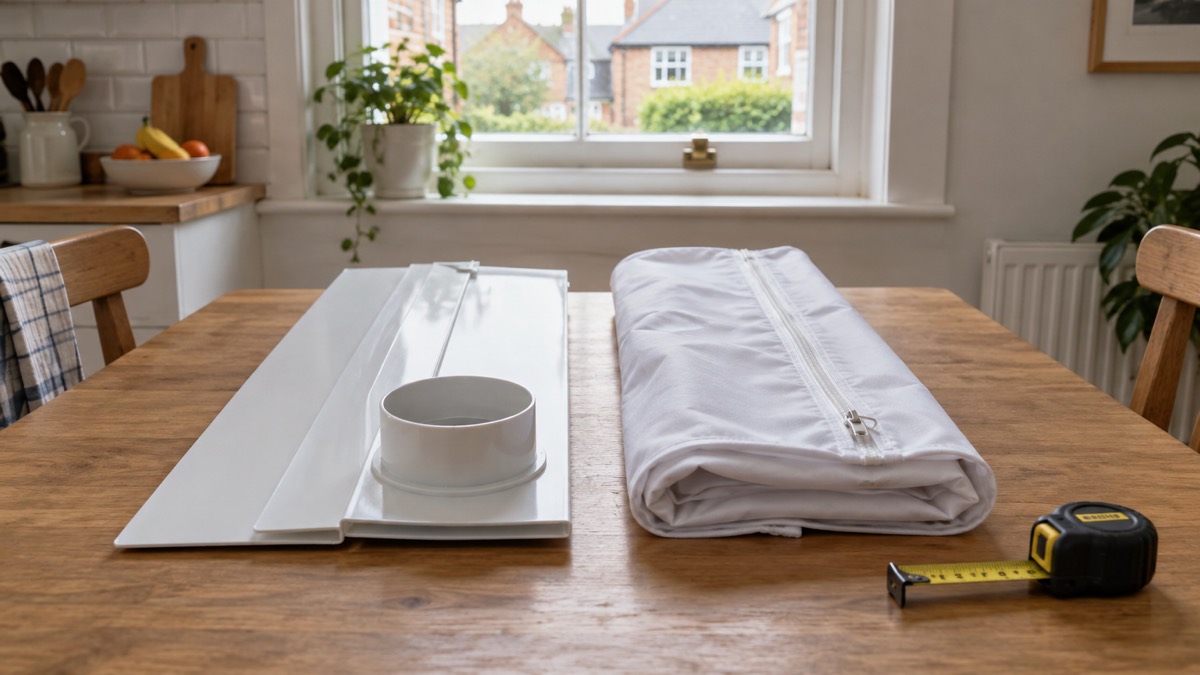
The standard window kit is a set of sliding plates that extend to fill a vertical opening. Meaco gives the dimensions precisely: Plate A is 65 cm, Plate B is 65 cm, Plate C is 51 cm, with a total combined length of 170 cm2. You slide the plates against each other to match the width of your window gap, fit the hose through the aperture, and close the window onto the kit to hold it in place.
This kit is designed for a particular window style. Meaco advises that if you are trying to cover a sliding door, there will be a small gap at the top, which will not massively affect the performance of the air conditioner9. If your windows are sash windows, this is the simpler and tidier option of the two.
The flexible kit: up to 4 m long, for any window
The flexible window kit takes a different approach. Meaco lists its dimensions as up to 39 cm in width and up to 4 m in length5, and states that it is suitable for all types of windows5. Where the standard kit relies on a vertical sliding sash to hold rigid plates, the flexible kit can be shaped to the opening you actually have, including windows that tilt, open sideways, or have awkward shapes.
The 4 m length matters for room layout as well as window type. It gives you freedom to position the unit where the socket and the space allow, rather than directly under the window, though a longer hose run is still a longer hose to manage. Households with modern casement or tilt-and-turn windows, which describe most windows fitted in the UK in recent decades, will usually end up using this kit.
| Standard window kit | Flexible window kit | |
|---|---|---|
| Dimensions | Plates of 65 cm, 65 cm and 51 cm, totalling 170 cm2 | Up to 39 cm wide, up to 4 m long5 |
| Suits | Sash windows5 | All types of windows5 |
| How it works | Rigid sliding plates held by the sash | Flexible material shaped to the opening |
| Supplied with | MeacoCool MC Series Pro units2 | MeacoCool MC Series Pro units2 |
Fitting a standard kit across a sliding door
Some rooms have no suitable window but do have a sliding patio door, and it is tempting to run the hose out through that instead. Meaco addresses this directly on its product page: "if you're trying to cover a sliding door, there will be a small gap at the top (this will not massively affect the performance of the air conditioner)"2.
So it works, with a caveat. A sliding door's full height is more than the standard kit's 170 cm of plates can cover, hence the gap at the top, and some warm air will find its way back in through it. The maker's own assessment is that the effect on cooling performance is not massive2, which means the set-up is a reasonable fallback rather than a perfect seal. If the gap bothers you, the flexible kit, suitable for all types of windows5, is the alternative worth trying on the same opening.
Running it safely: placement, ventilation and what else is in the room
The fire safety advice for high-draw appliances covers more than the socket. The Northern Ireland Fire and Rescue Service advises at least one metre of distance between a heater and combustible materials such as furniture, bedding or curtains, and recommends buying appliances that conform to safety standards from reputable retailers6. Warwickshire's advice for portable heaters is to place them on a flat, stable surface at least three feet from flammable materials such as curtains, furniture, bedding or clothing7. A portable air conditioner's hot hose and warm exhaust make the same clearance sensible: keep the hose route away from curtains and bedding, and stand the unit on a flat, stable floor.
Ventilation advice cuts both ways with an air conditioner. During a heatwave, the official health advice is to keep windows closed while it is hotter outside than inside, and a sealed window is exactly what your window kit gives you. Guy's and St Thomas' NHS Foundation Trust advise that while it is hotter outside than inside, earlier in the day, you should keep blinds or curtains closed at windows exposed to the sun13. Somerset Council's heat health alert advice adds: "only open windows when the air outside actually feels cooler than the air inside - and do not assume that has happened just because the sun has gone down"14.
The same message comes from every nation. Ready Scotland advises opening windows when the air feels cooler outside, for example at night, if it is safe to do so15. The Greater London Authority advises closing blinds and curtains on windows exposed to direct sunlight during the day, keeping windows closed during the hottest parts of the day, opening them when the air feels cooler outside, and getting air flowing through the home16. Llangattock Community Council in Wales puts it as shutting windows and pulling down the shades when it is hotter outside, and opening them for ventilation when it is cooler, if it is safe17. West Yorkshire Prepared add that light-coloured curtains kept closed help, while metallic blinds and dark curtains can make a room hotter18.
A portable air conditioner fits into that rhythm: sealed window and closed curtains while the unit runs through the hottest hours, then windows open for airflow once the outside air genuinely cools. Our page on how to stop the sun heating your rooms through the windows covers the shading side in more detail, and how to sleep and cool a bedroom on hot nights applies all of this to the room where most people actually want the unit.
Product recalls are worth checking
Electrical appliances of this kind are occasionally recalled, and it costs nothing to check before you buy or dig out an old unit. A 2026 product recall notice from the UK government's product safety system covers Ebac Limited air dehumidifiers, portable powered appliances, showing that cooling-and-drying appliances of this general type do get recalled when a fault is found19. If you already own a unit, check the maker's notices and the government's product safety alerts pages for your model.
Where a portable air conditioner fits among your other options
A portable air conditioner is the heavy end of household cooling, and most homes will want lighter options alongside it. A fan moves air without chilling it, uses far less power than a refrigerated unit, and needs no window kit, which also means it keeps working in a power cut if you choose a battery model. Our pages on electric fans and on cordless rechargeable fans versus mains fans set out those choices.
For the people in your household who are most affected by heat, the appliance is only part of the answer. Our guides on who is most at risk in hot weather, heat exhaustion and heatstroke and keeping babies and young children safe cover the health side, and heat-health alerts explain the warning system that tells you when a hot spell is coming, which is when a portable unit earns its keep.
If a heatwave coincides with a power cut, a portable air conditioner will not help you: at up to 2000 watts and 9.3 amps1 it is far beyond what any household battery or power bank can supply. Our page on how to keep cool during a power cut in hot weather covers that scenario, and the Met Office's battery fan advice20 is the starting point there.
Frequently asked questions
Can I run a portable air conditioner from a portable power station?
No, not for any useful length of time. A portable air conditioner typically draws 900 to 2000 watts and up to 9.3 amps1, which is beyond what small power stations and power banks are made to sustain. The Met Office's suggestion for hot weather on the move, a small hand-held battery fan20, is the realistic battery-powered option, and our power cuts guide covers what else to have ready.
Can it share a socket with other appliances?
It should not. Fire and rescue services advise one plug per socket4, and Devon and Somerset Fire and Rescue Service recommend that anything producing heat, such as a toaster, air fryer or kettle, has its own wall socket rather than an extension lead10. With the air conditioner drawing up to 9.3 amps1, give it a dedicated socket and run the kettle before or after, not during.
Which window kit do I need?
Match the kit to your windows. The standard kit, three plates totalling 170 cm, suits sash windows5; the flexible kit, up to 39 cm wide and 4 m long, suits all types of windows5. Meaco supplies both with its MC Series Pro units2, so start with the standard kit if you have sashes and the flexible kit otherwise.
Can I cut a window kit to size?
The maker's pages do not describe cutting the plates, so work within the stated sizes: plates of 65 cm, 65 cm and 51 cm, totalling 170 cm, adjusted by sliding them against each other2. For openings the rigid plates cannot seal, the maker's own answer is the flexible kit, suitable for all types of windows5, rather than cutting.
Will the gap at the top of a sliding door matter?
Only a little. Meaco states that covering a sliding door with the standard kit leaves a small gap at the top, and that this will not massively affect the performance of the air conditioner2. Expect slightly less efficient cooling than a fully sealed window, but a workable set-up if the sliding door is your only option.
Sources (20)
- Ratings of electrical appliances, Electrical Safety First, 2026-10-25
- MeacoCool MC Series Pro 10000 BTU portable air conditioner, heater and dehumidifier, Meaco, 2026-10-29
- Heating your home, North Yorkshire Fire and Rescue Service, 2026-03-09
- Cut the risk of fire in your home, Wiltshire and Swindon Prepared, 2026-10-25
- MeacoCool MC Series Pro 9000 BTU portable air conditioner, heater and dehumidifier, Meaco, 2026-10-29
- Home fire safety, Northern Ireland Fire and Rescue Service, 2026-10-14
- Safe home heating, Warwickshire County Council, 2026-10-29
- Stay fire safe, Manchester Fire and Rescue Service, 2026-10-29
- Kitchen fire safety, Devon and Somerset Fire and Rescue Service, 2026
- Staying safe this season, Devon and Somerset Fire and Rescue Service, 2025-12-01
- White goods electrical fire safety, Cheshire Fire and Rescue Service, 2026-05-20
- Christmas safety tips, Warwickshire County Council, 2026-10-29
- Heatwave advice, Guy's and St Thomas' NHS Foundation Trust, 2026-06
- Stay cool and safe in hot weather, Somerset Council, 2026-07-08
- Hot weather, Ready Scotland, 2026-03-24
- Coping with hot weather in London, Greater London Authority, 2026-10-25
- Adverse weather events, Llangattock Community Council, 2026-10-25
- Heatwaves, West Yorkshire Prepared, 2026-10-29
- Product recall: Ebac Limited air dehumidifiers, UK Government product safety alerts, 2026-04-21
- Stay safe in extreme heat, Met Office, 2026-10-29
 Baby and Child Hot Weather
 Hot Weather Preparation
 Flood Warning Checklist
 Air Pollution and Hay Fever
 Babies and Children in Heat
 Blue-Green Algae Risks
 Dehydration Signs and Prevention
 Evaporative Coolers and Fans
 Electric Fans Guide
 Heat Exhaustion and Heatstroke
 UK Heatwave Definition
 Who Is at Risk in Hot Weather
 Why UK Summers Are Hotter
 Sun Safety and Sunscreen
 Swimming Outdoors Safely