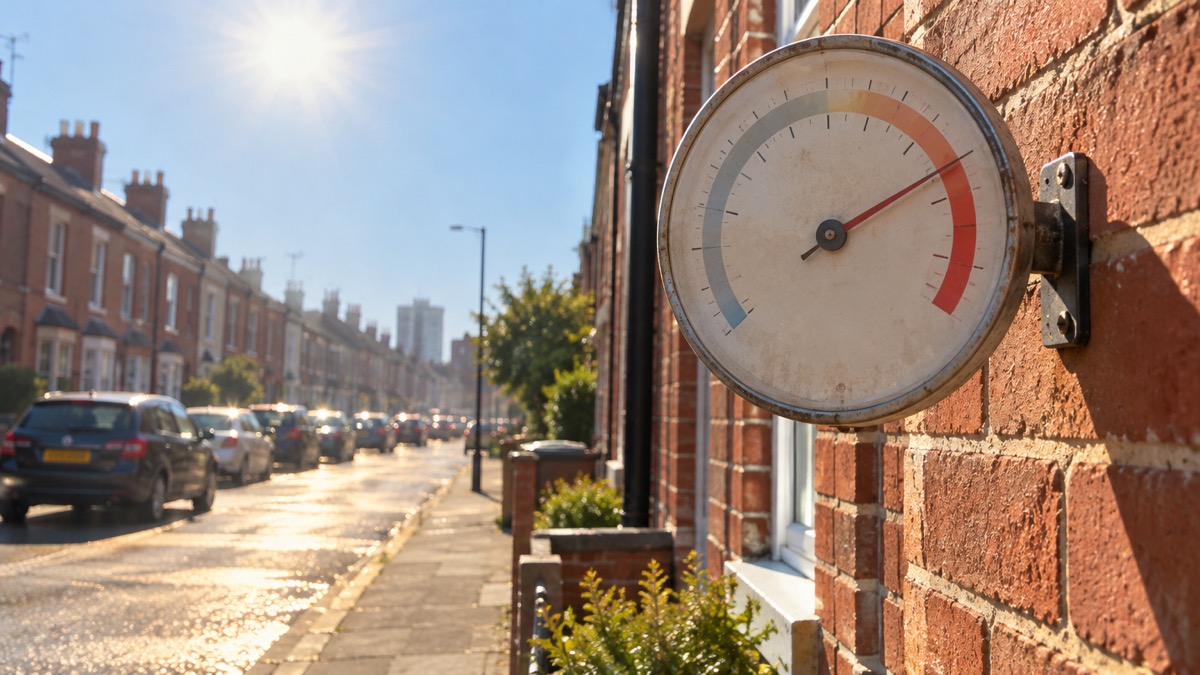
A heatwave in the UK is not simply "a few hot days". The Met Office declares one only when a location records at least three consecutive days with daily maximum temperatures meeting or exceeding a specific heatwave temperature threshold for that area1. That threshold is not the same everywhere: it varies by UK county and ranges from 25°C to 28°C, so a spell that counts as a heatwave in Manchester would not count as one in Cambridgeshire1.
The reason for the local variation is that a heatwave is defined as an extended period of hot weather relative to the expected conditions of the area at that time of year, which may be accompanied by high humidity1. In other words, 26°C means something different in a county used to mild summers than it does in one of England's warmer corners. The thresholds are recalculated against long-term climate averages, and they have risen over the years as temperatures climb around the globe2.
This page explains the official definition, how the Met Office works out each county's threshold, why the numbers have been raised, and how to check the forecast and sign up for warnings so you know before the hot weather arrives. For what to do once a heatwave is under way, see our household guide to heatwaves and drought.
The three-day rule: what makes a heatwave official
The core of the Met Office definition is duration combined with temperature. A UK heatwave threshold is met when a location records a period of at least three consecutive days with daily maximum temperatures meeting or exceeding the heatwave temperature threshold1. Wiltshire and Swindon Prepared puts the same rule in plainer words: in the UK, a heatwave is declared when temperatures meet a set threshold for 3 or more consecutive days2. The government's drought management guidance for England uses the same test, describing a heatwave as declared when the daily maximum temperature exceeds a specific temperature threshold in an area for at least 3 consecutive days6.
Two things follow from this that are worth knowing as a householder. First, a single very hot day, even a record-breaking one, is not a heatwave on its own. The definition is about sustained heat, because it is sustained heat that puts strain on people, homes and services rather than one scorching afternoon. Second, the temperature that has to be sustained depends entirely on where you live. Manchester City Council, for example, tells residents that in Manchester a heatwave means temperatures of 25°C or more for three consecutive days3, which is the bottom of the national range.
It also matters that the definition is relative rather than absolute. The Met Office describes a heatwave as an extended period of hot weather relative to the expected conditions of the area at that time of year1. This is why the UK's definition differs from other countries': Norway's heatwave definition, for instance, requires over 28 degrees for 5 days2. The UK's three-day rule with county thresholds is calibrated to British conditions, where long spells above the high twenties are still unusual enough to demand preparation.
Thresholds by county: 25°C to 28°C
Every UK county has its own heatwave temperature threshold, and the Met Office publishes a UK temperature threshold map so you can look yours up1. The thresholds sit between 25°C and 28°C, with the hotter counties needing hotter weather before a heatwave is declared. The examples below, drawn from official local guidance, show the spread:
| Area | Heatwave threshold | Source of figure |
|---|---|---|
| Manchester | 25°C or more for three consecutive days | Manchester City Council3 |
| East Riding of Yorkshire | 26°C | Wiltshire and Swindon Prepared2 |
| Wiltshire | 27°C | Wiltshire and Swindon Prepared2 |
| Cambridgeshire | 28°C | Wiltshire and Swindon Prepared2 |
The practical point for your household is that you should not rely on a single national number. If you hear "it will reach 27°C this week", whether that could become an official heatwave depends on your county's threshold and on whether the heat lasts three days. Check the Met Office threshold map for your own county rather than assuming the figure you last heard in the news1.
It is also worth separating the heatwave definition from health risk. Oxfordshire County Council warns that temperatures above 25°C increase health risks for babies and young children, older people, people who are homeless, outdoor and manual workers, residents in top-floor flats, and those with long-term health conditions7. In other words, you do not need to wait for an official heatwave declaration, or for your county's threshold to be crossed, before taking hot weather seriously. If temperatures are above 25°C and someone in your home falls into one of those groups, the precautions matter already. Our page on who is most at risk in hot weather goes through this in detail.
Why the threshold varies by county
The threshold varies by UK county because it is built from what each county normally experiences in summer1. The Met Office calculates the thresholds using the 1991 to 2020 climatology of daily maximum temperature at the mid-point of the meteorological summer, 15 July1. Wiltshire and Swindon Prepared describes the same method in shorter form: the thresholds are calculated by the Met Office using climatology of daily maximum temperatures at the mid-point of summer2.
What this means in practice is that the threshold represents roughly how hot a genuinely unusual day is for that county. A county whose typical mid-July maximum is higher, such as Cambridgeshire at 28°C, needs a hotter spell to register as a heatwave than a county whose summers are usually cooler, such as Manchester at 25°C2. The definition is therefore a measure of anomaly: heat that stands out against local norms, rather than heat measured against a single national yardstick.
This design has consequences for how you should read heatwave news. A 27°C spell in Wiltshire sits right at that county's threshold, so three such days would be a heatwave there, while the same three days in Cambridgeshire would fall short of its 28°C threshold2. Neither tells you the health risk on its own. The Met Office also monitors heatwaves and provides advice and mapping to help areas monitor the ongoing situation2, so the county-level picture feeds into the warnings and alerts described later on this page.
How the Met Office calculates the thresholds
The calculation rests on long-term averages rather than recent extremes. The current thresholds use the 1991 to 2020 climatology of daily maximum temperature at the mid-point of the meteorological summer, 15 July1. Climatology here means the statistical picture of typical weather built from decades of observations, so each county's threshold reflects what its mid-summer days have usually reached over that 30-year period.
The Met Office's role goes beyond setting the number. It monitors heatwaves and provides advice and mapping to help areas monitor the ongoing situation2. It also operates the National Severe Weather Warning Service, which issues the yellow, amber and red warnings the public sees, and for some regions it defines warning thresholds of its own. For the North West, Lancashire County Council notes local threshold maximum temperatures defined by the Met Office National Severe Weather Warning Service of 30°C day time and 15°C night time8. Those figures are separate from the county heatwave thresholds and belong to the warning service, which is explained further below.
One more piece of the Met Office's work is worth knowing if you live in England or Wales: the Met Office Fire Severity Index, which informs an assessment of the likelihood and potential severity of wildfires9. During hot, dry spells this index feeds the picture of how severe any fire could become. If a heatwave coincides with drought, see our pages on wildfires and grass fires and on how drought is declared in England.
Thresholds have risen as temperatures climb
The thresholds are not fixed forever. They have risen over the years as temperatures generally rise around the globe2. The current set is based on the 1991 to 2020 averaging period1, and each time the averaging period is updated, the bar moves with the climate.
The background to this is well documented. Derbyshire County Council, citing the Met Office, notes that the Met Office has charted higher annual temperatures, increased days with very heavy rainfall and record-breaking high temperatures since the 1961 to 1990 period, and that according to the Met Office the UK is likely to have hotter, drier summers and warmer, wetter winters10. So the shift from the older averaging period to 1991 to 2020 raised the heatwave thresholds, and a future update would raise them again.
For your household, the message is that the definition of "unusual" heat is a moving target. A spell that would have been declared a heatwave under older thresholds may no longer qualify under the current ones, even though it feels just as hot and carries the same health risks. That is another reason not to wait for an official declaration before acting: the threshold tells you when the Met Office's statistics flag an anomaly, not when you should start drinking more water or shading your windows. Our page on how to keep your home cool in hot weather covers the practical steps.
Heatwaves are likely to become more frequent and more intense
The direction of travel is clear in official guidance from across the UK. Birmingham Women's and Children's NHS Foundation Trust states plainly that the UK can expect more frequent and more intense heatwaves, so it is important that we all make preparations now11. Guy's and St Thomas' NHS Foundation Trust says climate change is already causing warmer temperatures in the UK and heatwaves are becoming more frequent, longer and more intense4. The Met Office's own advice for older people echoes this: as our climate changes, hot spells are expected to be more frequent and more intense12.
Some of the projections are striking. The Met Office states that as greenhouse gas concentrations increase, heatwaves of similar intensity are projected to become even more frequent, perhaps occurring as regularly as every other year by the 2050s1. It also notes that the likelihood of the UK experiencing a summer as hot or hotter than 2018 is a little over 1 in 10, and that such a summer is 30 times more likely to occur now than before the industrial revolution because of the higher concentration of carbon dioxide in the atmosphere1. An NHS risk document for the West Midlands region reports that the number of extremely hot days in the UK could increase four-fold, posing increasing risk to human health from extreme heat13.
The recent record shows what this looks like in practice:
- August 2003: a UK heatwave lasted 10 days and resulted in over 2,000 deaths, with temperatures reaching what was then a record 38.5°C in Faversham, England and 33°C in Anglesey, Wales5.
- 2019: a temperature of 38.7°C was recorded in Cambridge5.
- July 2022: the previous UK temperature record of 38.7°C was provisionally met or exceeded at 46 stations, from Kent to North Yorkshire and from Suffolk to Warwickshire14.
- 2022 in London: temperatures exceeded 40°C during the exceptional heat of that year15.
- 2025 in London: London experienced four official heatwaves15.
The Met Office also notes that the UK experiences occasional heatwaves, but of a lesser frequency and intensity to those seen elsewhere globally14, and that the UK in summer can experience blocking anticyclones, which can bring long spells of warm weather and create heatwave conditions14. Wiltshire and Swindon Prepared adds that heatwaves are most common in the summer months when high pressure develops over an area, and that these systems are slow moving and can stay in place for several days or weeks2. That slow-moving quality is exactly why the three-day rule exists: the weather pattern that drives UK heatwaves tends to park itself over the country.
If you want to understand the climate trend in more depth, see why UK summers are getting hotter and drier, and for the droughts that often follow, England's 2026 drought and where restrictions apply.
How to check the forecast and get warnings
Knowing the definition is only useful if you can see a heatwave coming. The consistent official advice is to stay informed. Lancashire Prepared tells residents to stay informed by looking at the weather forecast and checking warnings from the Met Office to find out the risk for their area16. Surrey Prepared's in-case-of-emergency template directs people to check for weather warnings at www.metoffice.gov.uk/public/weather/warnings17. Essex Prepared advises checking the weather forecast regularly, noting that the Met Office provides forecasts for locations around the country18.
The practical options are:
- The Met Office website: forecasts and warnings for your exact location18.
- The Met Office App: Surrey Prepared advises getting the Met Office App, including alerts to your smartphone, and signing up to Met Office severe weather warnings19.
- By phone: West Yorkshire Prepared lists the Met Office contact number as 0870 900 010020. The Met Office also runs a 24/7 Weather Desk on 0370 900 0100, which you can call at any hour13.
- Social media: the Met Office posts updates at @metoffice17.
- Your own observations: the Met Office's Weather Observation Website (WOW) is a hub for UK weather observations, allowing anyone to submit their own weather data anywhere in the world21.
Signing up in advance is the step most people skip. You can sign up for e-mail alerts from the Met Office or download their Weather App so you are always updated with the latest warnings19. For heat-health alerts specifically, see how to sign up for heat-health alerts, and for staying informed in any emergency, our staying informed guide.
Met Office warning colours: what each level means
Alongside the heatwave definition, the Met Office runs the National Severe Weather Warning Service, which issues yellow, amber and red warnings that advise when to be aware, be prepared and take action20. The warnings use a colour-coded system to show the likelihood and effects of expected severe weather18. They let the public and emergency services know about potentially hazardous conditions22.
| Warning colour | What it means for you |
|---|---|
| Yellow | Check the details of the forecast and consider taking steps to minimise impacts for you and your household. Even in a yellow warning area, people will see disruption to a greater or lesser extent, so check which steps you could take to prepare23. |
| Amber | A heightened state of alert, sitting between yellow and red in the colour-coded system that shows likelihood and effects20. |
| Red | Reserved for very dangerous weather with a high level of certainty. You should take direct action to keep yourself and others safe. It is likely there will be a risk to life, as well as substantial disruption to travel and infrastructure23. |
Extreme heat is one of the hazards covered by these warnings. An example of how specific they are: in July 2021 the Met Office issued an amber weather warning for extreme heat covering Northern Ireland, running between 8.00 am on Wednesday 21 July and 11.59 pm on Friday 23 July22. Each warning names the area, the hazard and the exact window of time, so read the detail rather than just the colour.
The London Fire Brigade notes that the Met Office tracks weather and issues a warning if a heatwave is predicted24. So in practice you may see an extreme heat warning before any official heatwave is declared, because warnings are based on forecasts while the heatwave definition is confirmed by observed temperatures over three days. Treat a warning as your cue to act, not the declaration. For the health side of alerting, see heat-health alerts: yellow, amber and red explained.
Heat-health alerts: the second warning system in England
England has two early warning systems related to high temperature: the Heat-Health Alerting system (HHA) and the extreme heat warnings that are part of the National Severe Weather Warning Service25. The HHA system is part of the Weather-Health Alerting system, operated by the UK Health Security Agency (UKHSA) in partnership with the Met Office25. The Heat-health Alert service is provided by UKHSA in partnership with the Met Office from June to September, with extraordinary alerts issued outside this period if conditions are reached26.
The alerts are based on Met Office regional daytime and night-time maximum temperature forecasts, with an assessment of potential impacts and likelihood when thresholds are reached26. During the summer, UKHSA and the Met Office monitor the weather forecasts and, where hot weather is identified, carry out a joint dynamic risk assessment and then issue the appropriate alert25. Since summer 2021, UKHSA and the Met Office have collaborated to ensure that the HHA and extreme heat warnings are aligned and work together to communicate the expected impacts so that users act to minimise them27.
The regional thresholds for these alerts can differ from the county heatwave thresholds. In the North West, the trigger for a heat health alert is 30°C on successive days with an intervening night temperature no lower than 15°C16. Night-time matters here: hot nights are what make heat dangerous for health, because bodies and buildings get no chance to cool down.
Government advice for England adds that during the summer, UKHSA will work with the Met Office to issue alerts alongside the weather forecast if the weather is so hot that it has the potential to affect people's health28. So as a household in England you effectively have two layers of protection: extreme heat warnings from the Met Office's warning service, and heat-health alerts from UKHSA. Sign up for both, and act on either.
The numbers in local risk registers: planning scenarios, not the public definition
You may come across much higher temperature figures in local authority documents and wonder how they fit the definition. Surrey's Community Risk Register, for example, describes its high temperatures and heatwaves risk (R073) as five consecutive days with maximum temperatures exceeding 35°C29. These are planning scenarios used to prepare local emergency responses, not the definition the Met Office uses when it declares a heatwave or issues a warning.
These are not rival definitions of a heatwave. They are the severe scenarios that emergency planners use to prepare services for the worst realistic cases, well beyond the three-day county-threshold rule that determines whether an official heatwave is declared1. The National Risk Register records what such events can do: the August 2003 heatwave lasted 10 days and resulted in over 2,000 deaths5.
As a householder, you do not need to memorise the planning figures. You need the Met Office threshold for your county, the warnings that tell you when hot weather is coming, and the household steps that reduce risk at any temperature above 25°C1.
What to do when a heatwave is forecast
Once a warning or alert lands, the official advice is consistent. Listen to the news and check your local weather forecast so that you know when hot weather is expected4. Birmingham Women's and Children's NHS Foundation Trust, drawing on the National Heatwave Plan for England, advises checking on elderly or sick neighbours, family or friends every day during a heatwave11. Our page on how to check on older and vulnerable neighbours in the heat explains how to do this well.
For medical help, the advice is clear: if you need medical help for a heat-related health problem, contact NHS 111. In an emergency, or when you think someone has heatstroke, call 9994. Learn the warning signs beforehand on our pages about heat exhaustion and heatstroke and when to call 999 or NHS 111 for heat illness.
In London, transport is a specific consideration: during very high temperatures, temporary speed restrictions may need to be introduced on parts of the Tube and Rail network as a safety precaution, so check before you travel for delays or cancellations24. And if the heat coincides with dry conditions, see what to do if you see or are near a wildfire.
Before the next heatwave arrives, work through our hot weather preparation checklist, and if you want the wider picture of hotter, drier summers and what they mean for water supplies, start at heatwaves and drought: a household guide.
Sources (30)
- What is a heatwave, Met Office
- Heat wave risk, Wiltshire and Swindon Prepared
- Cool spaces to beat the heat in Manchester, Manchester City Council
- Heatwave advice, Guy's and St Thomas' NHS Foundation Trust, June 2026
- National Risk Register, GOV.UK
- Drought: how it is managed in England, GOV.UK
- Keeping cool in heat waves, Oxfordshire County Council
- How to keep cool this summer, Lancashire County Council
- UK_National_Risk_Register_2017.pdf, Cabinet Office
- Adapting to extreme weather, Derbyshire County Council
- Heatwaves, Birmingham Women's and Children's NHS Foundation Trust
- Tips for keeping older people cool, Met Office
- Community Risk Register, NHS Dudley Integrated Health and Care NHS Foundation Trust, March 2024
- Hot weather and its impacts, Met Office, July 2022
- Heat risk, Greater London Authority
- Heatwave: protect yourself, Lancashire Prepared
- In case of emergency template, Surrey Prepared
- Met Office weather warnings, Essex Prepared
- Sign up to warnings and alerts, Surrey County Council, 28 September 2026
- Severe weather, West Yorkshire Prepared
- City flooding: emergency information and preparedness, City of London Corporation
- Extreme heat weather warning: information and advice, nidirect, 20 July 2021
- When and why do we issue warnings, Met Office, 26 October 2026
- Extreme weather summer guide, London Fire Brigade, May 2024
- Heat health alerting system, GOV.UK, 19 December 2024
- Heat-health alert service, Met Office
- Hot Weather Toolkit 2025, NHS Humber and North Yorkshire Integrated Care Board, 28 May 2025
- Beat the heat: staying safe in hot weather, GOV.UK, 21 July 2026
- Community Risk Register 2026, Surrey County Council, 2026
- London Risk Register v14, Greater London Authority, January 2025
 Baby and Child Hot Weather
 Hot Weather Preparation
 Flood Warning Checklist
 Air Pollution and Hay Fever
 Babies and Children in Heat
 Blue-Green Algae Risks
 Dehydration Signs and Prevention
 Evaporative Coolers and Fans
 Electric Fans Guide
 Heat Exhaustion and Heatstroke
 Who Is at Risk in Hot Weather
 Portable Air Conditioners Guide
 Why UK Summers Are Hotter
 Sun Safety and Sunscreen
 Swimming Outdoors Safely