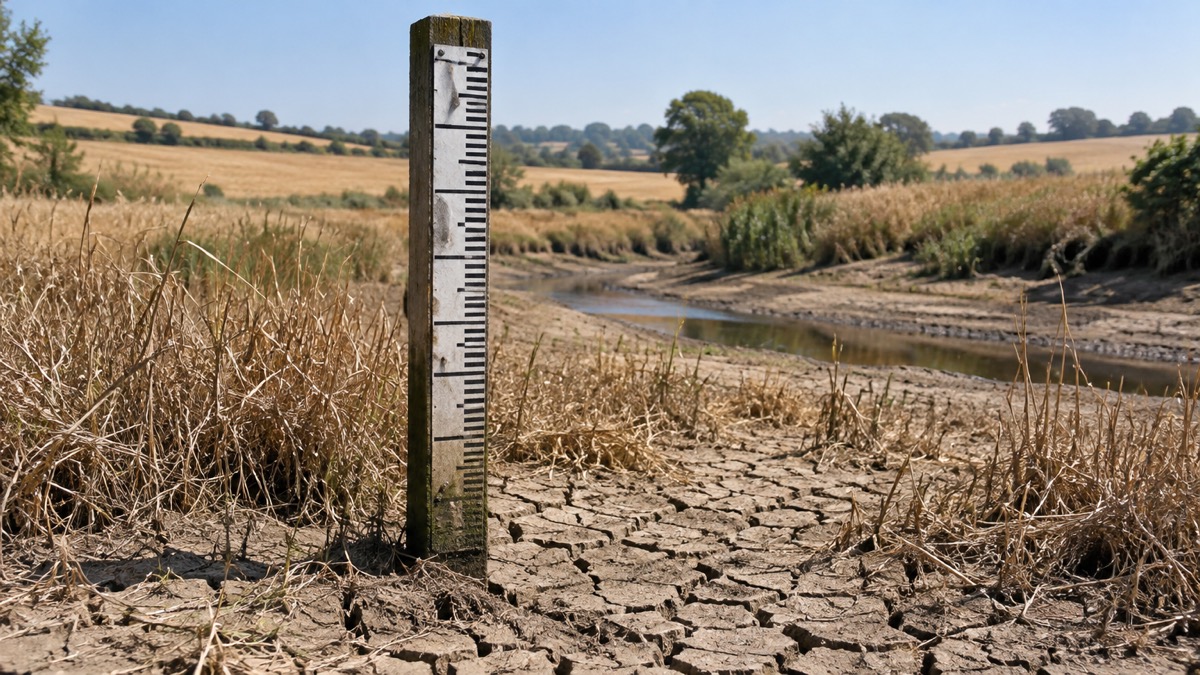
Drought was declared across more than two thirds of England on 10 August 2026 after record hot, dry weather, and the situation has deepened since. Devon and Somerset Fire and Rescue Service reported that drought conditions in the south west had reached the severe category, describing it as a UK first1.
The numbers behind the headlines are stark. In the week ending 13 October 2026, reservoir storage across England stood at 54% of capacity, around 21% below the long-term average for the time of year, and eighteen reservoir groups were less than 50% full, with 11 classed as exceptionally low2. Only 26% of the October long-term average rainfall had fallen on England as a whole by late October2. This page explains what those stages mean, who declares them, what restrictions each one can bring to your household, and how a drought ends.
What a drought is, and why England is in one
A drought means a prolonged period of shortages in the water supply, which can happen after an unusually low period of rainfall for an extended period of time6. Westminster City Council puts it in everyday terms: a drought happens when there is very little or no rain for a long time, causing water shortages, dry soils and environmental damage, and affecting communities, businesses and food production7. The Environment Agency is blunter about definition: all droughts are characterised by a prolonged period of low rainfall creating a shortage of water, but there is not a single definition of drought5. That is why declarations are made area by area, on the evidence of rivers, reservoirs and groundwater, rather than by a national rainfall threshold.
Droughts can occur during prolonged periods of dry weather, which are becoming more frequent in England8. Drought is featured as a risk facing England on the National Risk Register5, and locally it is rated a medium risk: Wiltshire and Swindon's community risk register gives drought a likelihood and impact rating of 2/3, with an impact of Moderate (3)9.
England's geography shapes how droughts develop. In the uplands of the north and west, water resources deplete relatively quickly after just 2 or 3 consecutive months of below average rainfall, because there is little groundwater base flow to support the rivers5. In the east and south, water depends more heavily on groundwater and reservoirs, which is why a single dry winter can set up a drought that lasts well into the following year. There is also a cross-border dimension: most of England's water supply comes from England, but some areas are supplied with water from Wales, so a drought in Wales can affect public water supply in England5.
The current drought did not arrive suddenly. A drought means a prolonged period of shortages in the water supply, and it can happen after an unusually low period of rainfall, for an extended period of time10. The Environment Agency is responsible for safeguarding water resources in England and protecting the environment, and it chairs the National Drought Group, which is comprised of senior members from the English and Welsh governments, the Environment Agency, Natural Resources Wales, water companies, and farming and environmental groups4. The Agency has drought plans for each of its 14 operational areas, reviews them annually in the spring, and carries out a full update every 5 years or following major droughts5.
Who declares drought in England
In England, the Environment Agency decides when we are in drought conditions, working together with water companies to reduce the impact of drought for people in affected areas9. The Agency's legal footing comes from the Water Resources Act 1991, which places a statutory duty on it to secure the proper use of water resources in England, including protecting the environment5. It is responsible for safeguarding water resources in England and protecting the environment, and it has drought plans for each of its 14 operational areas, each with technical drought teams plus a national team5. The Agency carries out a light touch review of its drought plans annually in the spring and a full update every 5 years or following major droughts5.
Above the Environment Agency sits the National Drought Group. It was set up by the Defra Secretary of State in February 2012 to manage that year's drought5. It is chaired by the Environment Agency and is convened in England, whilst in Wales there is the equivalent Wales Drought Group4. Its membership comprises senior members from the English and Welsh governments, the Environment Agency, Natural Resources Wales, water companies, and farming and environmental groups4. The Group meets biannually outside of a drought to collaborate on improving drought preparation, management and response, and its frequency of meetings increases during a drought5. It has three subgroups covering Water Supply, Communication, and Environment, Agriculture and Land Management5. During the current drought the National Drought Group continues to meet regularly to monitor risks, preparation and impacts2.
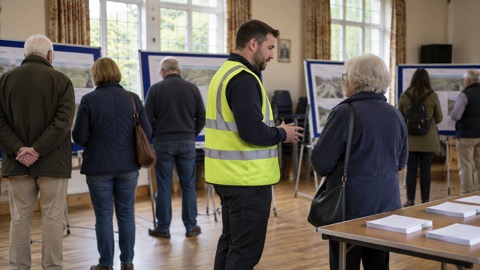
Water companies have their own statutory role. It is a requirement from the UK government for water companies in England and Wales to produce drought plans and update them every five years, consulting on these plans with customers and other organisations4. Different levels of action are taken depending on the severity of the drought, including voluntary requests to customers to use less water and application of temporary restrictions on water use4. You can read more about what those plans contain on our page on water company drought plans.
Two further bodies can act at the sharp end. Drought permits, which allow water companies to abstract more water, reduce other abstractions and restrict certain types of water use, are granted in England by the Environment Agency and in Wales by Natural Resources Wales11. Drought orders, which also permit the Environment Agency or Natural Resources Wales to modify, restrict or stop abstractions to protect the environment, are determined by the Defra Secretary of State in England or Welsh Ministers for sites in Wales5. Our page on drought permits, orders and emergency rota cuts covers these in detail.
The stages of drought and what each one means for your household
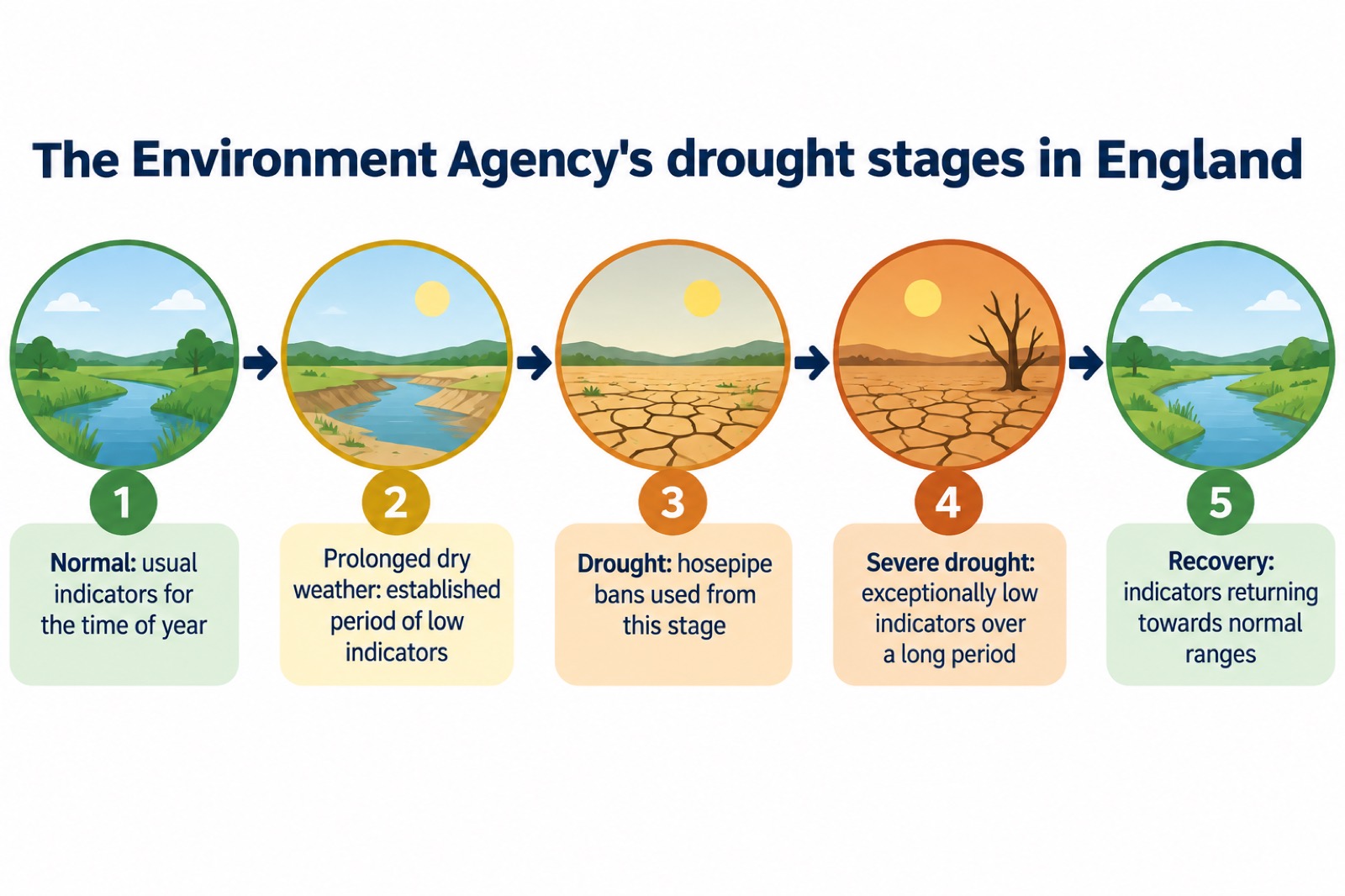
The Environment Agency drought framework has five stages of drought management: normal; prolonged dry weather; drought (temporary use bans, known as hosepipe bans, are used from this stage); severe drought; and recovering drought4. The Agency describes responding under 4 stages of drought management after normal: prolonged dry weather, drought, severe drought and recovery5. Each stage is based on indicators such as rainfall, river flows, reservoir storage and groundwater levels, and each carries a different set of likely impacts.
| Stage | What the indicators show | What it can mean for you |
|---|---|---|
| Normal (green) | Usual ranges for the time of year | Localised environmental incidents during a short summer heatwave or dry spell, for example fish kills5 |
| Prolonged dry weather (yellow) | An established period of low indicators for the time of the year | Heightened risk of environmental damage, short term risk to wildlife and plants5 |
| Drought | Indicators low enough for drought to be declared | Hosepipe bans (temporary use bans) begin at this stage4; water companies may make voluntary requests to use less water4 |
| Severe drought (red) | Exceptionally low indicators over a long period of time | Widespread long term environmental damage, widespread wildfires, failure of crops or plants, shortage of fodder and drinking water for livestock, and failure of public and private water supplies5 |
| Recovery | Indicators improving and returning towards normal ranges for the time of year | Restrictions ease, but the drought is not over until water resources are fully replenished5 |
Two things about the stages are worth fixing in mind. First, moving up a stage does not automatically trigger new restrictions on households: temporary use bans begin at the drought stage, and different levels of action are taken depending on the severity of the drought. Second, the stages describe pressure on the environment and water resources, not a countdown to taps running dry: the severe drought stage is defined by exceptionally low indicators over a long period of time5.
Arrangements differ in Wales. Natural Resources Wales classifies drought into four stages: normal, prolonged dry weather, drought and recovery from drought4. Natural Resources Wales produces a drought plan which describes the indicators used to classify the different stages of drought and provides a flexible framework for dealing with different drought events, acting as an operational manual for NRW drought teams11. In cross-border catchments with Wales, the Environment Agency leads on drought planning for the River Severn, and Natural Resources Wales leads for the River Wye and River Dee5.
Hosepipe bans and other water restrictions
A hosepipe ban, formally a temporary use ban, is the restriction most households meet first. Temporary use bans are used from the drought stage of the Environment Agency framework4. Cambridge Water's temporary hosepipe ban, for example, prohibits watering a garden using a hosepipe or sprinkler system12. What you can and cannot do during a ban is set by law, and there are exemptions for some households: see our pages on hosepipe ban rules and hosepipe ban exemptions.
A ban does not mean supplies are about to fail. Cambridge Water states it has been undertaking actions detailed in its drought plan since the beginning of April to reduce demand and increase water available for supply, and that it is not planning to impose further water use restrictions at the moment; a statutory order would be needed for further restrictions if dry weather continues12. That next step matters to households: compensation does not apply during hosepipe restrictions, which are designated as an Ordinary Drought Order; compensation only applies during an Emergency Drought Order12.
Beyond household bans, drought permits and orders change what happens to the water environment itself. The effects are visible well beyond the tap: Cambridge Water reports farmers experiencing restrictions on irrigation licences, the Canal and River Trust closing several navigation routes due to water levels, and the Environment Agency undertaking fish rescues in streams and rivers due to low flows12.
If restrictions tighten further, the historical precedent is the 1975 to 1976 drought, when restrictions on water use included limited and localised use of rota cuts and standpipes in parts of England and Wales5. Water companies' drought plans set out the levels of action they would take, from voluntary requests to use less water through to temporary restrictions4. Our page on where restrictions apply now tracks the current position.
Cutting your water use at home
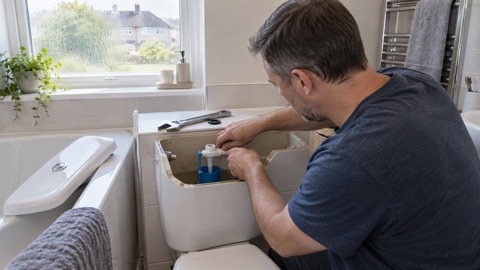
Official advice during a drought is practical and starts in the garden: use a watering can instead of a hosepipe and install a water butt if you can to capture rain6. Surrey's emergency planning guidance adds that you should use water efficiently and find out ways to save water from your water company, noting that if you have a water meter this will help you track the effect13. NHS Lanarkshire's summer preparedness advice includes taking shorter showers14.
A few habits carry most of the benefit:
- In the garden, use a watering can instead of a hosepipe, and install a water butt if you can to capture rain6
- Take shorter showers14
- Follow your water company's water-saving advice, especially if you are on a meter13
- Fix dripping taps and running toilets when you find them, as your water company's advice will confirm7
Water companies' public messaging during droughts tends to focus on individual responsibility and water-saving tips, with a tone that remains predominantly informative and directive, relying on increased frequency and urgency as conditions worsen15. That is worth knowing when you read the news: repeated appeals to save water are a normal part of the drought stage, not a sign that supplies are about to be cut off. Our page on how to save water at home goes further, and our hot weather preparation checklist puts it alongside the rest of your summer readiness.
Health risks in a drought: hygiene, dust and dehydration
Drought is not only a matter of supply. The UK Health Security Agency publishes public health advice on how to protect yourself from the potential health consequences of a drought6, and it has provided advice on the potential health impacts of drought and the measures we can all take to reduce risks to our health5. When droughts are accompanied by a heatwave, health impacts can include dehydration, increased transmission of infectious diseases and poorer mental health6.
NHS guidance for Scotland, which applies the same principles, sets out the mechanisms plainly. Drought may lead to the spread of infectious disease through reduced water quality, poor hygiene and poor sanitation, and to mental health conditions16. Drier soil during a drought can result in the release of dust and other pollutants into the air16. A drought may also cause interruptions to water supplies, like a drop in water pressure16. Essex Prepared likewise lists public health risks from dehydration and hygiene-related illnesses among the impacts of water supply failures17.
What that means in practice for a household:
- Keep drinking enough, and know the signs of dehydration in hot weather
- Do not cut back on handwashing: hygiene-related illness is a specific drought risk16
- Take care on dusty, dry days if you have a lung condition, as dust and pollutants can be released into the air16
- Look after your mental health and that of people around you; drought and heat can worsen stress and anxiety6
- Check on older and vulnerable neighbours, who face the combined risks of heat and reduced supply
A review of water companies' drought communication plans found that few messages addressed health-related risks such as dehydration, the spread of water- and food-borne diseases, mental health conditions and physical health15. So do not wait to be told: the health advice exists, and it is worth acting on before anyone asks you to. If you are in Scotland, NHS inform provides advice on steps you can take to protect your health during a drought18. Our pages on heat exhaustion and heatstroke and who is most at risk in hot weather cover the heat side in full.
Wildfire risk rises in dry weather
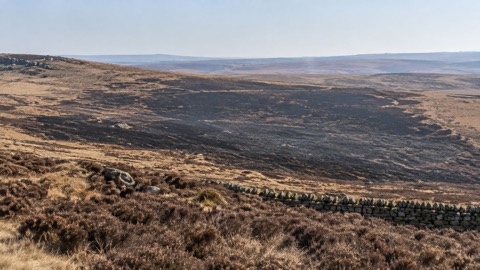
The most dangerous consequence of a drought for many households is fire. Prolonged periods of dry weather or drought conditions make vegetation highly flammable19, and dry conditions can allow fire to spread quickly, putting lives, wildlife and property at risk, as the Northern Ireland Fire and Rescue Service warns20. Wildfires can spread quickly and threaten homes and infrastructure, particularly during warm, dry weather21. In dry conditions there is an increased risk of grass or wildfires22, and often the dry conditions lead to an increase in the number of gorse fires23.
The trend is upward. As heatwaves and summer droughts become more common, the risk of wildfires will also increase, harming air quality, wildlife and habitats24. The Welsh Government's resilience assessment finds that the wildfire risk is increasing, the wildfire season is getting longer and more wildfires are occurring simultaneously, especially during summer heatwave conditions25.
Access can be closed before fires even start: Natural England may have to restrict access to some areas if there is a risk of fire caused by the dry conditions5. Wildfires are a particular risk during dry weather spells, when they can devastate wildlife and habitats as well as people and property26. Our pages on barbecues and wildfire risk, what to do if you see a wildfire and protecting your home from wildfire give the full guidance.
Rivers, ponds and private supplies
Low water changes the risks around water itself. Drought can cause lower water levels in rivers, lochs and streams16, and droughts can reduce river flows and levels in lakes making them more dangerous, so you should find out what is happening in your local area before you undertake activities like swimming or diving6. In the week of 9 to 15 October 2026, twenty-four reported river flow sites (44% of the total) were classed as below normal and 10 sites (18%) were classed as notably low2. Our page on swimming safely outdoors covers the precautions, and blue-green algae is a separate drought-season hazard: there have been 41 confirmed algae and 99 confirmed dead fish incidents attributed to drought and dry weather in England since the start of 20262.
Garden ponds need thought on two fronts. The Environment Agency is unable to carry out fish rescues from private and ornamental ponds: landowners are responsible for fish in these sites, though the EA will give advice on managing stock safely and legally27. Any fish being introduced to open waters needs Environment Agency approval first, and people should not release unwanted fish into ponds, lakes or other waterbodies27. And supervise young children near water at all times: the Royal Society for the Prevention of Accidents reports that garden ponds are involved in more than half of all toddler drownings, with five under-sixes drowning every year in ponds in the UK28.
If your home is on a private water supply, drought is a direct supply risk. During periods of very low rainfall groundwater levels can become exceptionally low, causing spring sources to dry up or pumps to run dry11. Argyll and Bute Council advises that first steps are likely to include reducing current usage to conserve the supply and considering where you could access drinking water should the supply cease29. Our page on what to do if your private supply dries up sets out the full steps.
Where to check the drought status for your area
The most reliable picture of England's drought comes from the Environment Agency's own reporting. The Agency publishes monthly water situation reports and weekly rainfall and river flow reports for England6, and during the current drought it is publishing weekly dry weather and drought summary reports; questions about the current report can be sent to drought.national@environment-agency.gov.uk2. Each of the Environment Agency's 14 operational areas has a drought plan outlining the steps taken at the local level4, and requests can be made for copies of area drought plans through the Agency's customer contact team at enquiries@environment-agency.gov.uk5.
For restrictions that affect you directly, your water company is the authority. Cumberland Council's weather readiness guidance directs customers to check the latest situation on the United Utilities website8, and the same principle applies to every company: search your supplier's name plus "drought" or "restrictions". Our page on England's 2026 drought and where restrictions apply gathers the current position in one place.
Behind the scenes, the Environment Agency has activated its incident response arrangements, with Gold Command structures in place and drought plans being implemented2. The Agency is a Category One responder, and during a live incident its teams carry out Warning and Informing duties with local communities, deploy equipment and sample and monitor during pollution incidents30. If you have concerns about river or stream water quality, contact your local Environment Agency office on 03708 50650627. The Agency is also responsible for 2,000 reservoirs in England and Wales and enforces the Reservoirs Act 197531.
How a drought ends, and England's past droughts
A drought does not end when the rain returns. Only when rainfall has fully replenished groundwaters, reservoirs and rivers would a drought be over, and this can sometimes take a long time5. That is why the framework has a distinct recovery stage, with indicators improving and returning towards normal ranges for the time of year5, and why areas can sit in recovery for months while reservoirs and groundwater catch up. The total of 403 drought and dry weather environmental incidents recorded in England since the start of 2026 already exceeds the overall totals for 2022 (380) and 2025 (321)2, and to date there have been 186 confirmed abstraction or low flow incidents since the start of 2026, higher than the equivalent total from 20252.
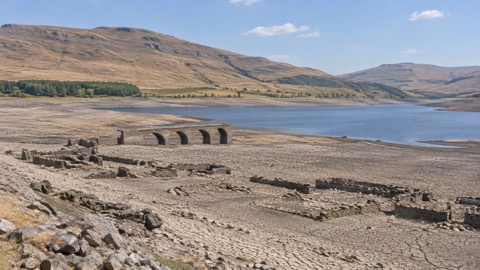
England has been here before. Over the past 50 years the most notable droughts were 1975 to 1976, 1989 to 1992, 1995 to 1996, 2004 to 2006, 2010 to 2012, 2016 to 2018, 2022 to 2023 and 2025 to 20265. From September 2010 to March 2012 many parts of England experienced the driest 18 months for over 100 years5. Large rainfall deficits in winter 1989 to 1990 led to a significant impact on groundwater and resulted in a drought that continued to the end of summer 1992 in the east of England5. The Environment Agency has published a report setting out a timeline of how the 2025 drought developed in England32. Our page on past UK droughts and heatwaves compares them in full.
For now, the practical position for households is this: know your stage, follow your water company's restrictions, save water where you can, take the health and wildfire precautions seriously, and watch the Environment Agency's weekly reports for the recovery that will eventually come.
Sources (32)
- Help preserve water supplies during severe drought, Devon and Somerset Fire and Rescue Service, 2026-10-16
- Dry weather and drought in England: 9 to 15 October 2026, Environment Agency, 2026-10-23
- UK Drought: Preparing for water shortage | British Red Cross, British Red Cross
- Drought (households), Ofwat, 2026-10-29
- Drought: how it is managed in England, Environment Agency, 2026-04-08
- Droughts: be informed about hazards, Prepare Campaign, 2026-10-19
- Advice and support: drought, Westminster City Council, 2026-08-06
- How to stay safe during hot weather, Cumberland Council, 2026
- Drought risk, Wiltshire and Swindon Prepared, 2026-10-25
- Drought - Risks - Tags - Wiltshire & Swindon Prepared, Wiltshire & Swindon Prepared
- Drought planning and management, Natural Resources Wales, 2026-10-29
- Temporary hosepipe ban FAQs, Cambridge Water, 2026-10-28
- Prepare for emergencies: risks, Surrey County Council, 2026-10-28
- Summer preparedness, NHS Lanarkshire, 2024-06-26
- Public messaging for summer concurrent risks: extreme heat, drought and wildfires, UK Government, 2025-12-16
- How to stay safe during a drought, NHS inform (Scotland), 2026-05-12
- Utility failure, Essex Prepared, 2026-10-29
- FAQs for the public | Beta | SEPA | Scottish Environment Protection Agency, Scottish Environment Protection Agency (SEPA)
- Wildfire, Essex Prepared, 2026-10-29
- Stay safe this summer: essential tips from NIFRS, Northern Ireland Fire and Rescue Service, 2026-06-22
- How to prevent wildfires, Wiltshire and Swindon Prepared, 2026-10-25
- Fire service shares summer safety advice as temperatures rise, North Yorkshire Fire and Rescue Service, 2026-06-26
- Fire and summer safety advice, nidirect, 2026-07-03
- Staffordshire's changing local climate, Staffordshire County Council, 2026
- Resilience and risks in Wales, Welsh Government, 2026-09-07
- Be wildfire aware in the countryside, Surrey County Council, 2026-09-07
- Private water supplies, Cornwall Council, 2026-10-29
- Drowning prevention, Royal Society for the Prevention of Accidents, 2026-10-26
- Loss of supply: private water supply users, Argyll and Bute Council, 2026
- Spotlight on the Environment Agency's incident response, Wiltshire and Swindon Prepared, 2026-10-25
- Reservoir flood risk, Derbyshire County Council, 2026-10-29
- 2025 drought: how it developed in England, Environment Agency, 2026-01-26
 Flood Warning Checklist
 First Steps After a Flood
 Insurance Claim Records
 England 2026 Drought Areas
 Past UK Droughts and Heatwaves
 Saving Water at Home
 Water Company Drought Plans
 Wildfires and Grass Fires