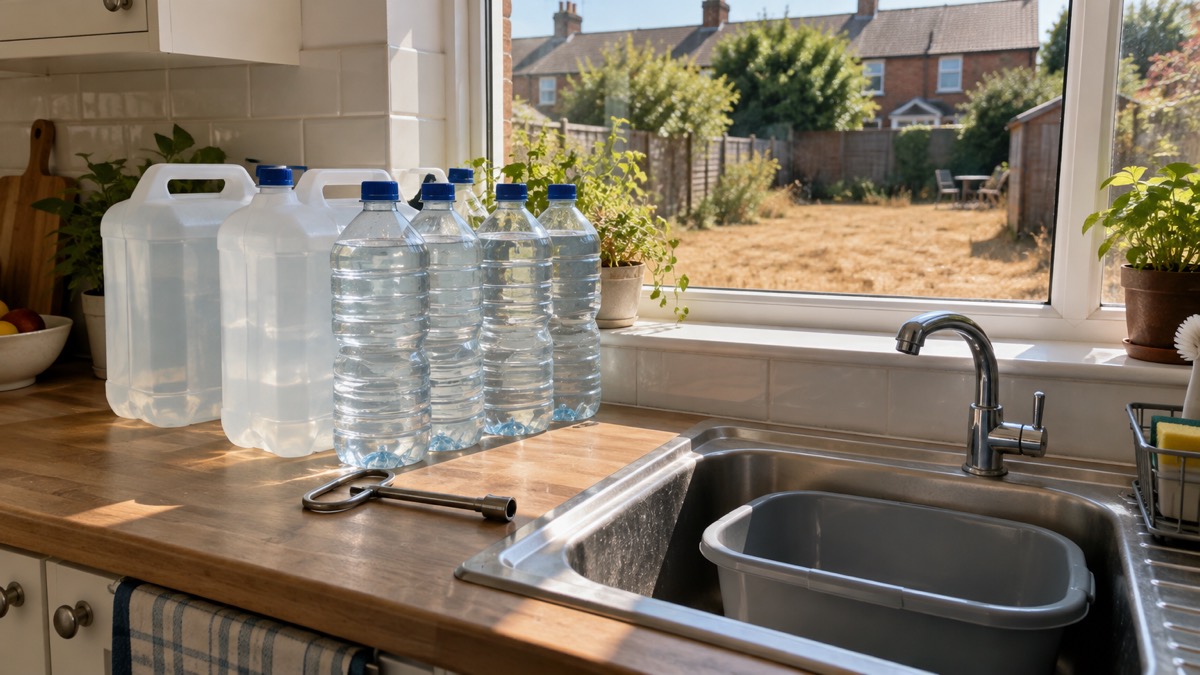
When a drought deepens, the restrictions on your water supply can go well beyond a hosepipe ban. Water companies have two legal tools, drought permits and drought orders, that let them take more water from the environment and restrict more uses of water. Between 1996 and 2026 there have been a total of 124 drought permits and 57 drought orders issued, with 2025 seeing the highest number of drought permits ever issued1. The most severe step, an emergency drought order, can cut household supplies to standpipes in the street, but these types of order have not been used since 19761.
For most households, a drought means a hosepipe ban first, then possibly tighter restrictions on non-essential uses such as car washing and watering sports pitches. Only in an extreme, prolonged drought does the law allow a water company to limit the supply of water itself and make alternative arrangements, for example by erecting a standpipe in the street2. This page explains what each tool allows, who grants it, what happens if your supply is cut, and how compensation works.
What drought permits and drought orders allow
Drought permits and drought orders are legal mechanisms to allow more flexibility in managing water resources when there is an exceptional shortage of rain. Their legal basis is the Water Resources Act 1991 as amended by the Environment Act 1995 and the Water Act 20031. They are the steps a water company takes when its ordinary measures, such as a hosepipe ban, are no longer enough.
If granted, drought permits or orders allow water companies to abstract more water, reduce other abstractions and restrict certain types of water use3. Drought orders go further in one respect: they also permit Natural Resources Wales or the Environment Agency to modify, restrict or stop abstractions in order to protect the environment6. So a drought order can work in both directions, letting a company take more water while giving the environmental regulator power to rein in other abstractors.
A water company's own drought plan describes the difference plainly. Drought permits allow water companies to temporarily take more water from specified sources. Drought orders are broader and allow water companies to take more water from the environment and apply restrictions on non-essential water usage4. United Utilities' draft Drought Plan 2027, for example, lists the specific locations where it may have to apply for drought permits in a drought, from Delph Reservoir and Dovestone Reservoir to Ullswater, Windermere and a set of boreholes at Bowscar, Gamblesby and Tarn Wood4.
| Tool | Who it applies to | What it allows | Who grants it |
|---|---|---|---|
| Drought permit | Water companies | Temporarily take more water from specified sources; reduce other abstractions4 | Environment Agency in England; Natural Resources Wales in Wales3 |
| Ordinary drought order | Water companies | Broader powers: more water from the environment plus restrictions on non-essential use, such as no car washing or watering gardens4 | Defra Secretary of State in England; Welsh Ministers in Wales1 |
| Emergency drought order | Water companies | Complete discretion over which uses of water are prohibited or limited, and supply by standpipes or water tanks1 | Defra Secretary of State in England; Welsh Ministers in Wales1 |
There are also environmental drought orders, which work differently. An Environment Agency environmental drought order requires a deficiency in the flow or level of water posing a serious threat to dependent flora or fauna, caused by an exceptional shortage of rain1. Natural Resources Wales can apply for its own drought order if the environment is suffering serious damage as the result of abstraction during a drought, and states it will only apply for environmental drought orders if they prove necessary6. These protect rivers and wetlands rather than restricting household use.
Who grants them in England and in Wales
The arrangements differ between the two countries, and it matters for who you contact if you want to object or find out more.
In England, drought permits are granted by the Environment Agency and drought orders are determined by the Defra Secretary of State1. Defra is responsible for granting drought orders, with the Environment Agency providing technical advice to Defra1. If objections are made to a drought permit, the Environment Agency will appoint a Planning Inspector to hold the drought permit hearing1.
In Wales, drought permits are granted by Natural Resources Wales, and drought orders are granted by Welsh Ministers3. The Wales Permitting Centre within Natural Resources Wales deals with water company drought permit applications and responds to ministers about drought order applications in Wales6. Natural Resources Wales is also a statutory consultee on draft water company drought plans and responds with a formal representation3.
Drought orders must be advertised in a local paper and explain that objections can be made to the Secretary of State for the Environment, Food and Rural Affairs or, in Wales, the National Assembly for Wales2. So if you want to make your views known about a proposed order, the advertisement in your local paper is the place to find the deadline and address for objections.
Behind the decisions sit drought plans at every level. Each of the Environment Agency's 14 operational areas has a drought plan, outlining the steps taken at the local level5. Natural Resources Wales produces a drought plan which describes the indicators used to classify the different stages of drought and provides a flexible framework for dealing with different drought events, acting as an operational manual for NRW drought teams6. Water companies in England and Wales are under a statutory requirement from the UK government to produce drought plans and update them every five years, consulting on these plans with customers and other organisations5. In Wales, Natural Resources Wales and the water companies Dŵr Cymru Welsh Water and Hafren Dyfrdwy produce drought plans outlining how they will manage water supplies during periods of dry weather8.
One wrinkle affects companies that straddle the border. If a water company is wholly or mainly in England, with sites that affect Wales, it must follow Defra and the Environment Agency's water company drought plan guidance, and refer to NRW's guideline for environmental assessments in Wales, considering the Environment (Wales) Act 2016 and the Well-being of Future Generations (Wales) Act 20156.
A permit needs an exceptional shortage of rain
A water company cannot simply ask for a permit when reservoirs look low. The Environment Agency will only grant drought permits if the company can show that it has experienced an exceptional shortage of rain, and that it has taken actions to reduce demand including putting in place a temporary use ban4. In other words, the hosepipe ban comes first, and the permit is only considered after it.
There are further conditions. The Environment Agency does not normally grant drought permits where a water company has not included the proposal as an option in its drought plan, and the company must demonstrate it has implemented additional water conservation measures first1. The same logic applies to orders: the Environment Agency does not usually support requests for drought orders to abstract more water unless the water company demonstrates that it has implemented additional demand management measures before applying1.
Water companies can apply for drought permits to help refill reservoirs and work together with farmers and others to explore opportunities to support each other and protect the environment9. In England, the Environment Agency decides when we are in drought conditions, working together with water companies to reduce the impact of drought for people in affected areas9. Drought plans specify the triggers, such as low rainfall levels or low reservoir levels, that will prompt companies to take action to manage supply and water demand5.
A drought order needs a serious or imminent risk to supply
Drought orders sit above permits in the escalation, and the conditions reflect that. An ordinary drought order limits the use of water for specific activities, for example no car washing or watering gardens2. United Utilities describes these as non-essential use bans, also known as ordinary drought orders, which restrict more activities than a temporary use ban, and plans for them at a 1.25% risk a year as part of its level of service4. At level 3 of its plan, the company would apply for and introduce a drought order to restrict non-essential use, restricting business uses of water such as car washing, watering sports pitches and commercial window cleaning4.
The most serious form is the emergency drought order. These enable a water company to have complete discretion on the uses of water that may be prohibited or limited, and to authorise supply by standpipes or water tanks1. An emergency drought order limits the supply of water and makes alternative arrangements for the supply of water, for example by erecting a standpipe in the street2. In Wales the description is the same7.
There are limits on how long these powers last. Emergency drought orders are for three months or less and can be extended up to a further two months2. Ordinary drought orders can be for six months or less, and can be extended up to a year2.
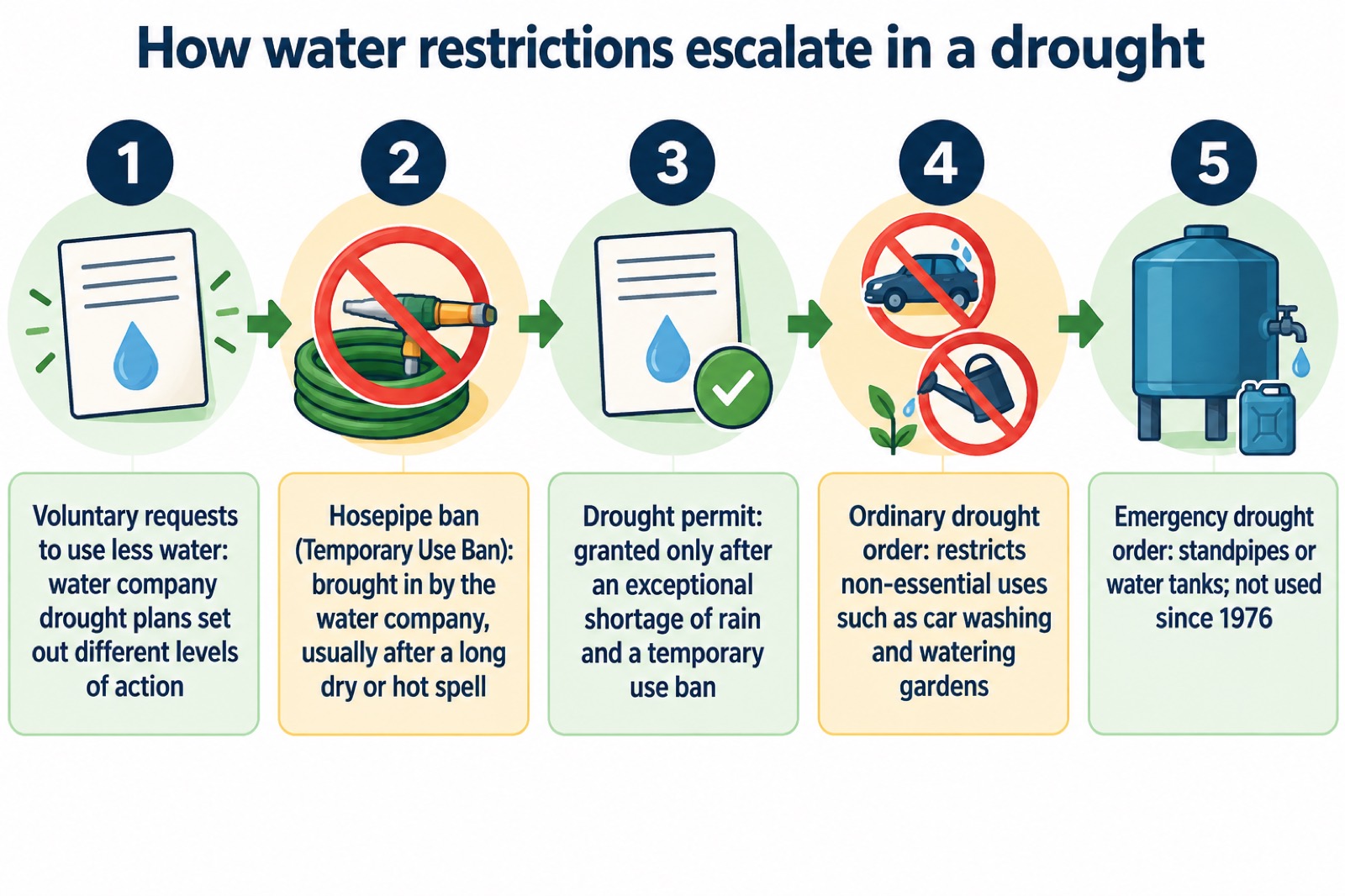
The escalation from ban to order follows a sequence the public advice makes clear. Water companies can bring in hosepipe bans when water is in short supply, usually after a long dry or hot spell10. If there is still a water shortage after a hosepipe ban has been imposed, a water company can apply to the government for a drought order2. During a drought, a company may have to restrict the use of hosepipes for specific activities by imposing Temporary Use Bans to conserve water supplies, and you may still water your garden using watering cans and buckets11.
How often permits and orders are actually used
These powers are used more often than many people assume, though the extreme ones are rare. Between 1996 and 2026 there have been a total of 124 drought permits and 57 drought orders issued, with 2025 seeing the highest number of drought permits issued1. In the 2025 to 2026 drought, all but one water company activated their drought plans and a total of 46 drought permits were issued to three water companies, the highest amount of drought permits ever issued, along with 2 drought orders1. The year before, in 2022 to 2023, thirty drought permits were issued to help water companies protect or improve public supply, more than any other year up to then1.
Earlier droughts show the same pattern at smaller scale. In the 2016 to 2019 drought there were 6 drought permits issued in the north west and Yorkshire, and one drought order was granted to the Environment Agency in the north west1. In the 2004 to 2006 drought, at the height of the drought, hosepipe bans were imposed by 8 water companies affecting over 15 million people1. During the England and Wales drought of 2010 to 2012, several water companies in southern, central and south-east England introduced hose-pipe bans in early April 201212.
Drought permits and orders are granted case by case, and the picture changes from week to week, so check the current position with your water company and the Environment Agency rather than relying on past examples. What matters for households is that permits and orders are tools the companies and the Environment Agency can use when reservoirs and rivers run low, and that restrictions on household use arrive only after the earlier stages have not been enough.
Emergency drought orders are a different matter entirely: these types of order have not been used since 19761. Water company severe drought plans, which set out what happens at that stage, are not in the public domain and must meet the measures set out in the Water company security and emergency measures: 2022 ministerial direction1. At the severe drought stage the Environment Agency moves to category 1 incident response mode, and government may activate its incident response arrangements including COBR1.
If your supply is cut under an emergency drought order
This is the scenario the rest of this page builds towards, and it is worth knowing in advance even though it has not happened since 1976. An emergency drought order limits the supply of water and makes alternative arrangements for the supply of water, for example by erecting a standpipe in the street2. The order gives the water company complete discretion on the uses of water that may be prohibited or limited, and it can authorise supply by standpipes or water tanks1.
If it happens, the practical arrangements follow the pattern for any water supply interruption. Different levels of action will be taken depending on the severity of the drought, including voluntary requests to customers to use less water and application of temporary restrictions on water use5. To protect water treatment plants, extraction of water from rivers, lakes or wells in the affected area may be stopped, and water companies have arrangements to provide alternative safe water for drinking such as bottled water13.
While there is no mains water supply, use alternative water supplies such as bottled water solely for drinking, washing your hands and food preparation14. That is the official advice from the government's readiness campaign, and it is worth planning around: any water you store or are given goes to the uses that matter most first.
If you rely on a private water supply rather than the mains, the advice is to refer to your contingency plan if the supply becomes insufficient due to drought conditions15. Farmers on private water supplies are advised to monitor water levels and water quality closely during drought conditions, reduce non-essential water use where possible, and have plans in place for alternative water supplies for both livestock and essential farm operations before supplies become critical16.
Bottled water stations and alternative supplies
When mains supply is interrupted, bottled water is the main alternative. Water companies have arrangements to provide alternative safe water for drinking such as bottled water13.
The government's advice on water supply interruptions sets out how to use alternative supplies sensibly:
- Use bottled water solely for drinking, washing your hands and food preparation while there is no mains supply14
- Keep water for the highest-priority uses: drinking, hand washing and food preparation14
- Follow your water company's information channels, which will say where supplies are being distributed17
For households that want to be ready in advance, the same planning applies as for any emergency: see our water in an emergency guide and the emergency kit checklist. The government's drought advice also covers everyday water saving: only use your washing machine and dishwasher if you have a full load, and use the eco mode if available, which uses less water and saves energy18.
Essential uses: drinking, cooking, washing and flushing
The law draws a line between essential and non-essential uses, and that line decides both what must be protected and what compensation covers. Essential household water supplies, for the purposes of emergency drought order compensation, include water supplies for purposes such as cooking, washing, drinking and flushing the toilet5. It does not include uses such as watering the garden, car washing or filling a pool5.
The same distinction appears elsewhere in water regulation. The Drinking Water Inspectorate defines domestic purposes as drinking, washing, bathing and showering, washing of laundry, toilet flushing and central heating19. During the 2026 hosepipe restrictions in the South West, the public health advice was clear that water can still be used as normal for drinking, hygiene, washing and cooking17.
So under a hosepipe ban or an ordinary drought order, your indoor essential uses continue as normal. What changes is the outdoor and discretionary use: hosepipes for specific activities under a Temporary Use Ban11, then activities such as car washing and garden watering under an ordinary drought order2, then, only under an emergency drought order, the supply itself1.
For the garden, there are ways to make the water you are allowed go further. When you empty paddling pools, containers, buckets and watering cans, do so as soon as they have been used, and paddling pool water can be used to water the garden, advice from the Mid and West Wales Fire and Rescue Service15. Our pages on watering the garden during a hosepipe ban and paddling pools, ponds and car washing cover the detail.
Compensation when an emergency drought order cuts your supply
If your supply is cut off due to an emergency drought order, you may be able to claim compensation2. Compensation does not apply during a hosepipe ban; it only applies during an emergency drought order5.
The rules come from Ofwat, the water regulator. All companies are required under licence conditions to pay compensation to customers where essential household water supplies are interrupted as a result of restrictions authorised by emergency drought orders5. Although this measure is not part of the guaranteed standards scheme laid down by government, it does mean that customers have access to compensation if essential supplies are not maintained5.
Two points are worth fixing in your mind:
- What counts: the compensation covers essential supplies, meaning cooking, washing, drinking and flushing the toilet5
- What does not: it does not include uses such as watering the garden, car washing or filling a pool5
If an emergency drought order affects you, contact your water company to claim. The company's code of practice sets out how it handles such matters; Southern Water's household code of practice, for example, describes how during a drought it may have to restrict the use of hosepipes for specific activities by imposing Temporary Use Bans to conserve water supplies, and that customers may still water their gardens using watering cans and buckets11.
Hosepipe bans versus drought orders: the short version
The two are often confused, so here is the difference in one place. A hosepipe ban, formally a Temporary Use Ban, is a restriction a water company imposes itself. Water companies may choose to enforce Temporary Usage Bans, or hosepipe bans, to help conserve water18. They can bring them in when water is in short supply, usually after a long dry or hot spell10. They restrict hosepipe use for specific activities, and you may still water your garden using watering cans and buckets11.
A drought order needs government approval. If there is still a water shortage after a hosepipe ban has been imposed, a water company can apply to the government for a drought order2. An ordinary drought order limits the use of water for specific activities, for example no car washing or watering gardens2, and restricts business uses too, such as watering sports pitches and commercial window cleaning4. An emergency drought order goes further still and can cut the supply itself, with standpipes in the street1.
Our page on hosepipe bans and how temporary use bans work covers the first stage in detail, and what you can and cannot do in a hosepipe ban lists the restricted activities.
Where to get help and information
In Wales, Natural Resources Wales is the principal adviser to Welsh Government about issues relating to the environment and its natural resources, managing water and flood defences in Wales and responding as a Category 1 emergency responder to reported environmental incidents20.
For the wider picture of how drought develops and is declared, see how drought is declared in England and what each stage means and England's 2026 drought and where restrictions apply. Households that need extra support during disruptions can also read our guide to extra help in emergencies.
Sources (20)
- Drought: how it is managed in England, Department for Environment, Food and Rural Affairs, 2026-04-08
- Water shortages and restrictions to your supply, Citizens Advice, 2020-02-24
- Drought planning and management, Natural Resources Wales, 2026-10-29
- Summary of our Draft Drought Plan 2027, United Utilities, 2026
- Drought, Ofwat, 2026-10-29
- Drought planning and management, Natural Resources Wales, 2026-10-29
- Water shortages and restrictions to your supply (Wales), Citizens Advice, 2020-02-24
- Resilience and risks in Wales, Welsh Government, 2026-09-07
- Drought, Wiltshire and Swindon Prepared, 2026-10-25
- Stay safe during hot weather, London Borough of Bexley, 2026
- Southern Water household code of practice, Southern Water, 2022-11
- England and Wales drought 2010 to 2012, Met Office, 2012
- What to do in a radiation emergency, UK Government, 2024-09-10
- Water supply interruptions or outages, Be Ready Campaign, 2026-10-12
- Diogelwch Dŵr yn yr Ardd, Mid and West Wales Fire and Rescue Service, 2026-10-29
- Private water supplies, Cornwall Council, 2026-10-29
- Stay safe this summer, Cornwall Council, 2026-08-08
- Droughts, Prepare Campaign, 2026-10-19
- Buying a dwelling with a private water supply, Drinking Water Inspectorate, 2026-10-28
- Adverse weather events, Llangattock Community Council, 2026-10-25