
Every water company in England and Wales must, by law, prepare a drought plan, consult customers and other organisations on it, and publish it. In England this duty comes from the Water Industry Act 1991 as amended by the Water Act 2003, and it requires each company to prepare and publish a drought plan every 5 years1. In Wales the duty is the same: water companies have a statutory duty to prepare, consult, publish and maintain a drought plan2.
Those plans are not abstract documents. They set out the triggers, such as low rainfall levels or low reservoir levels, that will prompt the company to take action to manage supply and demand, and the steps it will take as a drought deepens, from voluntary requests to use less water through to temporary restrictions on water use3. In practice this is what decides when your hosepipe ban arrives, and when it is lifted. This page explains what the plans must contain, how the escalation works, how to check drought risk where you live, how the arrangements differ in Wales and Scotland, and how to have your say when your company next consults.
What a water company drought plan actually is
A water company drought plan shows how the company will supply water to customers during periods of low rainfall, when water supplies become depleted, and how adverse effects during droughts will be minimised6. In England it is a requirement for all water companies to have a statutory drought plan which describes the actions they will take in the event of a drought1. It is, in effect, the company's operational manual for a dry year: what it will watch, when it will act, and what it will ask of you at each point.
Two things about the plans are worth knowing as a householder. First, the version you can read is not the whole story. Water company severe drought plans, which cover the most extreme scenarios, are not in the public domain and must meet the measures set out in the Water company security and emergency measures: 2022 ministerial direction1. So the published plan tells you about hosepipe bans and demand management, but the arrangements for the very worst cases are held back.
Second, the drought plan sits alongside a longer-term document. Every 5 years, water companies also have a duty to prepare a water resources management plan showing how they will manage water resources over at least the next 25 years1. Ofwat describes this as a 25-year plan for managing water supplies3. The drought plan is about getting through the next dry spell; the water resources management plan is about making sure there is enough water in the decades ahead. If you want to understand why your company is, or is not, building new supply infrastructure, that is the document to read alongside the drought plan.
Every company must prepare, consult on and publish a plan
The duty to consult is as real as the duty to plan. It is a statutory requirement from the UK government for water companies in England and Wales to produce drought plans and update them every five years, consulting on these plans with customers and other organisations3. In Wales, after consultation, water companies must produce a statement of response setting out how they have dealt with the representations received; Natural Resources Wales then advises the Welsh Government, which may request a hearing or inquiry or direct the company to publish its final plan6.
Several bodies are formally involved in scrutinising a draft plan before it is finalised:
- Ofwat, the economic regulator, is a statutory consultee on water company draft drought plans3
- Natural Resources Wales is a statutory consultee on draft water company drought plans in Wales and responds with a formal representation2
- The Environment Agency reviews its own drought plans for each of its 14 operational areas, carrying out a light touch review annually in the spring and a full update every 5 years or following major droughts1
The duty extends beyond the big household names. New appointments and variations, known as NAVs, are subject to the same obligations as water companies under the Water Industry Act 1991, including producing drought plans1. Retailers holding water supply and sewerage licences are not required to prepare their own drought plans, but they must work with the water companies to communicate drought messages and encourage customers to reduce water use1. So wherever you get your water from a licensed supplier, a drought plan exists for your area.
Triggers: the rainfall and reservoir levels that set off action
Drought plans specify the triggers, such as low rainfall levels or low reservoir levels, that will prompt companies to take action to manage supply and water demand3. These are set out in advance and published, which means a ban that feels sudden when it is announced has usually been some time in the making, with the company watching its indicators move for weeks beforehand.
What the triggers look like depends on where your water comes from. The drought status in any area is based on several factors, including historic rainfall, groundwater and reservoir levels7. A company that relies on reservoirs watches reservoir stocks; one that relies on groundwater watches borehole and spring levels. That is the kind of arithmetic going on behind every drought plan: how far below average the sources are, how much demand is rising, and how much of the dry season is still to come.
Droughts themselves come in two shapes, and the triggers are built with both in mind. Some droughts are short and intense, caused by a hot, dry summer. Others are long and take time to develop over multiple seasons of lower than average rainfall8. The long kind is why companies also watch winter recovery: below-average rainfall over autumn and winter 2024/2025 in eastern Scotland meant that groundwater recharge was limited and there was an increased risk of drought the following year5.
Restrictions rise in steps as a drought gets worse
Drought plans are built as a ladder, not a switch. Different levels of action are taken depending on the severity of the drought, including voluntary requests to customers to use less water and the application of temporary restrictions on water use3. Water companies may choose to enforce Temporary Usage Bans, or hosepipe bans, to help conserve water8. Analysis of UK water utilities' drought communication plans found a 6-stage process: 1 Normal Operation, 2 Developing Drought, 3 Drought, 4 Severe Drought, 5 Emergency Measures, and 6 End of Drought4.
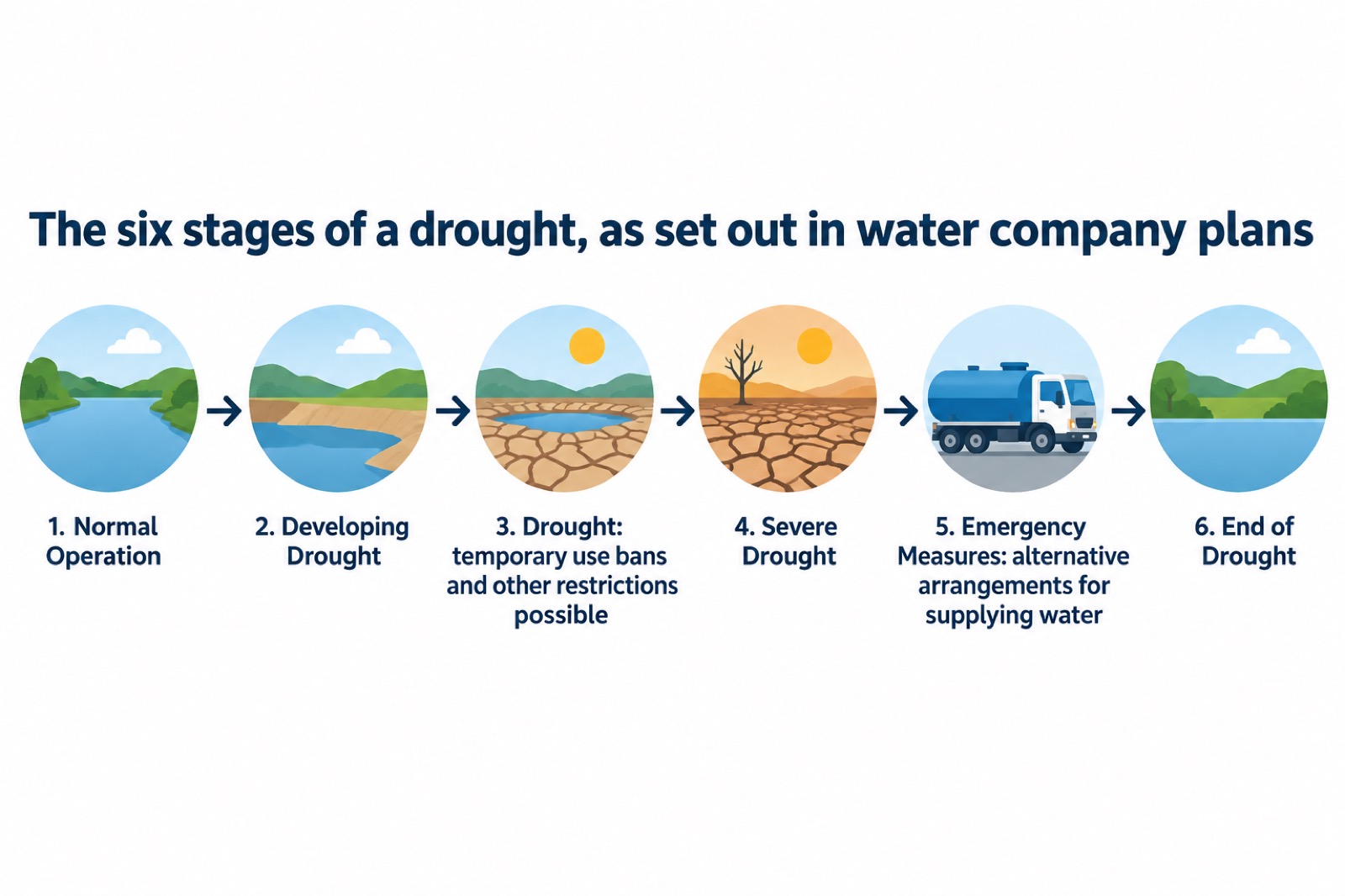
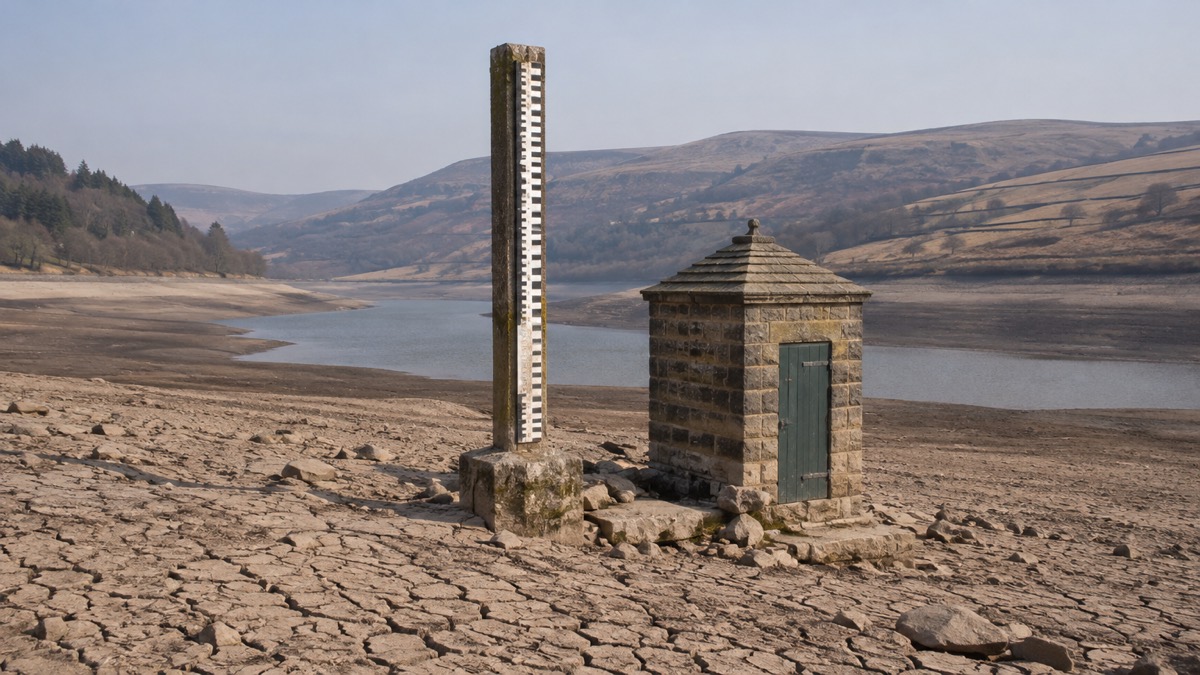
Two things about the ladder matter to households. The first is that a declaration of a drought stage does not automatically mean new restrictions on you. The stage names describe the state of the environment; the restrictions are a separate decision by your water company, phased in as the drought continues and dependent on its severity.
The second is that restrictions can tighten in ways you may not expect, and the details change as a drought develops. If you relied on an exemption in an earlier ban, check the current position with your water company rather than assuming it still applies. Our pages on hosepipe bans, hosepipe ban exemptions and what you can and cannot do in a hosepipe ban set out the detail.
At the top of the ladder sit drought permits and drought orders. These are legal mechanisms to allow more flexibility in managing water resources when there is an exceptional shortage of rain, under the Water Resources Act 1991 as amended by the Environment Act 1995 and the Water Act 20031. If granted, they allow water companies to abstract more water, reduce other abstractions and restrict certain types of water use; drought orders also permit Natural Resources Wales or the Environment Agency to modify, restrict or stop abstractions in order to protect the environment2. The Environment Agency does not normally grant drought permits where a water company has not included the proposal as an option in its drought plan, and the company must demonstrate it has implemented additional water conservation measures first1. Our page on drought permits, orders and emergency rota cuts covers what these powers can mean for your supply.
Where drought restrictions are in place now
Drought is not evenly spread, and neither are the restrictions. The scale of a serious drought shows how widely plans can be activated at once: during the 2022 to 2023 drought, 17 of 18 water companies activated their drought plans1. Where restrictions apply at any moment depends on your own water company's area, so check its position directly rather than relying on national headlines.
Restrictions follow the declarations company by company, and two neighbouring companies can be in very different positions. A company may already be carrying out the actions in its drought plan, as Cambridge Water did from the beginning of April, to reduce demand and increase water available for supply8. The reliable way to know what applies to you is to check your own water company's website8.
The practical message is simple: check your own company's position rather than the national headlines. Official guidance is to check your local news and your water company's website regularly for advice and information on water availability in your area and water management actions in force, including actions you can take to help8. Our page on England's 2026 drought and where restrictions apply tracks the detail.
Checking drought risk near you with the Drought Risk Assessment Tool
In Scotland, SEPA provides a Drought Risk Assessment Tool that shows the number of days in a row that river levels have been very low11. It can be used in combination with the weekly water scarcity reports to understand the risk of reaching Significant water scarcity11. The tool updates daily at 09:30 GMT11, and SEPA's report guidance gives the same figure: data is updated daily at 0930 GMT, 1030 BST12. To find your area, you can view water scarcity area descriptions or enter your postcode in the Drought Risk Assessment Tool search and click on Water Scarcity Level13.
Scotland is monitored separately. To find out what area you are in, view the water scarcity area descriptions or enter your postcode in the Drought Risk Assessment Tool search and click on Water Scarcity Level13. The tool can be used in combination with the weekly water scarcity reports to understand the risk of reaching Significant water scarcity, and it updates daily at 09:30 GMT13.
In England, the equivalent picture comes from the Environment Agency's drought management reporting and your water company's own water situation updates, such as those published by Portsmouth Water and Northumbrian Water7. The Environment Agency decides when we are in drought conditions in the UK, working together with water companies to reduce the impact of drought for people in affected areas15. Our page on how drought is declared in England and what each stage means explains the stages in detail.
Plans are updated every five years, and customers are consulted
The five-year cycle is fixed, but it is not rigid. Water companies in England and Wales must produce drought plans and update them every five years, consulting on these plans with customers and other organisations3. The Environment Agency, for its own drought plans, carries out a light touch review annually in the spring and a full update every 5 years or following major droughts1. Major droughts matter here: the 2022 to 2023 drought, in which 17 of 18 water companies activated their drought plans1, and the 2025 to 2026 drought, in which all but one company activated their plans and a total of 46 drought permits were issued to three water companies, the highest amount of drought permits ever issued, along with 2 drought orders1, will both have fed into the current round of revisions.
Consultations are your opportunity to shape the plan. When a company consults on its draft plan, representations from customers and organisations must be dealt with in a published statement of response6. Watch your company's website for a consultation opening, and respond: the level of service a company commits to is part of what gets consulted on. One draft drought plan for 2027 sets out temporary use bans, also known as hosepipe bans, at 5% risk a year, and emergency restrictions, which are alternative arrangements for supplying water such as standpipes, at 1.25% risk a year10. The documents do not settle which figure applies where, but the principle stands: how often a company expects to impose restrictions is a published commitment you can question.
History shows the cycle responding to events. During the England and Wales drought of 2010 to 2012, several water companies in southern, central and south-east England introduced hosepipe bans in early April 201216. Thirty drought permits were issued in 2022 to 2023 to help water companies protect or improve public supply, more than any other year up to that point1. Each episode has left its mark on the next generation of plans.
Drought plans in Wales
Wales runs the same statutory system with its own regulator. Natural Resources Wales has produced a water company drought plan technical guideline for a water company wholly or mainly in Wales to follow when preparing a drought plan6. Natural Resources Wales and the water companies, Dŵr Cymru Welsh Water and Hafren Dyfrdwy, produce drought plans outlining how they will manage water supplies during periods of dry weather17. The companies' plans show how the water undertaker will supply water to customers during periods of low rainfall, when water supplies become depleted and how adverse effects during droughts will be minimised2.
The Welsh arrangements have their own machinery. The Wales Permitting Centre within Natural Resources Wales deals with water company drought permit applications and responds to ministers about drought order applications in Wales6. Drought permits are granted in Wales by Natural Resources Wales and in England by the Environment Agency2. Natural Resources Wales updates its own drought plan annually and undertakes drought exercises based on historic droughts to test the actions in the plans6; its plan describes the indicators used to classify the different stages of drought and provides a flexible framework for dealing with different drought events, acting as an operational manual for NRW drought teams6.
One wrinkle affects companies that straddle the border. If a water company is wholly or mainly in England, with sites that affect Wales, it must follow Defra and the Environment Agency's water company drought plan guidance, and refer to NRW's guideline for environmental assessments in Wales, considering the Environment (Wales) Act 2016 and the Well-being of Future Generations (Wales) Act 20152. If you are in Wales but supplied by an England-based company, both frameworks apply to your supply.
Scotland: water scarcity instead of drought plans
Scotland's arrangements are different. There is no water company drought plan cycle; instead, SEPA monitors and manages water resources in line with Scotland's National Water Scarcity Plan18. Scotland's National Water Scarcity Plan contains hierarchy of actions tables giving the action associated with each water scarcity level for different users, for example irrigation catchments, Scottish Water and hydropower13. The Scottish Water website allows customers to see the status of the supply in their area and to report any problems with water supply19.
The impacts of water scarcity in Scotland reach beyond public supply: ecosystems can suffer, farmers face challenges in maintaining crop yields, industrial operations and production can be disrupted, and private water supplies can run dry20. SEPA's advice, repeated across its seasonal reports, is that everyone should plan to increase their resilience to the impacts of prolonged dry conditions, because taking the right steps now could help reduce the impact of water scarcity in the future5. If you are on a private supply in Scotland, see our page on what to do if your private water supply dries up.
Private water supplies: the plans that do not cover you
If your water comes from a private supply rather than a water company, none of these drought plans applies to your tap, and you need your own. Private supplies can become insufficient due to challenging weather conditions such as drought or severe cold weather, when sources dry up or freeze, or through undetected leaks, pipe bursts, pump failure, inadequate supply arrangements and disconnection of pipework21. Argyll and Bute Council gives the same list of causes for loss of supply for private water supply users22, and Scottish Borders Council likewise notes that supplies can be affected by periods of drought or severe cold weather, undetected leaks, pipe bursts or pump failures23.
The Drinking Water Inspectorate's advice is that if a private water supply should become insufficient due to drought conditions, a relevant person should refer to their contingency plan24. If you do not have one, that is the gap to close before the next dry summer. Our water in an emergency guide covers storing water for any household.
Who oversees drought plans and where to get help
The oversight is shared. The Environment Agency decides when we are in drought conditions in the UK, working together with water companies to reduce the impact of drought for people in affected areas15. Ofwat, as the economic regulator, does not have a lead operational response role in the event of any drought3, but it is a statutory consultee on water company draft drought plans3 and regulates the water sector in England and Wales25. Environment Agency area drought plans are available on request from its National Customer Contact Centre26, and requests for copies of area drought plans can be made through its customer contact team at enquiries@environment-agency.gov.uk1.
For day-to-day help, start with your water company. If you think you may need extra help from your water company, sign up to the Priority Services Register27. If you are on the Priority Services Register, your water company will arrange alternative supplies for you during an interruption28. Support may include access to bottled water during a water supply interruption, priority assistance, and tailored support if there is a power or gas outage29. Free similar services to the priority register are available in the water sector through Ofwat30. Our extra help in an emergency page explains who qualifies and how to register.
If your supply is interrupted, Ofwat provides information on what communication you should expect to receive from your water company19. Ofwat's phone number is 0121 644 750025. For the wider picture of preparing your household, see our heatwaves and drought guide and the government's advice on being informed about hazards.
The longer term: leaks, new supplies and what the plans cannot fix
Drought plans manage a crisis; they do not create water. The structural work sits in the water resources management plans and in Ofwat's funding decisions. At PR24, Ofwat's decisions allowed £5 billion to be spent on expanding supplies3. This includes funding for 424 million extra litres of water per day, currently over three million people's usage, to be delivered by 20303. Of this, £2 billion will kick off 30 large longer-term schemes, which will ultimately represent around £50 billion in investment3.
Leakage is tracked in stages. In the 2020 to 2025 period Ofwat set targets for companies to deliver a 16% reduction in leakage, and for 2025 to 2030 it is expecting companies to deliver a further reduction of 17%3. Across the 2025 to 2030 period, targets have also been set to incentivise companies to reduce leakage by 17%, per capita consumption by 6% and business demand by 1%3. Longer term, Ofwat's targets and cost allowances are supporting companies' commitment to deliver a 50% reduction in leakage from 2017-18 levels by 20503.
Companies are also expected to plan for the worst case in their emergency arrangements. Following the 2018 freeze and thaw, recommendations included that companies should develop or update their plans regarding the provision, deployment and delivery of alternative water supplies, for example bottled water or water bowsers, together with local partners and emergency services31. Ground movement adds to the risk: the land around us contracts and expands as we have droughts and heavy rainfall, and this movement can cause pipe breakages32, which is one reason supply problems can follow a drought even after the rain returns.
For what you can do in your own home while restrictions are in force, see our guides on how to save water at home when supplies are low and hot weather preparation.
Sources (32)
- Drought: how it is managed in England, GOV.UK, 2026
- Drought planning and management, Natural Resources Wales, 2026
- Drought, Ofwat, 2026
- Public messaging for summer concurrent risks: extreme heat, drought and wildfires, GOV.UK, 2025
- Autumn water situation report 2025, SEPA, 2025
- Drought planning and management (Welsh language URL), Natural Resources Wales, 2026
- Current water situation in our supply area, Portsmouth Water, 2026
- Droughts, Prepare Campaign, 2026
- Drought plan | South East Water, South East Water
- United Utilities Summary of our Draft Drought Plan 2027, United Utilities Water Limited
- Water scarcity, SEPA, 2026
- Water scarcity report, 1 October 2026, SEPA, 2026
- Water scarcity report FAQs, SEPA, 2026
- Water resources, Northumbrian Water, 2026
- Drought, Wiltshire and Swindon Prepared, 2026
- England and Wales drought 2010 to 2012, Met Office, 2012
- Resilience and risks in Wales, Welsh Government, 2026
- Winter water situation report 2026, SEPA, 2026
- Water supply interruptions or outages, Be Ready Campaign, 2026
- What is water scarcity, SEPA, 2026
- Managing insufficiency of private water supplies, Drinking Water Inspectorate, 2025
- Loss of supply for private water supply users, Argyll and Bute Council, 2026
- Private water supplies, Scottish Borders Council, 2026
- Private water supplies drought guidance, Drinking Water Inspectorate, 2026
- Customer experiences of sewer flooding update report, Ofwat and CCW, 2024
- Drought management for England, GOV.UK, 2015
- Prepare for emergencies: risks, Surrey County Council, 2026
- Water supply interruptions or outages, Prepare Campaign, 2026
- Wellbeing and safety, Surrey County Council, 2026
- Priority Services Register, Derbyshire County Council, 2026
- Thaw report, Ofwat, 2018
- Failure of water infrastructure or loss of drinking water, Wiltshire and Swindon Prepared, 2026
 Flood Warning Checklist
 First Steps After a Flood
 Insurance Claim Records
 England 2026 Drought Areas
 Past UK Droughts and Heatwaves
 Saving Water at Home
 Drought Stages in England
 Wildfires and Grass Fires