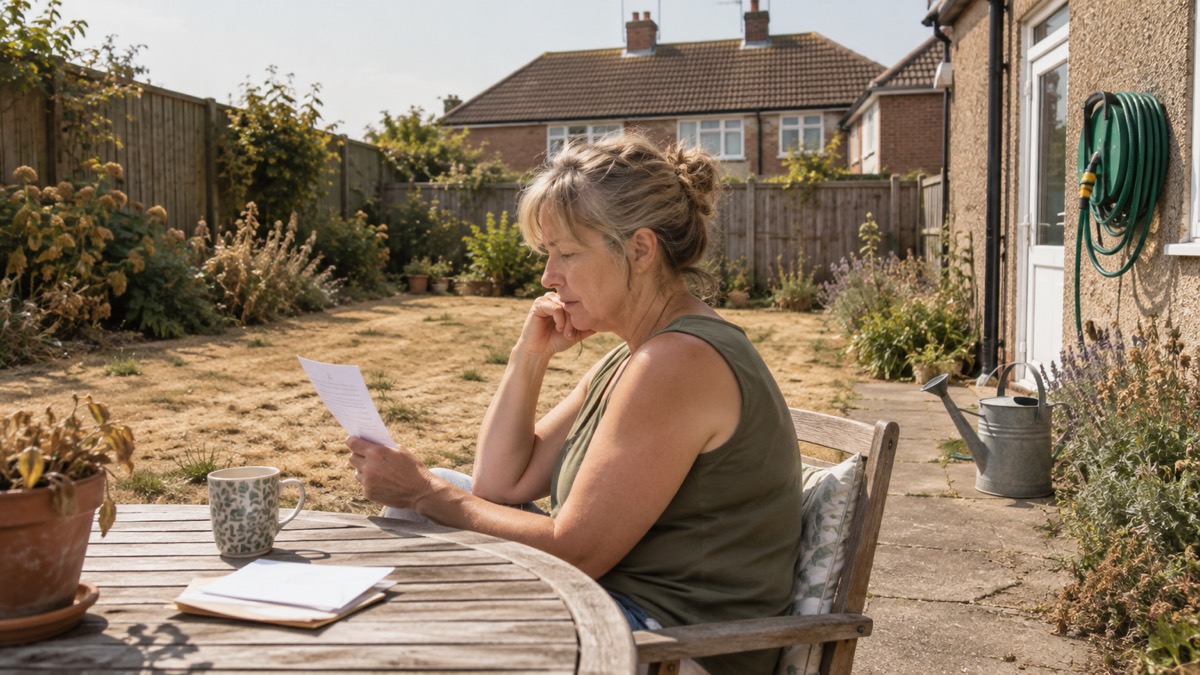
Drought now covers more than two thirds of England, and ten water companies have hosepipe bans in force across all or part of their supply areas. Reservoirs across England were at 54% of capacity in the week ending 13 October 2026, around 21% below the long-term average for the time of year, and England as a whole had received only 26% of the October long-term average rainfall to date1.
If you live in an area covered by a ban, the practical effect is simple: you must not use a hosepipe for non-essential water use, including watering the garden, washing the car, cleaning patios and windows, and filling paddling pools, hot tubs and swimming pools2. You can still water with a bucket or watering can, use grey water and rainwater, and keep yourself and your animals supplied with water. Breaching a ban is a criminal offence that can carry a fine of up to £1,0003.
This page sets out where restrictions apply, what you can and cannot do, who is exempt, how bans are enforced, and how to cut your household's water use while the drought continues.
Where the drought stands: more than two thirds of England
Reservoirs across England remain exceptionally low, with national storage at 54% of capacity, around 21% below the long-term average for the time of year, in the week ending 13 October 20265. Cambridge Water, whose region is under a temporary use ban, points to below average rainfall since March, with April one of the driest on record as well as hotter than normal, a May heatwave that included the record for the hottest May temperature ever recorded, and the highest ever customer demand for the time of year since April4.
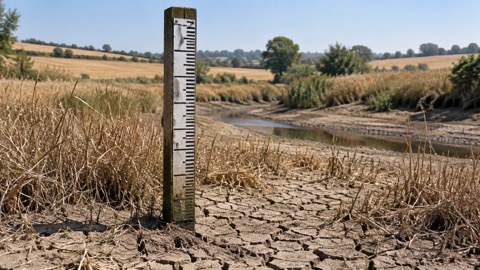
The position in mid-October 2026 shows how deep the shortfall now is. As well as national reservoir storage at 54% of capacity, eighteen reservoir groups were less than 50% full, with eleven classed as exceptionally low1. Of the river flow sites reported for the week of 9 to 15 October 2026, twenty-four sites (44% of the total) were classed as below normal, ten sites (18%) as notably low, and six sites (11%) as exceptionally low1. The Environment Agency has recorded 403 drought and dry weather environmental incidents since the start of 2026, more than the totals for 2022 (380) and 2025 (321), including 41 confirmed algae and 99 confirmed dead fish incidents, and there are currently 449 restrictions on abstraction licences1.
The Environment Agency manages drought through 14 operational areas, each with its own drought plan and a technical drought team, plus a national team5. Drought is not declared for the whole country at once: it is declared area by area as rainfall, river flows, reservoirs and groundwater fall below thresholds. Only when rainfall has fully replenished groundwaters, reservoirs and rivers would a drought be over, and this can sometimes take a long time5. If you want to understand the stages and what each one triggers, see how drought is declared in England.
Which water companies have hosepipe bans
Ten companies have implemented temporary use bans, in all or part of their supply areas: Affinity Water, Anglian Water, Bristol Water, Cambridge Water, Essex and Suffolk Water, Southern Water, South East Water, South West Water, Thames Water and Wessex Water1. Water companies may choose to enforce temporary use bans, or hosepipe bans, to help conserve water6. A ban applies to you if your home receives its water supply from the company concerned, regardless of who your bill comes from in some cases: Cambridge Water's restrictions also apply to customers in its region supplied by Independent Water Networks Ltd, ESP Utilities Group or Leep Networks (Water) Ltd4, and Affinity Water's ban applies to all customers across its Central and East regions and to New Appointments and Variations operators in those regions7.
| Company | Where the ban applies | When it began |
|---|---|---|
| South East Water | Kent, then Sussex, Surrey, Hampshire and Berkshire | Kent from 00:01 on 3 July 2026; announced for the other areas on 20 July 20263 |
| Cambridge Water | Its whole supply region | Effective from 9 July 2026, enforceable from 1am on 17 July 20264 |
| Affinity Water | Central region (Bedfordshire, Berkshire, Buckinghamshire, Hertfordshire, Surrey and parts of London and Essex), extended in August 2026 to the East region (Tendring Peninsula and north-east Essex, including Clacton-on-Sea, Harwich and Manningtree) | Central region from July 2026, East region from August 20267 |
| South West Water | Devon, Cornwall, parts of Dorset and Somerset and the Isles of Scilly | From 00:01 on 8 August 20268 |
| Bristol Water | All Bristol Water household customers | In force as at 9 to 15 October 20261 |
| Thames Water, Anglian Water, Essex and Suffolk Water, Southern Water, Wessex Water | All or part of their supply areas | In force as at 9 to 15 October 20261 |
Some of these bans are unusual for the companies imposing them. Cambridge Water's ban is its first since 1995, and before that 19764. Wessex Water notes there has not been a hosepipe ban in its supply region since 19769. For Cambridge Water, the ban followed below average rainfall since March, with April one of the driest on record and hotter than normal, a May heatwave that included the hottest May temperature ever recorded, and the highest ever customer demand for the time of year since April4.
In Wales, the position has eased in one area: Dŵr Cymru Welsh Water lifted the temporary hosepipe ban for customers on the Mid and South Ceredigion water network on 4 September 2026, after treated water storage levels improved. Some areas of England are supplied with water from Wales, so a drought in Wales can affect public water supply in England5.
What you can no longer do with a hosepipe
A hosepipe ban means you must not use a hosepipe for non-essential water use10. The restricted activities are broadly the same across the companies with bans, though each ban is its own legal instrument and the detail differs.
Under South West Water's restrictions, hosepipes should not be used for watering gardens, washing cars, patios and boats, hot tubs, or filling swimming and paddling pools2. Affinity Water's list adds cleaning windows and patios, using jet washers, garden sprinklers and pressure washers7. Bristol Water prohibits watering gardens including with a sprinkler or irrigation system, filling paddling pools, hot tubs, swimming pools, ponds or fountains, and washing cars, patios, driveways or windows with a hosepipe10. Cambridge Water restricts watering a garden using a hosepipe or sprinkler system4.
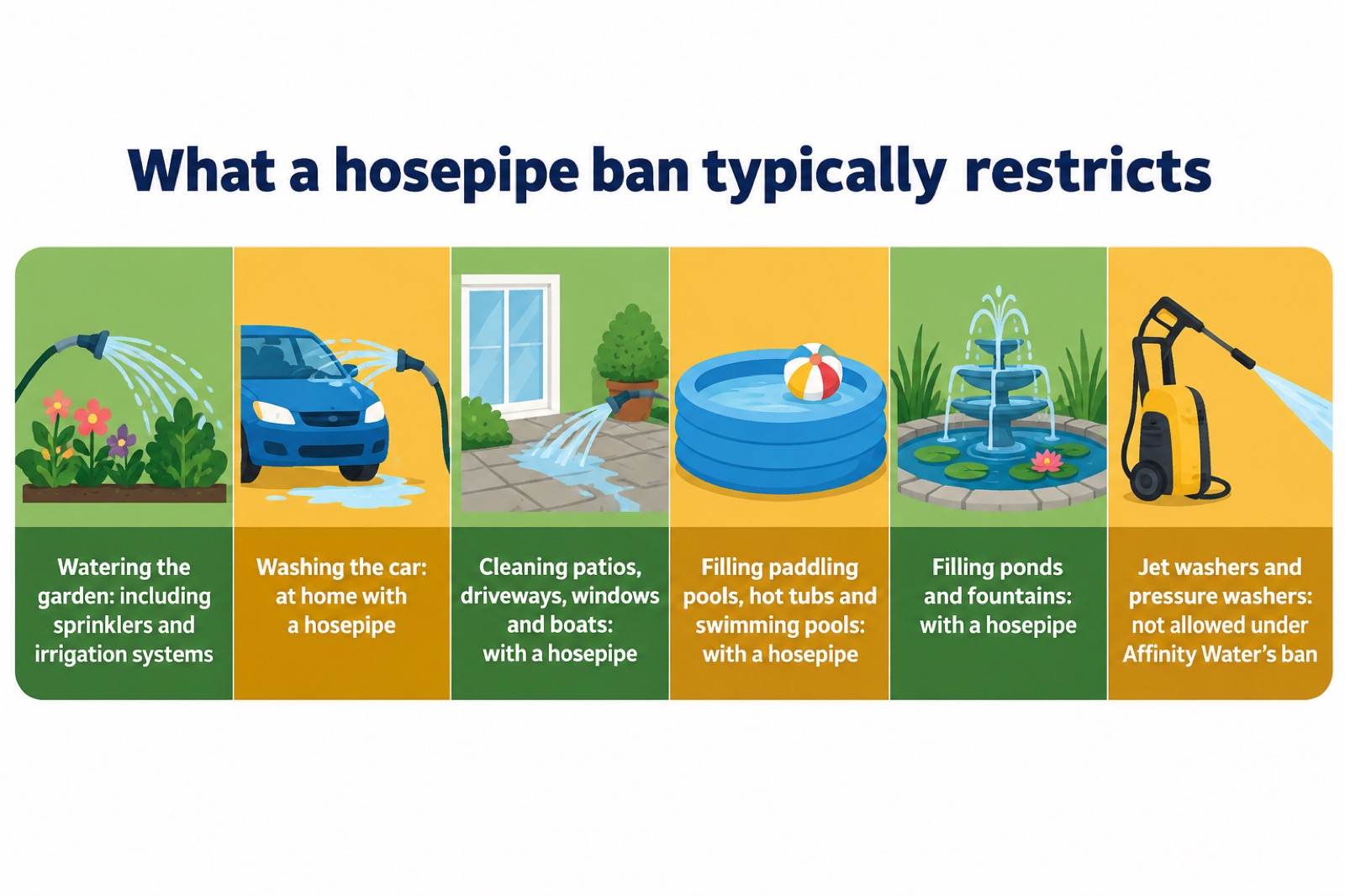
The scale of what is at stake explains the breadth of these bans. Cambridge Water notes that hosepipe usage at this time of year uses up to 1,000 litres of water an hour, the same as a family of four uses in two days, or around seven full bathtubs, and that its ban could save up to five million litres a day in its region, the same amount of water as two Olympic sized swimming pools4. For the fuller rules, see what you can and cannot do in a hosepipe ban.
What you can still do: watering cans, water butts and grey water
The bans restrict hosepipes, not water use itself. You may water your garden with tap water by hand, using a bucket or a watering can, and you may also water your garden with grey water or rainwater from a water butt, even through a hosepipe3. Bristol Water confirms you can water hanging baskets, but not using a hosepipe11. Water for drinking, cooking, showering and washing clothes is unaffected, and washing your car at a commercial car wash is a permitted use10.
Grey water, meaning water from baths, showers or washing up, comes with three rules from Bristol Water: only store it for up to 24 hours before use, apply it directly to the soil rather than using it in irrigation systems, and avoid using it on edible crops such as fruit and vegetables because of the potential risk of contamination11.
The government's preparedness campaign gives the same practical advice for households in a drought: in the garden, use a watering can instead of a hosepipe and install a water butt if you can to capture rain6. For more ideas, see how to save water at home when supplies are low.
Who is exempt from a hosepipe ban
The exceptions are set by law, rather than by the water companies11. In practice, the groups most households will encounter are these:
- Blue Badge holders, Priority Services Register customers and WaterSure tariff customers. Affinity Water allows customers on its Priority Services Register, on the WaterSure tariff and Blue Badge holders who cannot use a watering can or bucket because of a health condition or disability to still use their hosepipe7. Cambridge Water exempts blue badge holders, customers on the Priority Services register, and WaterSure tariff customers for medical reasons4. Bristol Water's exceptions include customers on its Priority Services Register, those receiving support from the WaterSure Plus tariff, and Blue Badge holders10.
- Businesses. Business customers are allowed to use a hosepipe if this is directly related to the use of water for commercial purposes4. Bristol Water notes the ban does not apply to businesses11.
- People with additional needs. Bristol Water states the hosepipe ban does not apply to people with additional needs, with the exceptions set by law11.
If you think you qualify, check with your own company. Cambridge Water asks customers who have not received a letter within ten days to contact it on 0800 389 10 11 to check their Priority Services registration status4. The Priority Services Register is worth joining before any emergency, not just droughts: it is the route to extra help from your supplier. See hosepipe ban exemptions and extra help in an emergency for more.
Fish ponds, fountains and animals: the exceptions
Animals come first in every set of rules. You can use a hosepipe where it is necessary to care for your animals, including providing drinking water and cleaning animals or their living areas, such as yards, stables or kennels11. You may use a hosepipe to top up a pond where it is necessary to maintain a minimum water level and protect the health and welfare of the fish, though Bristol Water reminds customers that tap water needs to be conditioned before being added to a pond11.
Fountains are more restricted. You must not use a hosepipe to refill or top up a water fountain while the hosepipe ban is in place11. The only exception Bristol Water gives is where a fountain is part of a fishpond and is needed to provide enough oxygen in the water to keep fish healthy11. South East Water restricts filling or maintaining an ornamental fountain, including a cascade or any other display of moving water, with an exemption only for recognised religious practices3.
Pools have their own set of exceptions. Bristol Water allows filling a swimming pool, paddling pool or hot tub only with a hand-held container using water from a tap, and the restriction does not apply if you are filling a pool during its construction, for medical reasons, for veterinary treatment, to keep fish or other aquatic animals in the pool, or as part of a business11. At garden centres, South East Water notes commercial watering of plants is not covered by the restrictions, but filling ornamental displays within the outlet is prohibited unless necessary to supply oxygen to keep fish healthy3. See paddling pools, ponds and car washing during a hosepipe ban for the detail.
Fines of up to £1,000 and how bans are enforced
A hosepipe ban carries legal force. Continuing to use a hosepipe without an exemption is a criminal offence under Section 76(1) of the Water Industry Act 1991 and the Water Use (Temporary Bans) Order 20107. Cambridge Water's ban is granted under Section 76 of the Water Industry Act 1991, as amended by the Flood and Water Management Act 20104. If convicted, a customer could face a fine of up to £1,000 per offence3, a figure confirmed by Cambridge Water, Affinity Water and Bristol Water for their own bans4.
Enforcement is gradual rather than immediate. Cambridge Water sets out its stages: stage one is to explain that the temporary use ban is in place and what activities are restricted; stage two is to highlight the specific breach and ask the customer to stop; stage three is to visit the customer; and after a formal review by the temporary use ban team, a case may be referred for prosecution4. Bristol Water says enforcement action may be taken in cases of repeated or serious breaches11. The purpose of the ban is to protect essential water supplies and minimise impact on the environment11.
"Under the Water Industry Act 1991, anyone who fails to comply with a temporary use ban could be prosecuted and fined up to £1,000."
For the full picture on penalties and the process, see hosepipe ban fines and how to report misuse.
Reporting a suspected breach: check the exceptions first
Before you report anyone, check the list of exceptions. Bristol Water advises customers who think someone is using a hosepipe in breach of the rules to check the list of exceptions before reporting the activity, because many uses, from business use to animal welfare, are permitted11. Its customers can report hosepipe use that is not permitted under the ban to Bristol Water after checking the exceptions page10. Affinity Water takes all reports of misuse seriously and will investigate accordingly7.
Do not call the police. Cambridge Water asks customers plainly: please do not call 999 if you see someone using a hosepipe4. A hosepipe ban is enforced by the water company, not by the emergency services. Call 999 only if someone is in immediate danger12.
Reporting leaks is just as useful as reporting misuse. Cambridge Water is fixing around 125 leaks a week with extra teams, has seven teams repairing leaks reactively and 11 leakage technicians and analysts searching for leaks proactively, and customers can report leaks online or by calling 0800 389 10114. Around 30% of all leakage occurs on customer property, so a leak on your own supply pipe is worth checking too4.
How long will the hosepipe ban last?
No company has given an end date, because the answer depends on rainfall and demand. South East Water says its ban will likely continue until water demand has reduced to manageable levels, water resources are back to normal levels and there is no further risk of supply interruptions across the network3. Cambridge Water says the restrictions will need to be in place until it receives prolonged significant rainfall and groundwater levels return much closer to normal4. Affinity Water will keep the ban in place only as long as necessary, monitoring the situation daily and lifting restrictions as soon as supply can meet demand7. Bristol Water says the ban will remain in effect until water resources have recovered sufficiently10.
The wider picture suggests recovery will take time. Only when rainfall has fully replenished groundwaters, reservoirs and rivers would a drought be over, and this can sometimes take a long time5. October 2026 has so far brought only 26% of the October long-term average rainfall to England1. Cambridge Water is not planning to impose further water use restrictions at the moment, but a statutory order would be needed for further restrictions if dry weather continues4. If restrictions do escalate, the next steps are drought permits and orders: see drought permits, orders and emergency rota cuts.
Cutting your household water use
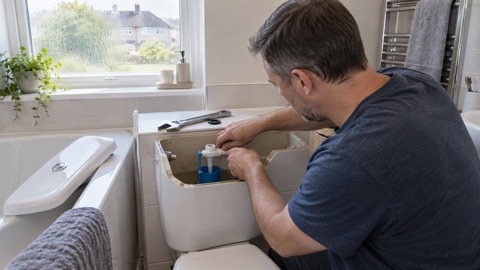
Every litre saved at home reduces the pressure on reservoirs and rivers that are already exceptionally low. The government's advice for households in a drought is to use a watering can instead of a hosepipe in the garden and to install a water butt if you can to capture rain6.
Bristol Water and Cambridge Water both offer kitchen-scale savings. Use a washing up bowl instead of letting the tap run: Cambridge Water says this can reduce wasted water by up to 50%4.
- Use a watering can instead of a hosepipe in the garden6
- Install a water butt to capture rain if you can6
- Take shorter showers13
- Use a washing up bowl instead of letting the tap run, cutting wasted water by up to 50%4
- Water the garden with grey water or rainwater, applied directly to the soil3
- Report leaks promptly: around 30% of all leakage occurs on customer property4
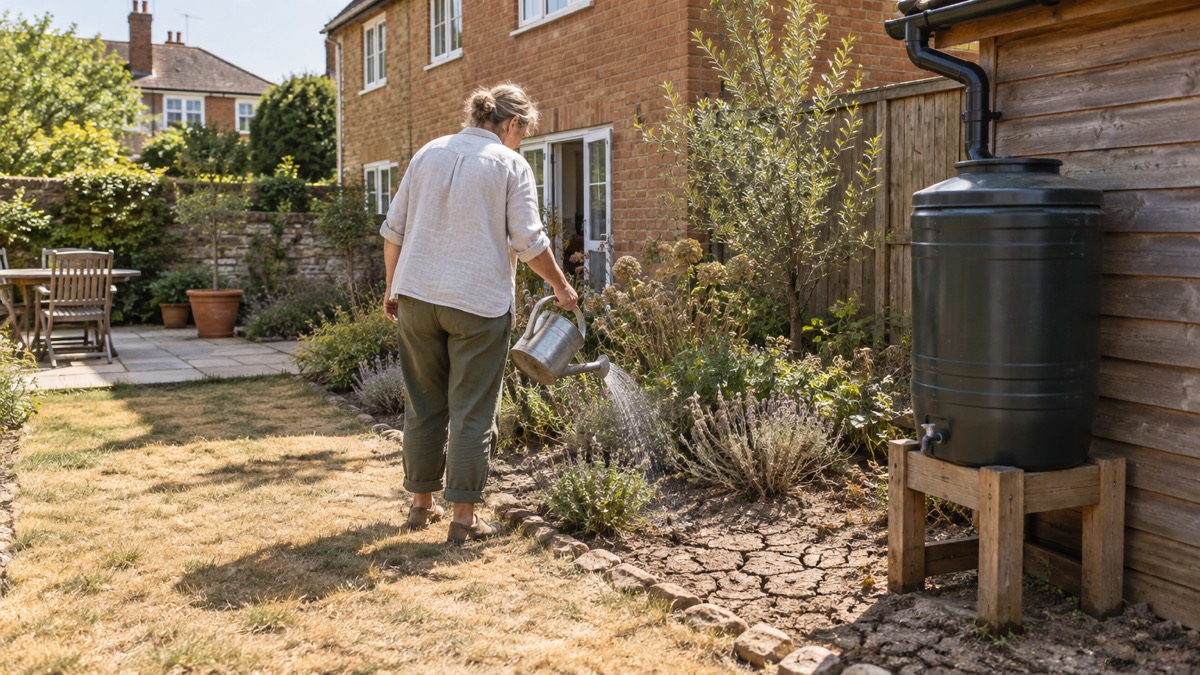
*A watering can and a water butt: the two pieces of garden kit that keep a garden going through a hosepipe ban.
Companies are doing their part on leakage. Cambridge Water has committed to a 20% reduction in leakage by 2030 and plans to replace 250km of water mains over the next five years, prioritising pipes prone to leaks or bursts4. Water companies in England and Wales must produce drought plans and update them every five years, consulting on these plans with customers and other organisations14, so households have a route to comment before the next drought: see water company drought plans.
Why England has been declared in drought
Droughts occur during prolonged periods of dry weather, which are becoming more frequent in England15. The current drought has a clear meteorological trail: 2025 saw the driest spring since 1893 followed by the hottest summer on record for England, and although England fully recovered by 23 March 2026, below average rainfall returned from March 2026 onwards, with April one of the driest on record and a May heatwave that set a new record for the hottest May temperature ever recorded4. In the uplands of the north and west of England, water resources deplete relatively quickly after just 2 or 3 consecutive months of below average rainfall, because there is little groundwater base flow to support the rivers5.
England has experienced notable droughts over the past 50 years in 1975 to 1976, 1989 to 1992, 1995 to 1996, 2004 to 2006, 2010 to 2012, 2016 to 2018, 2022 to 2023 and 2025 to 20265. The 2010 to 2012 drought saw 7 water companies in south and east England impose temporary use bans on 20 million people in April 20125, and the 2004 to 2006 drought saw hosepipe bans imposed by 8 water companies affecting over 15 million people5. In the 1975 to 1976 drought, restrictions included limited and localised use of rota cuts and standpipes in parts of England and Wales5, a reminder of what more severe drought stages can bring. For how today's situation compares, see past UK droughts and heatwaves and why UK summers are getting hotter and drier.
Sources (15)
- Dry weather and drought in England: 9 to 15 October 2026, Environment Agency, 2026
- Stay Safe This Summer, Cornwall Council, 2026
- Temporary use ban FAQs, South East Water, 2026
- Temporary hosepipe ban FAQs, Cambridge Water, 2026
- Drought: how it is managed in England, Environment Agency, 2026
- Droughts, Prepare Campaign, 2026
- Hosepipe ban, Affinity Water, 2026
- Hosepipe ban | South West Water, South West Water
- Spotlight on Wessex Water: advice on saving every drop, Wiltshire and Swindon Prepared, 2026
- Hosepipe ban FAQs, Bristol Water, 2026
- Household FAQs: hosepipe ban, Bristol Water, 2026
- Drought advice and support, Westminster City Council, 2026
- Summer preparedness, NHS Lanarkshire, 2024
- Drought, Ofwat, 2026
- How to stay safe during hot weather, Cumberland Council, 2026
 Flood Warning Checklist
 First Steps After a Flood
 Insurance Claim Records
 Past UK Droughts and Heatwaves
 Saving Water at Home
 Drought Stages in England
 Water Company Drought Plans
 Wildfires and Grass Fires