
Every water company in England and Wales runs a free scheme that gives customers who need extra help a higher priority when things go wrong. These are called Priority Services Registers, and joining one means your water company knows, before an emergency, that you may need water delivered to your door, advance warning of planned shut-offs, bills in a format you can read, or a password so you can check who is knocking at your door1. All water companies in England and Wales have schemes which allow customers to register for free additional support, according to the Consumer Council for Water, the independent body that represents water customers1.
The core promise is simple: if you are on the Priority Services Register, your water company will arrange alternative supplies for you during an interruption2. In practice that can mean bottled water delivered to your home rather than collected from a street station, being contacted immediately if your supply is affected, and being told in advance about planned work. Registration is free and only takes a few minutes3, and carers, friends or family can register on someone's behalf4.
This page explains what registered customers actually get, who qualifies, how to sign up with your own water company, and how the details differ between companies. If you are looking at the wider picture of priority services across gas, electricity and water, start with our guide to signing up to priority services registers.
Water delivered to your door when the supply fails
The main reason households join is what happens when the taps run dry. If you are on the Priority Services Register, your water company will arrange alternative supplies for you during an interruption, according to the UK government's Prepare campaign2, and the same advice appears on the government's Be Ready pages9. Surrey County Council describes the support as access to bottled water during a water supply interruption, priority assistance, and tailored support if there is a power or gas outage10.
What that means in practice depends on your circumstances. Thames Water says that if your water supply stops because of a problem on the network, and you cannot go outside during that time and need water for medical reasons, bottled water will be delivered to you5. This is the difference that matters most for people who cannot carry crates of bottles from a collection point in a car park: the register is what tells the company you cannot collect water yourself. Essex & Suffolk Water and Northumbrian Water both ask directly on their registration forms whether the person being registered would have difficulty collecting an alternative supply of water in the event of a disruption, precisely so that delivery can be arranged7.
Registered customers are also kept informed. If you are registered on the Priority Services Register for your local gas, electricity or water supplier, they will message you when there is an interruption to the supply in your area12. During drought conditions, when supplies may be disrupted over a wider area, the government's public health guidance says vulnerable consumers should contact their water company to register on their Priority Services Register so they can receive extra help and support, for example the delivery of bottled water13.
Southern Water adds a further layer: when you join, you are added to its Core Priority Services Register, which it uses to prioritise those who need support the most, especially during a loss of water supply14. A real example of how this works in an incident is described below, under bottled water stations and tankers.
For the wider picture of coping without mains water, including how much to store and how to keep it safe, see our guide to water in an emergency.
Who can join: health, disability, age and life circumstances
Eligibility is broad, and it is deliberately not limited to people with medical conditions. The Consumer Council for Water says priority services assist customers who may need extra help because of an illness, disability or language barrier, including limited mobility, sight, speech, hearing or cognitive impairment, serious illness, a medical need for water, or a mental health condition1. The Scottish Government's Ready Scotland guidance lists people who use medical equipment that needs power or water, people who are disabled or have a long-term health condition, households living with children under 5, and people over 606.
Water companies' own forms show how widely the net is cast. Northumbrian Water's list of circumstances that can qualify includes blind, partially sighted, deaf, hard of hearing or hearing impaired, dementia, developmental conditions such as autism, restricted mobility, learning disability, dialysis machine, mental health issues, speech impairment, physical impairment, elderly, and chronic or serious illness15. Beyond health, both Northumbrian Water and Essex & Suffolk Water also list life circumstances: bereavement, divorce or job loss, pregnancy and families with babies, young adult householder, and post hospital recovery15. Essex & Suffolk Water's message on its sign-up page is simply that help is here, for anyone who needs it11.
| Reason for joining | Examples from companies and official guidance |
|---|---|
| Medical need for water or power | Dialysis machine, medical equipment that needs power or water6 |
| Disability and sensory impairment | Blind, partially sighted, deaf, hard of hearing, speech impairment, physical impairment15 |
| Cognitive and mental health | Dementia, autism and other developmental conditions, learning disability, mental health issues15 |
| Age and family circumstances | Over 60, children under 5 in the household, pregnancy and families with babies6 |
| Life events | Bereavement, divorce or job loss, post hospital recovery, young adult householder15 |
| Communication barriers | Language barriers, difficulty understanding bills1 |
Arrangements differ slightly across the UK. All water companies in England and Wales have these schemes1. In Northern Ireland, the equivalent is the NI Water customer care register, which nidirect says is open to older people, people with a serious medical condition, or people who need extra help for any other reason8. Wessex Water's register covers anyone with particular requirements due to age, ill health, a disability, mental illness or additional needs16. If in doubt, register: the company will assess what you need, and there is no cost or penalty for asking.
How to register with your water company
You register with your own water company, and the route is the same across England and Wales: contact the company that supplies your water. The Consumer Council for Water says that to find out more and register for priority services, you will need to contact your water company1. The government's Prepare and Be Ready campaigns both advise signing up to your water supplier's Priority Service Register if you are eligible, so the company knows you need additional support, including when there is an interruption to your supply2.
Most companies offer an online form, a phone line, or both:
- Online: Thames Water customers can register at thameswater.co.uk, and the company says it takes a couple of minutes4. Northumbrian Water's form can be completed by logging in with an online account or selecting "I don't have an online account"7. Essex & Suffolk Water has an online sign-up form11.
- By phone: South West Water customers can register by calling 0344 346 1010, or minicom 0800 169 9965, with Text Relay also available; you can also request a copy of the registration form by calling16.
- Through a central check: Cheshire Fire and Rescue Service points customers to thepsr.co.uk to check whether they can join the free Priority Services Register, which gives extra advice and support from your energy or water supplier17.
After you submit the form, processing is not instant: Northumbrian Water and Essex & Suffolk Water both say they will update the account within 10 days7. If a supply interruption happens in that window, contact your water company directly and say you have applied.
Lancashire Prepared notes that if you are a vulnerable customer in need of extra support, you can register with your water company as a priority customer16. Greater Manchester's resilience guidance likewise directs residents to find out whether they are eligible for their gas, electricity and water suppliers' Priority Services Registers18. For a fuller walkthrough covering energy suppliers as well as water, see signing up to priority services registers.
What you need to fill in the form
The forms are short, and the main thing you need is a recent bill, because companies identify your account by a number printed on it. Southern Water's update form asks for your name and address and your customer number, which it describes as an 8 to 10 digit number in the top right corner of your bill19. Its main register page also refers to a 13-digit payment reference number in the top right corner of the bill14. Northumbrian Water and Essex & Suffolk Water both ask for the 10 digit account number found in the top right corner of any recent bill, entered without spaces7.
Beyond that, expect to give:
- Name, address and contact details, and for Northumbrian Water, date of birth, with email and account number optional7.
- Your circumstances, chosen from the company's list of health conditions and life events15.
- Whether you could collect an alternative water supply yourself during a disruption, so the company knows whether to arrange delivery7.
- A short description of the support needed, with a limit of 500 characters for additional information on the Northumbrian Water form15.
- Your communication preferences, such as bill format and how you want to be contacted1.
Accessibility help is available if the form itself is a barrier. Southern Water says its form can be viewed in a different language or with changed accessibility options using the Recite Me tool19. If you cannot find your account number, a recent bill is the place to look; if you do not have one to hand, the company's priority services team can locate your account from your address.
Help beyond outages: passwords, knock and wait, and accessible bills
The register is not only for emergencies. Much of what it offers is everyday support, and the Consumer Council for Water sets out the main categories1.
Passwords. You can register a password that the water company will use if they need to call at your property1. Northumbrian Water describes its password scheme as protecting your home: you ask for the password from the team when they knock on your door, so you can verify they are genuine before opening up15. This matters because outages and emergencies bring company staff and contractors into residential streets, and bogus callers exploit exactly those moments. Our guide to doorstep password schemes covers how these work in more detail.
Knock and wait. If you have limited mobility or are unable to leave home, you can ask the company to give you longer to answer the door1.
Accessible bills and communications. You can register your preference for how the company communicates with you. The Consumer Council for Water lists help understanding your bill before it is sent, personalised call assistance, documents in a specific background colour, text phone, Text Relay and Minicom, and sign language home visits1. Northumbrian Water and Essex & Suffolk Water offer bills in Braille, large print, audio CD, a call to explain the bill, easy read, or a standard bill15.
Meter reading. If you cannot read your meter in its present location, you can ask for it to be moved, or for it to be read for you more often by the company1.
Understanding and support. Many water companies' employees have had training from the mental health charity Mind to help them understand the support people facing mental health problems need1. Cornwall Council summarises the range as additional help during power or water outages, accessible communications, and other practical support3.
If you act for someone whose cognition is affected, tell the company: the Consumer Council for Water advises that if you are a lasting power of attorney, Deputy or Benefits Appointee, you should advise the company so they can update the customer's account1. For what companies are obliged to provide to registered customers, see what energy and water companies must do.
Registering someone else, and naming a person to speak for you
You do not need to be the account holder, or even live at the address, to put someone on the register. Thames Water says carers, friends or family can register on behalf of someone, and that it is easy and quick, only taking a couple of minutes4. Northumbrian Water says help is available for anyone who needs it, and registration can be done for yourself, someone who lives with you, or someone who does not live with you7. A person registering on behalf of someone else can nominate themselves as the point of contact for that account15.
Two points of detail from the companies' own forms:
- If you are filling in the Essex & Suffolk Water form on behalf of someone under 16, the company asks you to register as yourself11.
- Northumbrian Water's form asks how the person being registered can be supported, with a 500 character limit, so you can set out their needs in their own words15.
The government's Prepare campaign adds a prompt for carers: ask anyone you provide care for if they are registered, and if you believe you are registered but have not received support during an incident, contact your water company as soon as possible2. The Greater London Authority's flash flooding advice makes the same point from the other direction: if you are a vulnerable person, or know someone who is, sign up to the priority services registers for both power and water20. Naming a nominee on the account is covered in our guide to naming a nominee on your water or energy account.
A case study from Wiltshire and Swindon Prepared, describing Thames Water's response to a burst water main, records why this matters: if a customer is not registered on the PSR they may struggle to get the water they need, or experience delays which could impact their physical and mental wellbeing4. The same case study notes Thames Water was aiming to increase the number of customers registered on its Priority Services Register from the current 673,000 households4.
Bottled water stations and tankers: who gets water first
When a water company loses supply across an area, it usually sets up bottled water collection points and may deploy tankers. Not everyone is served in the same order, and the register is what determines priority. South East Water states plainly that during supply incidents its priority is getting water to its most vulnerable customers on the Priority Services Register, along with hospitals, care homes and schools, and it urges farmers and landowners to activate their own contingency plans for water21.
Within the register itself, companies grade need. An Ofwat report on water companies' freeze-thaw responses says customers who need water because of a medical condition such as home dialysis are categorised as P1, priority 1, customers, and are contacted immediately if affected by a supply interruption22. The Consumer Council for Water adds that water companies provide extra help if you need dialysis at home, including early notification of planned water interruptions, and will try to time planned shut-offs so they do not happen on the day of your dialysis1.
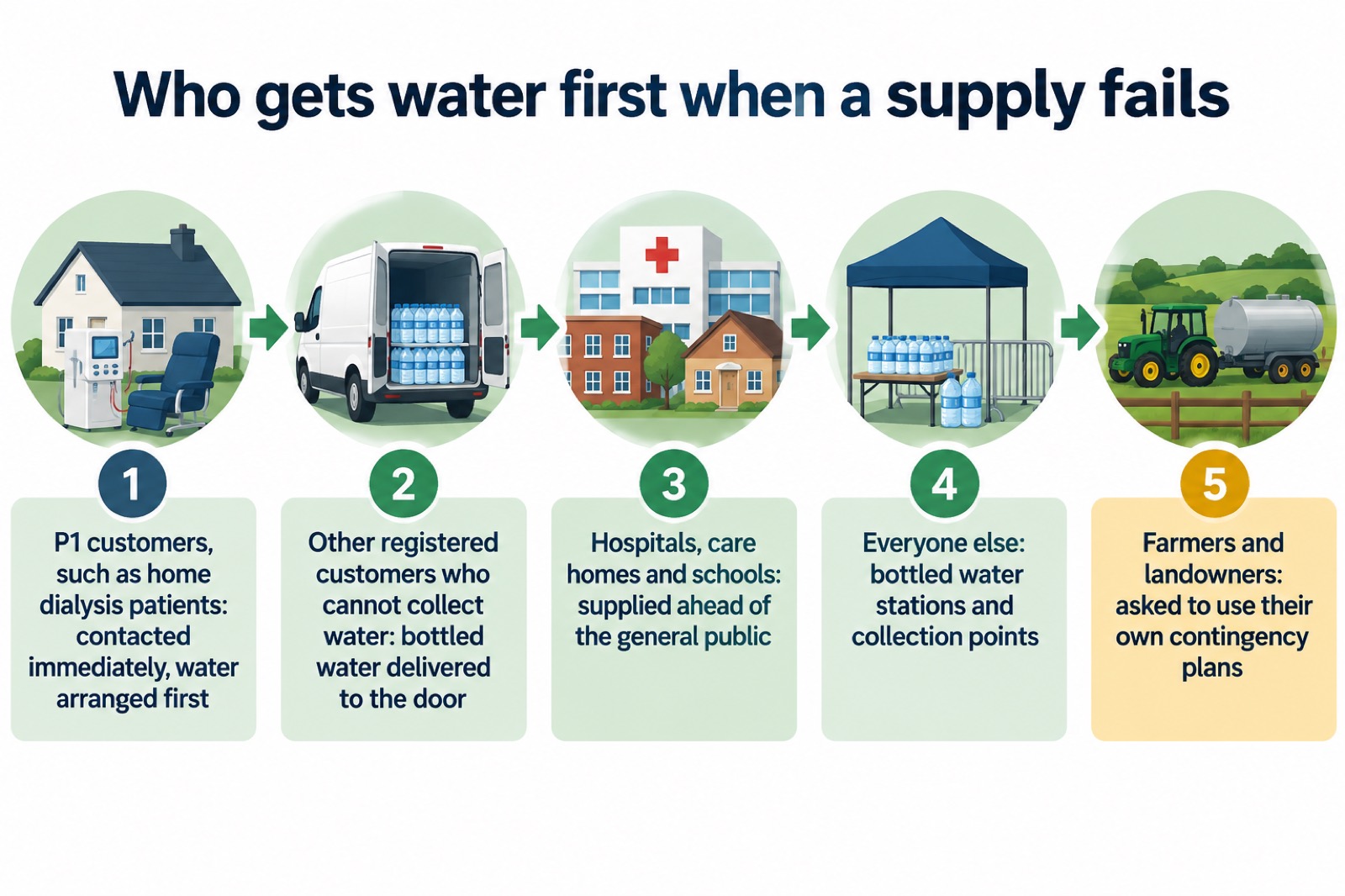
The practical implication for an ordinary household is this: if someone in your home could not reasonably collect bottled water from a street station, whether because of mobility, health or age, make sure the company knows by registering and answering the collection question honestly. If you keep livestock, plan your own water contingency in advance, because the company's emergency supply is aimed at vulnerable people first21. Our water in an emergency guide covers storing and treating water for the general case.
Keep your details up to date, or come off the register
Circumstances change, and an out-of-date register is much less useful than an accurate one. Thames Water says it checks in with registered customers every two years to make sure the details on file are up to date5. You do not need to wait for that check. Essex & Suffolk Water and Northumbrian Water both say you can update your Priority Services details anytime with an online account15.
Southern Water has a dedicated update page: existing Priority Services Register customers can use the online form to let the company know if they need a different service, including if they no longer need Priority Services19. The form works in two steps: step 1 asks for your name, address and contact details, and step 2 asks whether you still require Priority Services and what needs apply to you19. Northumbrian Water's form includes a remove option to take a registration off Priority Services7.
Coming off the register is as straightforward as joining, and there is no downside to having been on it temporarily. Southern Water notes you can apply to join on a long-term or a temporary basis14, which suits a recovery period after hospital, a temporary illness, or a family circumstance that has since resolved. If you move house, your registration does not necessarily follow you; our page on re-registering after moving house or switching supplier explains what to do.
One registration, several utilities: how the sharing works
Many households that need priority support from their water company need it from their energy supplier too, and the two systems are increasingly linked. Thames Water says that once you have registered for its Priority Services, it will let your energy provider know, so you can get their support too5. A UK government resilience framework implementation update records that the majority of water companies and gas and electricity distribution network operators now share their Priority Services Register in this way23.
Consent sits behind that sharing. Ofgem policy states that all energy companies should proactively identify and record information about their vulnerable customers, and share this data between energy companies with the informed consent of the customer prior to sharing24. Buckinghamshire County Council's guidance notes that other suppliers may also keep a register, including water and telecoms suppliers25.
Do not assume the sharing covers everything, though. Derbyshire County Council advises registering by contacting your energy supplier or network operator directly26, and its registration page adds that if you have a different supplier for your gas and energy, you need to contact them both27. The safest approach is to register with each company separately, then let any data sharing do the rest. Our extra help section brings together the support available to older, disabled and medically dependent households, including personal alarms and key safes that complement a priority services registration.
Sources (27)
- Priority services for water customers, Consumer Council for Water, 2026-07-08
- Water supply interruptions or outages, GOV.UK Prepare campaign, 2026-10-12
- Storm preparation, Cornwall Council, 2026-10-29
- Spotlight on Thames Water: prioritising support for those who need it most, Wiltshire and Swindon Prepared, 2026-10-25
- Priority Services, Thames Water, 2026-10-28
- Emergency plan, Ready Scotland, 2026-10-29
- Register for Priority Services, Northumbrian Water, 2026-10-28
- Strong winds and heavy rain warning: information and advice, nidirect, 2026-01-27
- Water supply interruptions or outages, GOV.UK Be Ready campaign, 2026-10-12
- Wellbeing and safety, Surrey County Council, 2026-10-28
- Sign up for Priority Services, Essex & Suffolk Water, 2026-10-28
- How prepared are you and your family? | Dorset Local Resilience Forum, Dorset Local Resilience Forum
- Public health impact of drought: advice for the public, GOV.UK, 2022-07-28
- Priority Service Register, Southern Water, 2026-10-28
- Priority Services, Northumbrian Water, 2026-10-28
- Utility companies: priority services, Dorset Prepared, 2024-02-22
- Safe and Well booklet, Cheshire Fire and Rescue Service, 2026-04
- Prepare yourself: loss of essential services, Greater Manchester Combined Authority, 2026-10-29
- Update your Priority Services details, Southern Water, 2026-10-28
- How to prepare for flash flooding, Greater London Authority, 2026-10-25
- FAQs: Kent and Sussex supply issues, South East Water, 2026-10-28
- Freeze-Thaw Response, February 2023, Ofwat, 2023-05
- UK Government Resilience Framework 2023: implementation update, GOV.UK, 2023-12-04
- PSR update March 2015: open letter, Ofgem, 2015-03-26
- Help from energy supplier, Buckinghamshire Council, 2026-10-29
- Priority Services Register, Derbyshire County Council, 2026-10-29
- Priority Services Register: registration, Derbyshire County Council, 2026-10-29
 Joining Priority Services
 Personal Evacuation Plans
 Carers Planning for Absence