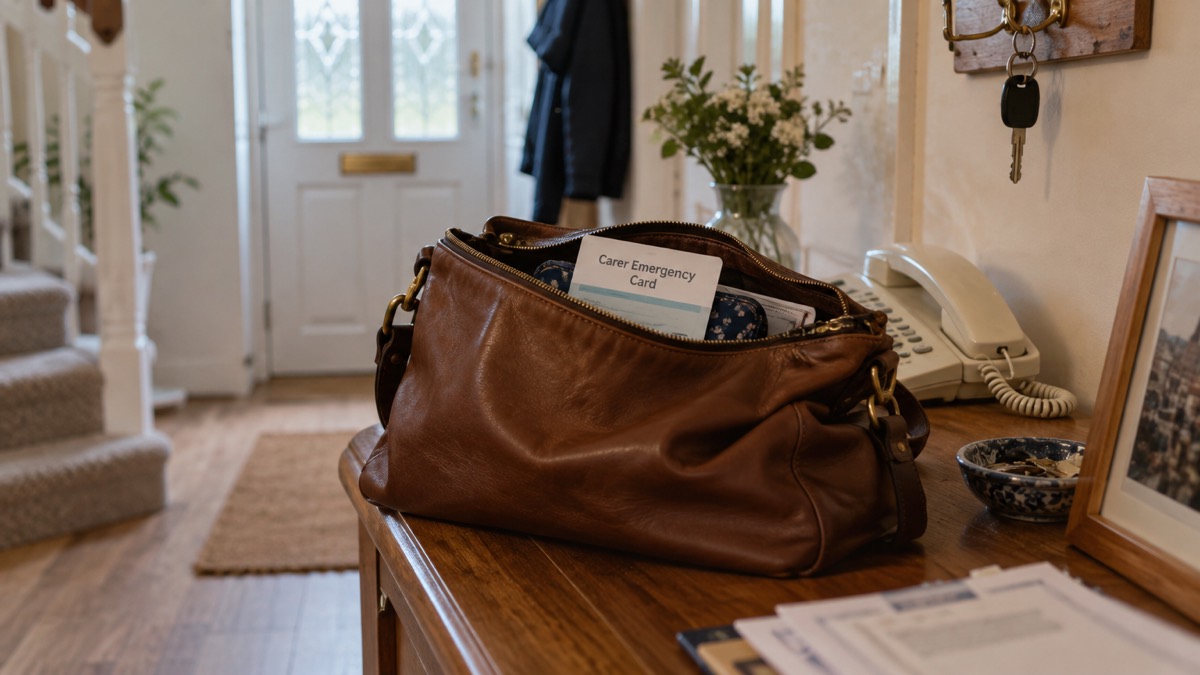
If you look after someone, an emergency plan answers one question in advance: what happens to them if something happens to you? A carer's emergency plan is a simple document that sets out what needs to be done to support the person you care for if you cannot carry out your caring role at short notice, and it names someone to be contacted1. Councils across England and Scotland run schemes that pair the plan with a credit card-sized emergency card, so that if you are taken ill or have an accident, the emergency services can see straight away that someone depends on you and can put your plan into action3.
The plan is for carers who are depended on as the main source of support for a person1. It is not about the big national emergencies: it is about the personal ones, being admitted to hospital, a period of ill health, an accident, or another emergency such as a storm that stops you getting to the person you care for5. Having a plan in place can reduce the worry for you, the person you care for and your family7.
This page explains what to put in the plan, who to ask to step in, how the card schemes work and how to apply, what to do if you have no one to name, and what a plan will not do for you. It sits alongside our wider guide to extra help in an emergency for older, disabled and medically dependent households.
What a carer's emergency plan is for
An emergency plan contains important information about the person you care for and explains what needs to happen if something happens to you, such as if you are unwell or have an accident and cannot care for them2. Suffolk County Council describes its Family Carers Emergency Plan as setting out in advance what needs to happen to the person you care for in an emergency if you are unable to continue providing care, and identifying someone to be contacted1. NHS Tayside in Scotland describes the same idea as a simple document outlining what needs to be done to support the person you care for if you are unable to carry out your caring role at short notice9.
The point is that the person you care for will still be looked after if something happens to you4. Without a plan, whoever turns up, a paramedic, a neighbour, a hospital ward, has to work out from scratch what the person needs, who to ring and where medication is kept. With a plan, that information exists already, and in many areas there is a phone number on your card that anyone can call to put it into action2.
A crisis or emergency, in the terms of these schemes, is something that could not have been planned for and that stops you giving your usual level of care. Derbyshire County Council gives the examples of being admitted to hospital or going through a period of ill health3. Cornwall Council's Emergency Carer's Card Scheme is for carers concerned about what would happen if they were taken ill, were in an accident, or were stopped from getting to the person they care for by another emergency5. A planned admission or arranged respite is a different matter: those should be organised through the person's normal care arrangements, not through the emergency scheme.
A GP practice writing for carers makes the wider case: a contingency plan gives you peace of mind that, in an emergency, you and your cared-for person's wishes about replacement care have already been documented, and it is important to have a plan in place to help you both in an emergency10. Some areas also have a Carers Emergency response service that may be able to provide carers for your loved one in an emergency if they need that level of support, and a local carers organisation can signpost you to it10.
What to put in your plan
The core of the plan is a clear account of the care you give and the people who need to know about it. Derbyshire County Council sets out the essentials: emergency plans need to include details about the care and support you provide for the person, as well as emergency contacts, health needs, preferred routines and any communication difficulties3.
The Scottish Government's readiness advice for disabled people and carers gives a fuller list for anyone who receives care or support services, and it works just as well for the person you care for. A complete plan covers:
- important contact details
- any essential daily support tasks
- medication requirements
- information about medical conditions
- alternative support arrangements if carers cannot reach you
- instructions for emergency responders if you have additional communication needs
Round this out with the practical household details any emergency plan carries. The Greater London Authority's household plan advice is to include emergency contact details for your family or the people you live with, as well as details relating to your insurance and utility providers11. These household details sit alongside the carer-specific information above, so that whoever picks the plan up finds both the care arrangements and the everyday contacts in one place.
| Section of the plan | What to write |
|---|---|
| Emergency contacts | Emergency contact details for your family or the people you live with11 |
| The care you give | Essential daily support tasks, medication requirements and preferred routines3 |
| Health information | Medical conditions, health needs and any communication difficulties3 |
| Services involved | Who provides paid care or support, and alternative arrangements if they cannot attend12 |
| Practical details | Details relating to your insurance and utility providers11 |
| Instructions for responders | What an ambulance crew or responder needs to know first, especially if the person has communication needs12 |
Our checklist page, Carer's Emergency Plan: What to Include, takes you through the same material item by item if you want a version to work from.
Who to ask to step in
A plan only works if the people named in it have agreed to be named. Staffordshire County Council's advice on carers' contingency planning is direct: talk to family, friends and, where appropriate, the person you care for6. The national Be Ready advice for disabled people and carers says the same from the other side: talk to your friends, family, carers, neighbours and support network about needs and how they might change in an emergency13.
Have the conversation before you write the plan, not after. Each person you name should know roughly what they might be asked to do, how to get into the home, and what the person's routines are. The person you care for should, wherever they can take part, know who has been named and agree to it: the plan is for their benefit, and a stranger they have never met may frighten them more than the emergency itself.
Neighbours are worth thinking about specifically. The Royal Borough of Windsor and Maidenhead's home emergency plan checklist includes, as a step in an emergency, considering contacting neighbours or those who may be affected by the situation14. Argyll and Bute Council's community emergency planning guidance makes the broader point that it is very important to talk to people in your community who have resources they can use to help15. For a carer, the neighbour who can sit with someone for an hour until family arrives is often the difference between a manageable evening and a crisis.
If the person you care for uses technology to stay safe, name who holds access to it. If they have a key safe for carers and responders, record the code location in the plan rather than the code itself, and say who knows it. If they wear a personal alarm, note the provider and what happens when it is pressed, so whoever steps in knows help may already be on the way.
Carer's emergency cards
The card is the part of the scheme that travels with you. NHS Tayside describes it as a credit card-sized card that lets others know you have a caring role9. Derbyshire County Council says it shows that you are a carer and can alert emergency services that someone relies on you3. The national easy-read guidance for disabled people and carers puts it simply: a carer's card lets people know that you care for someone16.
What is on the card varies by scheme, but the Norfolk version shows the shape: the card states that you are a carer and that someone is relying on you to keep them safe and well, it shows your emergency plan number and the emergency helpline number, and you should always carry it with you2. Once you create an emergency plan in Norfolk, you get an emergency carer's card with a phone number on it which can be called to put your plan into action2. In Suffolk, after completing the form you receive a key fob with the contact details for Customer First and the ID number of the person you care for1. In Cornwall, the card can be used to call the central office to arrange an alternative carer5.
The card matters most in the situations where you cannot speak for yourself. If you collapse in the street, the card in your wallet tells a paramedic that someone is at home alone, and gives them a number to call. That is why the advice is to carry it always, not just when you are going further afield2. Our page on the In Case of Emergency Card covers the general version of this idea for any household.
Schemes are run locally, so assume the scheme is local to the council area and check with the council for where the person you care for lives. Ask them whether a carer's emergency card scheme operates there, how to register, and what the card will trigger if you are suddenly unable to care.
How to apply
Every scheme has its own registration route, but they follow the same pattern: you fill in a form with the details of your caring role and your emergency contacts, the scheme records it, and you receive a card or fob carrying the helpline number.
| Area | How to register | What you receive |
|---|---|---|
| Norfolk | Fill out the adult carer emergency plan form, which can be printed to share with your support network; help filling it in on 0344 800 8020, open 24 hours a day2 | An emergency carer's card with a phone number that can be called to put your plan into action2 |
| Suffolk | Apply by completing an application form, with submission details included in the form1 | A key fob with the contact details for Customer First and the ID number of the person you care for1 |
| Derbyshire | Record your details using the online form, or email carers.adultcare@derbyshire.gov.uk3 | A carer's emergency card3 |
| Cornwall | Apply for the card from Cornwall Carers Service5 | An Emergency Carer's Card that can be used to call the central office to arrange an alternative carer5 |
| Nottinghamshire | If you are caring for someone who lives in Nottinghamshire County, the council can give you a Carer's Emergency Card4 | A Carer's Emergency Card4 |
| Norfolk (First Response) | If you care for someone age 18+, you can create an emergency plan online17 | An online emergency plan helping make sure the person is safe if you are not available17 |
| Torbay | Join Torbay Carers and set up your back up plan, in case you have an emergency and are unable to care12 | A back up plan through the carers service12 |
Help is available if the form is a barrier. In Norfolk, you can telephone 0344 800 8020 for help to fill in the form, and that number is open 24 hours a day2. NHS Tayside advises speaking to your local carers centre for help setting up your emergency plan and getting your card9. Carers UK also offers an interactive online tool to help you create an emergency plan, which Oxford Health NHS Foundation Trust points carers towards18. If you care for someone age 18+ in the Norfolk First Response area, you can create the plan online rather than on paper17.
Nottinghamshire County Council publishes its guidance in an easy-read format, which is worth knowing about if the person you care for wants to understand the plan themselves, or if you find plain-English forms easier4. The national easy-read guide to preparing for emergencies for disabled people and carers covers the same ground across all nations16.
If you have no one to name as an emergency contact
Not everyone has family nearby or friends who can step in, and the schemes are built with that in mind. Derbyshire County Council is explicit: if you do not have any emergency contacts, you can still apply for a card and tick the "no emergency contacts" box3. Norfolk goes further: if you do not have anyone to add to your emergency plan, or only have one person, you can add that you will need adult social care to organise support in the event of an emergency2.
This is the point where a carer's assessment earns its place. A carer's assessment, through your council's adult social care team, is the route to discussing what support would be needed if your caring role broke down, and the emergency plan can record the outcome. A GP practice writing for carers notes that a local carers organisation can help you with a contingency plan and signpost you to a Carers Emergency response service that may be able to provide carers in an emergency if the person needs that level of support10.
If you have one contact but not a second, name the one and state in the plan what should happen if they cannot be reached. A single named person who works away, or who is themselves unwell, is not cover on their own. Where no one can be named, the plan should say plainly who should be called instead, whether that is adult social care, the carers emergency response service, or the scheme's own helpline.
What an emergency plan does not give you
This is the limit most worth understanding before you rely on the scheme. The card and plan make sure the right information reaches the right people quickly; they do not guarantee that a replacement carer arrives within the hour, and they do not jump the queue for a care needs assessment. What replacement care is actually arranged, and how quickly, depends on what the scheme in your area offers and on what the person you care for is entitled to through ordinary social care routes.
The plan also does not replace the emergency services. If the person you care for has fallen and cannot get up, or is seriously unwell, the plan is not the response: call 999. And be clear about what the scheme itself will and will not do: an emergency plan does not include free care or rapid access to social care services8. Our pages on falls at home and on what to do if the person you care for goes missing cover the two emergencies carers most often face that sit outside the card scheme itself.
Register as a carer with your GP
Alongside the council scheme, register as a carer with your GP surgery. This is separate from the emergency card: it tells the practice that you have a caring role, so that appointments, invitations and advice reach you with that role in mind. Some GP practices have web forms on their websites for carers to register online more easily.
Registration also connects you to the health protections carers are entitled to. Government guidance is that main carers of an older or disabled person should be offered a free flu jab, and Carers UK has urged unpaid carers to take up the offer. Ask at your surgery or a pharmacy, and make sure your carer registration is in place so the invitation comes to you.
In some areas the carers service itself runs the planning. In Torbay, you join Torbay Carers and set up your back up plan, in case you have an emergency and are unable to care17. Your local carers centre is a good single point of contact for finding what exists where you live, wherever in the UK you are.
Keeping the plan where people can find it
A plan no one can find is no plan at all. The consistent advice, from every government and council source, is to keep a paper copy somewhere obvious and tell people where it is.
- Keep a printed or handwritten copy somewhere handy and make sure everyone in your home knows where it is19
- Discuss it with the people you live with and keep a paper copy somewhere easy to find20
- Keep your completed plan somewhere safe where you can easily find it in an emergency21
- Keep it somewhere easy to find and tell friends, family and carers where to find it16
- Keep important contact details in an easy-to-find location and identify family members, friends or neighbours who may be able to help in an emergency18
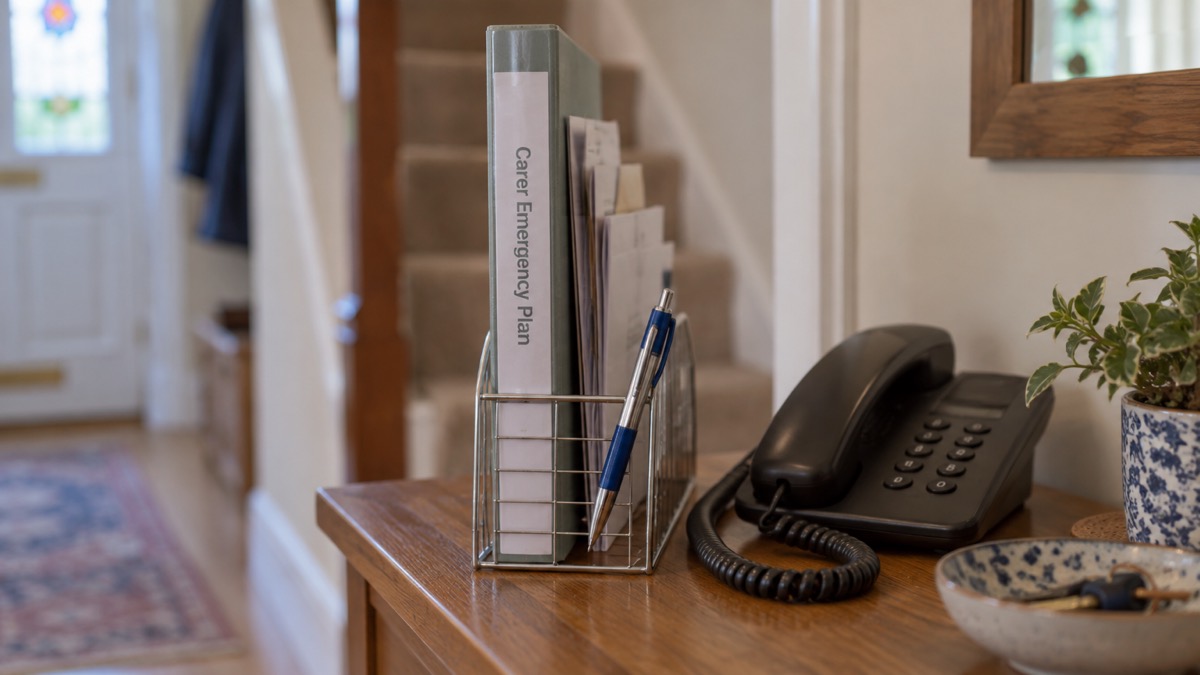
Give printed copies to the people named in the plan, not just a mention of it: each named contact should hold the pages they would need, so they are not reading them for the first time over the phone at midnight. Keep a printed or handwritten copy somewhere handy as well, and make sure everyone in your home knows where it is. Tell friends, family and carers where to find it.
Review the plan when circumstances change: a new medication, a contact who has moved away, a change in the person's mobility. A plan written two years ago and never revisited will still name the right people only by luck.
Fire safety for carers
Fire is the emergency where a carer's knowledge changes the outcome most, and fire and rescue services have specific advice for carers. Manchester Fire and Rescue Service advises that if you are providing care or support to a vulnerable person, it is important to include and record fire safety in your assessments and care planning22. Devon and Somerset and other services advise parents and carers to make a fire escape plan with your household23.
London Fire Brigade advises carers and support workers to use online resources such as the Home Fire Safety Checker, or to download the Checklist for Person Centred Fire Risk, and to contact the brigade to request an in-person Home Fire Safety Visit24. If you are a formal carer, support worker or other healthcare professional, record and report your concerns to your line manager so an action plan can be put in place24. An unpaid carer can do the same by raising concerns directly with the fire and rescue service for the person's area; our page on how to refer a vulnerable person for a fire safety check explains the process.
Some risks are specific to the people carers look after. Emollient and skin creams, widely used by older and disabled people, carry a fire risk that carers should understand, and London Fire Brigade's guidance for carers and support workers covers it25. Hoarding, where it affects the person you care for, changes how a fire develops and how they escape, and the brigade's guidance on hoarding disorder is written for exactly this situation24. Our page on fire risk for older and disabled people at home brings the whole subject together.
Landline switchover and care alarms
If the person you care for has a care alarm, health pendant or telecare device that works through the telephone line, the UK's move from copper landlines to digital phone services matters to your plan. Ofcom's warning is plain: your care alarm or telecare device might not work properly on a digital landline26.
The action is simple and it comes from Ofcom and from government guidance: tell your landline provider in advance. If you tell your landline provider in advance, they can help check whether your device will work and make any necessary arrangements, including pausing the change until a safe solution is in place if needed26. Government guidance on telecare says the same: if you or someone you know uses telecare, you should contact your landline provider in the first instance, because they can help make sure the alarm keeps working through the switchover28.
Telecare alarm systems can alert call centres or carers if individuals experience a problem, such as a fall at home or outside, depending on the device and its connectivity28. That is a real layer of cover for the person you care for, but only if it keeps working through the switchover, so check it as part of writing and reviewing your plan. Our pages on personal alarms, on what happens when you press a personal alarm, and on whether telecare works in a power cut cover the rest of that ground.
Where to get help
Your first contacts, in order:
- Your council's adult social care team, to ask about the carer's emergency card scheme where you live
- Your local carers centre, for help setting up your emergency plan and getting your card3
- Your GP surgery, to register as a carer and for the health protections that come with it10
- Your fire and rescue service, for a home fire safety visit for the person you care for24
- Your landline provider, if a care alarm uses the phone line27
For the wider household side of preparing, our getting started guide covers the basics every home should have ready, and the extra help section gathers the specific arrangements for older, disabled and medically dependent households, from priority services registers to personal evacuation plans for disabled residents in flats.
Sources (28)
- Family Carers Emergency Plan, Suffolk County Council, 2026
- Carer's Emergency Plan, Norfolk County Council, 2026
- Carer's Emergency Card, Derbyshire County Council, 2026
- Help in an Emergency: Easy Read, Nottinghamshire County Council, 2026
- Emergency Planning for Carers, Cornwall Council, 2026
- Support for Unpaid Carers: Plan for Emergencies and Changes, Staffordshire County Council, 2026
- Norfolk First Response, Norfolk County Council, 2026
- Community Emergency Plan Toolkit, UK Government, 2016
- Carer's Emergency Plan, NHS Tayside, 2026
- Planning Ahead as a Carer, Beacon Medical Group, 2026
- Emergency Planning Advice for Londoners, Greater London Authority, 2026
- Disabled People and Carers, Scottish Government Ready Scotland, 2026
- Advice for Disabled Persons and Carers, UK Government Be Ready campaign, 2026
- Your Home Emergency Plan, Royal Borough of Windsor and Maidenhead, 2026
- How to Make a Community Emergency Plan, Argyll and Bute Council, 2026
- Be Prepared for Winter Emergencies, Norfolk and Suffolk NHS Integrated Care Board, 2026
- Carers Service: Planning Ahead, Torbay and South Devon NHS, 2025
- Carers Handbook: Emergency Plan, Oxford Health NHS Foundation Trust, 2025
- Be Prepared for Emergencies, North Devon Council, 2026
- Emergency Planning, Belfast City Council, 2026
- Easy Read: Disabled Persons and Carers, UK Government Be Ready campaign, 2024
- Additional Advice for Carers, Manchester Fire and Rescue Service, 2026
- Fire Safety Interventions, Cornwall Fire and Rescue Service, 2026
- Hoarding Disorder: Guidance for Carers and Support Workers, London Fire Brigade, 2026
- Emollient and Skin Creams: Guidance for Carers and Support Workers, London Fire Brigade, 2026
- Future of Landline Calls, Ofcom, 2026
- Advice for Consumers: Future of Landline Calls, Ofcom, 2024
- Find a Telecare Provider, UK Government, 2025
 Joining Priority Services
 Water Priority Services
 Personal Evacuation Plans