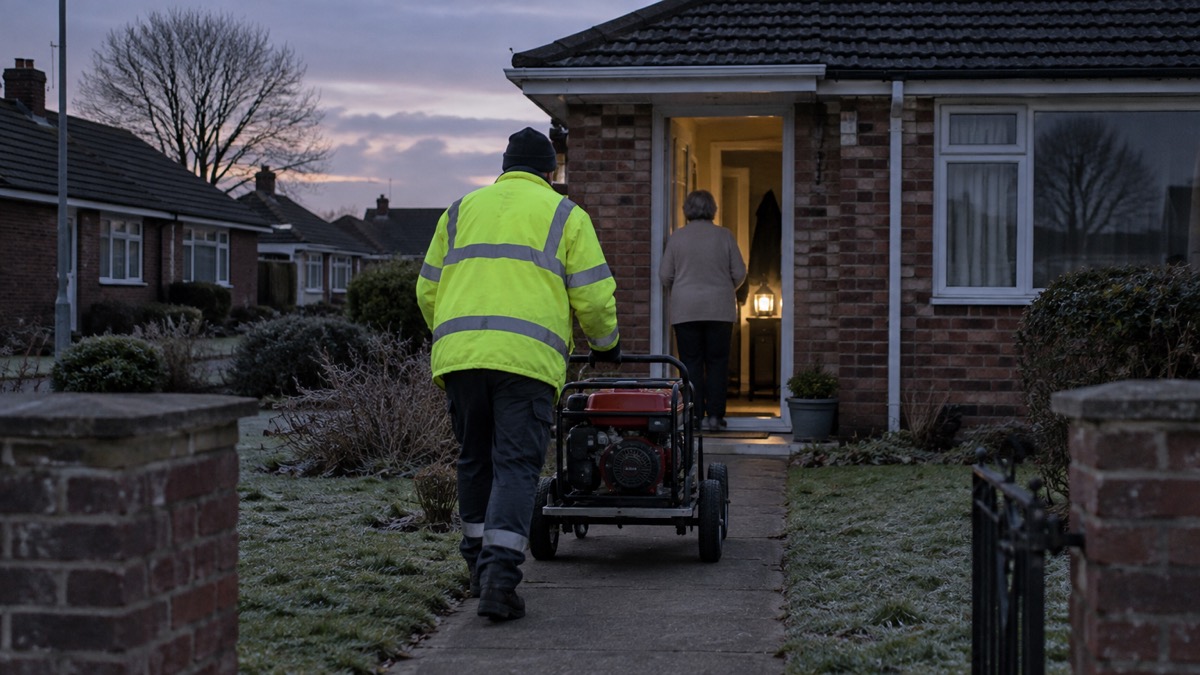
If you or someone in your household needs extra help during a power cut, gas outage or water supply interruption, you can join the Priority Services Register. It is free, it takes a few minutes, and you sign up at thepsr.co.uk or by contacting your supplier directly1. The register is a free UK wide service that provides extra help during power cuts or when there is an interruption to your electricity, gas or water supply2.
The most important thing to understand before you start is that there is not one single register. Your energy supplier keeps one, your electricity network operator keeps one, and your water company keeps its own. Registering with one does not automatically add you to all the others, although your energy supplier can pass your details to your network operator if you agree3. This page explains how to sign up with each of them, what details are asked for, what being registered actually gets you, and when you need to register again.
Who can join the Priority Services Register
You can join if you have a disability, a long-term health condition, rely on medical equipment, are pregnant, have young children, or are of pensionable age4. In Scotland, the eligibility list is set out as: you use medical equipment that needs power or water, you are disabled or have a long-term health condition, you live with children under 5, or you are over 608. The RNIB, writing for people with sight loss, adds that you can join if you have reached your state pension age9.
The eligibility rules are broader than many people expect. You do not need to be registered disabled or to have a formal diagnosis. If your circumstances mean a power cut or water outage would hit your household harder than most, that is what the schemes are for. All providers offer different schemes and eligibility criteria, so it is best to check each provider's website for their exact rules5.
The help can be permanent or temporary. Ofgem, the energy regulator, states that the extra help "could be all the time, or for a short period due to something that's happened in your life"10. That covers a temporary illness, a period of recovery after hospital, or any stretch where you need more support than usual.
| Who can join | Examples given in official guidance |
|---|---|
| People with a disability or long-term health condition | Any condition affecting daily living4 |
| People who rely on medical equipment | Equipment needing electricity, gas or water4 |
| Pregnant households | At any stage4 |
| Households with young children | Children under 5 in Scotland's scheme8 |
| Older people | Pensionable age4; state pension age9; over 60 in Scotland8 |
| Carers | Registering on behalf of someone you care for11 |
How to register: one form at thepsr.co.uk or a call to your supplier
The simplest route for most households is the shared sign-up website. GOV.UK's Prepare campaign, the Be Ready campaign, and local resilience guidance all point to the same address: sign up at thepsr.co.uk, or by contacting your energy supplier1. The site covers both energy and water: official guidance for water supply interruptions tells you to "sign up to your water supplier's Priority Service Register" via thepsr.co.uk if you are eligible12, and the same address is given for energy suppliers13.
If you prefer to register by phone, call your supplier directly. The scheme is offered by your energy supplier, so they are the first point of contact for electricity and gas7. For water, contact your water company. If you are unsure who your water supplier is, you can find out by entering your postcode on the Water UK website14.
Some companies also take registrations through their own websites. Thames Water, for example, lets customers register online at thameswater.co.uk, and states that it takes a couple of minutes, with carers, friends or family able to register on behalf of someone15. Whichever route you use, the outcome is the same: your details go onto that company's register.
What the form asks for is your household's circumstances: who lives there, any disabilities or health conditions, whether anyone relies on medical equipment that needs power or water, and how you prefer to be contacted. You give a phone number or email so the company can reach you during an outage. If you use electrical medical equipment, SP Energy Networks advises that you should make sure you are fully prepared for a power cut as well as registering, because the register is support, not a guarantee16.
No proof needed, and you can sign up for someone else
Registration is free and only takes a few minutes4. You can also sign up on behalf of someone else, including a family member, and if you do not know their account number, their home address is enough for the company to find their customer details. If a supplier needs more information about your circumstances, they will ask you directly rather than require a doctor's letter as standard.
You can also register on behalf of someone else. Scottish and Southern Electricity Networks, writing about customers living with dementia, asks carers to "register on behalf of someone you care for, help us understand their needs, and nominate an alternative contact if support is needed"11. Thames Water likewise confirms that carers, friends or family can register on behalf of someone15. This matters if the person you care for would struggle to complete a form themselves, or would not think to register until an emergency had already begun.
When you register, you can nominate a carer, family member or friend to speak to the company on your behalf. United Utilities explains that this is for people who "have difficulty communicating or find it hard to understand your bill and other information you receive from us"17. The nominated person can then be contacted and given information, which is especially useful during an outage when the company needs to reach someone quickly. For more on naming someone formally on an account, see our page on naming a nominee on your water or energy account.
What the register gives you in a power cut
Being registered changes what your electricity company does around a power cut, even though it does not change the repair itself. The RNIB summarises it plainly: being on the register means your provider will understand more about your individual needs and support you during a power cut, and you should be made aware of planned power cuts in advance9. Advance notice of planned interruptions is one of the most concrete benefits, because it gives you time to charge devices, arrange care, or go elsewhere for the day.
For customers living with dementia, SSEN offers a free personalised Power Cut Plan, tailored to needs, routines and communication preferences, and included in the welcome letter once you are registered11. Registered customers also receive updates during planned or unplanned power cuts, and access to support tailored to their needs11. If you use a home ventilator, the Leeds NHS home ventilation manual instructs you to register as a priority user with your electricity provider, because this means you get advance notice of any planned power cuts18.
Registered customers are also messaged when something goes wrong. Dorset Prepared explains that if you are registered on the Priority Services Register for your local gas, electricity or water supplier, they will message you when there is an interruption to the supply in your area19. That message can tell you what has happened, roughly how long it will last, and what to do next, which is often the difference between a difficult evening and a dangerous one.
If you use electrical medical equipment, prepare for power cuts as well as registering. Our guides on home oxygen therapy, airflow pressure-relieving mattresses and backup power at home cover what to have ready, and the main power cuts guide sets out what to do when the supply goes.
Being on the register will not get your power back sooner
This is the point most worth understanding before you rely on the register. SSEN states it directly: "Our teams work hard to restore power to affected areas but can't prioritise individual households"11. SP Energy Networks says the same: "Being on our register won't necessarily mean we can restore your power more quickly, however we will try to proactively contact you if we know of a problem in your area"16.
The reason is how power networks are built. Engineers restore power in the order that reconnects the most households per repair, which usually means fixing the bigger faults first. A registered household on a street fed by a damaged cable waits with everyone else on that cable. What the register changes is everything around the wait: the company knows you are there, contacts you, and can offer support while the repair is done.
So treat the register as one layer of preparation, not the whole plan. Keep torches where you can find them, keep a charged power bank, and know how to report the outage. Call 105, the free power cut number, to report a power cut or get information during one6. Being registered does not replace calling 105: the register tells the company you need extra support, while 105 is how the outage gets reported and information reaches you. Our staying informed guide covers other ways to keep in touch during an emergency.
Water supply interruptions: bottled water and who gets it first
Water companies keep their own Priority Services Register, and it works in a similar way. Surrey County Council lists what it can include: "access to bottled water during a water supply interruption, priority assistance, and tailored support if there is a power or gas outage"20. The Prepare campaign states it as a commitment: if you are on the Priority Services Register, your water company will arrange alternative supplies for you12.
That prioritisation matters when supplies are limited, for example after a burst main, when bottled water has to be distributed to a whole area at once. Registered households with the greatest need are the ones the company aims to reach first, and water companies' plans for supply incidents explicitly cover alternative water supplies and the prioritisation of vulnerable customers.
A real example shows how this works in practice. A collection point serves everyone, but registered customers who cannot collect water themselves, because of mobility, illness or reliance on water for medical equipment, are the ones the company will try to reach with delivered supplies. Thames Water's own account of responding to a burst main describes prioritising support for those who need it most15.
If you are unsure who your water supplier is, enter your postcode on the Water UK website to find out14. For a fuller picture of what registered water customers can expect, see our page on water company priority services, and for the wider picture of what companies owe you, what energy and water companies must do for registered customers.
Does registering with one company register me with the others?
No, and this is where households most often come unstuck. There are several registers, kept by different organisations, and they do not all share your details automatically.
Your energy supplier (the company that sends your bills) and your network operator (the company responsible for the wires and pipes in your area) both keep a Priority Services Register10. Buckinghamshire Council adds that other suppliers may also keep one, including water and telecoms suppliers5. So a household could reasonably be on four or more separate registers: the electricity supplier's, the gas network's, the electricity network's and the water company's.
There is one important piece of data sharing, but it is partial. Derbyshire County Council explains: "Your supplier can pass details to your network operator to add you to their register as well. It's a good idea to do this" especially if you rely on your energy for medical reasons3. In other words, your supplier can forward your details to the network operator, but you should ask for this to happen rather than assume it has. Nothing in the guidance suggests your water registration is shared with your energy suppliers, or the other way round: the water register is separate, and you sign up to it separately12.
| Register | Who keeps it | How to get on it |
|---|---|---|
| Electricity and gas supplier register | Your energy supplier7 | thepsr.co.uk or contact your supplier1 |
| Electricity network register | Your regional network operator10 | Ask your supplier to pass your details on3, or contact the network directly |
| Gas network register | Your regional gas network, for example Cadent21 | Contact your supplier, or check eligibility with the gas network21 |
| Water company register | Your water company12 | thepsr.co.uk or contact your water company12 |
For gas customers, the same principle applies: energy suppliers and network operators will both keep a Priority Services Register21. That means a registration with your supplier does not automatically cover the network operator for your area, so if you rely on the extra support, check with both.
Keeping your details up to date
You only need to register once with each supplier9. But two changes undo a registration, and both are common.
The first is switching supplier. Ofgem states it plainly: "If you switch supplier, you'll need to ask to join their Priority Services Register"10. Derbyshire County Council says the same, and adds moving home: you'll need to register again if you change suppliers or move home7. The RNIB advises checking whether you need to register again whenever you change supplier or move address9.
The second is moving home. The easy read guidance from the Prepare campaign asks registered customers to tell the organisations their new address as soon as possible22. Even if you stay with the same supplier, a move to a different network area or water company region means your old registration no longer points at the right company for your new home.
The practical habit is this: whenever you move or switch, treat re-registering as part of the paperwork, alongside redirecting post and updating your bank. Our page on whether you need to re-register after moving house or switching supplier goes through the steps in order. And if your circumstances change in other ways, for example a new medical condition or a change in who cares for you, tell the companies so their records reflect what they would actually find at your door.
Northern Ireland: Customer Care Registers
Northern Ireland runs its own equivalents, called Customer Care Registers1. The Prepare campaign confirms: "If you are in Northern Ireland these are called Customer Care Registers"23. The principle is the same, but the organisations and the sign-up routes differ, so do not rely on thepsr.co.uk if you live there.
For electricity, nidirect, the Northern Ireland government information service, advises: "If you depend on electrical equipment that is vital to your health, contact Northern Ireland Electricity (NIE) Networks" to get on their medical customer care register24. Contact NIE Networks directly, and contact your gas and water providers in Northern Ireland separately, since each keeps its own register on the same pattern as Great Britain.
Where this fits in your wider preparations
The government's own preparedness advice puts the registers in context. Registering is one step among several that a household can take, and it is the one that takes the least effort for the most return: a few minutes at thepsr.co.uk, and your suppliers know to look for you if your gas, electricity or water supply is cut off.
If you care for someone, registration sits alongside a carer's emergency plan, so that support continues even when you cannot be there. See our guides on carers: planning for when you cannot be there, dementia and emergencies, and the wider extra help in an emergency section for older, disabled and medically dependent households.
Sources (24)
- Power cuts: be informed about hazards, Be Ready campaign, 2026-10-21
- Priority Services Register Scotland, Scottish Borders Council, 2026-10-29
- Priority services register, Derbyshire County Council, 2026-10-29
- Storm preparation advice, Cornwall Council, 2026-10-29
- Help from energy supplier, Buckinghamshire Council, 2026-10-29
- Severe weather advice, Cumberland Council, 2026
- Priority services register, Derbyshire County Council, 2026-10-29
- Flooding: be informed about hazards, Readiness campaign Scotland, 2026-03-24
- Priority Services Register, RNIB, 2026-10-29
- Join your supplier's Priority Services Register, Ofgem, 2026
- Priority services for customers living with dementia, Scottish and Southern Electricity Networks, 2026-10-25
- Water supply interruptions or outages, Prepare campaign, 2026-10-12
- Loss of essential services, Greater Manchester Combined Authority, 2026-10-29
- Water testing, Drinking Water Inspectorate, 2025-12-09
- Spotlight on Thames Water: prioritising support for those who need it most, Wiltshire and Swindon Prepared, 2026-10-25
- Priority services registration form, SP Energy Networks, 2026-10-29
- About priority services, United Utilities, 2026-10-28
- Home ventilation patient manual, Leeds Teaching Hospitals NHS Trust, 2024-10
- Protect yourself and your family, Dorset Prepared, 2026-04-21
- Wellbeing and safety, Surrey County Council, 2026-10-28
- Safe and well booklet, Cheshire Fire and Rescue Service, 2026-10-29
- Easy read: disabled persons and carers, Prepare campaign, 2024-07
- Get prepared for emergencies, Prepare campaign, 2026-10-21
- Strong winds weather warning information and advice, nidirect, 2026-10-24
 Water Priority Services
 Personal Evacuation Plans
 Carers Planning for Absence