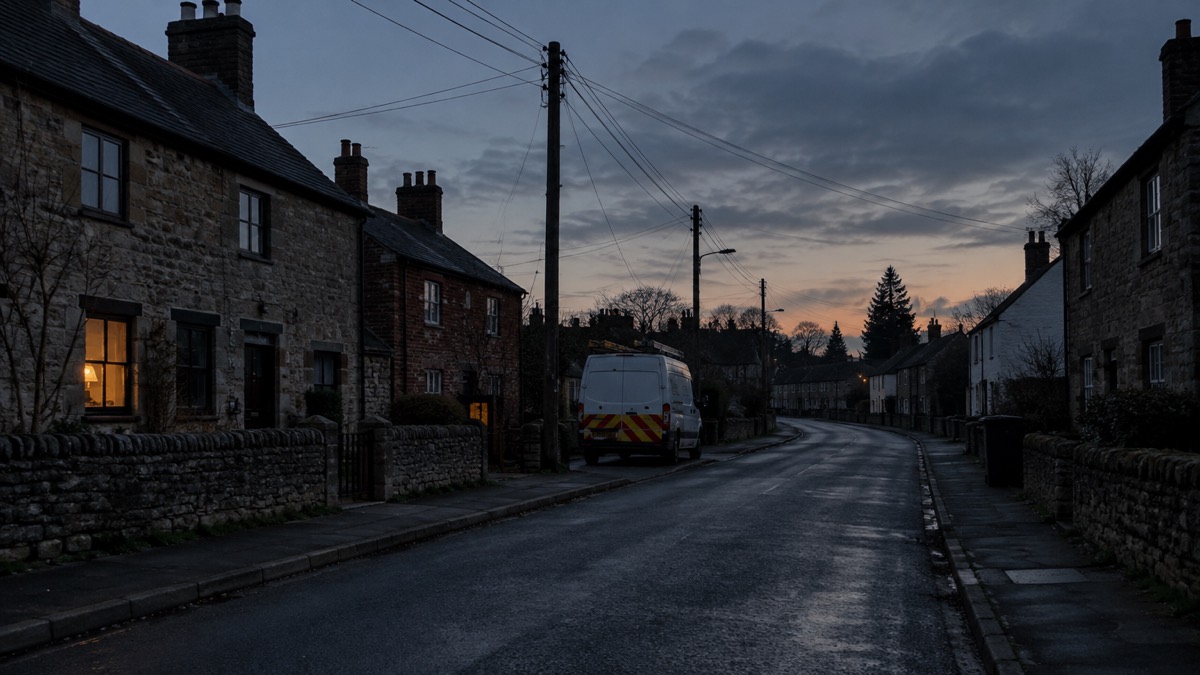
If your electricity has gone off, the number to ring in England, Scotland and Wales is 105. It is free of charge, it is available around the clock, and it connects you straight to your local distribution network operator, the company that owns the wires and is responsible for restoring your power1. You do not need to know which company covers your area before you call: 105 works that out for you. In Northern Ireland the number is different: call NIE Networks on 03457 643 6431.
One point catches many households out: your electricity supplier, the company that sends your bills, is not the company that fixes power cuts. Your local network operator is responsible for fixing power cuts in your area3. Calling your supplier about an outage will usually just send you round the houses. Ring 105 instead, or report the fault online, and you will reach the people who can actually help4.
Ring 105: the free power cut number for England, Scotland and Wales
105 exists to give you an easy-to-remember number to call that will put you through to the local people who can help during a power cut9. It is a free service for people in England, Scotland and Wales10, and the number is free and available nationwide2. When you call, you are connected to your local distribution network operator, who can log the fault, tell you what has happened, and give you an idea of when power will be back2.
Before you dial, it is worth checking whether the fault is really outside your home. If only your house is dark, the problem may be your trip switches or a faulty meter rather than the network. If your supply is cut off because of a faulty energy meter, contact your energy supplier instead of the network operator3. If the whole street is off, 105 is the right call.
A few practical habits make the call easier when you need it:
- Save 105 in your mobile phone contacts and keep the number on the fridge, so you can find it in the dark6.
- Charge mobile phones and power banks before a storm is forecast, so you can still call and receive updates11.
- Keep a torch where you can reach it, so you are not hunting for your phone by feel.
The fire and rescue services back the same message. Scottish Fire and Rescue Service guidance says you can report a power cut online or by calling 105, which is a free service in Scotland, England and Wales12. London Fire Brigade advises that in the event of a power cut you call 105, free of charge, and that help and advice is available 24/713. The Met Office gives the same number in its power cut advice10, and UK government guidance lists 105 as the number to report a power cut in England, Scotland and Wales14.
Who fixes your power: your network operator, not your supplier
The electricity system has two kinds of company in it, and knowing the difference saves you time on a dark evening. The company you pay your bills to is your supplier. The company that owns the cables and substations that bring electricity to your door is your local distribution network operator, or DNO. If your home or business loses power, your local DNO is responsible for restoring it2. Your local network operator is responsible for fixing power cuts in your area3.
There are 14 Distribution Network Operators across the country15. They carry their electricity at much lower voltages than the transmission networks15. Your DNO is responsible for managing the electricity cables in your area, and this is not your electricity supplier, who sends you your bill15.
The split in responsibility also runs to the equipment at your property. The power distribution company's responsibility covers only the incoming supply cable and the service "cut out"; the meter and the internal wiring are the responsibility of your power provider16. So a fault in your home's wiring is a job for an electrician, a faulty meter is a job for your supplier, and a fault on the street is a job for the network operator, reached through 105.
To find out which network operator covers your address, you have two easy routes. Call 105, or use the online postcode checker to find out who your distribution network operator is2. The Power Track site at powercut105.com does the same job: you can enter your postcode and the site will tell you what company supplies you5.
| The problem | Who to contact | How |
|---|---|---|
| Power off on the street | Your network operator | Call 105, or report online2 |
| Faulty energy meter | Your energy supplier | Use the number on your bill3 |
| Fault in your home's wiring | A qualified electrician | The network operator's responsibility ends at the cut out16 |
| Fallen or damaged power line | Your network operator | Call 105, or 999 if life is at risk6 |
Reporting online or by WhatsApp instead of calling
If you would rather not call, you can report a power cut online. Ofgem's advice is to report it directly to your local network operator using their website3. The Powercut 105 website is the general route: it helps you find your supplier and report a power cut17, and Scottish Fire and Rescue Service guidance confirms you can report a power cut online there or by calling 10512. Surrey's emergency planning guidance gives the same advice: if the power goes off you can report it by calling 105 or visit the Power Cut website to be directed to the operator for your area7.
Some operators go further. Northern Powergrid lets you use its online power cuts map tool to report a power cut and track real-time updates18. It also offers reporting via WhatsApp, though the opening hours differ between documents: its contact page says WhatsApp reporting is available 8am to 8pm Monday to Friday and 9am to 5pm on Saturday18, while an earlier company announcement said customers could report a power cut 24/7 by following Northern Powergrid on Facebook and X, or via WhatsApp on 0191 687 22 54, Monday to Friday between 9am and 5pm19.
Online reporting suits some households better than the phone, and not only by preference:
- Reporting online avoids the phone entirely: Northern Powergrid lets you report a power cut via its online power cuts map tool, which also tracks real-time updates18.
- WhatsApp reporting has set hours at some operators: Northern Powergrid's WhatsApp service runs 8am to 8pm Monday to Friday and 9am to 5pm on Saturday18.
Northern Ireland: call NIE Networks on 03457 643 643
Northern Ireland has its own electricity network and its own number, and 105 does not cover it. The NIE Networks Customer Helpline is 03457 643 643, for reporting a power cut or a damaged power line20. The nidirect government guidance gives this number in its storm and ice warnings20, and its household emergency kit advice lists Northern Ireland Electricity on the same number23.
The safety advice around damaged equipment is firm and comes from the fire and rescue service. The Northern Ireland Fire & Rescue Service's statement during Storm Éowyn was direct:
"Stay clear of any damaged electricity equipment and report it immediately to NIE Networks on 03457 643 643."
Northern Ireland Fire & Rescue Service24
The same message was repeated in the service's operational updates: stay clear of damaged electricity equipment and report it immediately25. The nidirect storm guidance adds a warning that matters in wooded areas: be extra careful around fallen trees, as they often take electricity poles and wires with them as they fall20.
So in Northern Ireland the routine is the same as in Great Britain, only the number changes. Power off, or a line down, or a substation door swinging open: call 03457 643 643, stay well clear of anything damaged, and if there is an immediate danger to life, call 999. More detail on Northern Ireland's arrangements is on our Northern Ireland: NIE Networks, Reporting and Help page.
Fallen lines and damaged substations: stay well clear and call 105
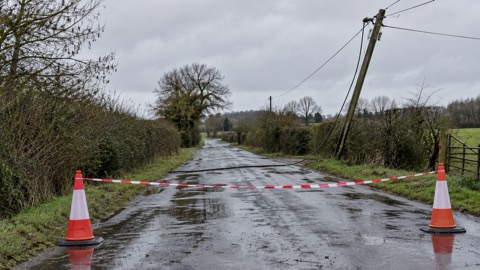
A power cut is an inconvenience. A fallen power line is a danger to life, and it needs to be treated as one even when it looks harmless. Anglesey Council's winter readiness advice is blunt: always treat fallen lines as live and report them right away by calling 1056. The same guidance describes 105 as the national emergency helpline for reporting power cuts and fallen power lines6.
Fallen trees are the common route into this danger. Power companies may be impacted by fallen trees in storms knocking out overhead cables, alongside high voltage underground cable faults that require a complicated process of fault location using specialist equipment26. The nidirect wind warning advice is to be extra careful around fallen trees, as they often take electricity poles and wires with them as they fall20. If a tree has come down on your land and there is any chance it has brought a line with it, do not start clearing it: report it first.
Damaged substations and other electrical equipment should be reported the same way. Surrey's guidance is that if you spot damaged or dangerous electrical equipment, including during or after a power cut, you should report the problem, but call 999 in an emergency7. We cover this in more depth on our Fallen Overhead Lines: Keep Away and Ring 105 and Reporting a Damaged or Open Substation pages.
Tracking a power cut and getting restoration updates
Reporting the fault is only half of what 105 does. Call 105 free of charge to report the problem and get updates on when power will be restored11. Once your operator knows you are affected, it can keep you informed while engineers work. Anglesey Council's advice is to report any power cut immediately, and the operator will keep you updated by text or voice alert messaging whilst engineers are on the job6.
The main tracking tool for many operators is Power Track. It gives details of power cuts and restoration times, and lets you report power cuts and network damage27. SSEN describes visiting the Power Track website to give you details of power cuts and restoration times, with reporting available there as well27. There is also a Power Track app, which provides details of power cuts and restoration times and can be used to report power cuts and network damage28.
To make sure updates actually reach you:
- You can stay updated and track the progress of faults in your area on the Power Track map, or report damage to the network there29.
The Welsh Government's resilience statement makes the wider point plainly: understanding how to receive information during a power cut can help reduce disruption when incidents occur30. If you or someone in your household needs extra support during long outages, the Priority Services Register: Who Can Join and What It Gives page explains how to sign up with your operator in advance.
How long restoration should take: 12 hours, or 24 to 48 in severe storms
Network operators do not have unlimited time to get you back on. Ofgem sets restoration targets that depend on the weather and the size of the fault. For interruptions outside of severe weather, the target is 12 hours8. In severe storm category 1 weather, the target is 24 hours3. In severe storm category 2 weather, it is 48 hours3. There is also a rule for large single faults: network companies have 24 hours to restore your power if more than 5,000 homes are affected by a single fault31.
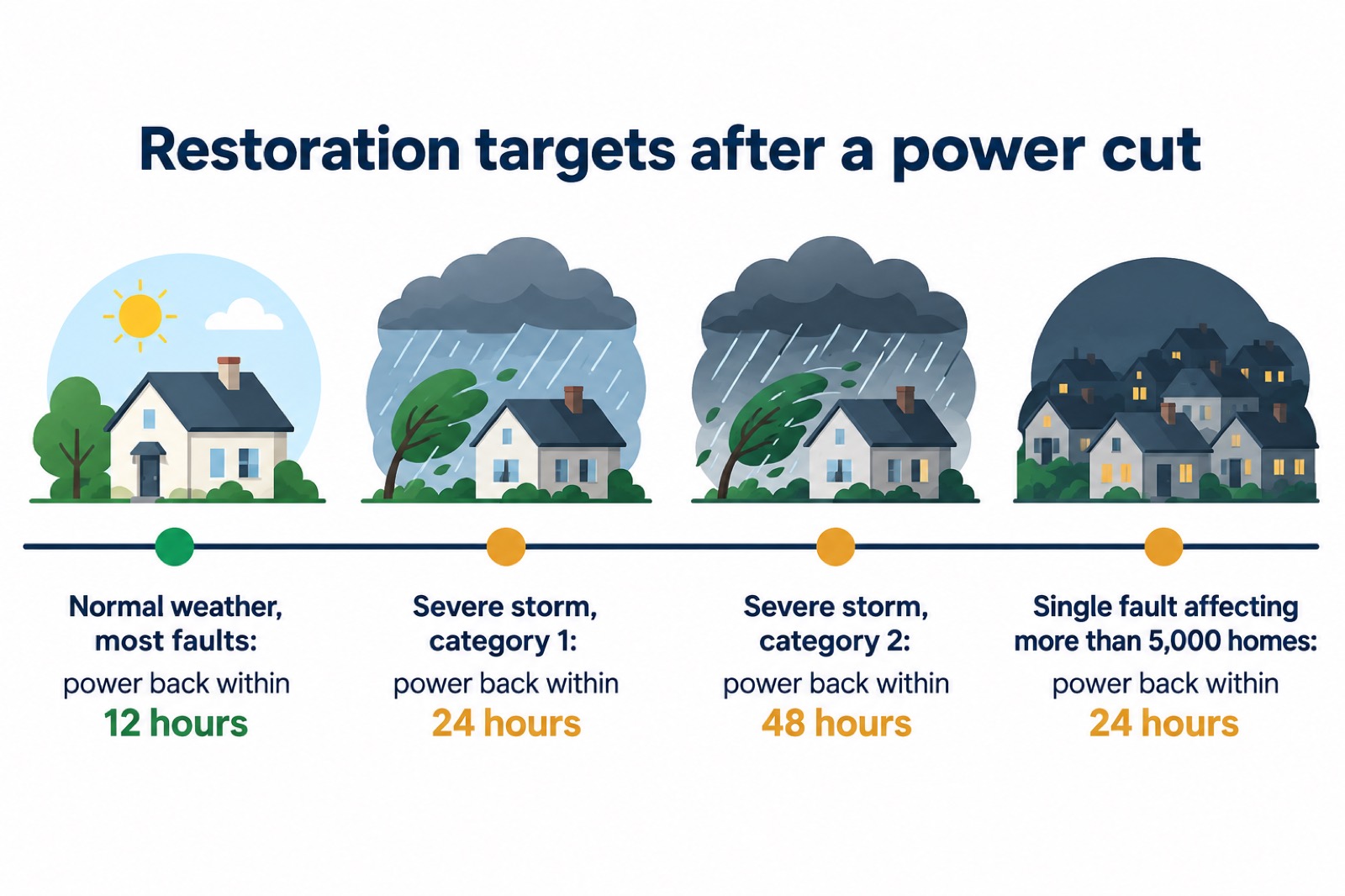
These are targets, not promises. After a major storm, damage across a whole region can take longer to repair than any single target allows, and the operators triage: hospitals, water treatment and the largest numbers of affected customers generally come first. What the targets do give you is a yardstick. If the power has been off longer than the target for the conditions, you have grounds to chase your operator, and, as the next section explains, you may be owed money.
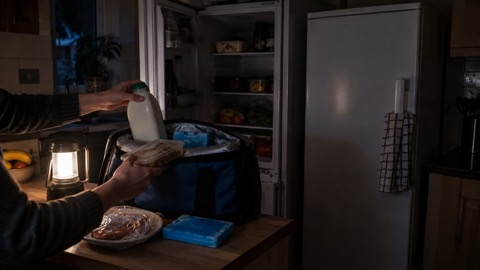
While you wait, the practical priorities are covered elsewhere on this site: What to Do When the Electricity Goes Off, Keeping Warm Without Electricity, and How Long Until the Electricity Comes Back?. Two rules from the official guidance are worth repeating here. Keep fridges and freezers closed, with a blanket over, as they will stay cold for many hours9. And throw away food from a fridge if the electricity has been off for more than 4 hours, and food from a freezer if it has been off for more than 24 hours32. Our Fridge and Freezer Food When the Electricity Is Off page goes through this in full.
Planned power cuts and how you are told about them
Not every power cut is a fault. Network operators sometimes switch the power off deliberately to maintain or upgrade equipment, and these planned interruptions are notified in advance rather than reported. Ofgem's guidance on reporting applies to unplanned cuts: report it directly to your local network operator using their website3. For planned work, the operator should tell you when the supply will be interrupted and for how long, so the right response is to read the notice and prepare, not to ring 105 on the day.
Preparation for a planned cut is the same as for any other outage, just with warning. The Met Office's power cut advice is to keep fridges and freezers closed with a blanket over them9, and the general household advice is to keep fridge and freezer doors closed to protect the contents33. Charge what needs charging the night before11. If someone in the house relies on medical equipment that needs electricity, tell the operator in advance and join its priority register; our Checklist for Households Using Medical Equipment page sets this out.
The broader lesson from the official guidance is about information. Official advice notes that understanding how to receive information during a power cut can help reduce disruption when incidents occur30. If a cut does happen, whether planned or not, official guidance says to report it directly to your local network operator using their website8. Our Planned Interruptions: Why They Happen and How to Prepare page covers the detail.
Compensation when power is off for more than 24 hours
If the power stays off longer than it should, you may be owed money, but in most cases you have to claim it: the payments are not automatic. The baseline figures are £100 for homes or £195 for businesses if less than 5,000 properties are affected for more than 12 hours, or more than 5,000 properties are affected for more than 24 hours3.
On top of that baseline, you will get an extra £45 for every additional 12-hour period without electricity3. Ofgem's own examples show how this works. If your power is off for more than 12 hours and then interrupted for 36 hours in total, you could get 2 additional £45 payments, adding up to £903. If it is off for more than 24 hours and interrupted for 72 hours, you could get 4 additional £45 payments, adding up to £1803.
| Situation | What you could get |
|---|---|
| Less than 5,000 properties off more than 12 hours, or more than 5,000 off more than 24 hours | £100 for homes, £195 for businesses3 |
| Each additional 12 hours without electricity | An extra £453 |
| Power off more than 4 times between 1 April and 31 March, each lasting at least 3 hours | An extra £1003 |
Repeated cuts have their own payment. You could get an extra £100 if your power has gone off more than 4 times between 1 April and 31 March the following year, with each cut lasting at least 3 hours3. This one is worth remembering if your area suffers a run of small faults that never individually trigger a payment.
How you claim depends on the payment. Claims for the frequent-cut payment, an extra £100 if your power has gone off more than 4 times between 1 April and 31 March the following year, each lasting at least 3 hours, must be made to the network operator8. In Northern Ireland, if a planned power cut goes ahead without three days' notice, you are entitled to £25 per home, and the claim must be made within one month of the day of the power interruption34. Keep a note of the dates and times of each outage so you can support your claim.
Sources (34)
- Be informed about hazards: power cuts, UK government Be Ready campaign, 2026
- Energy outages, National Energy System Operator, 2026
- Plan for a power cut, Ofgem, 2026
- Stay safe in a thunderstorm, Met Office, 2026
- Power Track: what is it, Wiltshire and Swindon Prepared, 2026
- Winter ready, Anglesey County Council, 2026
- Power, gas and water: what if they fail, Surrey County Council, 2026
- Check if you can get a payment for a power cut, Ofgem, 2026
- What to do in a power cut, Met Office, 2026
- Met Office weather ready tips for snow and ice, Met Office, 2025
- Storms and wind, Readiness campaign for Scotland, 2026
- Power cuts, Scottish Fire and Rescue Service, 2025
- Electrical items in the home, London Fire Brigade, 2026
- Be ready for emergencies, UK government Be Ready campaign, 2026
- How the power system works in the UK, Wiltshire and Swindon Prepared, 2026
- Flooding aftercare, Runnymede Borough Council, 2026
- Be prepared for winter emergencies, NHS Norfolk and Suffolk, 2026
- Contact us: power cuts, Northern Powergrid, 2026
- Northern Powergrid reminds communities not to light fireworks or bonfires near power equipment, Northern Powergrid, 2023
- Strong winds and heavy rain warning: information and advice, nidirect, 2026
- Ice weather warning: information and advice, nidirect, 2026
- Strong winds weather warning: information and advice, nidirect, 2026
- Household emergency kit, nidirect, 2026
- NIFRS statement: NIFRS Storm Éowyn safety response, Northern Ireland Fire & Rescue Service, 2025
- NIFRS statement: NIFRS Storm Éowyn operational update 2pm, Northern Ireland Fire & Rescue Service, 2025
- Generators, Wiltshire and Swindon Prepared, 2026
- SSEN Distribution moves to Yellow Alert status, SSEN, 2024
- SSEN remains at weather warning for the North of Scotland - SSEN, Scottish and Southern Electricity Networks (SSEN)
- We're moving to Weather Warning status ahead of gale-force winds forecast for Saturday and Sunday - SSEN, Scottish and Southern Electricity Networks (SSEN)
- Statement on resilience and emergency preparedness, Welsh Government, 2026
- England and Wales energy domestic consumer advice, Ofgem, 2024
- After a flood, UK government, 2026
- 12 tips to prepare for a power cut, Horsted Keynes Parish Council, 2026
- How to find out if there's a power cut and claim compensation - Which?, Which?
 Power Cut Kit Checklist
 What to Keep Charged
 Household Emergency Plan
 What to Do in a Power Cut
 Getting Ready for a Power Cut
 Fridge and Freezer Food
 Keeping Warm Without Electricity
 Central Heating Without Power
 Cold Homes and Health
 Carbon Monoxide Risks
 Staying Safe in the Dark
 Smoke and Carbon Monoxide Alarms
 How Long Until Power Returns
 When the Power Comes Back
 Fallen Overhead Lines