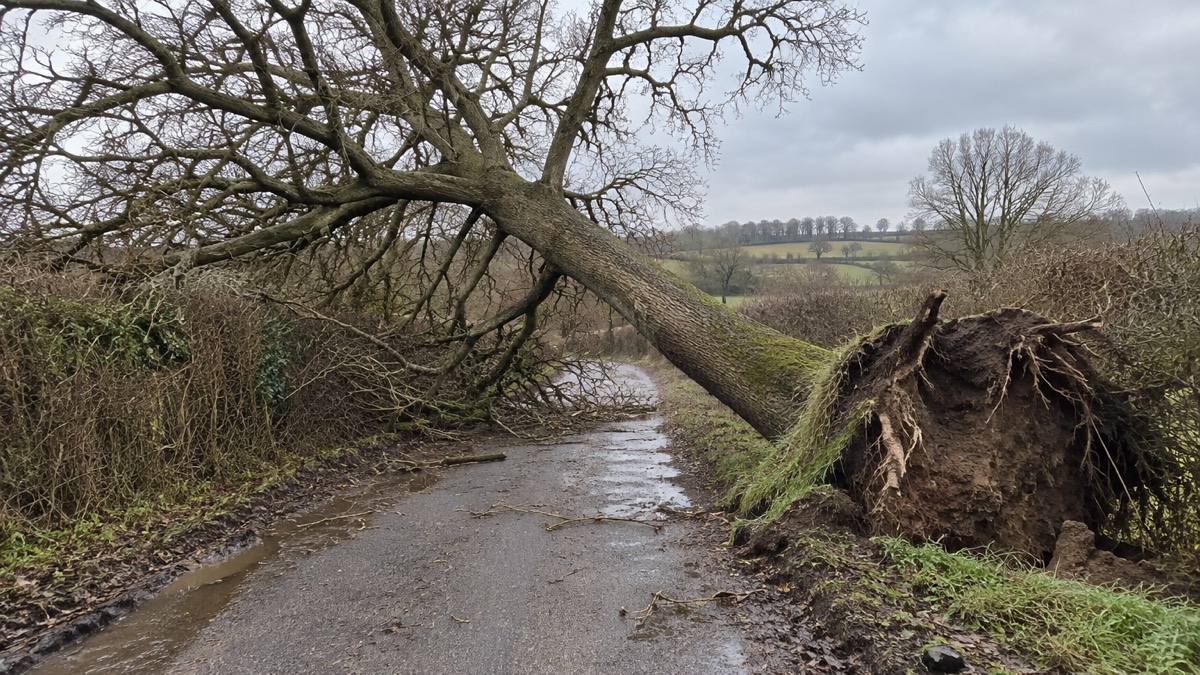
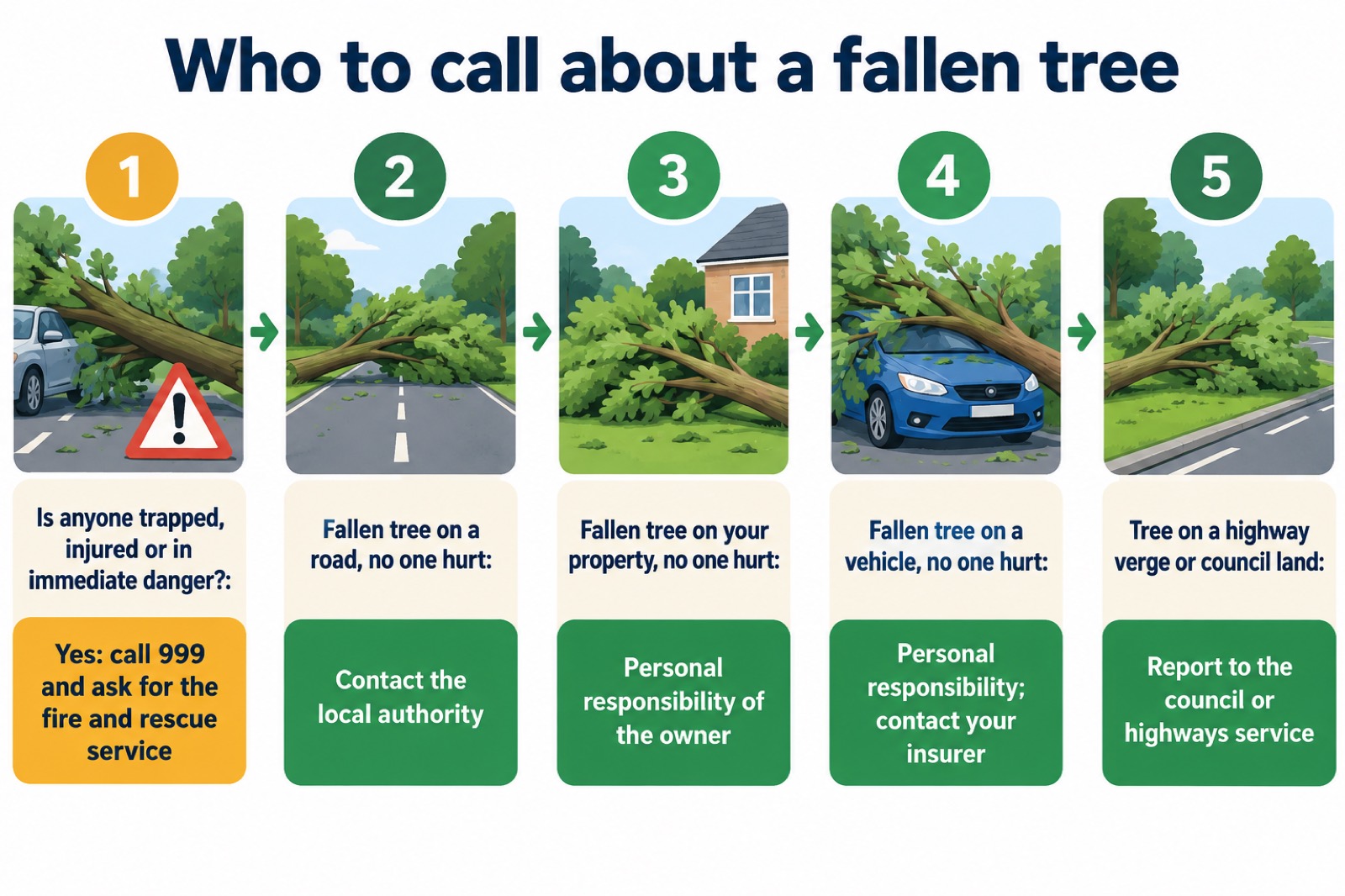
When a tree comes down or one nearby looks ready to fall, the first question is always the same: who do I call? The answer depends on whether life is at risk. If a tree has fallen on a property, a road or a vehicle and is endangering life, call 999 immediately and ask for the fire and rescue service1. If nobody is trapped or injured, a fallen tree on a road is a matter for the local authority2, and a fallen tree on your own property is your responsibility as the owner3.
The second question is who owns the tree. A tree on private land, including a neighbour's front or back garden, belongs to the owner of that land4. A tree on a highway verge, blocking a road or creating another emergency situation is the responsibility of the highways authority4. Councils deal with trees on their own land but have limited powers over privately owned trees5, and some will not touch a private tree unless it threatens the highway or public land6.
This page sets out what to do in each situation: the emergency numbers to use, how to make a report that gets acted on, what councils will and will not do, and how to keep your own trees safe before the next gale. For wider preparation for wind and storms, see Storms, Snow and Ice: A Household Guide.
A tree has fallen and is causing danger: call 999
The fire and rescue service is clear about the dividing line. North Yorkshire Fire and Rescue Service advises: "If a tree has fallen on a property and IS endangering life, then please call 999 immediately and ask for the Fire and Rescue Service." The same applies to a tree that has fallen on a road or a vehicle, and to an unsafe structure overhanging a public highway or public footpath1. Devon and Somerset Fire and Rescue Service give the same message from the other side: contact your local council about fallen trees or dangerous debris, "unless someone is trapped or injured then" call the fire service2.
So before you pick up the phone, ask yourself three things: is anyone trapped, is anyone injured, and could the tree fall further or move and hurt someone? If the answer to any of those is yes, or even possibly yes, call 999. Fire crews have the equipment to make a fallen tree safe, and a 999 call is the only route that reaches them immediately.
If nobody is hurt, do not call 999. Dorset and Wiltshire Fire and Rescue Service publish a breakdown of who to call for storm damage: a fallen tree on a road or vehicle endangering life goes to the fire and rescue service via 999; a fallen tree on a road not endangering life goes to the local authority; and a fallen tree on property not endangering life is a matter of personal responsibility3. North Yorkshire Fire and Rescue Service put the same split in plain terms after Storm Isha: "If a tree has fallen on a road BUT is NOT endangering life then you should call the local authority"8, and "If a tree has fallen on a property BUT is NOT endangering life, then this is the personal responsibility of the owner"9.
One more danger deserves its own warning, because it changes what you do while you wait for help.
A tree on your land is your responsibility to keep safe
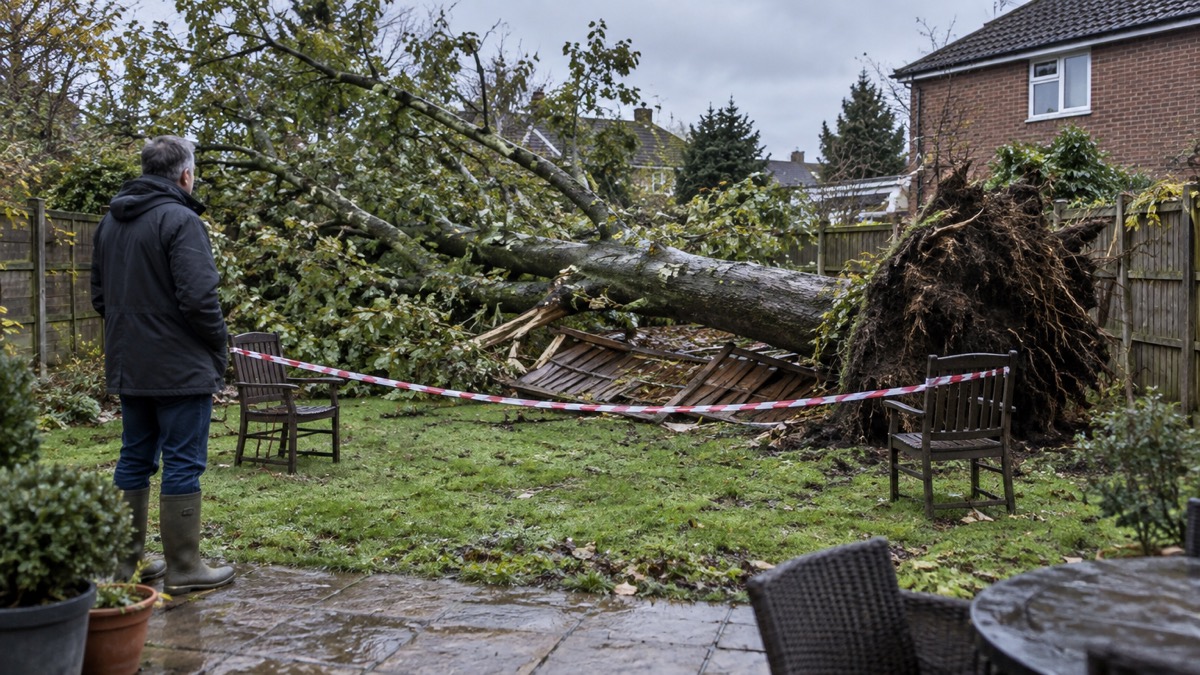
If a tree stands on your land, the duty to keep it safe is yours. Oxfordshire County Council's guidance is unambiguous: "If a tree is located on your land, you have a duty of care to make sure that your tree(s) are kept in a safe manner"10. Gloucester City Council puts the same duty in terms of the people around you: "If you have a tree on your land you have a duty of care to ensure that your tree does not pose a risk to people on or adjacent to your land"11.
In practice this means two things. First, look at your trees before the storm season arrives rather than after it: a tree that is visibly leaning, has lost large branches, or has a split in its trunk is a tree you should be asking a professional about now. Second, keep the rest of your property in good order too. nidirect's strong winds advice is to "keep your property in a well-maintained condition (for example replace/ repair any loose roof tiles, guttering, and so on that could potentially come loose and cause injury or damage to property)"7. Loose tiles and dead branches become the same kind of hazard in a gale, and both are yours to fix.
The duty also reaches beyond your boundary. The Gloucester wording, "people on or adjacent to your land", means a tree in your garden that could fall onto a pavement, a road or a neighbour's property is your problem even though the people at risk are not on your land11. Councils will not step in for you: Gloucester City Council states plainly, "We are not responsible for trees on private land"11, and Cornwall Council "has limited powers to act in the case of privately owned trees", directing concerns to the landowner5.
If a tree on your land does fall, the position after the event is the same as before it. A tree that has fallen on a property but is not endangering life is the personal responsibility of the owner9. You arrange the removal, and you speak to your insurer. More on that below.
Who is responsible for a tree on a neighbour's land, a road or public land
Responsibility follows the land, not the tree's size, age or species. Elmbridge Borough Council's guidance gives the two rules that cover most cases: "If a tree is on private land (such as front or back garden), the owner of the land is responsible for the tree", and "If a tree is on a highway verge, blocking a road or creating another emergency situation, Surrey Highways is responsible"4. Substitute your own county or unitary highways service for Surrey and the second rule holds across England and Wales.
| Where the tree is | Who is responsible | What to do |
|---|---|---|
| Your own garden or land | You, the landowner10 | Arrange inspection and any work yourself |
| A neighbour's garden or private land | The owner of that land4 | Raise concerns with the landowner |
| A highway verge or the road | The highways authority4 | Report to the council or highways service |
| Council-owned land, parks and open spaces | The council12 | Report to the council |
| A private road or private land | Usually the landowner13 | Do not report it to the highways service online14 |
Two boundaries catch people out. The first is the private road. Suffolk Highways ask you not to report a fallen or overhanging tree online "if it's on a private road"14, because private roads and roads on private land are usually the responsibility of the landowner13. The second is the council's own land. Liverpool City Council handles dangerous or fallen trees on its land with emergency teams and a contractor carrying out assessment and work12, and Leeds City Council will act on trees threatening the highway or public-owned land6.
A neighbour's tree that worries you is, in the first instance, a conversation with the neighbour. Councils have limited powers over private trees5, so a report to the council about next door's garden tree will usually come back to the landowner. That changes the moment the tree creates an immediate danger to people outside the private land: then the 999 and highways routes above apply.
How to report a dangerous tree to your local council
Every council runs its own reporting route, and the details differ, but the pattern is the same across the country. Cornwall Council, for example, lists what can be reported: a fallen tree or branch causing a concern on the highway, tree encroachment, an unstable tree, and a dead or dying tree presenting potential safety, obstruction or visibility concerns5. Devon County Council reacts to fallen trees on the highway, which "can be reported online via our report a problem page"15. Cumberland Council says problems with the roads in Cumberland, including fallen trees, can be reported to Cumberland Council or on the Highways Hotline, or to Westmorland and Furness Council if you are in that area16.
When you report, give the council what it needs to find the tree. Leeds City Council's tree emergency service asks for two things: "the exact location of the tree or branch" and "a contact name and telephone number"6. A what3words reference, a house number or a landmark helps; "the big tree near the shops" does not.
Some councils are emphatic about how not to report a dangerous tree. Liverpool City Council warn: "Do not contact us online to report dangerous trees as it will not notify the emergency teams and will delay inspection, which could result in serious harm." In Liverpool, the phone number for dangerous trees is 0151 233 3001, Monday to Friday, 8am to 6pm12. Check your own council's website for its equivalent number before a storm arrives, and keep it with your emergency contacts.
Numbers that may be useful, depending on where you live:
- Suffolk Highways, immediate danger from a fallen or overhanging tree: 0345 606 617117
- National Highways Information Line, tree on a trunk road in Suffolk: 0300 123 500018
- Northern Ireland, fallen tree or blocked road: 0300 200 789919
- Gloucester City Council, extremely dangerous tree, immediate risk, weekends and bank holidays: 01452 396 39611
- Leeds City Council, tree or branch causing immediate danger to the highway, a person or property: 0113 378 18556
For a fuller walkthrough of the road-blocking situation, see How to Report a Fallen Tree Blocking a Road.
Signs that a tree may be unsafe
Councils and fire services frame the warning signs in terms of what a tree is doing to the space around it. Cornwall Council's reportable list is a good checklist of the states that concern them: a fallen tree or branch causing a concern on the highway, tree encroachment, an unstable tree, and a dead or dying tree presenting potential safety, obstruction or visibility concerns5. If a tree near you fits any of those descriptions, it is reportable to the responsible landowner or council.
Look at the whole tree, not just the canopy:
- Lean: a tree that has begun to lean, or leans more than it did, may have failed at the root plate.
- Fallen or hanging branches: branches broken but still caught in the crown will drop without warning.
- Dead or dying sections: large areas of dead wood in an otherwise living tree.
- Obstruction or visibility: a tree that blocks sight lines at a junction or driveway5.
- Pests and disease: if you find a pest or disease on a tree that you cannot identify or that may be notifiable, Oxfordshire County Council advise that "you can log a report using Tree Alert"10.
The strongest signal of all is a storm itself. nidirect's advice after strong winds is blunt: "not walk too close to walls, buildings, and trees as they could have been weakened"7. A tree that survived the gale may still have been damaged by it, and the damage may not be visible from the ground. If a tree on your land was in the path of a named storm, treat an inspection by a professional as the natural next step, and see Preparing Your Home and Garden for High Winds for what else to check.
Keeping a tree on your property in a safe condition
Keeping a tree safe is mostly a matter of routine maintenance, done in calm weather rather than in the aftermath of a storm. The fire and rescue services' general advice on property upkeep applies to trees as much as to roof tiles: keep your property in a well-maintained condition, replacing or repairing anything that could come loose and cause injury or damage7.
North Yorkshire Fire and Rescue Service add a specific point about vegetation close to the house: "Cutting back trees and shrubs that are close to or touching your house and dispose of the waste responsibly"20. Their advice comes from wildfire prevention, where trees touching the house carry fire to it, but the same clearance helps in wind: a branch that touches your roof in a gale abrades tiles and can work loose. Dispose of the cuttings responsibly rather than burning them, and if you do have a bonfire, London Fire Brigade warn that "Having a bonfire or burning rubbish in your garden or elsewhere can be extremely dangerous in dry conditions"21.
Work out what you can safely do yourself and what needs a professional. Cutting a small branch at ground level with hand tools is one thing; anything involving a ladder, a chainsaw, a height above shoulder level, or a branch within reach of overhead lines is a job for someone trained and insured. If electricity lines are anywhere near the tree, treat them as the deciding factor and get the network operator's advice before any work begins.
A short annual check, ideally in late autumn before the worst of the winter wind, covers most of what a household needs:
- Walk the boundary and look at each tree from a distance, checking its lean and shape.
- Look up into the crown for dead, hanging or broken branches.
- Look at the base for fresh cracks in the ground, fungi, or water pooling around the roots.
- Trim back any shrubs or trees that are close to or touching your home, and dispose of cuttings responsibly20.
- Note anything that has changed since last year, and get a professional opinion on the changes.
After a tree falls onto your home: access, damage and getting help
Once everyone is safe and the emergency services have made the scene safe if they were needed, the practical work begins. Oxfordshire County Council's guidance for trees fallen onto your property is to "contact emergency services for help, if necessary. Contact your own mortgage provider and / or insurer for advice in the first instance"10. Your insurer comes first among the phone calls you make yourself, before you arrange clearance or repairs, because the insurer will want to see the damage and may send their own assessor.
If the tree is yours and it has fallen onto your own property, the clearance is your responsibility9. If it has fallen from next door or from further away, the responsibility sits with the owner of the land it came from4. Where a tree has fallen from council-owned land into your property, some councils handle property damage claims: Liverpool City Council note that "This only applies to trees on council-owned land that have fallen into your property"12. For the insurance side in detail, see Does Home Insurance Cover Wind and Gale Damage?.
Access is often the immediate problem. A tree across a driveway or a garden path blocks more than movement: it can block an escape route. If the fallen tree or any other obstruction affects how you would get out of the house in an emergency, say so when you report it, and treat it as urgent. If the tree has brought down part of a structure, Elmbridge Borough Council direct residents to building control: "To report an unsafe structure, visit: Elmbridge Building Control: report a dangerous structure"4. Your own council's building control team is the equivalent service.
In Northern Ireland, where a tree has brought down electricity equipment, nidirect's instruction is to "Report anything that looks dangerous to NIE Networks on 03457 643643"22. Elsewhere in the UK, the equivalent network operator runs a fault line for damaged equipment, and the same caution applies: keep clear of the tree and the lines until the operator confirms the supply is off.
After a storm: patience, priorities and weakened trees
Storms change the arithmetic for everyone, including the councils. Liverpool City Council explain what happens on their side: after a storm, each tree is assessed and works prioritised based on risk, and "This may mean that a tree, or stacked cut up timber, may be left for a few days whilst we attend to other damage across the city"12. A tree left lying in a park for a few days is not a forgotten report; it is a lower priority than a tree across a live road. Report once, then let the system work12.
Your own safety checks after a gale come before your phone calls. nidirect's post-storm advice has two parts: "not walk too close to walls, buildings, and trees as they could have been weakened", and "check for damage and make sure any such damage is secured, when it is safe to do so"7. The Northern Ireland government repeated both instructions in later strong wind warnings22, and the same advice applies across the UK. Weakened structures do not always fail at the moment of the storm; some fail hours or days later under a smaller load, or when someone walks beneath them.
On the roads, expect closures rather than shortcuts. When an amber wind warning is in place, "Some roads and bridges likely to close"23, and North Yorkshire Fire and Rescue Service's advice during Storm Debi was simply to "Use main roads"23. Main roads are cleared and inspected first; minor roads may hold fallen trees and debris for longer. If you must travel after a storm, plan around the main network and check before you set out, and see Trains, Buses and Bridge Closures in Bad Weather and How to Drive Safely in Strong Winds.
A summary of the after-storm sequence:
- Stay clear of walls, buildings and trees that may have been weakened7.
- Once it is safe, check your property for damage and secure what you can7.
- Report fallen trees and dangerous debris to your local council, unless someone is trapped or injured, in which case call 9992.
- Report once, and expect council work to be prioritised by risk12.
- Contact your insurer for damage to your own property10.
Sources (23)
- Stay safe during Storm Babet, North Yorkshire Fire and Rescue Service, 2023-10-19
- Safety in severe weather conditions, Devon and Somerset Fire and Rescue Service, 2026
- Who to call for storm damage, Dorset and Wiltshire Fire and Rescue Service, 2022-08-03
- Report an emergency incident, Elmbridge Borough Council, 2026
- Find support with storm damage, Cornwall Council, 2026-10-22
- Tree emergencies, Leeds City Council, 2026-10-29
- Strong winds and heavy rain warning: information and advice, nidirect, 2026-01-27
- Our response to Storm Isha, North Yorkshire Fire and Rescue Service, 2024-01-22
- Tips for keeping safe during strong winds, North Yorkshire Fire and Rescue Service, 2023-12-20
- Reporting a dangerous tree, Oxfordshire County Council, 2026
- Dangerous tree on private land, Gloucester City Council, 2026-10-29
- Dangerous or fallen trees, Liverpool City Council, 2026-10-29
- Report blocked drains, highways flooding issue, Lincolnshire County Council, 2026-10-29
- Storm Ciaran, Suffolk County Council, 2026-10-29
- What do we do?, Devon County Council, 2023-10-05
- Staying safe in strong winds, Cumberland Council, 2026
- Weather warning, Suffolk County Council, 2026-10-29
- Severe weather information and services, Suffolk County Council, 2026-10-29
- Thunderstorms weather warning advice and information, nidirect, 2026-08-30
- Protecting your home from wildfires, North Yorkshire Fire and Rescue Service, 2026
- Extreme weather summer guide, London Fire Brigade, 2024-05
- Strong winds weather warning: information and advice, nidirect, 2026-10-24
- Amber warning in place as Storm Debi hits North Yorkshire, North Yorkshire Fire and Rescue Service, 2023-11-13
 Flood Warning Checklist
 First Steps After a Flood
 Insurance Claim Records
 Storm Arwen 2021
 Storm Boelo
 Coastal Safety in Gales
 Council Help in Severe Weather
 Storm Darragh 2024
 Landslips After Heavy Rain
 Lightning Safety
 How Storms Are Named
 Travel Disruption in Bad Weather