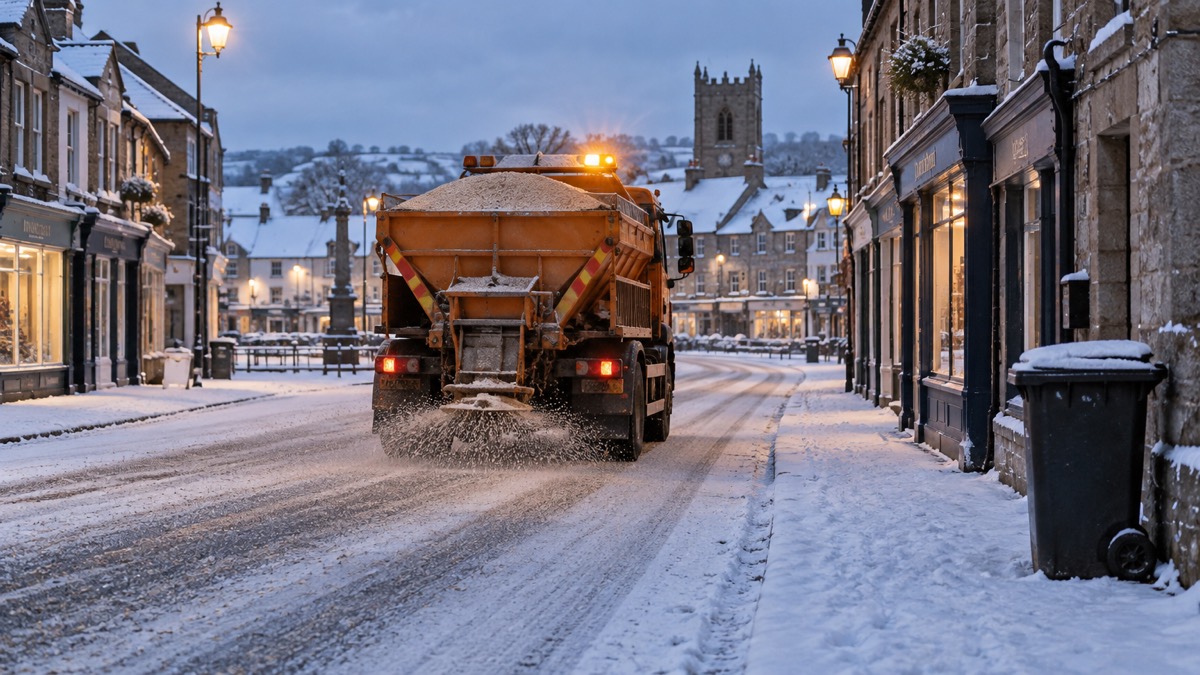
When severe weather strikes, your council is one of the main organisations working through it. Pembrokeshire County Council describes a typical response: providing advice and information, gritting and snow clearance, flood response, dealing with dangerous buildings, perhaps opening rest centres, maintaining home care, closing schools if necessary, checking and clearing drains and culverts, and continuing other everyday services as far as practicable1. In other words, the council is not just the gritting service: it is the body that keeps care visits running, decides what happens to bins, checks dangerous structures and tells you what is going on.
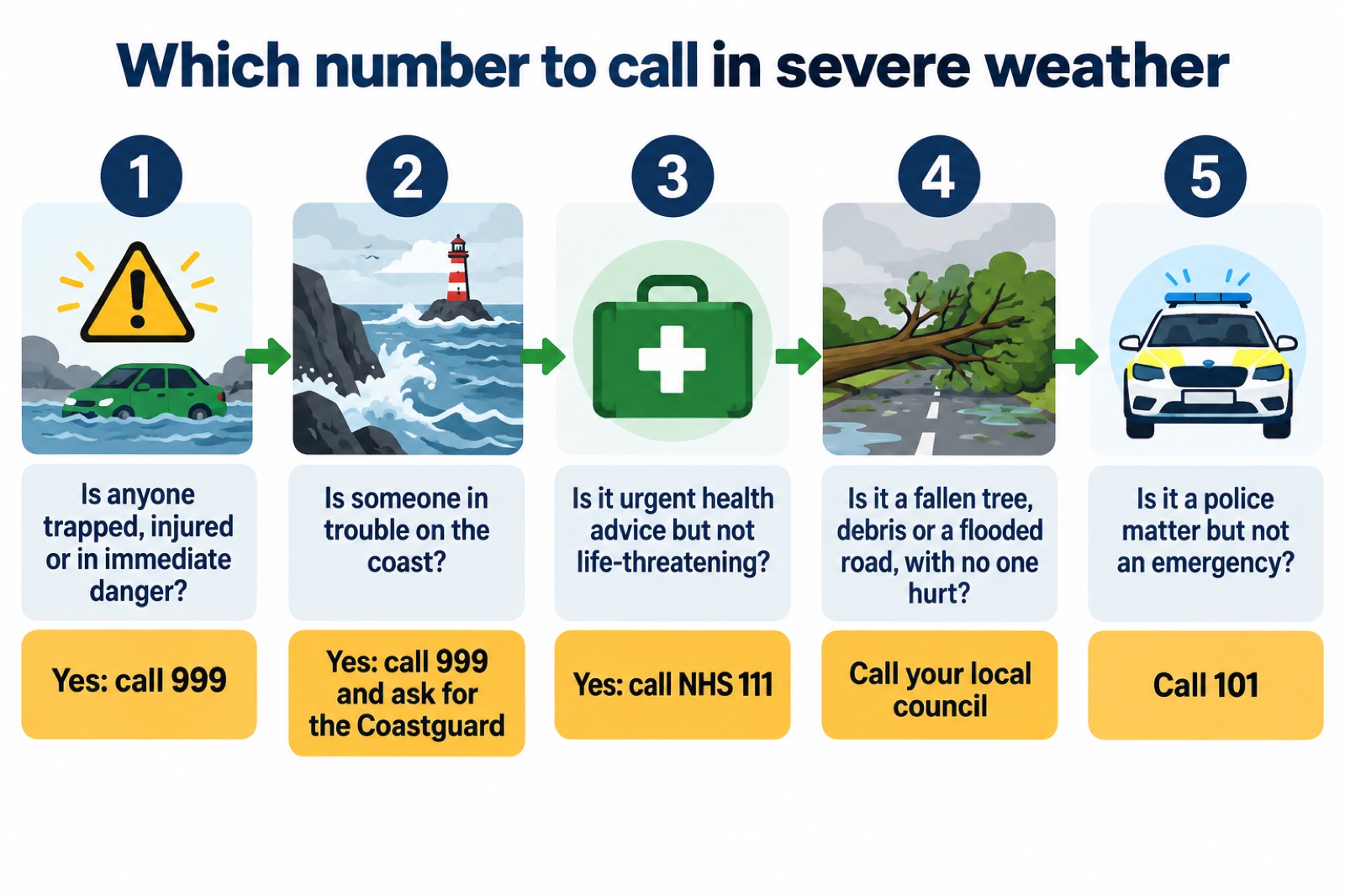
The first thing most households need to know is which number to call. If there is danger to life, call 999: that applies to flooding emergencies, storm injuries and anyone trapped2. For everything else, from a flooded road to a missed bin, your council is usually the right first call, and this page sets out how to reach the right team, what happens to services such as bins and care visits, and how councils plan and warn residents before severe weather arrives. For the wider picture of storms, snow and ice, see our guide to storms, snow and ice.
Which number to call: 999, 101, 111 or your council
Getting this right matters, because the wrong number delays help. The rule is simple: 999 is for emergencies and danger to life, and every official source in this area says the same thing. Devon County Council tells residents that if it is an emergency and there is danger to life as a result of flooding, call 9999. Westminster City Council says the same for anyone in immediate danger of flood water10. The Met Office advises calling 999 and waiting for help if you are trapped by floodwater or affected by fast flowing or deep water during heavy rain11, and the same advice applies in thunderstorms12. North Wales Fire and Rescue Service says simply: call 999 immediately13. West Yorkshire Prepared repeats the instruction for a severe flood warning: call 999 if in immediate danger14.
For matters that are urgent but not life-threatening, other numbers apply. Cornwall Council sets out the distinction clearly: call 999 for the police, fire service or medical emergencies, and call the police on 101 for non-emergencies2. For health concerns that are not emergencies, Public Health Wales advises calling your GP or NHS Direct on 111, and dialling 999 only if it is an emergency5. Cornwall Council adds that NHS 111 is for urgent but not life-threatening health advice, including when your GP surgery is closed2.
For roads, trees and debris, the council is the right call. Devon and Somerset Fire and Rescue Service advises contacting your local council if you see fallen trees or debris that is dangerous, unless someone is trapped or injured, in which case call 9994. Oxfordshire County Council gives a single emergency contact number, 0345 310 1111, for reporting flooding on a highway, including blocked drains and gullies15. Your own council will have an equivalent number or online form, usually on its website's roads, flooding or emergencies section.
| Situation | Who to call | Notes |
|---|---|---|
| Danger to life, anyone trapped or injured | 999 | Applies to flooding, storms and fast or deep water3 |
| Someone in trouble on the coast | 999, ask for the Coastguard | Met Office and Cornwall Council advice6 |
| Police non-emergency | 101 | For non-emergencies2 |
| Urgent health advice, not life-threatening | NHS 111 | Including when your GP surgery is closed5 |
| Fallen tree or dangerous debris, no one hurt | Your local council | Fire and rescue service advice4 |
| Flooding on a road, blocked drains | Your council's highways team | Oxfordshire uses 0345 310 111115 |
Reporting flooding, fallen trees and storm damage
Councils act on what residents report, so reporting problems promptly does make a difference. Carmarthenshire County Council is explicit about why: all flooding incidents should be reported, especially incidents that affect residences and businesses internally, because the council uses this data when prioritising resources16. A report that seems small to you may be one of dozens that together show where the council needs to act.
Most councils offer an online form for non-urgent reports. Nottinghamshire County Council lets residents use its online form to report a flooded road or drainage problem17. Derbyshire County Council asks residents to get urgent advice or help about a flood that is happening right now via its flooding emergencies page, and notes that by reporting flooding the council can work to find a solution to the issues causing it and reduce the likelihood of, or best prepare you for, a similar event in the future18. Cornwall Council takes phone reports of flooding or drainage issues on public roads, and urgent or hazardous highways issues, on 0300 1234 2222.
For trees, the reportable problems are broader than a trunk lying across a road. Cornwall Council lists fallen trees or branches causing a concern on the highway, tree encroachment, unstable trees, and dead or dying trees presenting potential safety, obstruction or visibility concerns2. Our guide to reporting a fallen tree blocking a road covers the practical steps, and our page on dangerous trees explains who is responsible for them.
Storm damage to buildings is also a council matter in some cases. Belfast City Council includes assessing structural damage to buildings among its emergency roles19. If a building is dangerous, report it to your council, which can assess it and take action. For repairs afterwards, Lancashire Prepared advises making sure any vulnerable neighbours or relatives are safe and helping them arrange repairs if required20. If your home is damaged, our page on wind and gale damage insurance may help.
Some areas have volunteer flood wardens who speed up reporting. In Cheltenham, during a flood, wardens report flooding issues, where there is no immediate risk to life, to the appropriate agency, providing the location, the number of properties at risk and knowledge of any vulnerable people who may be affected21. If your area has a flood warden scheme, contacting a warden can be the quickest route to get the right agency involved. For the wider picture, see our guide to flooding.
Social care help in an emergency out of hours
If you or someone you care for relies on council care services, severe weather does not stop the need for them, and councils plan for this. Pembrokeshire County Council lists maintaining home care among the services it continues during severe weather1. But if a crisis happens in the evening, at a weekend or on a bank holiday, you need the out-of-hours route rather than the daytime team.
Derbyshire County Council provides an emergency out-of-hours countywide support service from 5pm to 9am Monday to Friday, and 24 hours per day at weekends and on bank holidays. If you use the council's emergency contact numbers in an emergency, there is also the option to speak to an out-of-hours worker7. Other councils run similar arrangements: look for "out of hours" or "emergency social care" on your council's website, and save the number before winter arrives. Cornwall Council gives a dedicated social care emergency line for safeguarding adults and children, on 0300 1231 1162.
Behind these services sits a formal duty. Government guidance for Local Resilience Forums in England says the LRF should agree an overall lead agency for the management of vulnerable persons in emergencies, and that this is generally the local authority, because much of the day-to-day contact with vulnerable people sits with council services22. In practice, that means your council is the organisation expected to coordinate help for people who are vulnerable when an emergency hits. If you or a household member needs extra help during emergencies, our guide to extra help in an emergency sets out what to arrange in advance, including the Priority Services Register with your utility suppliers.
Flood wardens and similar schemes also watch out for vulnerable residents. In Cheltenham, wardens help support vulnerable residents who may need extra support, for example those who have disabilities, are elderly, pregnant or have young children, may be visiting the area, or who may be cut off and unable to access supplies21. If you know a neighbour who could be cut off by snow or flooding, telling the council or a local warden about them before an emergency is one of the most useful things you can do.
Bin collections during severe weather and disruption
Bin collections are the council service most households notice first when weather disrupts them, and arrangements change with the type of weather. In hot weather, the change is about timing. Surrey County Council advises that collections may start earlier in the mornings during extreme hot weather, and asks residents to make sure they put their bins out for collection the night before to ensure they are emptied8. nidirect, the Northern Ireland government service, gives the same practical advice for households: contact your local council for more information about bin and waste collection and recycling, and recycle as much as possible to reduce waste23.
In storms, snow and floods, the change is usually suspension or delay. Councils aim to continue everyday services as far as practicable during severe weather, as Pembrokeshire County Council puts it1, but "as far as practicable" means collections can be paused when roads are unsafe or crews are diverted. When that happens, the council will announce it through its usual channels, covered in the next section, and will usually tell you when to put bins out again or whether a missed collection will be caught up later.
What to do when collections are disrupted:
- Put bins out the night before during hot weather, since collections may start earlier8.
- Check your council's website and social media for cancellation or catch-up announcements24.
- Report a missed collection through your council's waste team once conditions allow; Cornwall Council takes waste collection and street cleaning calls on 0300 1234 1412.
- Contact your local council with any question about bin, waste and recycling collections23.
- Recycle as much as possible to reduce waste, which also reduces what piles up if collections slip23.
If waste builds up during a prolonged disruption, keep it sealed and stored safely, and follow any special arrangements your council announces. For the wider question of food safety when the power is off, see our guide to emergency food.
Damaged or missing bins: ordering a replacement
Storms blow bins over, scatter them down the street and sometimes remove them entirely. The remedy is straightforward: Cornwall Council confirms that if your bin or sack is damaged or missing, you can order a replacement2. Order it through your council's website or waste team, and do the same for recycling containers. Cornwall, for example, uses a colour-coded set: an orange bag for cardboard, a red bag for plastic and metal packaging, a blue bag for paper, a black box for glass and textiles, and a green outdoor collection caddy for food waste2. Your own council's system will differ, but replacements work the same way.
Grit bins, the salt containers kept at the roadside for icy conditions, are also council property in many areas, and they can be vandalised, lost or run empty during a hard winter. Derbyshire County Council asks residents to report a grit bin that has been vandalised or gone missing, or a bin or salt heap that needs filling, and notes that bins belonging to a parish or town council should be reported to them directly25. Be realistic about speed: the council says it may not be able to replace or refill all grit bins immediately, but will action as many reports as possible for bins it is responsible for25. Our page on how to request or refill a grit bin gives the detail, and which roads are gritted explains how councils decide.
Where councils post disruption updates and alerts
Knowing where to look before an emergency saves scrambling during one. Moray Council sets out the standard channels: during an emergency, information will be available on local radio stations, on social media, at rest centres or other facilities, and on emergency services and council websites24. That list is worth acting on now: find your council's social media accounts and its severe weather or emergencies page, and bookmark them. Our guide to staying informed in an emergency covers the fuller picture, including radio and power-cut arrangements.
Some councils go further and push information out directly. When flooding occurs, Nottinghamshire County Council issues flood bulletins by email, providing advice and information on how to prepare, how the council is responding, and the latest situation in Nottinghamshire17. Many councils offer a similar email list or alert service: Derbyshire County Council's severe weather planning page has information about how you can sign up for adverse weather alerts26. Lancashire Prepared, the resilience partnership for Lancashire, advises residents to sign up to receive alerts and information about risks in their area20. For weather warnings themselves, see our pages on Met Office weather warnings and how to sign up for Met Office alerts.
A practical checklist before winter:
- Bookmark your council's severe weather and waste collection pages.
- Follow your council on social media and note your local radio station24.
- Sign up for your council's weather or flood alert emails where offered26.
- Save the council's out-of-hours and highways numbers in your phone7.
- Check whether your area has flood wardens or a community resilience group21.
Local Resilience Forums: who plans your area's response
The council does not plan alone. Across the UK, emergencies are planned for by multi-agency partnerships that bring the council together with the emergency services, the NHS and other bodies. In England and Wales these are Local Resilience Forums. The UK government's preparedness campaigns describe them plainly: Local Resilience Forums identify potential risks and produce emergency plans to either prevent or lessen the impact of any incident on their local communities28. Essex Prepared, the resilience site for Essex, adds that based on risk assessments, the LRF helps develop joint emergency plans and contingency plans that outline how different agencies will respond to specific types of incidents30.
The legal foundation is the Civil Contingencies Act 2004. Essex Prepared describes an LRF as a multi-agency partnership that brings together Category 1 and Category 2 responders under the Civil Contingencies Act 2004 to coordinate planning, preparation and response for emergencies and major incidents within a specific geographical area30. The Welsh Government confirms the same basis: each LRF brings together all responder organisations who have a duty to assess risks and plan for emergencies under the Civil Contingencies Act 200431.
Who sits on one? The government's preparedness campaign describes LRFs as partnerships made up of representatives from local public services, including the emergency services, local authorities, the NHS, the Environment Agency and other organisations involved in emergency preparedness, such as utilities providers28. Surrey County Council describes its own forum as bringing together local public services to plan and prepare for local incidents and major emergencies32. Derbyshire County Council is a member of the Derbyshire Resilience Forum, which provides coordination of emergency planning including for extreme weather events26. Military representatives may also be involved: LRFs may coordinate with the military in certain circumstances where specialised capabilities are needed30.
The numbers differ across the four nations. There are 38 Local Resilience Forums in England, a figure confirmed both by Essex Prepared and by the UK Government Resilience Action Plan published in July 202530. Wales has four LRFs, again confirmed by both sources30, and the Welsh Government describes them as its 4 regional Local Resilience Forums31. Scotland's equivalent is three Regional Resilience Partnerships, and Northern Ireland has Emergency Preparedness Groups30. In Northern Ireland, community-level planning is also active: Belfast City Council notes there are over 40 groups now dealing with the impact of severe weather and climate change in their areas34. For how this fits the national picture, see our guide to how the UK prepares for emergencies.
| Nation | Planning partnership | Number |
|---|---|---|
| England | Local Resilience Forums | 3830 |
| Wales | Local Resilience Forums | 430 |
| Scotland | Regional Resilience Partnerships | 330 |
| Northern Ireland | Emergency Preparedness Groups | Community resilience groups numbering over 4034 |
Your Community Risk Register: the risks where you live
Every forum publishes a register of the risks it plans for. The government's Be Ready campaign states that each Local Resilience Forum publishes a Community Risk Register which sets out the different risks most likely to cause disruption in your region29, and that your Local Resilience Forum will publish information online about the risks in your local area29. Essex Prepared describes these registers as focusing on the highest priority risks in each local area30. Surrey's Community Risk Register, for example, provides information about hazards that exist within the county and details the measures in place to mitigate their impact32.
Reading your local register is one of the most useful half-hours of preparation you can do, because it tells you which risks are taken seriously where you live: flooding, severe weather, or something else entirely. Argyll and Bute Council, whose area has its own resilience arrangements, explains that the partnership has a duty to publish a Community Risk Register showing what risks have been identified in your area and their potential impact35.
One caution applies. Argyll and Bute Council notes that the CRR mainly talks about relatively high-level threats, and advises using local knowledge to identify other local risks not included35. A register may name surface water flooding as a county-wide risk while saying nothing about the culvert behind your street. Combine the register with what you know about your own neighbourhood, and read it alongside the Met Office warnings that apply to your region.
Community resilience: neighbours, sandbags and local help
Councils and responder agencies plan the official response, but many areas also have community-level plans, and severe weather is where they show their worth. Herefordshire Council says it is good practice for a community to identify local hazards and make plans on how to assist the emergency services and other responding agencies, and that a community resilience plan should provide a co-ordinated response of how the local community could support the emergency services27. Scottish Borders Council describes resilient communities as local community councils and individuals who are prepared and able to respond effectively and can deal with local issues34.
What that looks like in practice is concrete rather than abstract. Scottish Borders Council lists delivering supplies during severe weather if you have a suitable vehicle among the roles local volunteers can play34. Moray Council says the council may, where resources and priorities allow, react to anticipated or reported incidents and provide assistance including sandbagging operations24. Resources are finite, which is why some councils build local storage into their plans: Derbyshire County Council welcomes the opportunity to work with parish councils or local flood groups willing to store a supply of sandbags near vulnerable areas36.
If you want your community to be better prepared for the next storm, our guide to community resilience sets out how to start. The government guidance on vulnerable people also makes the local point: much of the day-to-day contact with vulnerable people sits with local authority services, so councils and community groups together are the mechanism through which help reaches those who need it22.
Sources (36)
- Severe weather: what the council does, Pembrokeshire County Council
- Find support with storm damage, Cornwall Council, 2026-10-22
- Flooding advice: call 999 if in immediate danger, London.gov.uk, 2026-10-26
- Safety in severe weather conditions, Devon and Somerset Fire and Rescue Service, 2026
- Weather and health: bad weather advice, Public Health Wales, 2026-07-16
- Stay safe in strong wind, Met Office, 2026-10-26
- Emergency contacts and out-of-hours social care, Derbyshire County Council, 2026-10-29
- Heatwave: keeping safe, Surrey County Council, 2026-10-28
- Flooding and drainage, Devon County Council, 2026-07-29
- Plan and prepare for floods, Westminster City Council, 2026-09-03
- Stay safe in heavy rain, Met Office, 2026-10-28
- Stay safe in a thunderstorm, Met Office, 2026-10-25
- Winter safety advice, North Wales Fire and Rescue Service, 2026-10-29
- Flooding: severe flood warning advice, West Yorkshire Prepared, 2026-10-29
- Severe weather road closures, Oxfordshire County Council, 2026
- Report a flooding incident, Carmarthenshire County Council, 2025-11-04
- Flooding advice: flooded roads, easy read, Nottinghamshire County Council, 2025-10-19
- Reporting flooding, Derbyshire County Council, 2026-10-29
- Emergency planning, Belfast City Council, 2026-10-29
- Storms and gales: protect yourself, Lancashire Prepared, 2026-10-29
- Flood wardens, Cheltenham Borough Council, 2026-10-29
- Identifying and supporting persons who are vulnerable in an emergency, UK Government, 2025-04-28
- Hot weather advice, nidirect, 2026-10-05
- Emergency preparations you can do, Moray Council, 2026-10-29
- Grit and salt bins, Derbyshire County Council, 2026-10-29
- Adapting to extreme weather, Derbyshire County Council, 2026-10-29
- Community resilience in Herefordshire, Herefordshire Council, 2026-10-29
- Check the risks where you are, UK Government Prepare campaign, 2026-10-20
- Be ready for emergencies: check the risks where you are, UK Government Be Ready campaign, 2026-10-20
- What is a Local Resilience Forum?, Essex Prepared, 2026-10-29
- Resilience and risks in Wales, Welsh Government, 2026-09-07
- Surrey's Local Resilience Forum, Surrey County Council, 2026-10-28
- The UK Government Resilience Action Plan, UK Government, 2025-07
- Resilient communities, Scottish Borders Council, 2026-10-29
- Making your plan, Argyll and Bute Council, 2026
- Resilience and sandbags, Derbyshire County Council, 2026-10-29
 Flood Warning Checklist
 First Steps After a Flood
 Insurance Claim Records
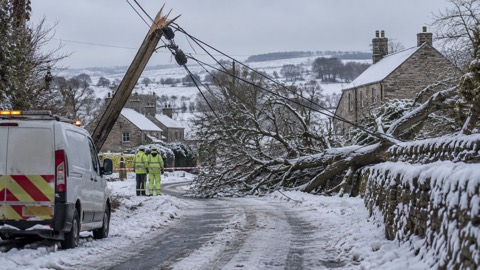 Storm Arwen 2021
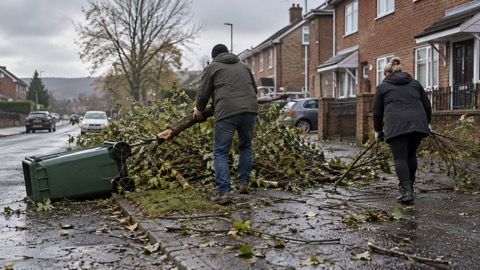 Storm Boelo
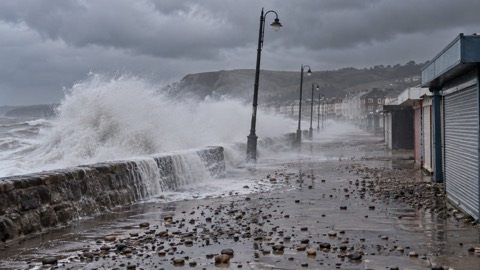 Coastal Safety in Gales
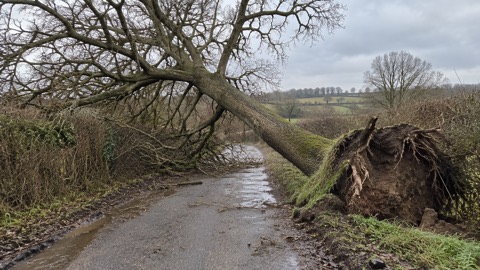 Dangerous Trees
 Storm Darragh 2024
 Landslips After Heavy Rain
 Lightning Safety
 How Storms Are Named
 Travel Disruption in Bad Weather