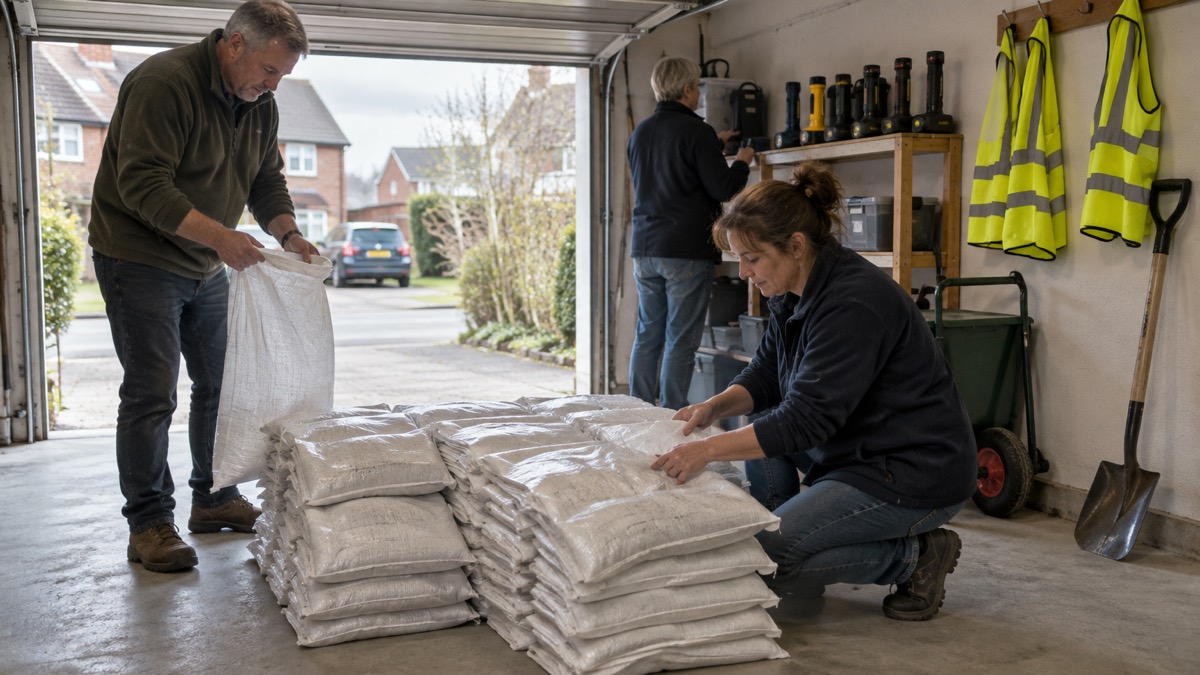
If your street, village or estate floods, the most useful thing you can do is organise with your neighbours before the water arrives. A flood action group is a voluntary group of local residents who work together to reduce the impact of flooding in their community, and in practice they are volunteers who work with local councils and agencies to reduce flood risks and represent local people1. You do not need special training, premises or funding to begin: most community groups start with just a handful of people who are keen to do something about flooding2.
Before starting anything new, check whether a group already exists near you. You can find your nearest flood action group, community flood wardens or community hub on social media, on your local council's website, or by contacting the National Flood Forum1. In Wales, Natural Resources Wales will tell you whether there is a community flood group in your area if you contact it at befloodready@cyfoethnaturiolcymru.gov.uk3. If nothing exists, this page sets out how to form a group, how to write a community flood plan, what help the National Flood Forum and Scottish Flood Forum provide, and where the limits lie.
Check for an existing flood action group first
Flooding is repetitive: the same streets flood again and again, and in many places residents have already organised. Surrey County Council's advice to residents is typical of councils across England: if your area is known to flood, see if there is a local Flood Action Group, or consider starting one7. The Environment Agency also publishes a Flood Action guide, which local resilience partnerships point residents to as a starting point8. In Cambridgeshire, the council hosts a step-by-step guide to creating a flood action group aimed at anyone thinking of starting one, covering what a flood group is, how to form one and how they operate9.
The evidence from areas where groups have been set up is that they spread. A Devon project report found that seven communities already had flood groups at the time of engagement, and the project supported the creation of fourteen additional groups10. So the first hour you spend searching may save you a year of work, and an existing group may welcome volunteers, flood wardens or a fresh flood plan more than it needs a rival group next door.
Where to look:
- Social media, and neighbourhood WhatsApp or Facebook groups. The London Fire Brigade encourages residents to share flood advice through neighbourhood WhatsApp or Facebook groups so everyone knows what to do11, and those groups are often where a flood action group is already coordinating.
- Your local council's website, which lists flood groups, community flood wardens and community hubs in many areas1.
- The National Flood Forum, which keeps details of flood action groups across England, Wales and Northern Ireland1.
- In Wales, Natural Resources Wales, at befloodready@cyfoethnaturiolcymru.gov.uk, which can also tell you about simulated flooding events a group can take part in3.
If you find a group, join it and bring your energy to what exists. If you find nothing, and your area is at risk, the next section is for you.
Most groups start with a handful of neighbours
A Flood Action Group, sometimes shortened to FAG, is a voluntary group of local residents who work together to help reduce the impact of flooding within their community12. Community resilience groups are usually made up of local people acting in a voluntary capacity to promote and represent the interests of a particular flood risk community2. That definition matters: the group belongs to the place, not to any agency, and its job is to speak for the people who live with the risk.
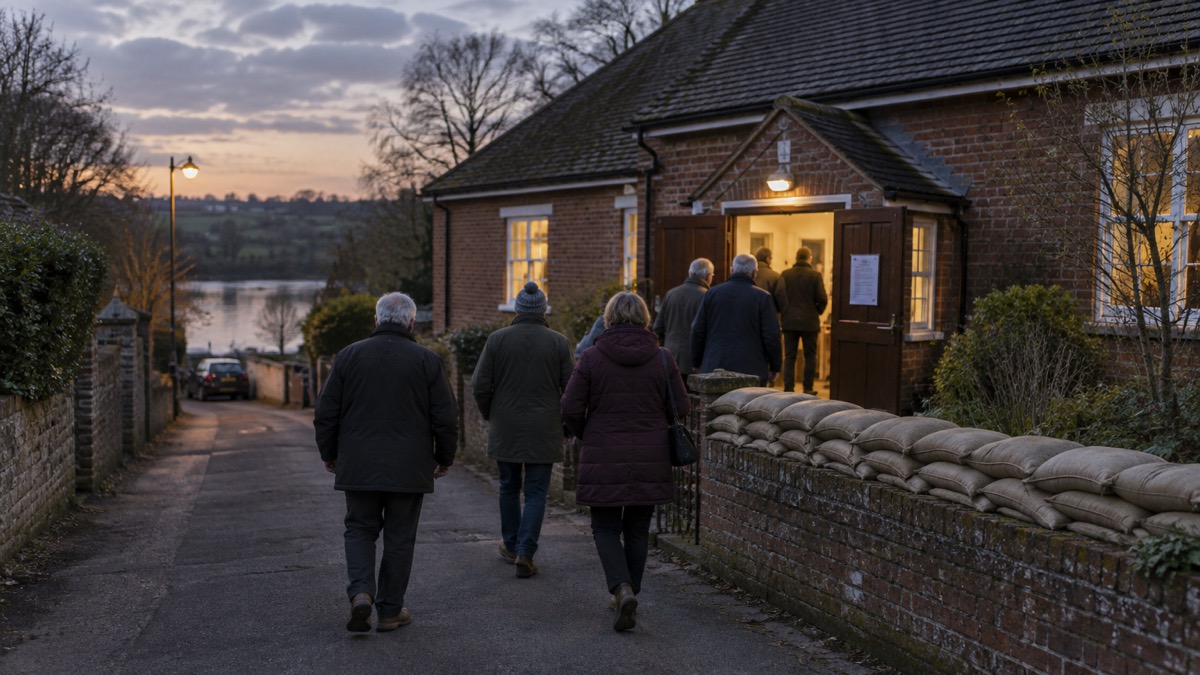
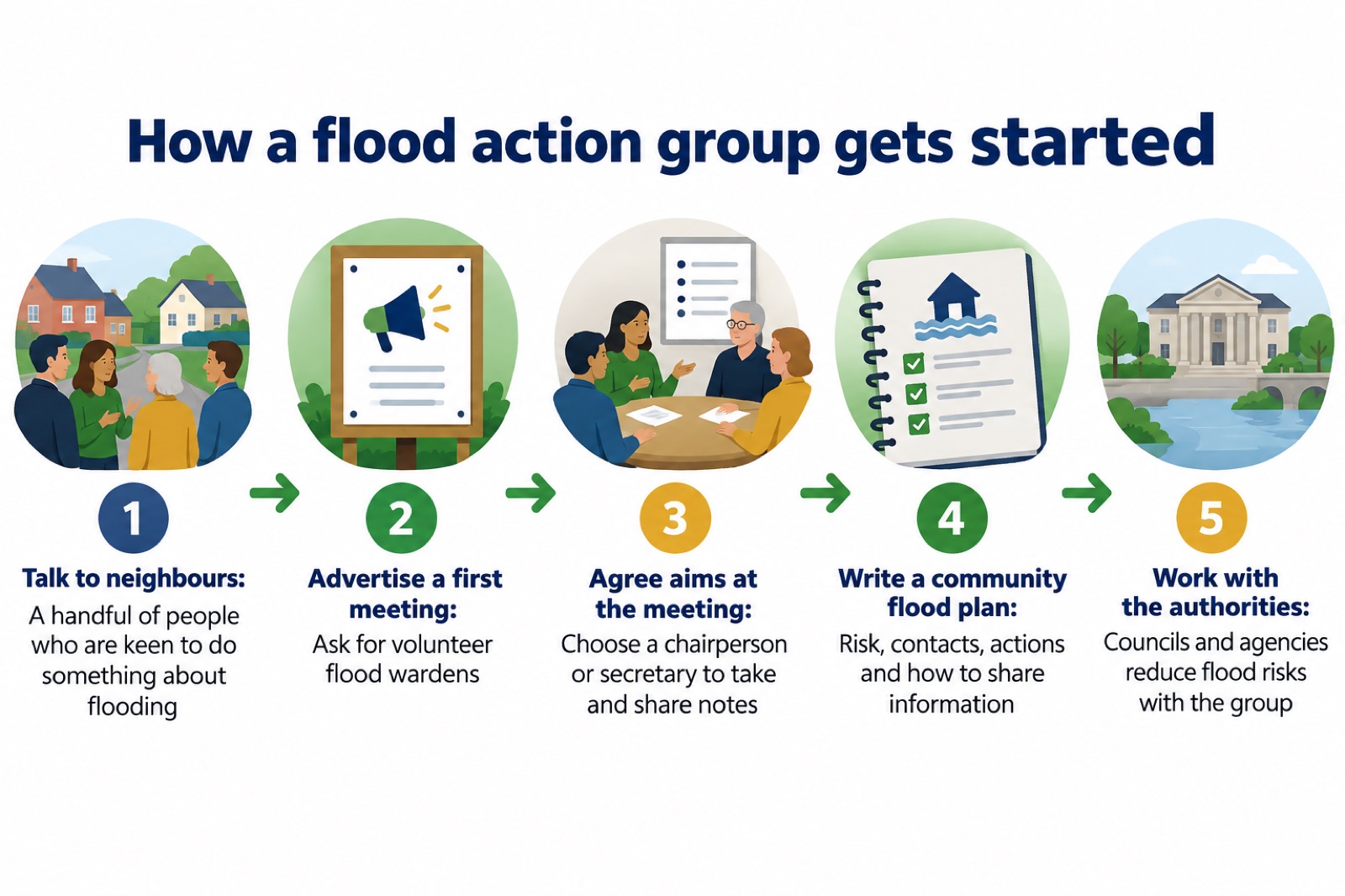
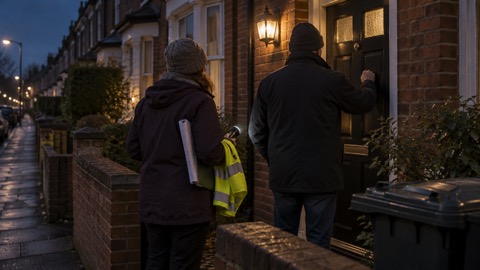
Do not wait for a committee. Orkney Islands Council's guidance on starting a community resilience group is blunt about the starting point: most community groups start with just a handful of people who are keen to do something about flooding2. A first conversation over a garden fence, a post in the street's WhatsApp group, or a note in the parish newsletter is enough to begin. From there, Thurrock Council's community flood planning advice sets out the practical first steps: organise and advertise a meeting asking for volunteer flood wardens, talk about what you want to achieve at the first meeting, and choose a chairperson or secretary to take and share notes13.
What a small group can already do:
- Share flood advice with neighbours through neighbourhood WhatsApp or Facebook groups, so everyone knows what to do11.
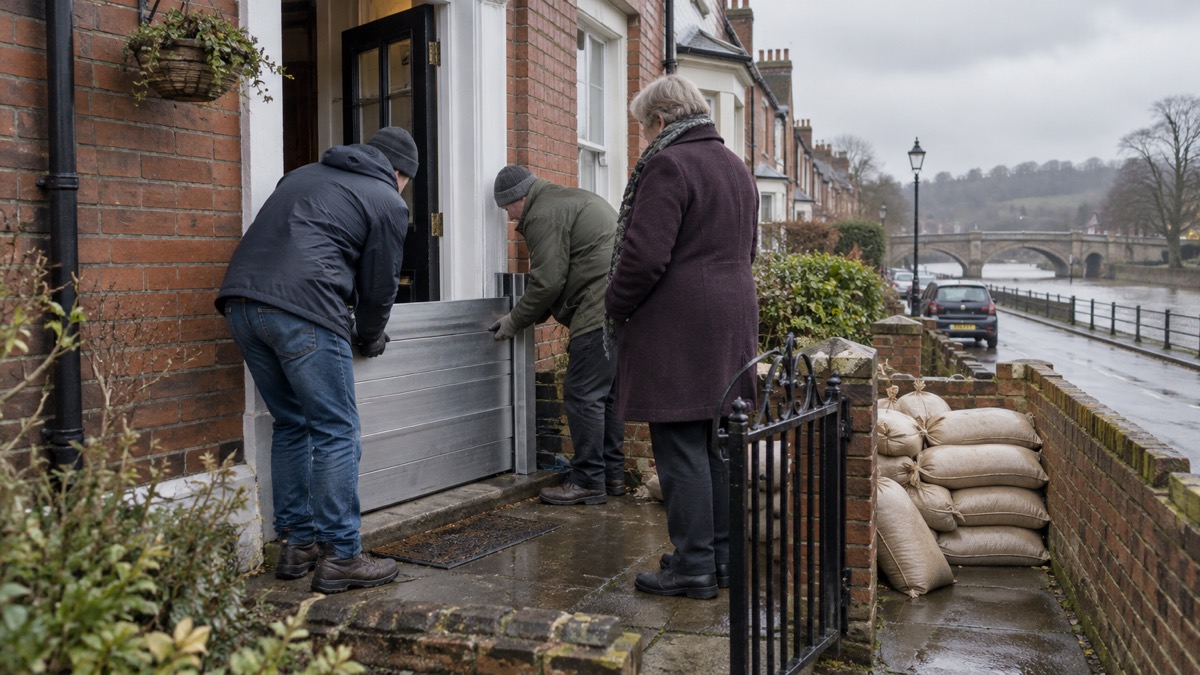
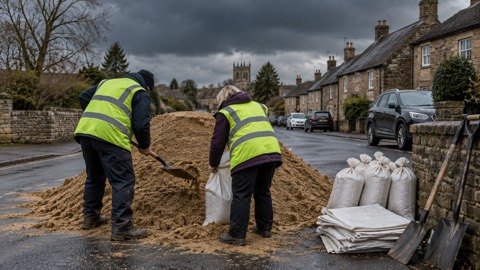
- Help neighbours set up flood protection when a warning comes, such as laying out sandbags or putting up flood barriers14.
- Start small on the causes as well as the response: you can change part of a garden from grey to green, or join up with your community to run a community depaving project, which reduces surface water runoff4.
- Sign up to receive Environment Agency flood alerts and warnings, and monitor reliable local news sources, so the group hears a warning early15.
A group does not need to be large to be useful, and it does not need to do everything at once. The Devon project's fourteen new groups grew out of exactly this kind of beginning10. What a small group does need is a plan, which is the next step, and a clear relationship with the authorities that manage flood risk. For more on the wider world of neighbourly organising, see our guide to community resilience and to setting up a local emergency group.
Write a community flood plan
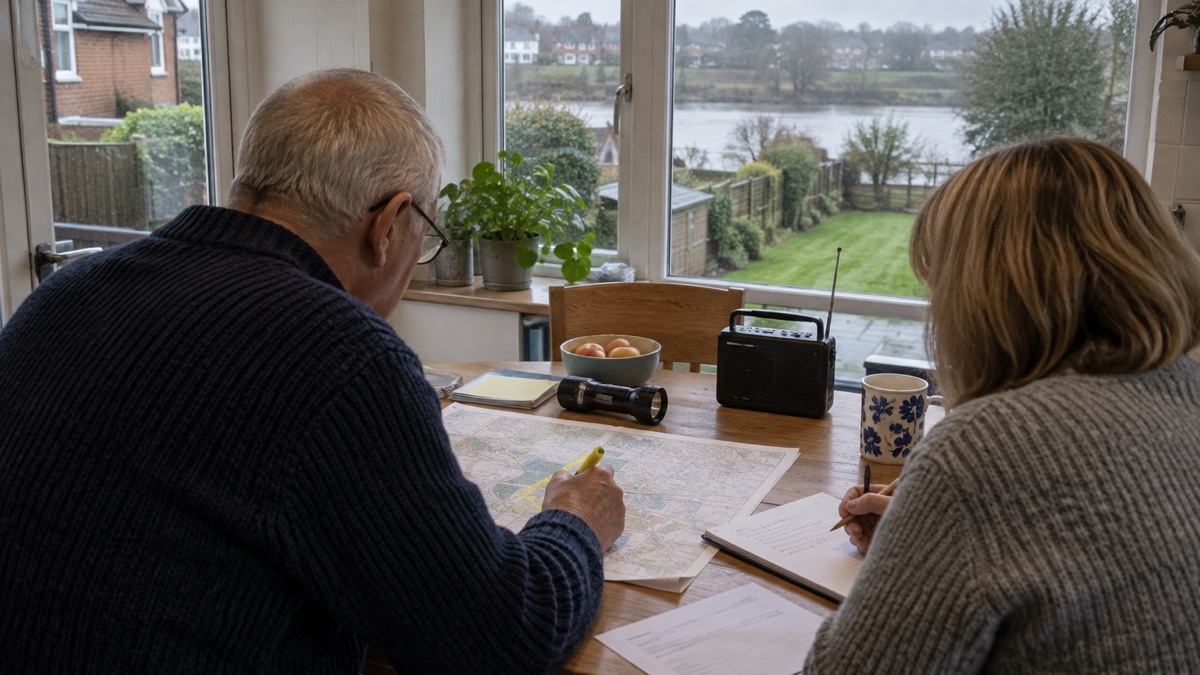
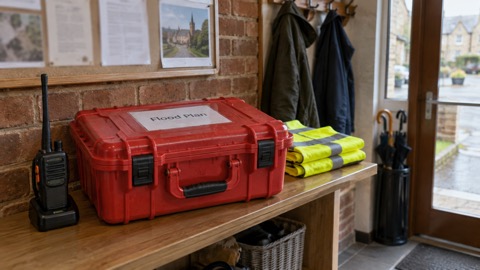
Once two or three neighbours are willing, write the plan down. Wiltshire and Swindon Prepared's advice to communities is simply to create a community flood plan16, and a community flood plan sets out the local community procedures and actions to prepare for, respond to and recover from a flood event17. Natural Resources Wales, whose guidance applies to communities across Wales, describes the purpose plainly: write a flood plan so you, your family or your workforce know what to do during a flood18. A community plan is the same idea at street or village scale.
Natural Resources Wales sets out what a community flood plan should include, and it is the most complete official checklist available3:
| What the plan contains | Why it matters |
|---|---|
| Details about the flood risk in your area | So everyone knows which properties and roads are at risk, and from what |
| A list of contacts, including the community flood lead and flood volunteers | So the group knows who does what and how to reach them |
| How to report an incident | So flooding is reported to the right authority quickly |
| Actions to take before, during and after a flood, for example contacting neighbours and moving vehicles | So the response is agreed in advance, not improvised in the dark |
| When you should take action | So the plan is triggered by a specific warning or water level |
| How to share information within the community, for example an online community group | So warnings reach everyone, not just those on a mailing list |
| How often the plan will be tested and reviewed | So the plan stays current as people move away and risks change |
You do not have to write it from a blank page. A template is available that you can use to develop a plan for dealing with flooding emergencies in your community19. Guidance on what a community flood plan should include covers the flood risk in your area, a list of contacts including the community flood lead and flood volunteers, how to report an incident, actions to take before, during and after a flood such as contacting neighbours and moving vehicles, when you should take action, how to share information within the community, and how often the plan will be tested and reviewed17. Government has also developed checklists to help you prepare for flooding if you support a community or group9. In Wales, contact Natural Resources Wales at befloodready@cyfoethnaturiolcymru.gov.uk, which will tell you whether a group exists in your area and can help with a simulated flooding event to test your plan3.
A plan is only worth having if it is used, so agree when it should be triggered and test it. Our pages on community flood plans, on when to activate a community emergency plan and on how to test and review a community emergency plan go into this in more depth. If your group organises volunteer flood wardens, our flood warden guide and flood warden checklist cover what they do before, during and after a flood.
Support from the National Flood Forum in England, Wales and Northern Ireland
The National Flood Forum is a voluntary organisation, funded in part by the government, that advises individuals and communities on flood resilience and insurance20. It is the main port of call for flood action groups in England, Wales and Northern Ireland: its recovery service includes helping communities establish and sustain Flood Action Groups, facilitating partnership working with councils, the Environment Agency and others, and equipping communities with the knowledge and tools to reduce their future flood risk4. Further advice about what to do during a flood and how to stay safe can be found on the National Flood Forum, which covers Wales, England and Northern Ireland4.
The Forum's helpline, 01299 403 055, provides general support before, during and after a flood on issues including insurance, home re-instatement and home resilience4. If your group hits a problem with insurance, the helpline is where to start, alongside your own insurer: the official after-a-flood advice is to contact your insurance company to start your claim, and they will tell you what to do next21. Households without insurance are advised to consider reaching out to the National Flood Forum on 01299 403055 or via its website4.
Beyond the helpline, the Forum works in partnership with local authorities, the Environment Agency, water companies and voluntary organisations to provide tailored recovery support4. Its recovery service includes helping communities establish and sustain Flood Action Groups, facilitating partnership working, and equipping communities with the knowledge and tools to reduce their future flood risk4. A new group can use these as a starting point: ask the helpline what support is available for groups in your area, and build your first meeting around what it offers.
For groups in Wales, support comes through both the National Flood Forum and Natural Resources Wales. Natural Resources Wales publishes the community flood plan guidance quoted above, runs the befloodready contact address, and can arrange a simulated flooding event for your community3. Contact Natural Resources Wales at befloodready@cyfoethnaturiolcymru.gov.uk and it will tell you whether a group exists in your area3.
Scottish Flood Forum: help for community resilience groups
In Scotland the equivalent body is the Scottish Flood Forum. It is a Scottish based organisation that provides support for and represents those affected by or at risk of flooding, and it is funded by the Scottish Government5. Its purpose is improving communities' understanding of the risks and consequences of flooding in their area, and it works to ensure communities are effectively and appropriately supported to recover and to become more resilient to flooding2.
The Scottish Flood Forum can provide a wide range of independent support to start, sustain and develop community resilience groups in flood risk areas, with practical support, advice and information2. That covers the whole life of a group, not just the first meeting, which matters because sustaining interest is one of the hardest parts of community organising. Its enquiry line is 0131 563 9392, available on weekdays between 9am and 5pm5.
Scottish community groups can also draw directly on the Scottish Flood Forum's own support. It provides a wide range of independent support to start, sustain and develop community resilience groups in flood risk areas2, including training and support for existing groups, whether formal, informal or part of a Community Council2. It supports a network of over 80 active community resilience groups in flood risk areas throughout Scotland2. For the wider picture of neighbourly roles in Scotland and elsewhere, see our guides to flood wardens and to volunteering in emergencies.
| National Flood Forum | Scottish Flood Forum | |
|---|---|---|
| Where it works | England, Wales and Northern Ireland | Scotland |
| What it is | A voluntary organisation, funded in part by the government, advising individuals and communities on flood resilience and insurance20 | A Scottish based organisation providing support for and representing those affected by or at risk of flooding, funded by the Scottish Government5 |
| How to contact | Helpline 01299 403 0554 | Enquiry line 0131 563 9392, weekdays 9am to 5pm5 |
| Support for groups | Advice and details of flood products; support before, during and after a flood, including insurance, home re-instatement and home resilience4 | Independent support to start, sustain and develop community resilience groups in flood risk areas2 |
Property flood protection: exhibitions, assessments and bulk buying
A flood action group is well placed to help households protect their own homes, because the decisions are easier taken together. The official advice is clear that this is worth doing: getting flood protection products, for example flood doors or self closing air bricks, reduces flood damage6. Suffolk's fire and rescue service adds that if it is appropriate to use purpose-made flood protection products, information is published on the National Flood Forum's Blue Pages23.
Blue Pages, at bluepages.org.uk, provides a directory of property flood products and services to help reduce the risk of flooding to your home4. Derbyshire County Council describes it as the National Flood Forum's directory of kite-marked flood resilience products20, and Nottinghamshire County Council notes that it lists a variety of products that might be suitable24. The Derby and Derbyshire flood warden handbook points wardens to the same address for further information on equipment available25. A group can walk neighbours through the directory together, invite suppliers to a community event, or arrange assessments street by street, which is often cheaper and less daunting than each household going alone.
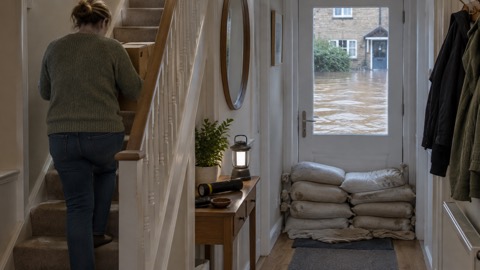
Alongside products, the group can help neighbours with the simpler measures that official guidance recommends when a flood warning is issued. Northumberland Council's flood advice for businesses, which applies equally to a community acting together, lists obtaining sandbags or other flood defence devices, moving equipment and furniture above the estimated flood level, switching off electrical and gas installations, making sure drains run efficiently, and placing unsealed food in airtight containers26. Laying out sandbags or putting up flood barriers for neighbours is explicitly one of the tasks a community emergency group can help with14. For what a household should keep ready at home, see our emergency kit guide and our flooding guide.
What the flood forums do not provide
The limits matter as much as the help. Natural Resources Wales is explicit about what a community flood group is not:
"Being part of a community flood group is not an Emergency Service role. You should not undertake any activities which could put your life or others in danger."
Natural Resources Wales community flood plan guidance3
That line should be in every group's plan and repeated at every meeting. The fire and rescue services, the Environment Agency and the other risk management authorities are the responders; the group's job is preparation, communication and neighbourly help, within the limits of safety. Our page on what volunteers can safely do, and where to stop sets this out in full.
The forums themselves are support and advisory bodies, not responders and not regulators. They will not manage a flood, clear water from your street, or compel a council or water company to act. Where a dispute arises, the route is through the risk management authorities: in England and Wales, the Lead Local Flood Authority, the county or unitary council's flood and water management team, leads the partnership and co-ordinates investigation and measures to mitigate surface water flooding27. Suffolk County Council and its Flood and Water Management Team, a Lead Local Flood Authority, hold exactly that role in their area27. Which agency is responsible for which source of flooding, from rivers and the sea to surface water and sewers, is explained in our flooding guide, and knowing it will save your group from pressing the wrong doorbell.
For mediation when relations with an authority or a neighbour break down, the Scottish Flood Forum is able to mediate as an honest broker in difficult situations, and you can get in touch with it for further information2. In Scotland, that is a route open to any community group; elsewhere, the National Flood Forum's role in supporting and representing communities24 is the nearest equivalent, alongside formal complaints routes through the council. Our page on how councils and emergency services work with local groups covers building those relationships before they are tested.
After a flood: what the group should tell neighbours
A flood action group earns its keep in the recovery phase as much as in the warning phase, because the weeks after a flood are when households are most at risk of harm from the aftermath. The messages to share are straightforward and official.
Electricity is the first danger. The Northern Ireland direct government service advises: get any electrical appliances that have come into contact with floodwater checked by a qualified electrician before using them again, and do not touch sources of electricity while standing in floodwater28. Runnymede Borough Council's flooding aftercare advice adds: unplug damaged electrical appliances and move all portable ones away from the area affected by flooding, and use a registered electrician to assess the condition and damage to electrical wiring, equipment and appliances affected by the flood29. Suffolk's before, during and after a flood booklet goes further: if your electricity supply is not already switched off at the mains, get a qualified person to do this, and get appliances checked by a professional electrician or gas plumber before use, including heating systems27. Northumberland Council similarly advises having flood-damaged installations checked by an approved electrical contractor before use26.
A group can also help neighbours with the practical aftermath: contacting insurance companies to start claims21, listening to local radio stations for further information and guidance23, and knowing where to turn for further support, which in Nottinghamshire and many other areas includes the National Flood Forum at 01299 403 05524. For the household side of recovery, see our flooding guide.
Keeping the group going
The Cambridgeshire resources list "how to sustain interest" among the topics for getting the most out of a flood action group9, and it is the honest challenge: floods are intermittent, and groups fade between them. The plan itself gives the group a reason to meet: a community flood plan should set out how often it will be tested and reviewed17, so put a testing schedule in the plan from the start and keep to it. In Scotland, the Scottish Flood Forum holds a quarterly networking event for community resilience group chairs and others to come together and share knowledge and lessons learnt2, a ready-made rhythm for keeping a group going between floods.
Funding, insurance and structure are questions most groups meet eventually. Our guides to funding for local resilience groups, to whether a local group needs a constitution and to volunteer insurance cover them. The National Flood Forum's helpline provides general support before, during and after a flood on issues including insurance4, and the Scottish Flood Forum is linked into national funding updates, raises awareness of available grants via its newsletter, and can advise on setting up a Bulk Buying Scheme for protection measures so group members get the best price possible from suppliers2. If your group works within a parish, town or community council, our page on parish and town councils in an emergency explains what those councils can do.
Sources (29)
- Prepare for flooding, GOV.UK
- Starting a community resilience group, Orkney Islands Council
- Community flood plan, Natural Resources Wales
- How to prepare for flash flooding, Greater London Authority
- Flood advice, Argyll and Bute Council
- Protect your property, GOV.UK
- Risks and preparing for emergencies, Surrey County Council
- Preparing for a flood, Wiltshire and Swindon Prepared
- Community flood group resources, Cambridgeshire County Council
- Devon Pathfinder community resilience flood report, Devon County Council, 2020-09-16
- Preparing for a flood, London Fire Brigade
- Flood and coastal risk management, Isle of Anglesey County Council
- Community flood planning, Thurrock Council
- Community emergency planning guide: make a plan, Ready Scotland, 2026-03
- Flood health action card for the voluntary and community sector, GOV.UK, 2025-03-27
- Flooding, Wiltshire and Swindon Prepared
- Community Flood Plan Template, London Borough of Merton, 2026
- Preparing for a flood, Natural Resources Wales
- Community resilience, Herefordshire Council
- Resilience and sandbags, Derbyshire County Council
- After a flood, GOV.UK
- Personal flood resilience, Derbyshire County Council
- What to do in a flood, Suffolk County Council
- Further support after a flood, Nottinghamshire County Council
- Derby and Derbyshire flood warden handbook, Parwich Parish Council, 2019-11
- Information about specific safety concerns, Northumberland County Council, 2026-05-21
- Before, during and after a flood, Suffolk County Council, 2021-05
- After a flood: clearing up, nidirect, 2026-05-06
- Flooding aftercare, Runnymede Borough Council, 2026-10-26
 Emergency Hub Kit Checklist
 Severe Weather Tasks for Groups
 Flood Warden Checklist
 Setting Up an Emergency Group
 Volunteering in Emergencies
 What Volunteers Can Safely Do
 Community Flood Plans
 Flood Wardens
 Clearing Snow and Ice
 Community Emergency Hubs
 Checking Vulnerable Neighbours
 Neighbourhood Phone Trees
 Registering and Looking After a Village Defibrillator on The Circuit
 Funding Resilience Groups
 Voluntary Organisations