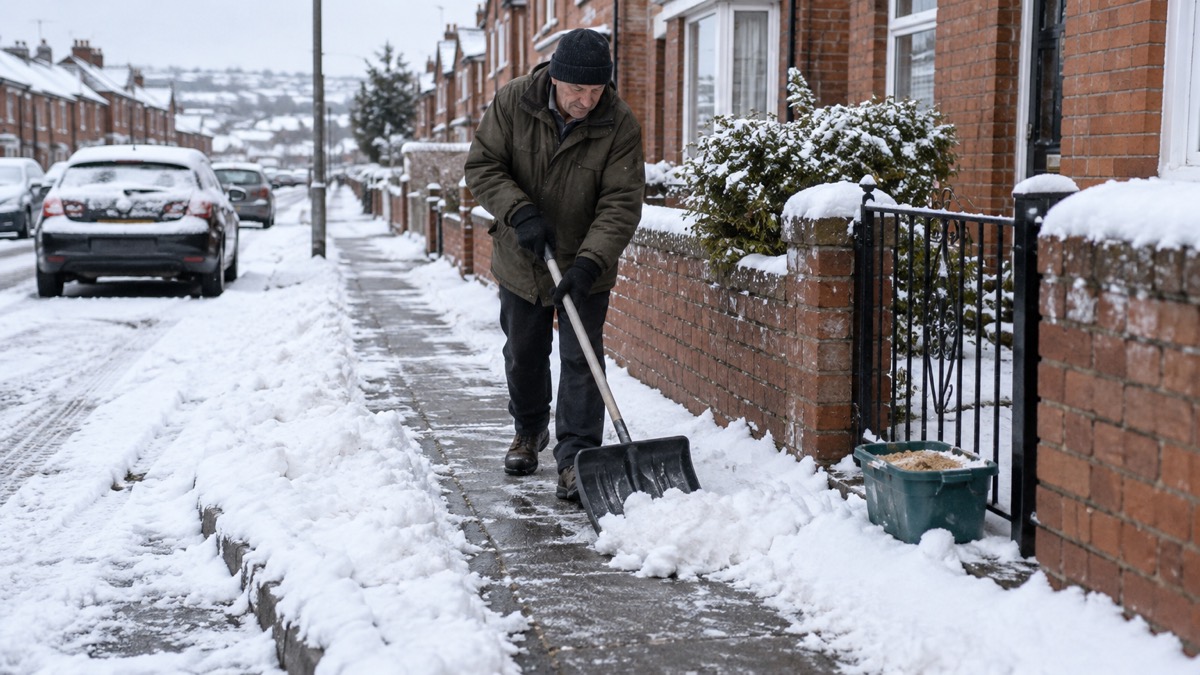
If snow has settled on the pavement outside your front door, you can pick up a shovel and clear it. There is no law stopping you from clearing snow and ice on the pavement outside your home or from public spaces1, and the government's own advice is that it is unlikely you will be sued or held responsible if someone is injured on a path or pavement you have cleared carefully1. Councils across England, Scotland and Wales publish the same message, and some actively encourage residents to clear the public pavement near their property and to help neighbours who cannot clear their own2.
The method is simple and the materials are ordinary household ones. Clear fresh snow early, while it is still loose, before it is trodden into a hard slab. Make a path down the middle of the area first, then shovel the snow from the centre to the sides3. Ordinary table or dishwasher salt will work, at a tablespoon for each square metre you clear3, and a teaspoon per square metre will defrost small ice patches4. Do not use hot water, because it may refreeze into black ice4.
There is no law against clearing the pavement outside your home
The clearest statement comes from the government's snow guidance on GOV.UK: "It's unlikely that you'll be sued or held responsible if someone is injured on a path or pavement if you've cleared it carefully"1. County councils repeat this in their own snow codes. Derbyshire's Snow Code says plainly that "There's no law stopping you from clearing snow and ice on the pavement outside your home or from public spaces"3. Warwickshire's version extends the same right to pathways to your property and to public space6, and Suffolk's highway maintenance pages give the same reassurance about pavements cleared carefully7.
The position is the same across the nations, with one useful extra detail in Scotland. Scottish Borders Council states that residents have no obligation to clear or grit the public pavements outside their house and no liability if someone slips and injures themselves there; you would be liable only if your clearing or gritting created a new or greater risk which the injured person could prove directly caused their injury2. Argyll and Bute Council passes on advice from the Scottish Government: "provided you are careful, use common sense and don't do anything which would be likely to cause harm or distress to others, it is highly unlikely that you will be found responsible for any accidents"8. Oxfordshire's snow guide adds a reassuring historical note: there have been no cases where anyone has been sued for clearing snow from pavements9.
Cheshire West and Chester Council addresses the fear directly, and its wording is worth quoting:
"Don't be put off clearing paths because you're afraid someone will get injured. Remember, people walking on snow and ice have a responsibility to be careful themselves."10
That last point matters to your decisions. People walking on snow and ice are expected to take care themselves, so your duty is not to guarantee a dry pavement, only to avoid making the surface clearly more dangerous than it was before. The things that would do that are the obvious ones: pouring water that later freezes, piling snow so it hides a hazard, or leaving a smoothed, wet surface to refreeze overnight. Avoid those and you have done what the law and every council snow code ask of you.
How to clear snow and ice from a pavement
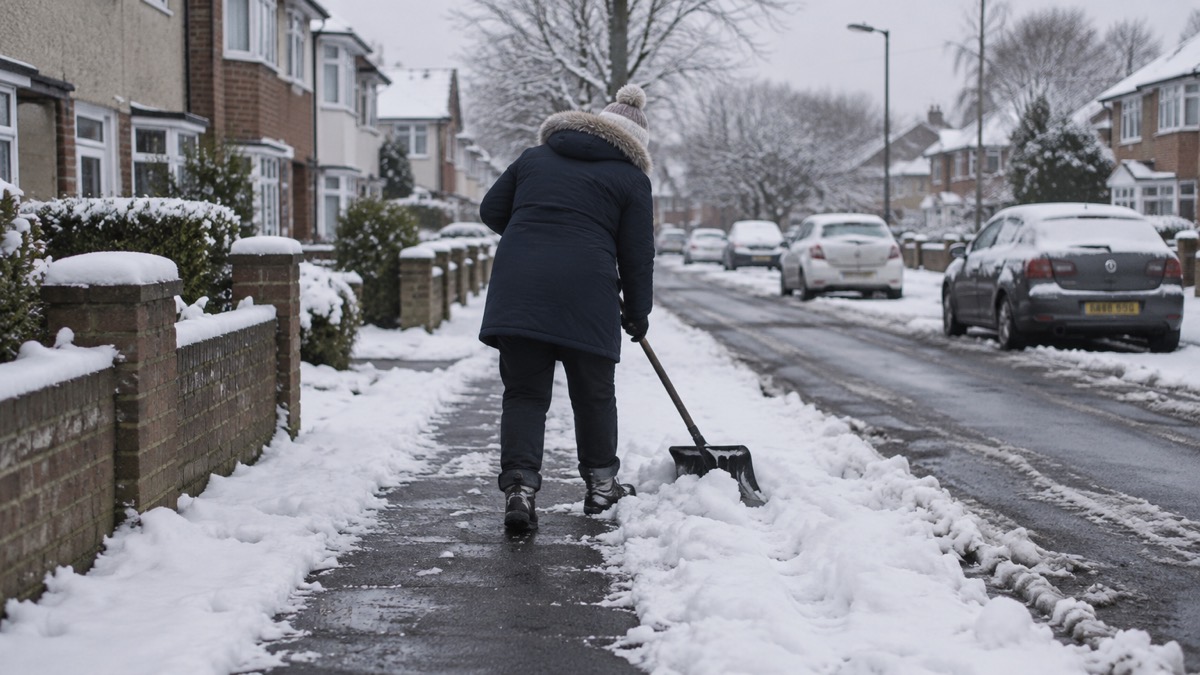
The government's snow code sets out a method that works for a front path, a pavement or a stretch of public footway. First, make a path down the middle of the area to be cleared, so you have a clear surface to walk on while you work. Then shovel the snow from the centre of the path to the sides3. Working from a cleared strip keeps you off the slippery surface and stops you treading fresh snow into a compacted layer that is far harder to shift.
Where you put the snow matters as much as getting it off the pavement. Derbyshire's Snow Code says to take care where you throw it so it does not block people's paths or drains3. Lincolnshire's Winter Service Plan, which covers its own footway clearing teams, advises placing snow at the edges of footways next to the road, because it helps form a barrier between cars and pedestrians4. Ready Scotland adds the two things not to do: do not cause an obstruction, and do not conceal a hazard with piled up snow5.
Once the surface is clear, treat it so it does not refreeze. Oxfordshire's snow guide is direct on this point: "If you do clear snow from the pavements make sure you use a de-icing material to ensure that the pavement doesn't re-freeze and make the situation more hazardous"9. A cleared but untreated pavement can be more slippery at night than the snow you removed, because meltwater and residual moisture freeze into an invisible glaze. A thin spread of salt, covered in the next section, prevents that.
There are two firm warnings that apply to the whole job. Never use hot water to melt snow or ice: Lincolnshire's plan warns it may refreeze to form black ice4, and Ready Scotland gives the same warning, that hot water could quickly turn to ice5. And do not lift too much snow at one time: compacted snow can be very heavy, and the strain of shifting large loads by shovel is a real risk for an otherwise fit adult4.
Clear fresh snow early, while it is loose
Every official source agrees on timing. Ready Scotland puts the point in three words: "Clearing fresh snow is easiest"5. Start removing the snow as soon as it stops falling if you can, before it is trodden down or compacts.
The reason is compaction. Fresh snow is light and loose, and a shovel slides through it. Once feet, pram wheels and car tyres have worked over it, it compresses into a dense layer bonded to the pavement, and removing it means scraping rather than shovelling. If you can only clear once, clear in the first hours after snowfall stops, before the pavement has been walked over, and salt the cleared surface immediately so overnight refreezing does not undo the work.
Salt and grit: ordinary table salt will work
You do not need specialist products to treat a domestic path. Cheshire West and Chester Council states that anyone can clear snow and ice from the pavement outside their home or public spaces to prevent slips and falls, and that normal table salt will work10. Derbyshire's Snow Code gives the dose: "Use ordinary table or dishwasher salt - a tablespoon for each square metre you clear should work"3. West Yorkshire Prepared repeats the same measure for households building a winter store11, and the Met Office's winter advice blog gives the same figure, a tablespoon of table or dishwasher salt for each square metre you clear12. For small ice patches rather than full clearance, Lincolnshire's Winter Service Plan uses an even lighter dose: a teaspoon of salt per square metre will defrost ice patches4.
| What you are treating | Material | How much | Source |
|---|---|---|---|
| A cleared path or pavement | Table or dishwasher salt | One tablespoon per square metre | 3 |
| Small ice patches | Salt | One teaspoon per square metre | 4 |
| Cleared areas needing grip, where salt is short | Sand or ash | A thin spread for grip | 4 |
Salt works by lowering the freezing temperature of water, which prevents ice or frost forming as the surface falls to 0°C10. Bedford Borough Council explains the practical consequence for roads, and it applies to paths too: salt does not directly melt snow. It has to be spread before the snow falls, and over time traffic works it into the surface, where it mixes with snow or moisture to form a saline solution that does not freeze as quickly as plain water13. On a quiet pavement there is no traffic to do that working in, so spread your salt as soon as you have cleared, and expect it to act gradually rather than instantly. National Highways notes a related limit on roads: salt will not stop snow from settling on a surface, but it acts as a debonding layer that makes the snow easier to plough off14.
Two rules govern council grit. The government's advice is not to use the salt from salting bins on your own path, because it is used to keep roads clear1. Northumberland County Council puts the same limit slightly differently: grit from bins and heaps can be used to clear snow and ice from roads and pavements around your home, but it should not be used on private property15. Lincolnshire's plan goes further and describes taking grit from highways grit bins for private property as theft4. The safe reading for a household is that grit from a public bin may be used on the public pavement and road outside your home, but not on your own drive or garden paths, for which you should use your own salt.
Working safely beside the road
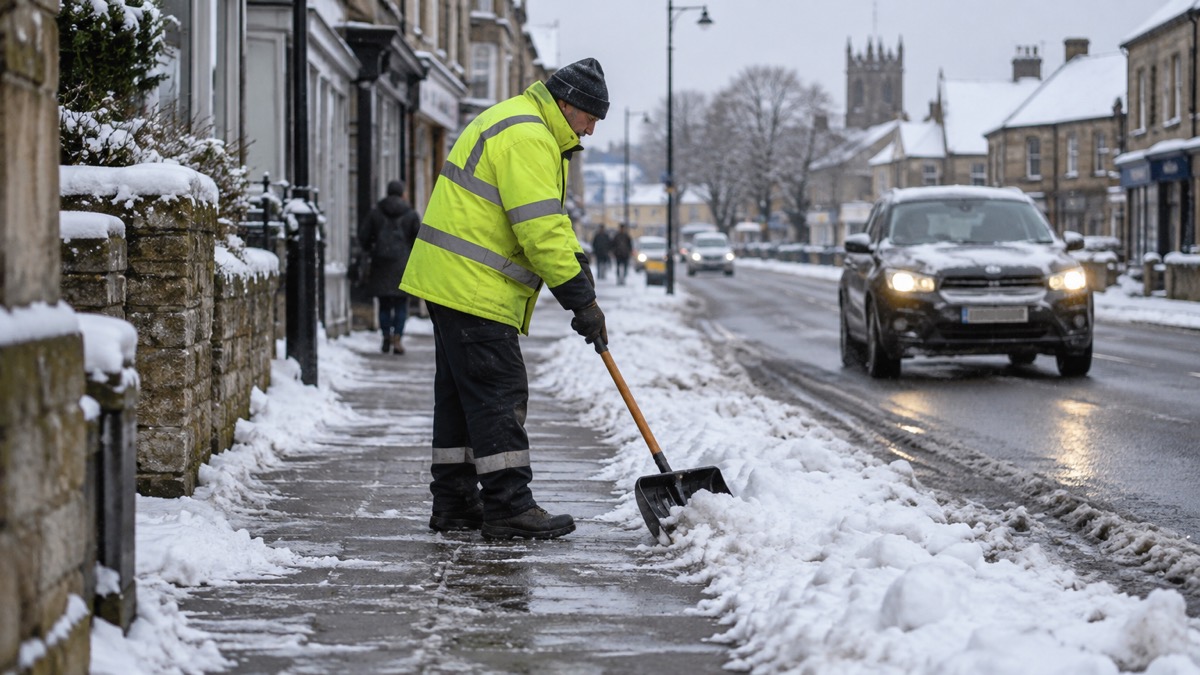
Clearing a public pavement usually means working within a metre or two of traffic, and Lincolnshire's Winter Service Plan, written for its footway clearing teams, sets out the precautions that apply just as much to a resident with a shovel. Work from the footway at all times, and work towards oncoming traffic wherever possible, so you can see and be seen. Wrap up warm, wear a reflective coat if you have one, and wear snow and ice grippers on your footwear when walking, especially when pushing snow. The plan also warns its crews to beware of hypothermia and wind chill effects, which creep up on someone working steadily in cold conditions4.
Poor visibility removes the main protection of working towards oncoming traffic, and drifting snow can change the ground underfoot between one shovel-load and the next. If snow is still falling hard, wait for it to stop, then clear early in the lull that follows.
If you are part of a community effort that goes beyond pavements, the rules for roads are stricter still. Lincolnshire's plan for clearing snow off the carriageway requires purpose-built snowploughs where available, and where a mechanical bucket is used it must skim the top of the snow to leave an inch of snow, so the blade does not damage the road surface, remove cat's eyes or strike ironwork. Operators must run dipped beam headlights and flashing amber beacons at all times, place snow on the verge or grassed areas, and keep in regular contact, at minimum hourly, with their operational base. They must not scrape the road surface, and must not obstruct accesses or footways with the snow4. These are instructions for trained operators with plant, and they mark the clear line between what a household or volunteer can safely do, clearing footways, and what belongs to council crews and contractors. Highland Council's winter policy likewise states that in exceptional snow conditions external contractors will be deployed to assist with snow clearance16.
Walking on icy pavements without slipping
Clearing snow and ice from the pavement outside your home or from public areas helps prevent slips and falls, as Essex Prepared's official guidance puts it17, but there will be stretches you have not cleared and days when the ice wins. The Met Office's seasonal advice for ice is to use pavements along main roads if you are making a journey on foot, because they are likely to be less slippery18. Main road pavements benefit from the same salting as the road beside them and from the traffic that works the salt in, which is why Suffolk gives priority in its own footway treatment to main shopping streets in town centres, other town pavements and well used cycle tracks7.
The Met Office's winter blog adds two habits worth adopting for the whole season. Leave the house five minutes earlier than usual, because rushing increases the risk of slips and falls, and wear footwear with good grip12. It also suggests looking out for neighbours: offer to clear their paths when you clear yours, and spread salt to reduce the risk of slips12. For a household view of the wider season, from storms to school closures, see the storms, snow and ice guide.
Snow warden schemes: volunteering to clear public footpaths
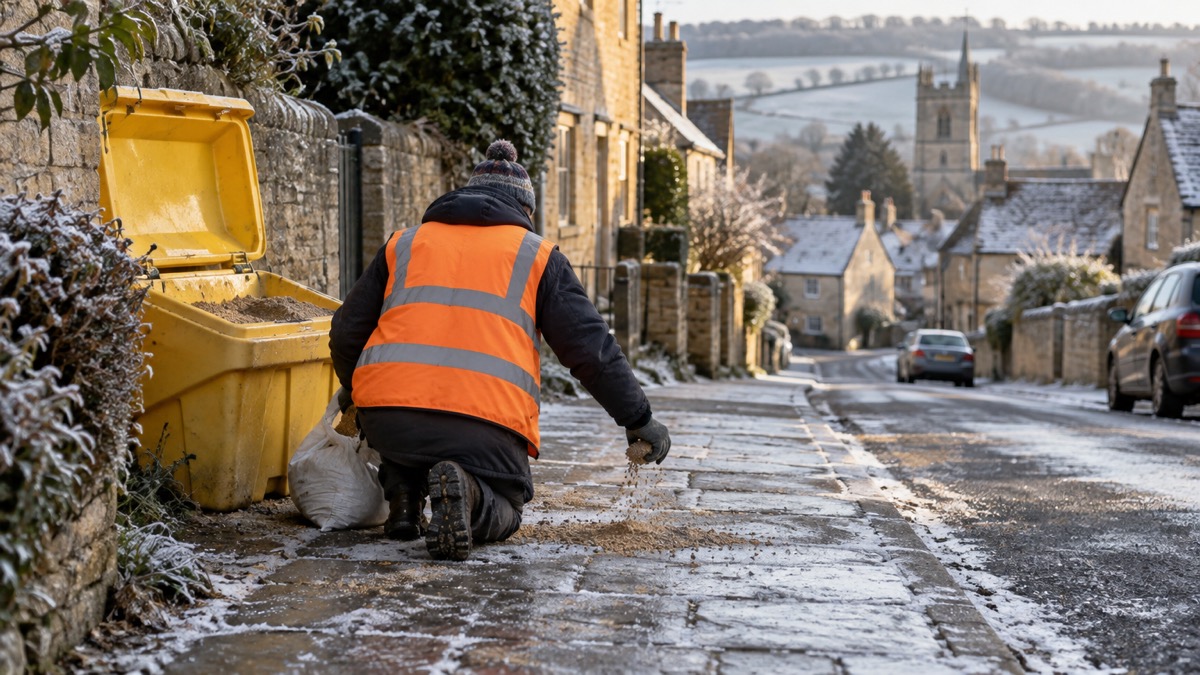
If clearing your own frontage is not enough, most counties now run a formal route into clearing public paths for the whole street. Northumberland County Council's Snow Warden Scheme allows an individual or a group of community volunteers to sign up to help clear snow and ice from public footpaths in their local areas, and by carrying out the voluntary duties you help keep your community safer during severe winter conditions19. Warwickshire County Council runs a network of voluntary snow wardens in partnership with parish and town councils and residents' associations, consulting area teams on local needs, with priority given to busy footway areas, areas outside shops and schools, and steep areas agreed in advance6. Highland Council provides assistance and resources for communities interested in helping to clear footpaths during winter20, and Scottish Borders includes clearing snow from pathways and community facilities among its resilient communities activities21.
The work is broader than shovelling. Devon County Council lists what its volunteers may do: spread grit, clear snow, and refill grit bins and bags22. A snow warden's duties may also include ordering grit and salt supplies, keeping a register of trained volunteers, receiving and responding to local weather alerts, organising volunteers to clear snow, organising volunteers to spread grit when icy weather is forecast, and encouraging responsible and appropriate use of salt22. Derbyshire County Council notes that some district, borough and town councils have signed up to help clear snow and ice from pavements and paths in some town centres, with volunteers from town and parish councils helping keep pavements and footpaths clear, and that it also works with farmers and external contractors to clear snow from some roads not on primary or secondary routes in heavy snow and freezing conditions23. For the fuller picture of these schemes, see the snow warden schemes guide.
What snow wardens receive: kit, salt and grit
Councils equip their volunteers. Northumberland provides a snow warden kit comprising a snow shovel, a bag of salt or grit, a thermal hat with a head torch, a pair of thermal gloves and a hi-vis vest19. Derbyshire provides between half a tonne and one tonne of grit, free of charge, delivered directly to a designated storage area, in 10kg and 25kg bags per participant24. Devon trains its snow wardens and provides ongoing advice and guidance, refills county-owned grit bins when notified that they are empty, and provides local councils and community organisations with up to five tonnes of salt free of charge, usually delivered in one-tonne dumpy bags to one agreed location before winter, along with a small number of bagged salt supplies22. Salt can be requested in Devon using an online salt ordering form, and there is a route for purchasing additional salt through contracted suppliers22. Lincolnshire undertakes to provide limited amounts of additional salt or grit in one tonne sacks to parish councils at agreed locations, on request or during the summer following a severe winter4. Salt quantities for town councils in Devon are agreed separately and depend on the services they plan to deliver22.
| What the council provides | Northumberland | Derbyshire | Devon |
|---|---|---|---|
| Kit | Shovel, salt or grit bag, thermal hat with head torch, thermal gloves, hi-vis vest19 | Grit in 10kg and 25kg bags24 | Training and ongoing advice22 |
| Salt or grit | Included in kit19 | ||
| Extra supplies | Via the scheme19 |
Registering, risk assessments and insurance
Registration differs by council, so start with your own authority. In Northumberland, you return a completed registration form and fitness declaration to a freepost address, or scan and email them to the highways and neighbourhood services team19. In Devon, you contact the community self help email address to register for access to the online training, and register or update your details via an online form22. Wiltshire and Swindon Prepared simply advises signing up to be a snow warden in your local area25. Northumberland also requires you to complete a Risk Assessment Form before it can issue your equipment19, and its scheme asks volunteers to follow the government's guidelines on clearing snow safely if they want to clear snow themselves19.
Insurance is where the formal scheme earns its keep, and where its limits sit. Devon County Council provides Public Liability Insurance for voluntary work completed under the approved Snow Warden Scheme, provided it is carried out safely and in accordance with guidance, covering third-party claims arising from authorised snow warden activities22. But the council states plainly: "We do not provide any other insurance cover"22. Volunteers are responsible for their own personal safety and property, damage to personal equipment or vehicles is not covered, and the Public Liability cover does not apply to work by contractors employed by a council or community organisation22. Anyone using their own vehicle, for example farmers, must ensure their insurer covers snow warden activities22. Snow wardens in Devon work on behalf of their local council or community organisation, not the county council, so check who you are actually volunteering for and what that body covers. For the wider picture, see the guide to whether emergency volunteers need insurance and the page on what volunteers can safely do.
Helping neighbours and the wider community
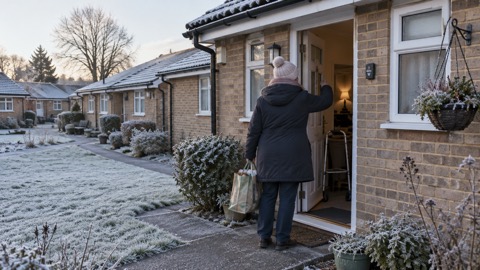
The most useful snow clearing is often not your own frontage. Scottish Borders Council encourages everyone to play their part by clearing snow and ice from the public pavement near their properties during bad weather and by helping neighbours who may not be able to clear it themselves2. The Met Office's winter advice makes the same suggestion at household level: offer to clear their paths when you clear yours, and spread salt to reduce the risk of slips12. A cleared path to an older or less mobile neighbour's door can be the difference between them getting out for shopping and prescriptions and being stuck indoors until a thaw. The guide to checking on vulnerable neighbours in an emergency covers the wider set of checks worth making.
Community effort scales further than individual goodwill. When snow blocks roads, local authorities bring in snow ploughs and work with local farmers to clear roads, prioritising routes around essential usage25. National Highways holds 12 snow blowers which can remove up to 1,200 tonnes of snow per hour on the strategic road network26. Highland Council operates 105 road gritters, 42 pavement gritters and one snowblower20. None of that reaches every pavement on the day, which is exactly the gap householders and snow wardens fill. If you want to organise something more lasting than a shovel rota, the pages on setting up a local emergency group, severe weather tasks for community groups and parish and town councils in an emergency set out the next steps, and the community resilience guide gives the overview.
Sources (26)
- Clearing snow from roads, paths and cycleways, GOV.UK
- Winter gritting FAQs, Scottish Borders Council
- The Snow Code, Derbyshire County Council
- Winter Service Plan, Lincolnshire County Council, April 2025
- Cold, snow and ice, Ready Scotland
- Snow wardens, Warwickshire County Council
- Check which roads are gritted, Suffolk County Council
- Grit bins and heaps, Argyll and Bute Council
- Snow Guide, Oxfordshire County Council, January 2015
- Common myths about gritting, Cheshire West and Chester Council
- Severe weather, West Yorkshire Prepared
- Weather ready tips for snow and ice, Met Office, 19 November 2025
- Keeping winter roads safe, Bedford Borough Council
- Does gritting always work?, Traffic England
- Gritting and ploughing, Northumberland County Council
- Winter Service Policy, The Highland Council, August 2018
- Snow and ice, Essex Prepared
- Stay safe in ice, Met Office
- Snow Warden Scheme, Northumberland County Council
- Winter service, The Highland Council, 18 September 2025
- Resilient communities, Scottish Borders Council
- Snow Warden Scheme, Devon County Council, 13 March 2026
- Gritting, Derbyshire County Council
- Winter service, Derbyshire County Council
- Heavy snow, Wiltshire and Swindon Prepared
- Winter driving: how we help you on our roads, National Highways
 Emergency Hub Kit Checklist
 Severe Weather Tasks for Groups
 Flood Warden Checklist
 Setting Up an Emergency Group
 Volunteering in Emergencies
 What Volunteers Can Safely Do
 Community Flood Plans
 Flood Wardens
 Starting a Flood Action Group
 Community Emergency Hubs
 Checking Vulnerable Neighbours
 Neighbourhood Phone Trees
 Registering and Looking After a Village Defibrillator on The Circuit
 Funding Resilience Groups
 Voluntary Organisations