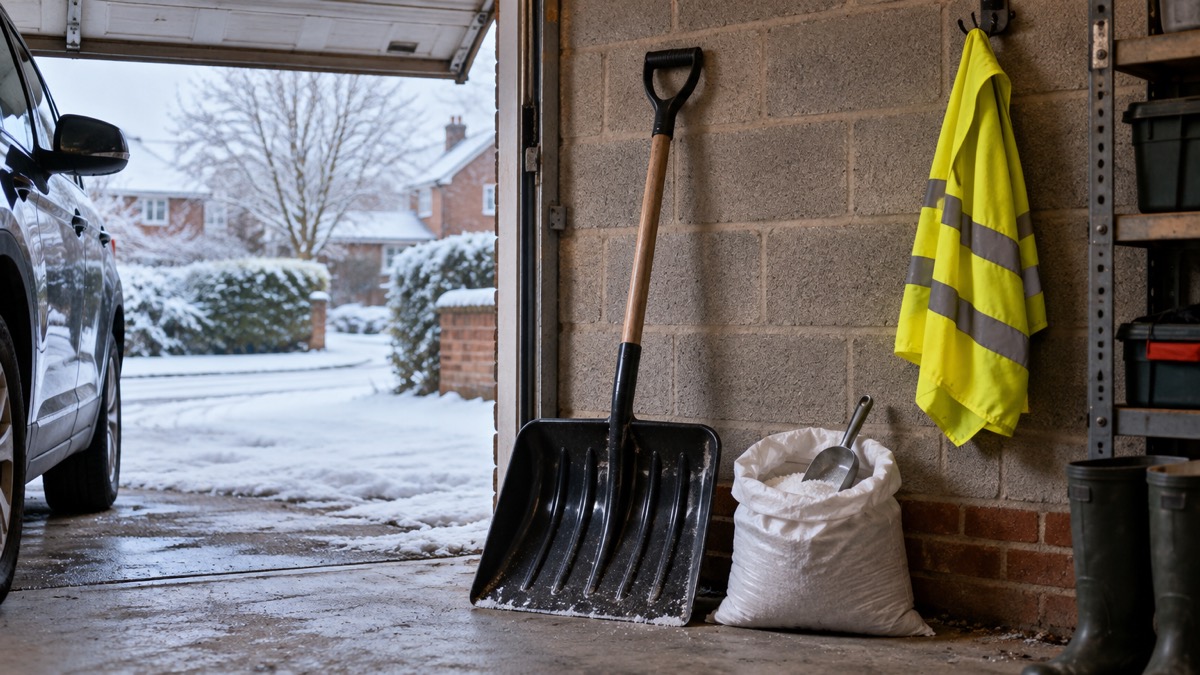
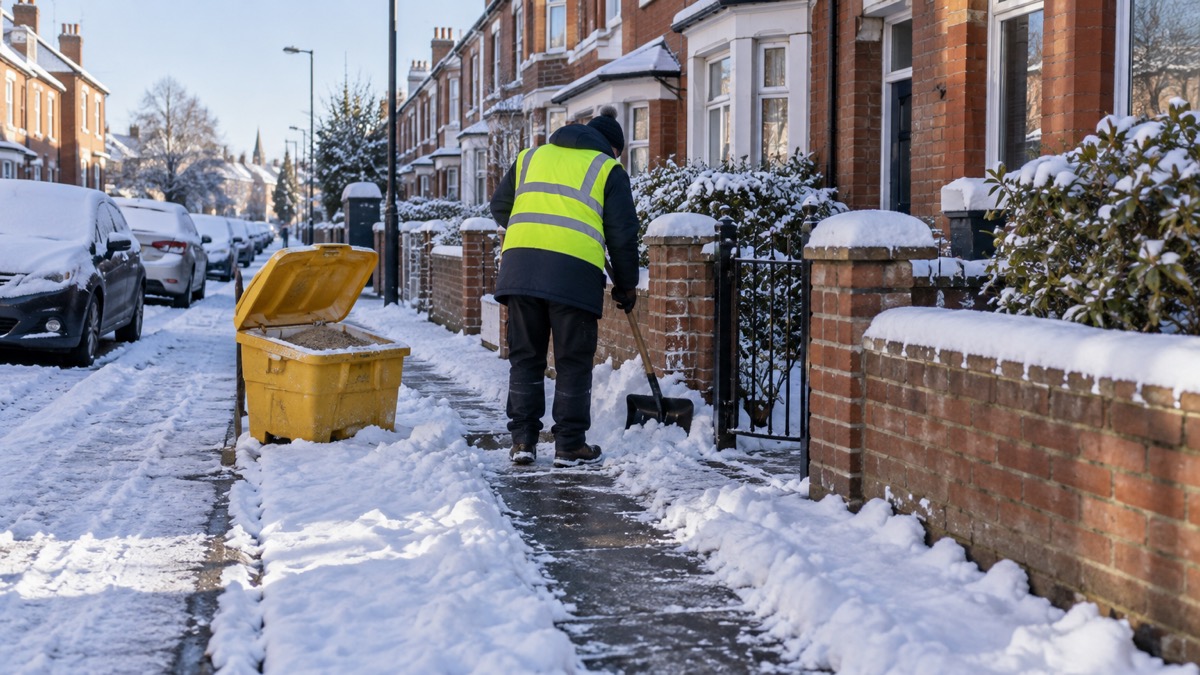
A snow warden scheme lets an individual or a group of community volunteers sign up to help clear snow and ice from public footpaths in their local area1. In return for your time, the council typically provides a kit of a snow shovel, a bag of salt or grit, a thermal hat with a head torch, thermal gloves and a hi-vis vest1, plus training and, in some schemes, up to five tonnes of salt delivered before winter2. The benefit is simple: helping to keep your community safer during severe winter conditions1.
Councils cannot treat every path. Devon County Council, for example, states plainly that it cannot always keep roads free of ice and snow3, and its priority is salting major roads when there is a risk of ice, clearing snow and reacting to floods and fallen trees2. Footpaths, cycleways and residential streets come far down the list, which is exactly where snow wardens fit in: a parish council's registered snow warden may be able to assist with gritting footways and cycleways in the local area3.
You do not need to join a scheme to clear the pavement outside your home. There is no law stopping you from clearing snow and ice from the pavement outside your property, pathways to your property or public space4, and councils actively encourage residents to help neighbours who cannot clear it themselves5. Joining a scheme gets you salt, equipment, training and insurance cover you would otherwise have to arrange yourself. If you just want to clear your own path, see our guide to clearing snow and ice from pavements outside your home.
What a snow warden actually does
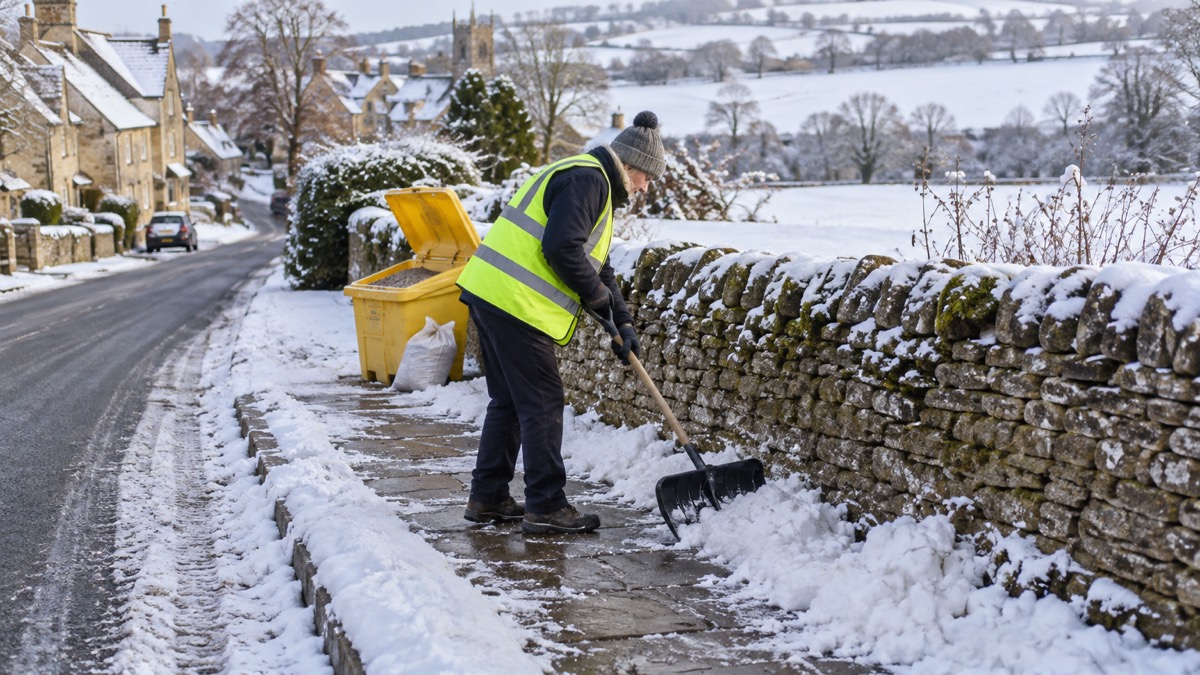
The core of the role is voluntary: clearing snow and spreading grit on public footpaths in your local area, on behalf of your local council or community organisation1. In Devon, the duties are broader than shovelling. A snow warden may be responsible for ordering grit and salt supplies, keeping a register of trained volunteers, receiving and responding to local weather alerts, organising volunteers to clear snow, organising volunteers to spread grit when icy weather is forecast, and encouraging responsible and appropriate use of salt2. Volunteers themselves may spread grit, clear snow, and refill grit bins and bags2.
Where the work happens is agreed locally rather than assigned from above. In Warwickshire, snow wardens consult with council area teams on local needs and jointly determine what local action needs to be taken, with priority given to busy footway areas, areas outside shops and schools, and steep areas agreed in advance4. That local agreement matters: it tells you which paths the council considers most important, and it means the council knows what you intend to do before you do it, which is what the insurance cover depends on.
The role sits alongside what councils do themselves. Warwickshire County Council works in partnership with parish and town councils and residents' associations to run its network of voluntary snow wardens4. In Derbyshire, some district, borough and town councils have signed up to help clear snow and ice from pavements and paths in some town centres, and volunteers from town and parish councils help keep pavements and footpaths clear6. Community emergency plans elsewhere show the same pattern: communities can clear snow from school and nursery access routes and playgrounds7, and in one Borders plan each householder or occupier is responsible for maintaining and clearing snow or ice from their own footpaths and driveways, with volunteers covering the shared spaces8.
If you are thinking about the wider role of a community group through winter, our pages on setting up a local emergency group and severe weather tasks for community groups cover the planning side.
How to sign up through your council
Every scheme runs through a local council or community body rather than direct individual enrolment. In Devon, you must be nominated by a town or parish council or similar community body2. Local councils and community organisations that want to join should contact the county council at communityselfhelp@devon.gov.uk2. In Warwickshire, would-be wardens are told to speak to their parish or town council, residents' association, housing association or district and borough council4. In Northumberland, the council asks you to return a completed registration form and fitness declaration, either by post to Freepost NCC LOCAL SERVICES or scanned and emailed to the council's highways and neighbourhood services address1.
The steps are broadly the same everywhere:
- Raise it with your parish, town or community council and get nominated2.
- Complete the registration form, and the fitness declaration where the council asks for one1.
- Complete the council's training. In Devon, you contact communityselfhelp@devon.gov.uk to register for access to the online training, and register or update your details via the online form2.
- Complete the risk assessment form before the council can issue your equipment1.
- Agree where salt will be stored and delivered2.
If your area has no scheme, check your council's website: for information about your council's winter service, the Met Office advises checking its website9. In Derbyshire, you can email snow@derbyshire.gov.uk for further information about either of its schemes6. In Scotland, the route is different and runs through the Winter Resilience Programme described later in this page.
The risk assessment and training come first
Northumberland County Council is explicit that you must complete the Risk Assessment Form before it can issue your equipment1. This is not a formality. The assessment sets out what you will do, where, and what hazards apply, and it is the document the council relies on when it provides equipment and insurance cover for authorised activities.
Training requirements vary. Devon provides online training for snow wardens2. Lincolnshire's Winter Service Plan, which covers its staff and volunteer arrangements, requires completion of a Weather Training Course or Winter Weather Scenario Training, with a refresher within a 5-year period10. The same principle of assessing risk before acting runs through volunteer schemes generally: the Derby and Derbyshire flood warden handbook recommends that wardens, parish and town councils and community groups undertake dynamic risk assessments prior to undertaking the role11. A dynamic risk assessment simply means looking at conditions on the day, ice, traffic, visibility, and deciding whether the task is safe before starting.
The snow warden kit: what the council issues
Northumberland's scheme issues a kit comprising a snow shovel, a bag of salt or grit, a thermal hat with a head torch, a pair of thermal gloves and a hi-vis vest1. That list tells you what the council considers the minimum for the job: a proper shovel rather than a garden spade, salt to treat the cleared surface, warmth for the head and hands, light for working in dark winter mornings or evenings, and high visibility near traffic.
| Kit item | What it does for you |
|---|---|
| Snow shovel | Moves snow without the blade of a garden spade sticking or straining your back |
| Bag of salt or grit | Treats the cleared path so it does not refreeze |
| Thermal hat with head torch | Keeps warmth in and lets you work safely in the dark |
| Thermal gloves | Protects hands from cold while allowing grip |
| Hi-vis vest | Makes you visible to drivers when working near the road12 |
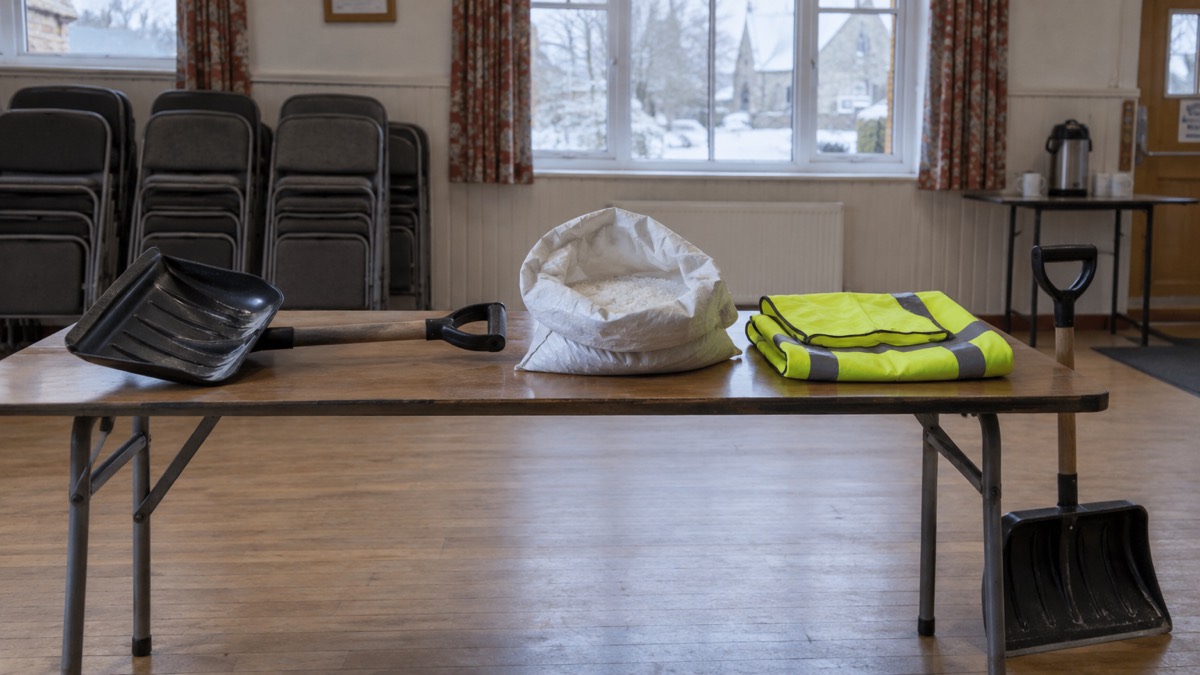
Other community plans show the same thinking about protective equipment. The Gavinton, Fogo and Polwarth Community Council Resilient Community Plan in the Scottish Borders specifies the correct PPE for clearing snow as boots, gloves, hard hat and a fluorescent jacket8. Lincolnshire's plan adds practical rules for working on footways: work from the footway at all times, working towards oncoming traffic wherever possible; place snow at the edges of footways next to the road to form a barrier between cars and pedestrians; put sand or ash down on cleared areas to give grip to walkers; use grit or salt from grit bins sparingly; wrap up warm; wear a reflective coat if available; wear snow and ice grippers when walking, especially when pushing snow; and beware of hypothermia and wind chill effects10.
Salt and grit: how much the council provides
The amounts differ by scheme, and it is worth knowing both figures before you plan storage.
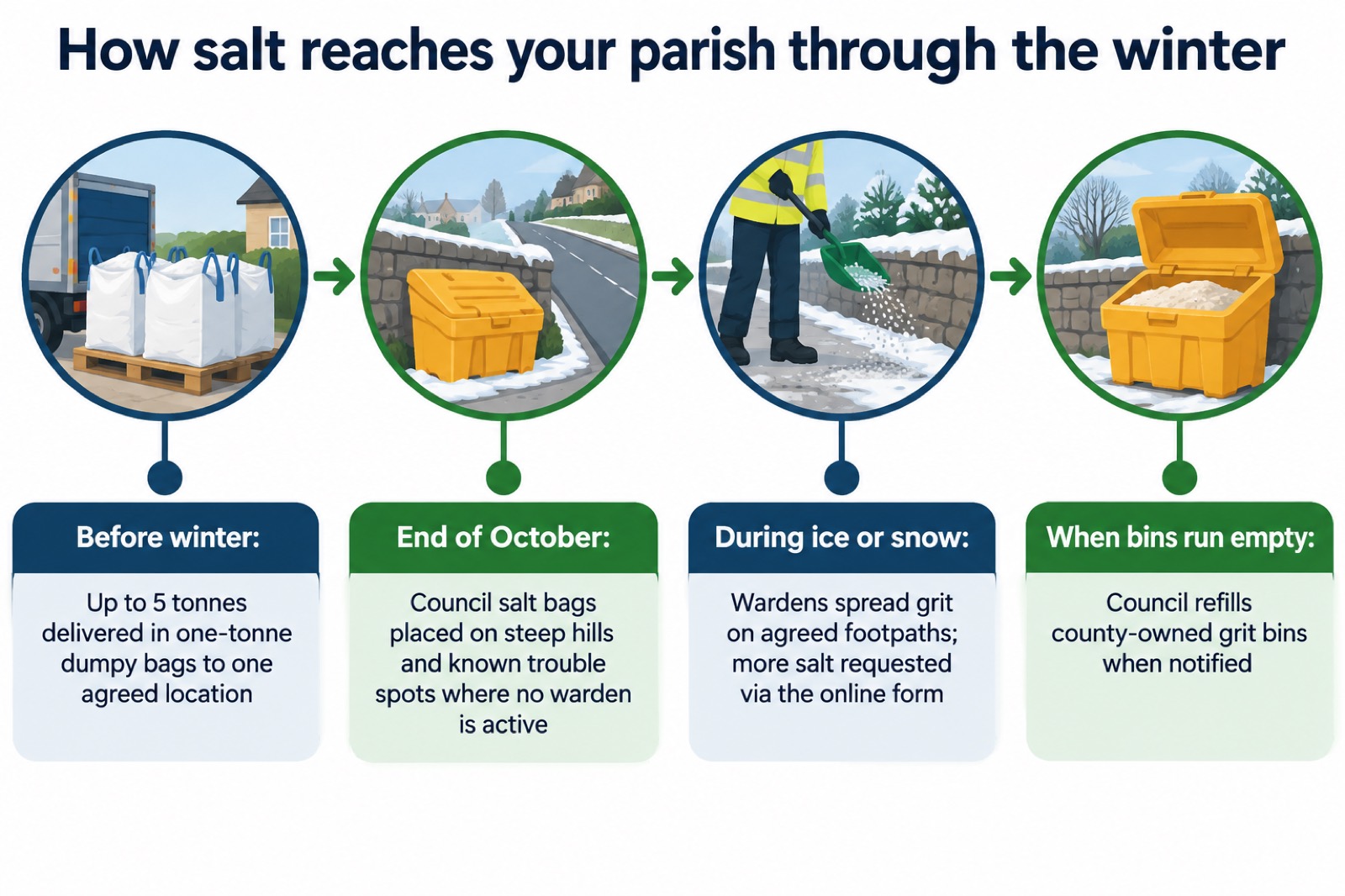
In Devon, local councils and community organisations on the Snow Warden Scheme can receive up to five tonnes of salt free of charge, usually delivered in one-tonne dumpy bags to one agreed location before winter, along with a small number of bagged salt supplies2. In Derbyshire, each participant receives between half a tonne and 1 tonne of grit, free of charge, delivered directly to a designated storage area in 10kg and 25kg bags6. Salt quantities for town councils in Devon are agreed separately and depend on the services they plan to deliver, for example clearing town centre pavements2.
| Scheme | Amount | Form | Delivery |
|---|---|---|---|
| Devon, parish or community group | Up to 5 tonnes | One-tonne dumpy bags, plus some bagged salt | One agreed location, before winter2 |
| Devon, town councils | Agreed separately | Depends on services planned | Agreed with the council2 |
| Derbyshire, per participant | 0.5 to 1 tonne | 10kg and 25kg bags | Direct to designated storage area6 |
| Highland Winter Resilience Programme | Salt in grit bins or heaps | Heaps up to 10 tonnes for central spots | Through the community council13 |
For context on how much salt councils themselves get through, National Highways holds around 280,000 tonnes of salt at the start of each winter14. Your tonne is a small, locally held reserve, which is the point: it is there when the gritters are committed elsewhere.
For your own path at home, the Met Office's guidance is that a tablespoon of ordinary table or dishwasher salt for each square metre cleared should melt snow or prevent black ice15. Council salt is for the agreed community areas, not for private drives.
Where to store your salt and how to order more
Because Devon delivers up to five tonnes to one agreed location before winter2, storage needs to be settled before the scheme starts, not after the first snowfall. A tonne of salt in a dumpy bag needs dry ground, access for the delivery lorry, and a position where the salt stays usable. Salt stored under cover keeps far better: Carmarthenshire keeps most of its approximately 12,200 tonnes of stock under cover in salt barns16, and the same logic applies at parish scale.
Ordering more during winter is straightforward in Devon: salt can be requested using the council's online salt ordering form, and there is a route for purchasing additional salt through contracted suppliers2. The council also refills county-owned grit bins when notified that they are empty, trains snow wardens and provides ongoing advice and guidance2.
One detail from Devon's Winter Service and Emergency Plan is worth knowing if your parish has an active snow warden: salt bags will not be placed by the county council in parishes where a snow warden is active, and the salt supplied to the parish should be used instead, with bags placed on steep hills or known trouble spots by the end of October17. In other words, once your parish has a warden and its own salt supply, the council expects that supply to be the local resource.
Insurance: what the council covers and what it does not
This is the part most volunteers ask about, and the answer is specific to each scheme, so check your own council's terms.
In Devon, the county council provides Public Liability Insurance for voluntary work completed under the approved Snow Warden Scheme, provided it is carried out safely and in accordance with guidance, covering third-party claims arising from authorised Snow Warden activities2. The limits are equally clear. The council does not provide any other insurance cover: volunteers are responsible for their own personal safety and property, damage to personal equipment or vehicles is not covered, and the Public Liability cover does not apply to work by contractors employed by a council or community organisation2. Anyone using their own vehicle, for example farmers, must ensure their insurer covers Snow Warden activities2.
"We do not provide any other insurance cover."
Two further points shape what that cover means in practice. First, snow wardens work on behalf of their local council or community organisation, not the county council2, so the nomination and the agreed areas of work are what tie the insurance to what you actually do. Second, the cover is for authorised activities carried out safely, which is why the risk assessment and training come first.
In Scotland, community plans show the equivalent arrangement: the insurance cover in place for both Scottish Borders Council and for the Gavinton, Fogo and Polwarth Community Council provides cover for volunteers and extends to the assigned volunteers identified in the plan8. For a wider look at the subject, see our page on whether emergency volunteers need insurance.
On the fear that stops many people helping at all, the official position is reassuring. There is no law to prevent the clearing of snow outside your house or on the pavement, and there have been no cases where anyone has been sued clearing snow from pavements, according to the Oxfordshire snow guide12. Occupiers do have a responsibility to ensure their own paths are safe to prevent visitor injuries12, which is a reason to clear, not a reason not to.
Clearing snow safely by yourself
Whether you are a registered warden or a resident clearing the pavement, the government Snow Code method is the same. Make sure you make a path down the middle of the area to be cleared first, so you have a clear surface to walk on, then shovel the snow from the centre of the path to the sides18. Pay particular care and attention to steps and steep gradients4.
The safe working rules below are worth following every time you go out to clear snow:
- Work from the footway at all times, working towards oncoming traffic wherever possible.
- Place snow at the edges of footways next to the road, as it forms a barrier between cars and pedestrians.
- Put sand or ash down on cleared areas to give grip to walkers.
- Use grit or salt from grit bins sparingly.
- Wrap up warm and wear a reflective coat if available.
- Wear snow and ice grippers when walking, especially when pushing snow.
- Beware of hypothermia and wind chill effects.
Beyond your own frontage, the official advice is to look outward. If your neighbour will have difficulty getting in and out of their home, offer to clear snow and ice around their property as well, especially if they are elderly or disabled and depend on social care services which need to reach them18. Scottish Borders Council encourages everyone to clear snow and ice from the public pavement near their properties during bad weather and to help neighbours who may not be able to clear it themselves5. Our guide to checking on vulnerable neighbours in an emergency covers the wider winter checks worth making.
The Winter Resilience Programme: the Scottish community council route
In Scotland, the equivalent route for communities is the Winter Resilience Programme. The Highland Council describes it as supporting communities who want to take local action to help clear snow and ice from footpaths during winter13. Community volunteers, working through their local community council, can access salt, provided in grit bins for urban areas or in heaps for rural areas, with larger heaps of up to 10 tonnes available for central locations like car parks or village squares13.
Registration follows the community council rather than an individual nomination. You download the application form and guidance notes, have it approved by your community council, and return the form to your local Roads Area Office13. This mirrors the English schemes in one important respect: the community body, not the individual, is the unit the council deals with, which is what ties the salt supply and the insurance to an agreed plan.
The rural salt heaps are a distinctive feature. Where an English parish receives dumpy bags at one agreed location2, the Highland model puts open heaps in rural areas and larger heaps of up to 10 tonnes at central spots such as village squares13, so that scattered communities can help themselves when the road network is impassable. If your community is starting from scratch, our page on parish and town councils in an emergency explains what these bodies can do.
Where schemes run and who to contact
Schemes are council-specific, so start with your own county, district or community council. The confirmed examples in this page give you a sense of the range:
| Area | Route in | Contact |
|---|---|---|
| Northumberland | Registration form and fitness declaration, then risk assessment | Freepost NCC LOCAL SERVICES, or highwaysandneighbourhoodservices@northumberland.gov.uk1 |
| Devon | Nominated by a parish, town or community body; online training | communityselfhelp@devon.gov.uk2 |
| Warwickshire | Via parish or town council, residents' association, housing association or district council | Your local council4 |
| Derbyshire | Either of its schemes | snow@derbyshire.gov.uk6 |
| Highland | Winter Resilience Programme via your community council | Local Roads Area Office13 |
Devon's scheme is well established: more than 325 parishes have snow wardens14. For information about your council's winter service generally, check its website9, and contact your local council for more advice on salt and salting bins9.
Sources (18)
- Snow Wardens, Northumberland County Council
- Snow Warden Scheme, Devon County Council
- What we are unable to do, Devon County Council
- Snow wardens, Warwickshire County Council
- Winter gritting FAQs, Scottish Borders Council
- Winter Service, Derbyshire County Council
- Why should your community prepare an emergency plan?, Argyll and Bute Council
- Gavinton, Fogo and Polwarth Resilient Community Plan, Scottish Borders Council, 2018
- Clearing paths and driveways, Met Office
- Winter Service Plan 2025/26, Lincolnshire County Council, April 2025
- Derby and Derbyshire Flood Warden Handbook, Derby and Derbyshire, November 2019
- Snow Guide, Oxfordshire County Council, January 2015
- Community Winter Resilience, The Highland Council
- Gritting frequently asked questions, Devon County Council
- Severe weather, West Yorkshire Prepared, West Yorkshire Prepared
- Gritting - Carmarthenshire County Council, Carmarthenshire County Council
- Winter Service and Emergency Plan, Devon County Council
- The Snow Code, Derbyshire County Council
 Good Neighbour Schemes
 Community First Responders
 Firewise Communities