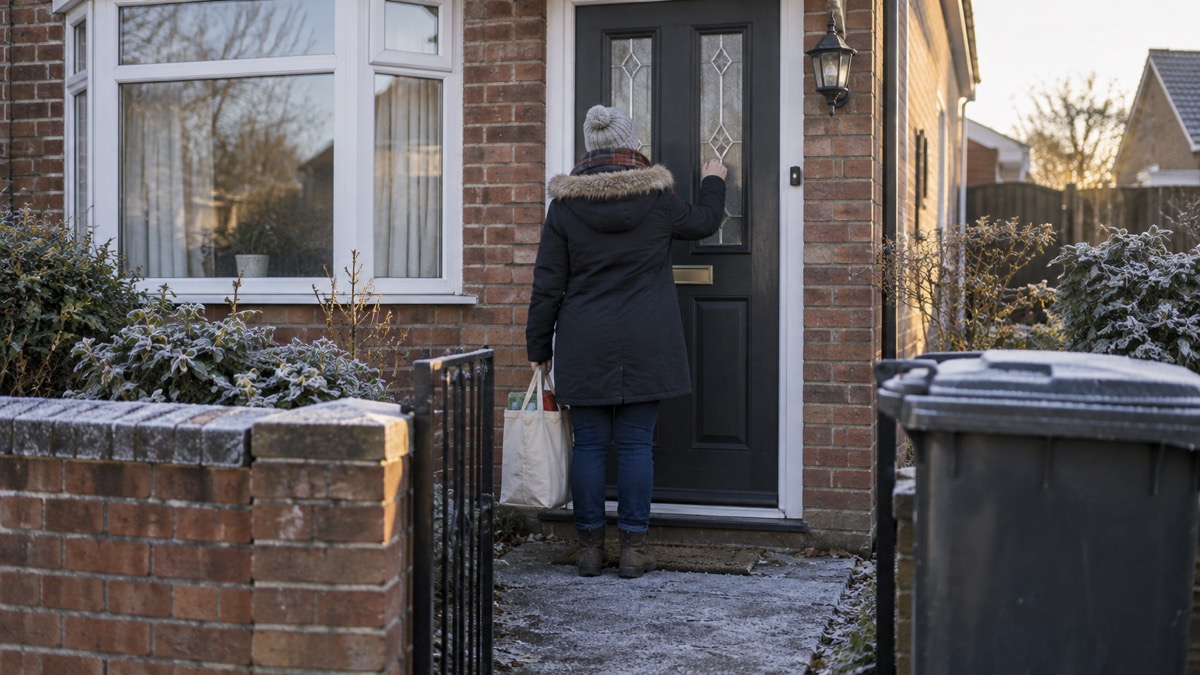
A good neighbour scheme is a small group of local volunteers who offer befriending or practical support to people in their own community, particularly those who are older, disabled or isolated1. The help is deliberately ordinary: a chat on the doorstep, a lift to a medical appointment, shopping picked up when someone cannot get out. What makes these schemes worth knowing about for emergency preparedness is that the same volunteers, with the same local knowledge and the same relationships, are usually the first people able to knock on doors when snow blocks the roads, flood water rises or the power goes off.
There is no single national body running good neighbour schemes. They are organised county by county, parish by parish, sometimes around a village hall noticeboard and sometimes through a council-supported network. Suffolk County Council, for example, describes its community support as offering "support with befriending or practical support from the local community"1. Derbyshire runs a winter version called snow buddies, where volunteers check on elderly and disabled neighbours to make sure they have enough heat and food2. The shape varies, but the idea is the same everywhere: neighbours agreeing, in advance and in an organised way, to look after each other.
This page explains what these schemes do day to day, how they work during an emergency, how to find or start one, and how your council can help a group go further with a community emergency plan, a hub, a defibrillator or a flood plan.
What a good neighbour scheme actually does
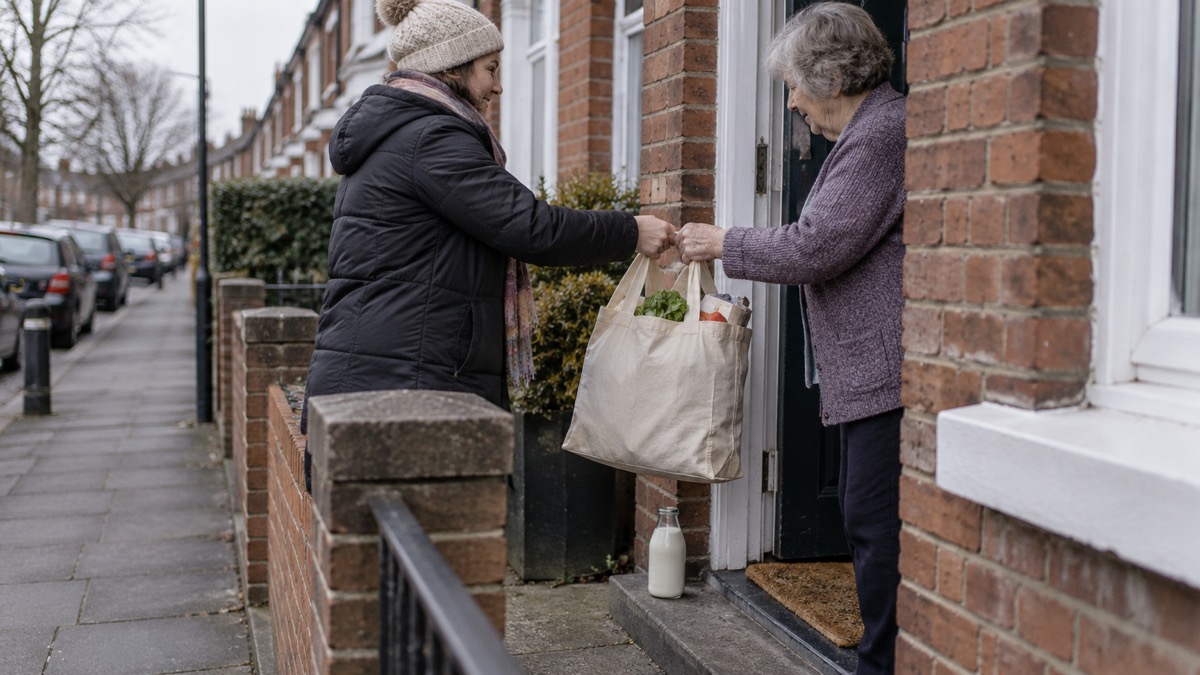
The core of any scheme is regular, low-key contact. The South Western Ambulance Service NHS Foundation Trust, which publishes guidance on supporting neighbours and vulnerable people, puts it simply: regularly check on your family, friends or neighbours11. Belfast City Council's winter warmth advice sets out what that checking involves for older neighbours: call in, check they are warm enough and their heating works, make sure they are drinking fluids and eating hot meals, suggest the flu jab, watch for signs something is wrong, check for fire hazards and a working smoke alarm, and offer to collect shopping3.
That list is a useful template for what a scheme's volunteers do week to week. Nottinghamshire's winter warmth advice adds that elderly friends and neighbours should have stocks of food and medicines so they do not need to go out during very cold weather, and that someone should make sure they are warm enough at night12. Cornwall Council points to the Warm Welcome scheme, in which local churches, faith groups, community centres and businesses open their doors so people can be warm and have some food rather than heating their own homes13.
| Type of everyday help | What it looks like | Who it suits |
|---|---|---|
| Befriending | Regular calls or visits, company, a chat at the door1 | People who live alone or are isolated |
| Practical support | Shopping, prescriptions, lifts, small jobs1 | People who cannot get out easily |
| Winter checking | Warmth, food, fluids, heating, smoke alarm checks3 | Older and disabled neighbours |
| Warm spaces | A warm room and food in a community building13 | Anyone struggling to heat their home |
Some schemes are seasonal. Derbyshire's snow buddies operate during winter months, checking that elderly and disabled neighbours and relatives are OK, with enough heat and food2. Others run all year and simply intensify when the weather turns. The National Risk Register, in its assessment of how the public helps in emergencies, describes the most important contribution as "performing essential acts of good neighbourliness", alongside looking out for calls for support from a local authority or from national and local charities14.
How neighbours help in an emergency
When an emergency hits, an organised group of neighbours can do things that no outside service can do quickly, because they already know who lives where and who needs what. The Scottish Government's Ready campaign advises that you can help neighbours by preparing their home before an emergency, picking up extra food, water, toiletries or medications, making sure they have important numbers written down, and keeping in contact by phone or visiting them if it is safe to do so15. London Fire Brigade's flood preparation advice says the same in one line: if you have vulnerable neighbours, make sure they know what they need to do in an emergency16.
The UK Government's Prepare campaign suggests asking neighbours directly whether they might have additional support needs during an emergency. They may have additional medical needs, be new to the area, not be able to use the internet or technology well, or not speak or read English well17. Asking before anything happens, rather than during it, is what turns goodwill into a workable scheme.
A practical structure many communities use is the emergency friend. The "Are You Ready" booklet advises identifying at least one emergency friend who lives nearby and a second one who lives further away, then arranging to swap house keys, provide places to stay, look after each other's children and keep copies of important documents safe for each other4. For a whole street or village, the same idea scales up into a neighbourhood phone tree or calling list, so that checking on everyone takes an hour rather than a day.
During the emergency itself, the National Risk Register says the public can help, if it is safe to do so, by checking on neighbours and vulnerable people in the community to see if they need help or assistance5. After a storm, Lancashire Prepared advises making sure any vulnerable neighbours or relatives are safe and helping them arrange repairs if required18.
Finding the neighbours who may need support
Every good scheme starts with the same task: working out who in your area would need help first in an emergency, and agreeing with them, in advance, what that help should be. Surrey County Council's severe weather advice is to look out for vulnerable neighbours, let them know if severe weather is approaching, and tell them you would be happy to help if needed19. That offer, made on a normal Tuesday, is what makes the knock on the door during a storm welcome rather than alarming.
The Prepare campaign sets out support needs to think about when planning for emergencies17:
- Additional medical needs
- New to the area
- Not able to use the internet or technology well
- Not able to speak or read English well
Consent and dignity matter here. People should be asked whether they want to be on a list, and told who will hold it and how it will be used. A named contact, a spare key arrangement, and a note of who their next of kin or GP is, will take a group much further than an unasked-for list of addresses. Our page on checking on vulnerable neighbours in an emergency goes into this in detail.
One more thing belongs in this stage: encouraging neighbours who are eligible to sign up to their local authority or local utilities provider's vulnerable customer schemes and priority services5. Those registers, such as water and power companies' Priority Services Registers, mean the official response reaches the right households too, not just the ones the neighbours know about.
How to join or start a scheme near you
If a scheme already exists near you, joining it is the quickest route. Greater Manchester's resilience team advises joining or supporting a local volunteering or community group before an emergency happens, which could be a local charity, a flood action group or a Neighbourhood Watch6. Neighbourhood Watch itself is a scheme for local residents who agree to keep an eye out for anything suspicious and tell one another or the police, and it helps reduce crime and opportunities for crime20. If your area has a good neighbour scheme, a snow buddy scheme, a snow warden scheme or a flood action group, your county, district or parish council will usually know.
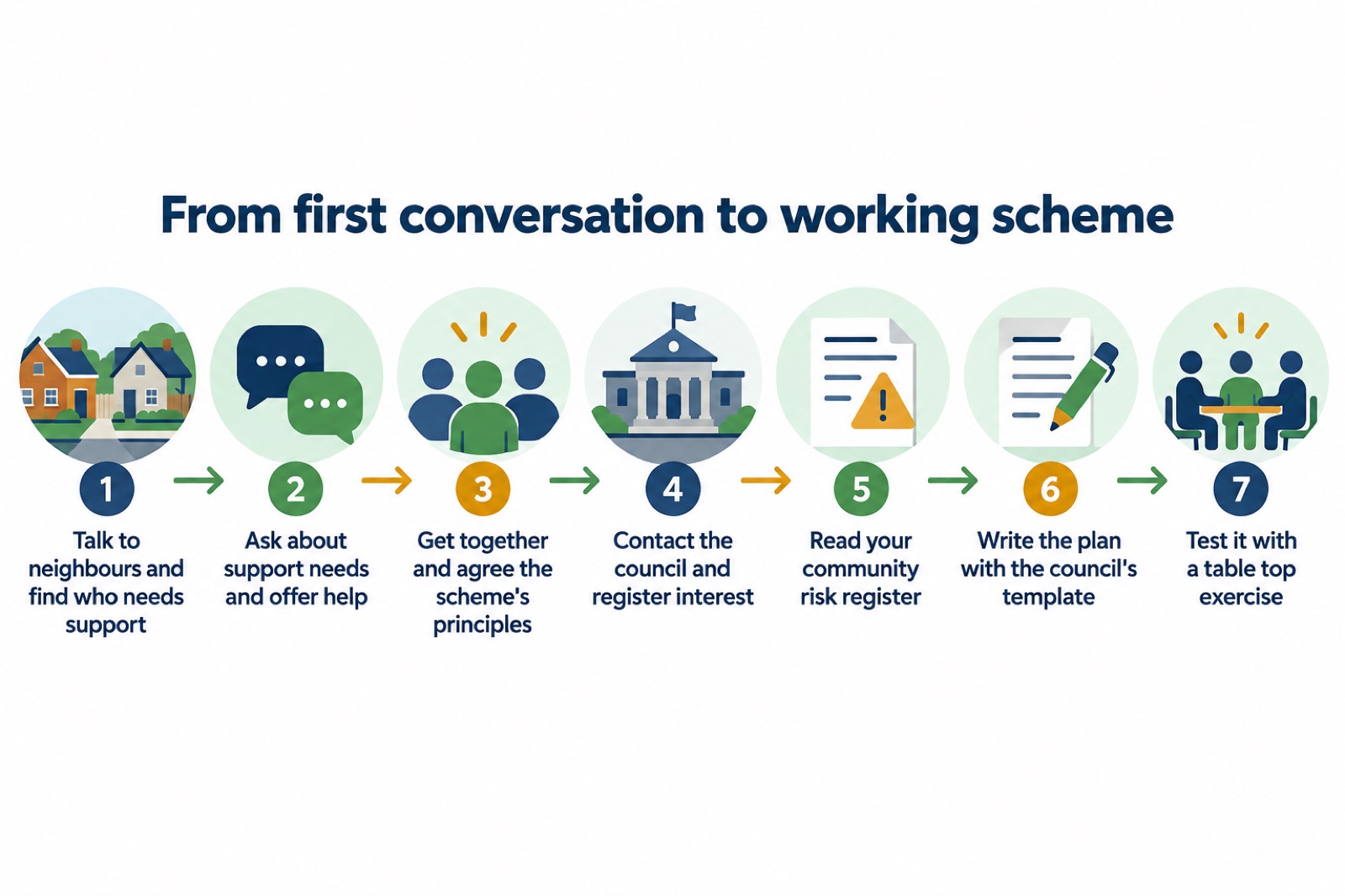
If nothing exists, you can start one. The steps are not complicated:
- Get together as a community and decide you want to be part of a scheme7
- Agree the key principles: what help you will offer, and what you will not7
- Decide on a building or meeting point if you want one7
- Contact your council to register interest and ask for support7
- Identify who is vulnerable in your area and who has useful skills21
- Write down who to contact and how the group will support the community6
Those first four steps come from Surrey County Council's guidance on setting up a Community Emergency Information Hub, but the same sequence works for any neighbour scheme7. West Yorkshire Prepared's community response planning pages add that a Community Response Plan is for community, faith or neighbourhood groups looking for ways they and their community can be better prepared for emergencies, and that having one could help keep everyone safe and informed during an emergency or major incident22. Dorset Prepared describes what the plan covers: what risks your community may face, what you can do to manage them, who has useful skills and training, what equipment is available, how to support vulnerable people safely, and how to look after and utilise volunteers21.
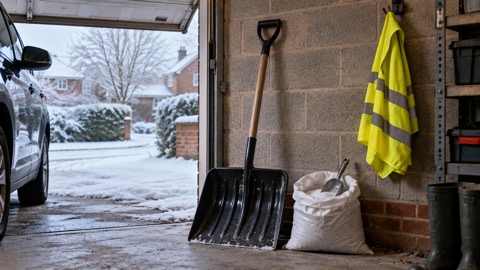
Some roles need specific training. Devon's Snow Warden Scheme provides advice, online training and salt to local councils and community organisations who support their area on a voluntary basis; you register by contacting communityselfhelp@devon.gov.uk for access to the online training, then complete or update your details via the online form23. Our pages on snow warden schemes, flood wardens and community first responders cover the trained roles in detail.
Your council can help you write a community emergency plan
You do not have to invent a community plan from nothing. Nottinghamshire County Council states that it is good practice for a community to identify local hazards and make plans on how to assist the emergency services and other responding agencies24. Herefordshire Council goes further and publishes a community flood plan template you can use to develop a plan for dealing with flooding emergencies in your community9. Greater Manchester's resilience team provides a community emergency plan template that gives an outline of the key information plans should include, because when an emergency happens it is best to have a plan in place so you know who to contact and how your group will support your community6.
The practical route in most areas is to contact your county or unitary council's emergency planning team, often called the Emergency Planning Officer, and ask what support they offer. Councils vary in what they provide, but common offers include plan templates, help identifying local hazards, links to the local resilience forum, and introductions to other groups nearby. Buckinghamshire Council, for example, supports community resilience groups that cooperate with the council and emergency services8.
A plan is only real if it is tested. Wiltshire and Swindon Prepared's case study of Emergency Contact Hubs notes that many communities have run table top exercises or physical exercises to test their own emergency or flood plan and their hubs, from a simple discussion to setting the hub up with a scenario such as flooding25. Our pages on how to test and review a community emergency plan and when to activate one cover this stage.
Choosing the area your scheme covers
Most schemes start small and grow by agreement rather than by design. A street, a hamlet or a parish is usually the right size, because the group needs to know the households personally for the checking and key-holding arrangements to work. The Nominated Neighbour Scheme, a related arrangement in which a trusted neighbour is nominated to check the credentials of callers at the door of an older person, is open to anyone who lives in Nottinghamshire, showing how these schemes are bounded by council area26. Your own council will tell you whether an equivalent scheme exists where you live.
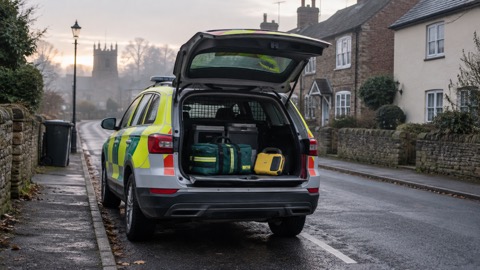
Some roles draw their area from the emergency rather than the neighbourhood. The GoodSAM Responder scheme, run by the Northern Ireland Ambulance Service in partnership with GoodSAM since July 2019, alerts nearby trained Responders to those in cardiac arrest, to provide assistance until the ambulance service arrives27. NHS England describes the wider programme as aiming to save lives by utilising technology to connect trained responders to nearby emergencies, harnessing the skills of community volunteers and professionals to offer immediate help before emergency services arrive28. If you have been trained in Basic Life Support and are willing to do CPR and use a defibrillator, you can register at www.goodsamapp.org after downloading the GoodSAM Responder App27. Our page on GoodSAM explains how the alerting works.
Community schemes have no legal duty to respond
This is the point most new volunteers get wrong, and it matters both for what you promise neighbours and for what you expect of yourself. Buckinghamshire Council states it plainly: there is no statutory responsibility for these groups to plan for, respond to, or recover from emergencies8. Herefordshire and Nottinghamshire councils both add that town and parish councils are not an emergency service and have no statutory responsibility to plan for, or respond to, emergencies9.
What follows from that is practical. A good neighbour scheme is a support network, not a substitute for the emergency services, and it should never present itself to residents as one. The National Risk Register's framing is the right one: the public helps by checking on neighbours if it is safe to do so5, and the official response does the rest. When a neighbour needs transport, medication, temporary accommodation or medical attention beyond what you can safely give, alert the local council4.
Insurance is the other thing to understand early. Devon's Snow Warden Scheme states that no other insurance cover is provided beyond what the scheme sets out: volunteers are responsible for their own personal safety and property, damage to personal equipment or vehicles is not covered, and Public Liability cover does not apply to work by contractors employed by a council or community organisation23. Before your group does anything beyond knocking and calling, read our page on whether emergency volunteers need insurance and our guide to what volunteers can safely do, and where to stop.
Community emergency hubs: where neighbours gather
A community emergency hub is the natural next step for a scheme that wants to be ready for a major incident. Surrey County Council aims to establish a network of hubs in community venues such as village halls, faith group meeting places, sports clubs or parish halls7. Dorset Prepared gives a broader list: a hub could be a religious building, a pub, a leisure centre or a library, and schools could also be used21. Buckinghamshire Council notes that Community Emergency Hubs are a national initiative, and that hubs cooperate with the council and emergency services, usually operating out of a chosen location8.
The set-up steps are the four listed earlier: get together as a community and decide you want to be part of the scheme, agree the key principles, decide on a building, then contact the council to register interest7. During a major flooding incident, community issues picked up at the hub are shared with the local authority or the Environment Agency via phone, email or when a representative visits the hub7. That two-way flow is the hub's real value: it turns scattered doorstep information into something the official response can act on.
Not every community uses a building. Wiltshire and Swindon's case study notes that others, particularly in urban areas, use a different approach: signposting, messaging and raising awareness through local events like fetes or markets29. Our page on setting up and running a community emergency hub covers venues, kit and registration in full.
Grants, defibrillators and flood plans
Money for your group
Community groups preparing for emergencies can draw on a wide range of funding sources. West Yorkshire Prepared's community resilience guide lists national government funding programmes, home schemes, utility companies, The National Lottery, national businesses, community fundraising pots and local authority Emergency Planning Officers as routes to explore30. Devon Communities Together has offered grants for community engagement and for equipment to communities preparing or implementing community emergency plans. Our page on funding for local resilience groups sets out where to apply.
Defibrillators
A public access defibrillator is one of the most common pieces of community equipment, and there are routes to a free one. The British Heart Foundation has offered free, BHF-funded public defibrillators to eligible community groups, with applications reopening in summer 2025. In the South Central Ambulance Service area, businesses can email the charity team at info@sca-charity.org.uk and local community groups can apply via an online form or by emailing scas.defib@nhs.net31. Before applying, check whether a defibrillator already exists near you at www.defibfinder.uk31.
Training usually comes with the equipment. The South Western Ambulance Service NHS Foundation Trust runs community CPR and defibrillator familiarisation sessions across the South West, delivered by a Community Training Volunteer, to give people the skills, confidence and knowledge to act fast in an emergency32. Resuscitation Council UK published version one of its guide, Public access defibrillators: A guide for communities, in October 2025. Once installed, a defibrillator should be registered so ambulance services can direct people to it; our page on registering and looking after a village defibrillator explains how.
Flood plans
If flooding is your area's main risk, a community flood plan is the document to write. Herefordshire Council hosts a template for developing a plan for dealing with flooding emergencies in your community9. The template carries one instruction that should sit at the top of every version: "Do not put yourself or others at risk."33
Some communities go beyond the plan into physical works. Nottinghamshire's Gotham natural flood management scheme is a £40,000 project, funded by the county council and Environment Agency Local Levy, aiming to reduce flood risk34. Nottinghamshire also runs a Community Flood Signage Scheme, led by the county council, which deploys flood signage34. Our pages on community flood plans, flood wardens and starting a flood action group cover the practical steps.
Your community risk register: what your area actually faces
Before writing any plan, find out what your area is planning for. Your local resilience forum publishes a community risk register. Gloucestershire's register is based on a combination of the UK Government's National Risk Register, professional judgement, historical evidence, scientific input and expert analysis10. It informs you about the highest risks in the county and their consequences, details steps to become better prepared and more resilient, and provides links to organisations and websites to find out more10.
Surrey's Community Risk Register, published in response to the Civil Contingencies Act 2004, identifies nine key local risks from the overall register35. West Yorkshire Prepared publishes its own register and points residents to it as a source to stay up to date on local risks30. Reading yours before your first meeting gives the group a shared, evidence-based view of whether flooding, snow, storms or something else should shape the plan.
Where to get help and more to read
Your first contacts are your county, district or parish council's emergency planning team, and any existing scheme in your area. Nottinghamshire's Nominated Neighbour Scheme is reached through Citizens Advice on 0808 223 113326. In Northern Ireland, the NI Energy Advice Service can be called on freephone 0800 111 44553. For emergencies themselves, call 999, or NHS 111 for urgent health advice4.
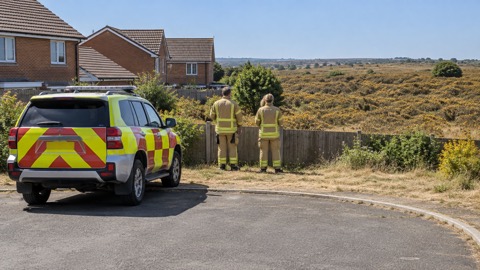
Beyond this page, the community section covers each step in more depth: setting up a local emergency group, volunteering in emergencies, how councils and emergency services work with local groups, and parish and town councils in an emergency. If wildfire is a risk where you live, Dorset and Wiltshire Fire and Rescue Service's Firewise programme encourages communities to work together to reduce the risk to homes from wildfire by taking practical steps in the area around the home and garden36, and our Firewise Communities page explains it.
The National Risk Register's summary of how the public helps is worth keeping in mind as your scheme takes shape: get involved via the structures established in your local area, look out for calls for support from a local authority or from national and local charities, and, most importantly, perform essential acts of good neighbourliness14. That is what a good neighbour scheme is, organised.
Sources (36)
- COVID-19 community support, Suffolk County Council
- Snow buddies, Derbyshire County Council
- Stay warm at winter, Belfast City Council
- Are You Ready booklet, Culham Parish Council, 2025-09
- National Risk Register 2020, HM Government, 2020
- Prepare your community, Greater Manchester Combined Authority
- Set up a Community Emergency Information Hub, Surrey County Council, 2026-06-01
- Community resilience, Buckinghamshire Council, 2026
- Community resilience in Herefordshire, Herefordshire Council, 2026-10-29
- Community Risk Register, Gloucestershire County Council, 2026-05-19
- Neighbour and vulnerable people support, South Western Ambulance Service NHS Foundation Trust
- Top tips for keeping warm, Nottinghamshire County Council, 2023
- Winter support, Cornwall Council, 2025-01-14
- National Risk Register 2023, HM Government, 2023
- Emergency plan, Ready Scotland, 2026-03-24
- Preparing for a flood, London Fire Brigade
- Get prepared for emergencies, UK Government Prepare campaign, 2026-10-21
- Storms and gales, Lancashire Prepared
- Risks and severe weather, Surrey County Council, 2026-10-28
- Protect Yourself booklet, Police Service of Northern Ireland, 2024
- Community involvement, Dorset Prepared, 2026-03-25
- Community response planning, West Yorkshire Prepared
- Snow Warden Scheme, Devon County Council, 2026-03-13
- Community resilience, Nottinghamshire County Council, 2026-10-29
- Spotlight on Emergency Contact Hubs (ECHs), Wiltshire and Swindon Prepared, 2026-10-25
- Safety advice for older people, easy read, Nottinghamshire County Council, 2025-10-02
- GoodSAM Responders, Northern Ireland Ambulance Service, 2026-10-29
- Improving outcomes in cardiac arrest, NHS England, 2026-10-29
- Spotlight on Emergency Contact Hubs, Wiltshire and Swindon Prepared, 2026-10-25
- Community resilience guide, West Yorkshire Prepared, 2026-05
- Public Access Defibrillators, South Central Ambulance Service, 2026-10-29
- CPR and defibrillator training, South Western Ambulance Service NHS Foundation Trust, 2026-10-29
- Community flood plan, GOV.UK, 2023-11-15
- Schemes to help reduce flooding, Nottinghamshire County Council, 2026-10-29
- Surrey Community Risk Register 2026, Surrey Local Resilience Forum, 2026
- Firewise Communities, Dorset and Wiltshire Fire and Rescue Service, 2024-02-15
 Snow Warden Schemes
 Community First Responders
 Firewise Communities