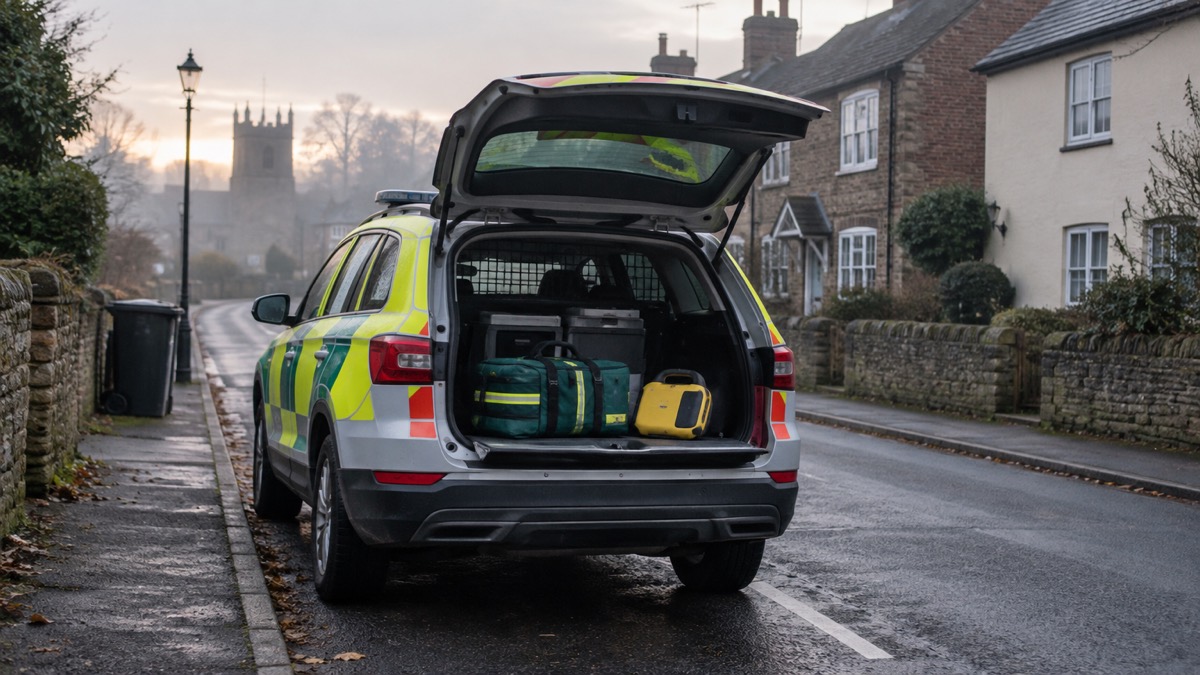
If you call 999 for an ambulance in the UK, the person who reaches you first may not arrive in an ambulance at all. It may be a neighbour in their own car, carrying a defibrillator and an oxygen kit, sent by the ambulance service because they can get to you faster. These volunteers are community first responders, and they are trained in the first three links of the Chain of Survival: early recognition of cardiac arrest, early CPR and early defibrillation1.
Their whole purpose is the first few minutes. The East of England Ambulance Service puts it plainly: "If we are able to send a community first responder, they may arrive before ambulances do"2. North East Ambulance Service says the same: a responder "can get to the scene before the ambulance to provide immediate care"3. In rural areas especially, where ambulance crews have longer to travel, a trained local volunteer is often the fastest way to get life-saving help to a patient4. In Wales, volunteer responders travel in their own vehicles to give "essential lifesaving treatment and support in those crucial minutes before the ambulance crew arrives"6.
This page explains what community first responders actually do at an emergency, which calls they are sent to and which they are not, how a 999 call brings one to your door, and how to become one yourself. It also covers GoodSAM, the phone app that alerts trained volunteers to cardiac arrests nearby, and how to find your nearest public access defibrillator.
What a community first responder does at an emergency
A community first responder is a member of the public, trained by the ambulance service to provide life-saving treatment to people in their local community while waiting for an ambulance or a rapid response vehicle5. They are not paramedics and they do not replace the ambulance crew. Their role, as the Scottish Ambulance Service describes it, is "to help stabilise the patient and provide the appropriate care until the more highly skilled ambulance crew arrives on scene to take over the treatment"4.
In practice, that means a defined set of skills. The Northern Ireland Ambulance Service trains its responders to provide basic life support, use an automated external defibrillator (AED), place unconscious casualties into the recovery position, provide life-saving interventions to a choking casualty, and update the emergency operations centre as required1. Everything they do is aimed at keeping the person alive and their condition stable until the crew arrives.
Responders are usually based in rural communities, where ambulance crews have longer to travel to the patient4. If you live in a rural area, the Northern Ireland Ambulance Service notes, the first person to arrive on scene may be a community first responder5. But the principle applies anywhere a trained volunteer happens to be closer than the nearest crew: several ambulance services describe sending a responder who is nearby alongside, or ahead of, the dispatched ambulance3.
One thing worth knowing as a householder: you do not need to be a trained responder to make the same difference. London Ambulance Service advises that early CPR and defibrillation "can more than double someone's chances of survival", and both can be performed by a member of the public before the ambulance service arrives11. If you want those skills for your own household, see our first aid guide.
The calls they attend, and the ones they are not sent to
Ambulance services only alert community first responders to a specific list of call types. These are the emergencies where minutes matter most and where a trained layperson can genuinely change the outcome.
Calls responders are alerted to1:
- Cardiac arrest
- Chest pain
- Choking
- Unconscious casualties
- Seizures
These overlap closely with the classic reasons to call 999 in the first place. London Ambulance Service lists chest pain, difficulty in breathing, unconsciousness, severe loss of blood, severe burns or scalds, choking, fitting or concussion, drowning and severe allergic reactions as examples of 999 calls10, and South Western Ambulance Service groups chest pain, breathing difficulties, heart attack and cardiac arrest together as ambulance emergencies13. The Scottish Ambulance Service confirms cardiac arrest as a call type a responder may attend12.
Cardiac arrest is the call every scheme is built around. It means someone has stopped breathing, lost consciousness or does not respond to stimulation14. The advised response from the ambulance services is consistent: call 999 immediately, start chest compressions if it is safe to do so, and send someone to fetch a defibrillator if one is nearby15. Call handlers can guide you through CPR and direct you to the closest public access defibrillator16. Before approaching the person, check for danger17.
Calls responders are not knowingly alerted to1:
- Patients under 12 years old
- Trauma incidents
- Situations involving possible hazards, including alcohol, drugs or potential violence
- Mental health crises
The exclusion of children under 12 and trauma calls reflects the limits of a responder's training and kit: those patients need skills and equipment beyond basic life support. The hazard exclusions are about volunteer safety. The same principle applies to you as a bystander: if you are not already at the scene of an emergency, do not attempt to get closer, as this can put you in danger and get in the way of the emergency services19.
How a 999 call brings a responder to you
The pathway from your phone call to a knock at the door is short. The first person you speak to when you call 999 is the BT operator, who will ask "Emergency, which service?"2. Once you are connected to the ambulance service's emergency operations centre, the call is assessed and an ambulance is dispatched if one is needed9.
Alongside that dispatch, the system looks for a responder. Yorkshire Ambulance Service describes sending a volunteer community first responder "to get to the scene before the ambulance to provide immediate care" when an ambulance is required9. North East Ambulance Service does the same3. In some cases, an alternative first response from within the community may urgently attend the patient to deliver first aid at the scene2. North West Ambulance Service adds that you may receive help from a community first responder if they are nearby10.
The responder is not choosing to come. They are alerted by the ambulance service, they update the emergency operations centre on what they find1, and the ambulance crew takes over treatment when it arrives4. From your point of view as the caller, nothing changes in what you should do: call 999, follow the call handler's instructions, start CPR if you are told to, and expect that the first help on scene may arrive in an ordinary car.
Why minutes matter: survival falls about 10% per minute
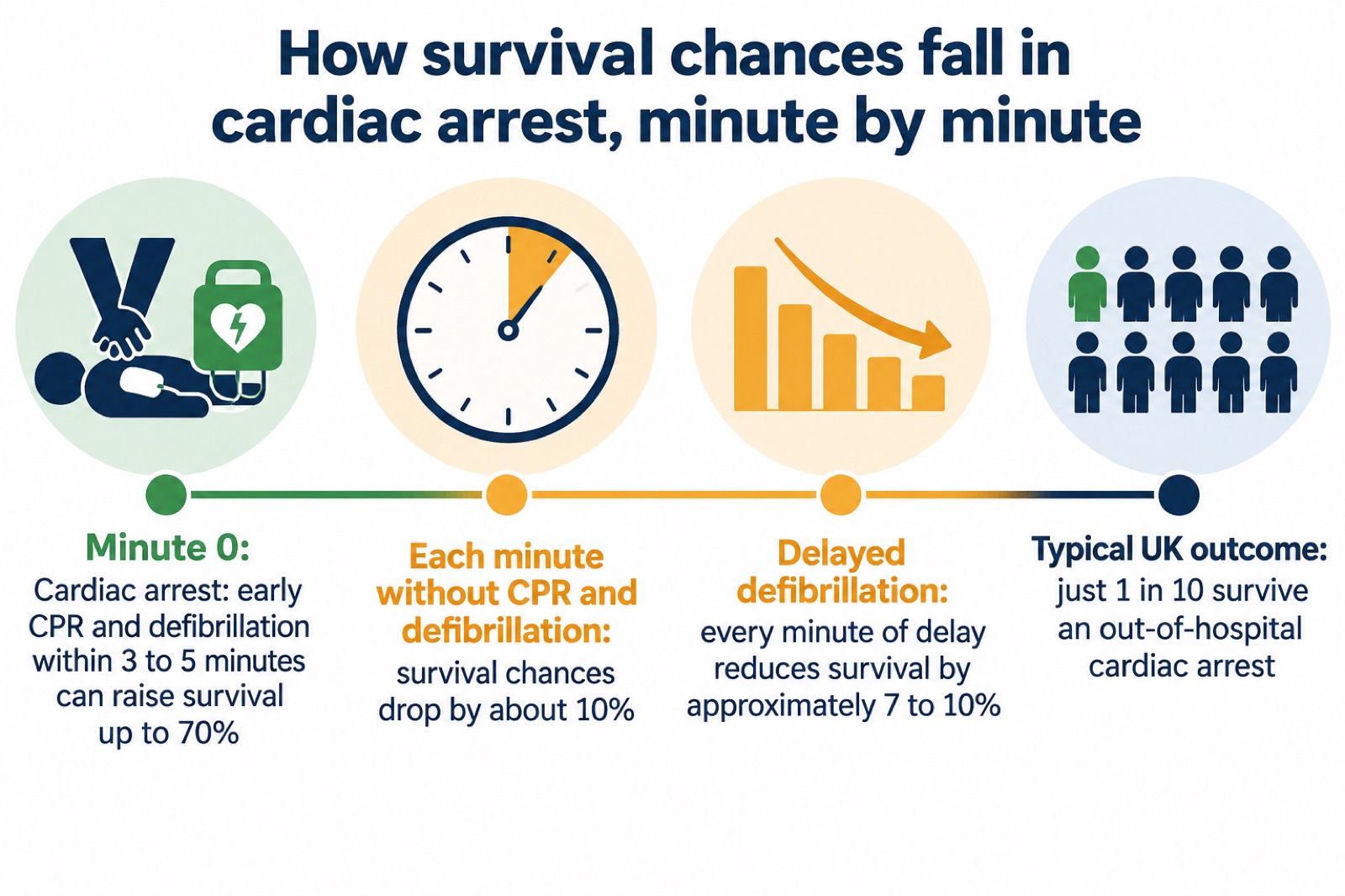
The reason ambulance services invest in volunteers is a single stark figure. Survival chances in cardiac arrest drop by about 10% for every minute without CPR and defibrillation1. East of England Ambulance Service states it as: "For every minute that someone's in cardiac arrest without receiving CPR and having a defibrillator used on them, their chances of survival fall"18, and the Northern Ireland Ambulance Service gives the same warning to callers7. The Resuscitation Council UK, cited by the Northern Ireland Ambulance Service, puts the effect of each minute's delay in defibrillation at approximately 7 to 10%20.
The consequences are plain. In the UK, survival rates remain critically low, with just 1 in 10 surviving an out-of-hospital cardiac arrest20, and North West Ambulance Service reports that less than 1 in 10 people survive a cardiac arrest21. Unless immediately treated with CPR and defibrillation, the person will die within minutes21. One of the main reasons survival is so low is the lack of action from bystanders before ambulance crews arrive21.
The flip side is why responders exist. When early CPR and a defibrillator are used within the first 3 to 5 minutes, survival rates can increase up to 70%22. That window is often shorter than the time it takes an ambulance to reach a rural address, which is exactly the gap a local responder fills4.
The kit a responder carries
Community first responders carry a standard issue of kit. Yorkshire Ambulance Service describes it as kit bags comprising an automated external defibrillator (AED), oxygen, oropharyngeal airways and a standard set of first aid equipment23. The defibrillator is the centrepiece: it is what allows a responder, or indeed an untrained member of the public, to deliver the shock that restarts a heart, and modern AEDs talk the user through each step.
The same thinking has spread to public spaces beyond responder schemes. Public Access Trauma (PAcT) first aid kits are designed "for use by any person, regardless of their level of training, to support the treatment of life threatening injuries"24. ProtectUK advises that these kits significantly enhance an organisation's existing first aid preparedness, increase first aid resilience amongst the general public and improve the survivability of a person with life threatening injuries24. A PAcT kit includes personal protective equipment: four pairs of disposable gloves, disposable glasses and a disposable face mask24.
| Kit | Carried or placed by | What it is for | Who can use it |
|---|---|---|---|
| AED, oxygen, oropharyngeal airways, standard first aid equipment | Community first responders23 | Basic life support and defibrillation while waiting for the crew | Trained responders1 |
| Public access defibrillator | Communities and businesses, in cabinets8 | Shock to restart the heart in cardiac arrest | Any member of the public; call handlers will explain how18 |
| PAcT first aid kit | Organisations in public places24 | Treatment of life threatening injuries | Any person, regardless of training level24 |
If your community is thinking about where a defibrillator should go, the South Central Ambulance Service recommends sites with a large footfall, such as a public telephone box, outside a pub, village hall or community centre, with 24/7 access to the public, an unlocked cabinet, and clear signage and lighting8. Public access defibrillators should be kept in unlocked cabinets so people can get to them quickly in an emergency26. Our page on locked or unlocked defibrillator cabinets compares the options, and registering and looking after a village defibrillator explains the upkeep.
Who can become a community first responder
The bar to entry is deliberately achievable. The Scottish Ambulance Service defines its responders as "volunteers who are trained by us to attend certain types of emergency calls in the area where they live or work"4. Yorkshire Ambulance Service describes them as volunteers with basic life support skills23. In other words, you do not need a medical background: the ambulance service provides the training, and you provide the availability in your own neighbourhood.
For the GoodSAM Responder scheme, which works alongside traditional schemes, the stated eligibility is being aged over 18 and trained as a minimum in basic first aid, with the ability to hold an airway open and perform CPR27.
Schemes themselves are usually set up as independent community groups or charities1. Each scheme has a Co-ordinator who acts as a point of contact for the volunteers and serves as the point of contact with the ambulance service7. So joining usually means two things: applying to your regional ambulance service, and linking up with your local scheme through its Co-ordinator.
The scale varies by nation. In Northern Ireland, as of September 2025, over 450 dedicated community first responders across 25 schemes were on call1. The Northern Ireland Ambulance Service arrived at the scene of an incident on 173,695 occasions in 2024/20255, which gives a sense of the call volume a small volunteer force sits alongside.
Volunteering as a responder is one of several ways to help your community prepare. Greater Manchester's resilience guidance suggests learning first aid because it can take some time for emergency services to arrive at an incident, and by learning first aid you can save lives and look after those who are injured28. If you are weighing up which role suits you, see our guides on volunteering in emergencies and what volunteers can safely do.
Training: a two-day course and a refresher every 12 months
Initial training for community first responders in Northern Ireland is a two-day course held over a weekend at the Clinical Education Training Centre in Knockbracken Healthcare Park, covering essential skills7. Other services run comparable induction training before a responder goes on call. The content maps to the first three links of the Chain of Survival: early recognition of cardiac arrest, early CPR and early defibrillation1.
After the course, support continues:
- Mentorship: new responders are recommended to work alongside an experienced responder to build confidence1
- Ongoing updates: refresher training every 12 months, held at your local scheme, plus non-clinical courses such as moving and handling1
If you are not ready to commit to a full responder scheme but want the core skills, shorter sessions exist across the country. South Western Ambulance Service runs community CPR and defibrillator familiarisation sessions, usually lasting 60 to 90 minutes, covering how to recognise a cardiac arrest, how to perform effective CPR, how to safely use a public access defibrillator, and what happens when you call 99922. South Central Ambulance Service offers a basic life support awareness session lasting 90 to 120 minutes8. The Met Office's community resilience training prospectus also offers courses for community and voluntary groups that work closely with local emergency responders; access is arranged by contacting your local responder contact29.
GoodSAM: the app that alerts trained volunteers to cardiac arrests
GoodSAM, short for "Good Samaritan", is a community of first aid trained responders, willing to assist during a cardiac arrest27. The app dispatches trained volunteers with basic life support skills to life-threatening emergencies, like a cardiac arrest, via their smartphone11. It has been endorsed by the Resuscitation Council UK27.
The mechanism is automatic. When a 999 call is assessed as life-threatening, the ambulance service sends the location to the GoodSAM app and the nearest available registered responder is alerted; if they cannot respond, the alert passes to the next nearest responder11. The system uses GPS to match life-threatening emergencies with the closest trained responders11. Responders are also directed to the nearest defibrillator11. The platform is integrated with most UK ambulance services, alerting nearest responders to out-of-hospital cardiac arrest or a patient choking with ineffective breathing27.
In Northern Ireland, the scheme has run since July 2019, and the aim is to increase survival by alerting nearby trained responders to those in cardiac arrest, to provide assistance until the ambulance service arrives30. Responders may be alerted when in the immediate vicinity of a cardiac arrest, so that they can start CPR in the critical minutes before the emergency services arrive, and use a defibrillator if one is available30. Nationally, NHS England describes the programme as aiming to save lives by utilising technology to connect trained responders to nearby emergencies, harnessing the skills of community volunteers and professionals to offer immediate help before emergency services arrive26.
How to register as a GoodSAM Responder:
- Train in basic life support: CPR and defibrillator use. In Northern Ireland, you register at www.goodsamapp.org after downloading the GoodSAM Responder App30.
- Verify your ID and qualifications. All responders have ID and certification verification of qualifications; when qualifications expire, you must renew your certification or you are no longer alerted27.
- Respond when alerted. If you accept an alert, fill in the details of the incident in the inbuilt Mission Log report, which you have access to after your account has been activated27.
Two protections are worth knowing. In Northern Ireland, the Department of Health is prepared to underwrite the costs associated with any legal claim for damages made against the ambulance service, including injury to the responder themselves, with cover starting from the time a volunteer indicates on the app that they have accepted the call27. And the Medical Protection Society considers that members acting as responders fall within its definition of a Good Samaritan act, provided the member complies with the GoodSAM Code of Conduct27. Our page on whether emergency volunteers need insurance covers this in more detail.
The alert radius is deliberately tight: the application will only alert you if you are within 500 metres of a casualty, and you are expected to walk to the patient27. For a fuller explanation of the app, see GoodSAM: how the responder alert app works.
GoodSAM from the caller's side: live video and translation
GoodSAM is not only for responders. If you call 999, the control officer may ask your permission to send a text message containing a secure link. If you agree, opening the link starts a live video stream direct from your phone to the control room31. The video footage allows control officers to send the most suitable resources and offer advice based on a more detailed understanding of the incident31. London Fire Brigade, which uses the same platform, notes that it can receive a live video stream of an incident from a 999 caller and share that footage with fire crews32.
The service is free and limited in what it takes: "It won't cost you anything, and no other data is taken from your phone, or stored on it"31. The video is stored securely for 30 days before being deleted31.
GoodSAM also works as a translation service for 104 different languages32. Control room officers send a text in English, which is translated and delivered in the caller's chosen language; the caller replies in that language and the message comes back to the officer in English32. The platform also offers precise location tools, including eastings and northings, What3Words and longitude and latitude, which is especially helpful for incidents like wildfires where crews need to be sent to a precise location distant from any identifiable landmarks32.
Finding a defibrillator near you
The quickest answer is www.defibfinder.uk, which shows whether there is a defibrillator near you8. If you are on a 999 call, you do not need to search alone: emergency call handlers will help direct callers to the nearest available device and explain how to use it18. In Northern Ireland's model, a second person at the scene retrieves the defibrillator, which will be within a one-mile radius, allowing the first caller to continue CPR20.
Ambulance stations, fire stations and local supermarkets are just some of the community buildings that have AEDs located for public access use20. When siting one, choose a location with 24/7 access to the public25.
Businesses and community groups wanting to place a defibrillator can contact the South Central Ambulance Service charity team at info@sca-charity.org.uk, or use the online form or scas.defib@nhs.net for local community groups8.
Where responder schemes fit in local emergency planning
Community first responder schemes sit within a wider structure of local emergency planning. Local Resilience Forums are multi-agency partnerships that bring together Category 1 and Category 2 responders under the Civil Contingencies Act 2004 to coordinate planning, preparation and response for emergencies and major incidents within a specific geographical area33. Category 1 responders include the police, fire and rescue services, ambulance services, NHS bodies, local authorities and the Environment Agency33.
Volunteer responders are part of that picture but separate from it: they are trained and tasked by the ambulance service, not by the forum. If you want to go further than responding, Greater Manchester's guidance suggests becoming a volunteer with the fire and rescue service to help keep communities safe by delivering informative, educational and practical support28. Our guides on setting up a local emergency group and how councils and emergency services work with local groups explain the rest of the landscape.
Sources (33)
- First Responders, Northern Ireland Ambulance Service, 2026
- Using 999, East of England Ambulance Service, 2026
- Calling 999, North East Ambulance Service, 2026
- Community First Responders, Scottish Ambulance Service, 2026
- Emergency Response, Northern Ireland Ambulance Service, 2024
- How we respond to 999, Welsh Ambulance Service, 2026
- First responders: who will treat you, Northern Ireland Ambulance Service, 2026
- AED and community defibrillators, South Central Ambulance Service, 2026
- What happens when you call 999, Yorkshire Ambulance Service, 2026
- Calling 999, London Ambulance Service, 2026
- GoodSAM app, London Ambulance Service, 2026
- What types of emergencies does a Community First Responder attend?, Scottish Ambulance Service, 2026
- Get the right help and support, South Western Ambulance Service, 2026
- What to do in a heart emergency, NHS inform Scotland, 2026
- Emergency heart care, London Ambulance Service, 2026
- Some of the reasons people call, Welsh Ambulance Service, 2026
- Cardiac arrest, Scottish Ambulance Service, 2026
- Cardiac arrest, East of England Ambulance Service, 2026
- Be informed about hazards, Prepare Campaign, 2026
- Public access defibrillators, Northern Ireland Ambulance Service, 2026
- Learn to save a life, North West Ambulance Service, 2024
- CPR and defibrillator training, South Western Ambulance Service, 2026
- Ambulance service responses, Yorkshire Ambulance Service, 2026
- Standards for public access trauma (PAcT) first aid kits and equipment, ProtectUK, 2026
- Public access defibrillators, South Central Ambulance Service, 2026
- Improving outcomes in cardiac arrest: tools and resources, NHS England, 2026
- GoodSAM public FAQ, Northern Ireland Ambulance Service, 2023
- Prepare your community, Greater Manchester Combined Authority, 2026
- Community resilience training prospectus, Met Office, 2026
- GoodSAM responders, Northern Ireland Ambulance Service, 2026
- Calling 999, London Fire Brigade, 2026
- Live video streaming of fires, London Fire Brigade, 2026
- What is a Local Resilience Forum?, Essex Prepared, 2026
 Snow Warden Schemes
 Good Neighbour Schemes
 Firewise Communities