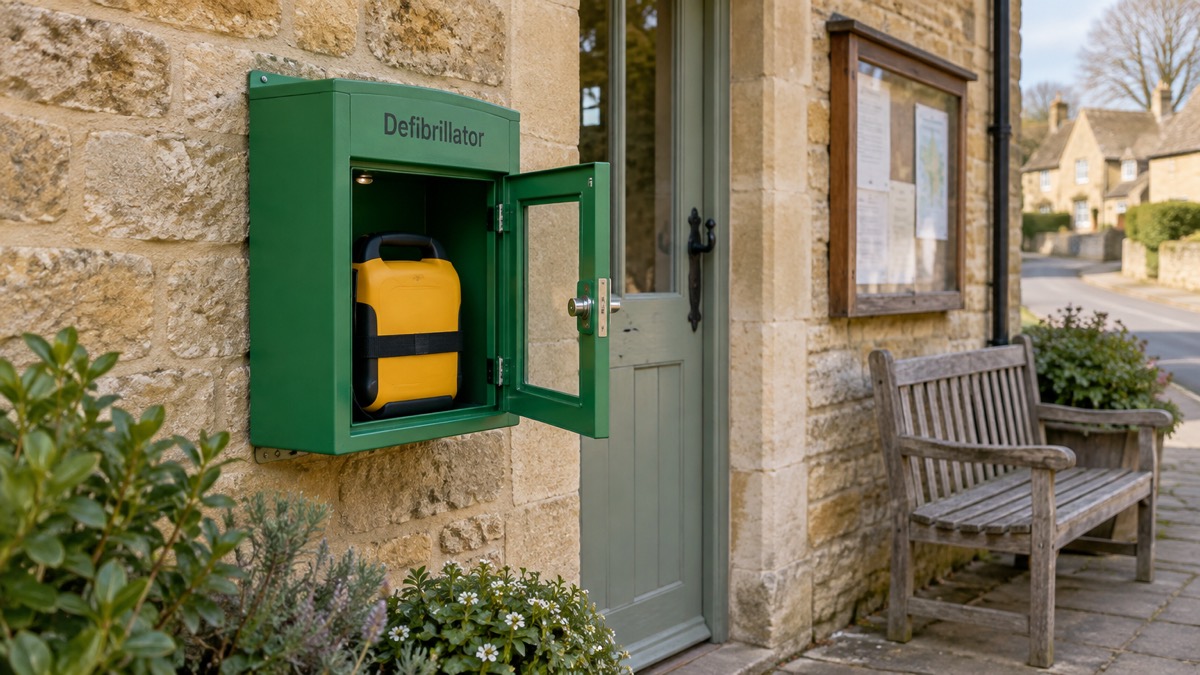
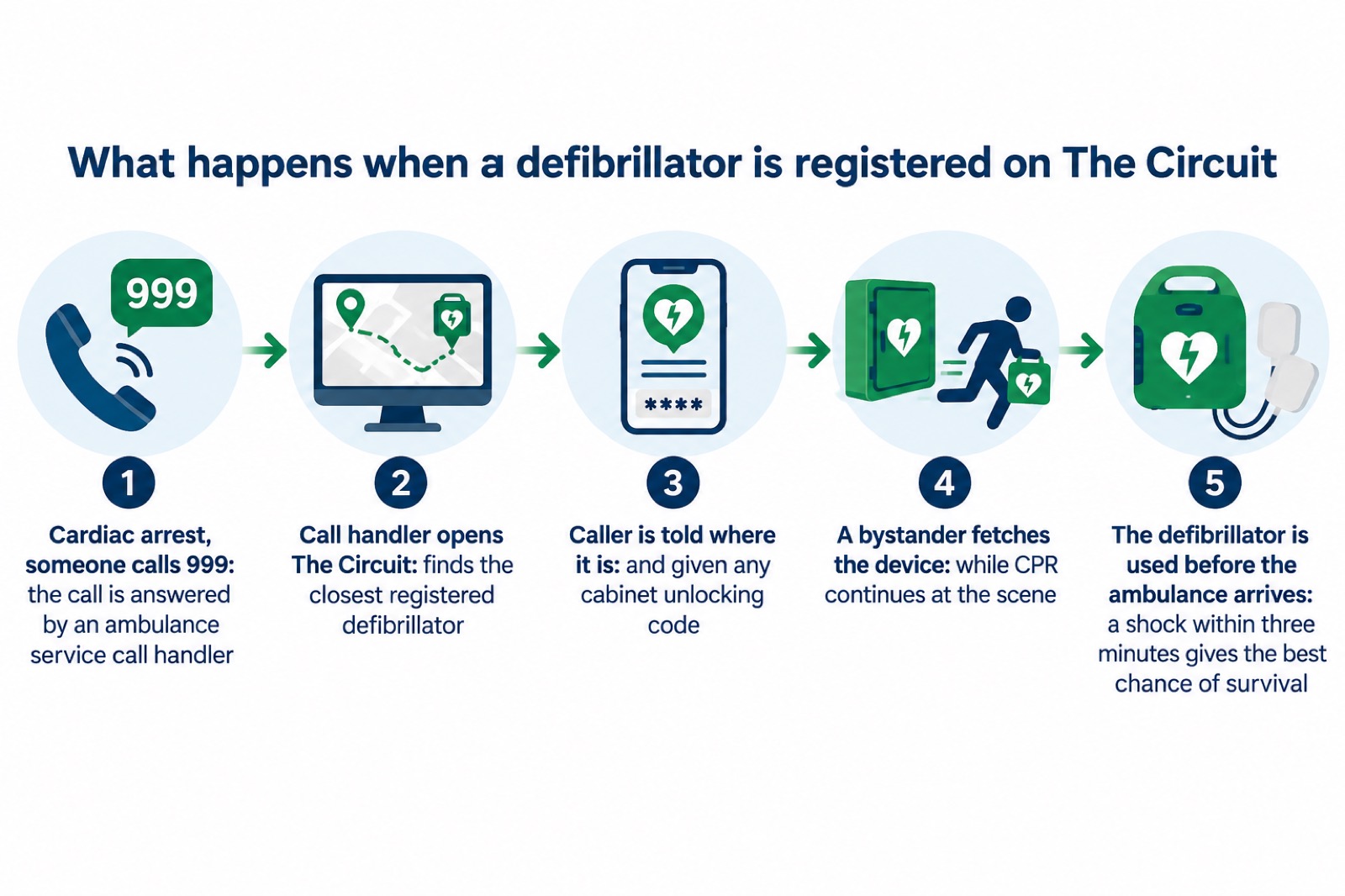
If your village, club, parish council or workplace has bought a defibrillator, the single most important thing you can do next is register it on The Circuit at www.thecircuit.uk. Registration is free and takes less than five minutes1. The Circuit is the national defibrillator network, and all 14 of the UK's ambulance services are linked to it, so a 999 call handler can direct a bystander to the closest registered defibrillator during a cardiac arrest2.
The reason it matters so much is simple: if your defibrillator is not registered, the ambulance service does not know it exists. Over 100,000 defibrillators are registered on The Circuit, but it is estimated that tens of thousands more are not3. An unregistered device may still save a life if someone happens to know it is there, but it will never be pointed out by a call handler to a panicking caller who does not.
This page covers the whole job: registering the device, choosing where it goes, deciding between a locked and unlocked cabinet, putting up signs, and the regular guardian checks that keep it response ready. It sits alongside our wider community resilience guide and our first aid at home guide.
How to register a defibrillator on The Circuit
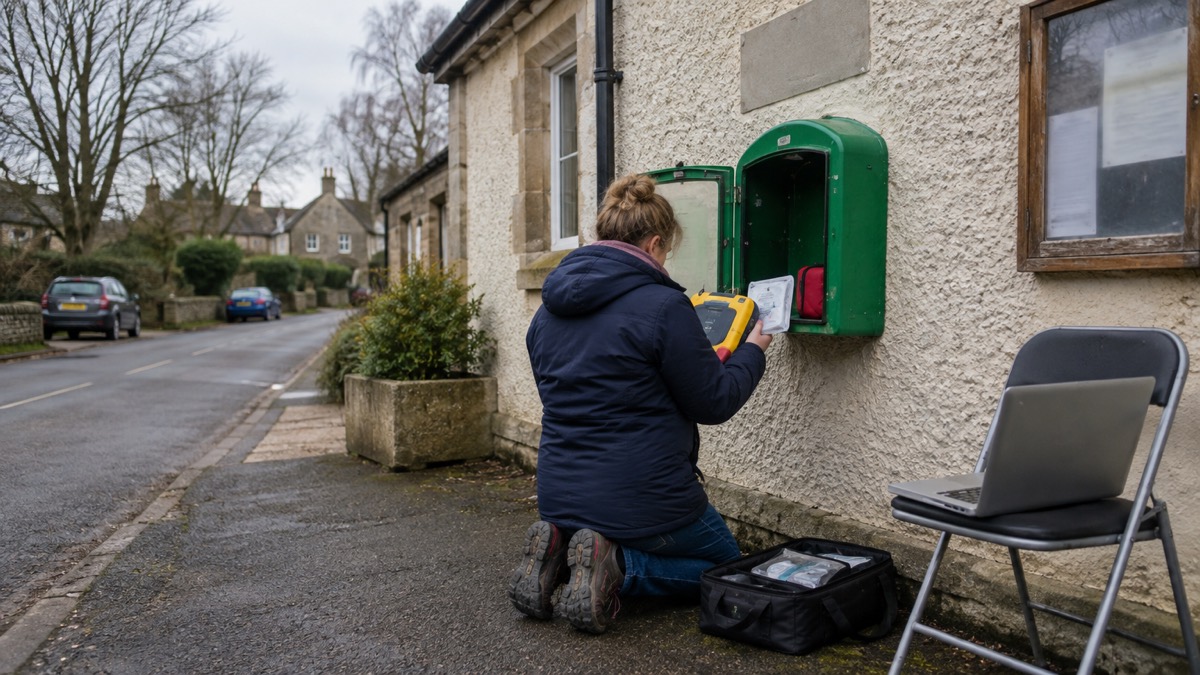
Go to www.thecircuit.uk and create an account, then add your defibrillator. NHS England, which is a partner in the network, is direct about this: "If you manage a defibrillator in your community, workplace, or school, it's essential to register it on The Circuit"1. Registering is quick, taking less than five minutes, and it is free1. South Central Ambulance Service gives the same instruction: "If you already have a defibrillator please make sure it is registered on the national database called The Circuit"5.
When you register, you record where the device is, when it is accessible and who the guardian is. You do not need 24-hour public access to register: "Even if your defibrillator is inside and not accessible 24/7 you can still register it with specific access details"5. A defibrillator kept inside a village hall that is only open certain hours is still worth registering, because the call handler can see those access details and judge whether to direct someone to it. The Circuit is designed to allow defibrillators that are not available 24/7 to be registered4.
If you are not sure whether your device is already registered, check first. Resuscitation Council UK's ResusReady guidance says: "Not sure if your defibrillator is registered? Visit www.defibfinder.uk to find out. If your defibrillator does not appear, it's not registered"6. DefibFinder is a website where you enter a UK postcode to find your nearest defibrillator or check if your defibrillator is already registered on The Circuit3.
If your organisation has many defibrillators
A parish council, sports club chain or business with devices at several sites does not need to register them one by one. Organisations with more than ten defibrillators can register them using an organisation account, which provides additional functionality and reporting to help a nominated administrator ensure defibrillators are checked regularly7. For a village with two or three devices, individual registrations are fine; for a district-wide scheme, the organisation account is the better tool.
Why registration matters: unregistered defibrillators are invisible to 999 call handlers
The Circuit is an online database that records the location of every publicly accessible defibrillator in the UK8. When someone calls 999 for a cardiac arrest, the ambulance service can access The Circuit database to find the closest defibrillator that is registered with them, which can be used before the ambulance arrives8. Emergency call handlers instruct people at the scene to give CPR and use a defibrillator, and tell the caller the location of the nearest defibrillator registered on The Circuit7.
That last phrase is the whole point. South Western Ambulance Service puts it plainly: "It is so important that all public access defibrillators are registered on The Circuit" because "if your defibrillator is not registered, we won't know it exists"9. Resuscitation Council UK says the same from the other side: if a defibrillator is not registered on The Circuit, ambulance service call handlers will not know it exists when that 999 call is made10. In Scotland, the Scottish Ambulance Service warns that an unregistered defibrillator "will not be visible to the Scottish Ambulance Service and may not be deployed when it is needed most"11.
The scale of the gap is significant. Over 110,000 defibrillators are registered on The Circuit, however it is estimated that tens of thousands of defibrillators are not10. Each of those invisible devices represents a village or club that raised money, bought a defibrillator and installed it, but whose device cannot be directed to by a call handler.
The time pressure explains why this is worth five minutes of admin. Studies have shown that a shock given within three minutes of cardiac arrest provides the best chance of survival4. An ambulance cannot usually arrive that quickly; a registered defibrillator in a phone box outside the pub can be fetched by a neighbour while someone else stays with the casualty and does CPR. In Northern Ireland, the ambulance service describes exactly this arrangement: a second person retrieves the defibrillator, which will be within a one-mile radius, allowing the first caller to continue giving instructions12.
Registration also brings ongoing benefits. Registered users receive reminders about checks, maintenance and expiry dates of consumables2, and The Circuit sends regular reminders to check your device and replace pads and batteries before they expire13. North East Ambulance Service asks existing owners directly: "Please make sure you tell us about it so we can make sure anyone who rings us for a cardiac arrest can access the nearest defib to them"14.
Choosing where to put a defibrillator in a village or club
A public access defibrillator is an Automated External Defibrillator (AED) that is accessible for use by anyone in the event of an emergency15. Where you put it decides whether it is used. The consistent advice from ambulance services is to choose places with large footfall: a public telephone box, outside a pub, village hall or community centre5. Defibrillators are commonly found in locations with high footfall, including schools, community centres, train stations, places of worship, leisure facilities, shopping centres and hospitality venues, often in wall-mounted cabinets with 24-hour access16.
The Scottish Ambulance Service advises placing the device in a prominent, easily visible location11. In Scotland, communities can go further and place defibrillators where they are most likely to be used, guided by the PADmap tool at www.padmap.org17. PADmap shows where cardiac arrests have happened and where defibrillators already exist, so a community can see the gaps rather than guessing.
A practical checklist for a village site:
- Footfall: a phone box, pub, shop, village hall or community centre, where people pass regularly5
- Access: 24/7 access to the public where possible18
- Visibility: prominent and easily seen, not tucked behind a door11
- Signage and lighting: clear signs and lighting so it can be found in the dark18
- Funding for the long term: consider how you will fund maintenance, the storage cabinet, directional signage, replacing consumables, insurance premiums, and replacement of batteries and pads2
That last point deserves emphasis. The purchase price of the device is only part of the cost. Pads and batteries expire, cabinets need power, and signs need replacing, so a village scheme should plan the ongoing funding at the same time as the installation2. Our page on funding for local resilience groups covers where grants can come from.
Cabinets: unlocked where possible, temperature-controlled outdoors
The clearest national advice on cabinets comes from NHS England: "Public access defibrillators should be kept in unlocked cabinets so people can get to them quickly in an emergency"1. The reason is time. "Locked cabinets need extra steps, like getting a code, which can slow things down"1. Community guidance from Resuscitation Council UK agrees that defibrillators should not have restricted access2.
If a locked cabinet is chosen anyway, perhaps because an insurer or site owner requires it, make sure the lock is simple to operate and well maintained with a suitable lubricant, that the keypad is visible and well-lit at night, and that the unlocking code is accurately recorded on The Circuit so the emergency call handler can pass it to a bystander19. For that to work, the details must be right. Independent guidance is specific about what a locked cabinet needs:
- The lock is simple to operate and well maintained, with a suitable lubricant recommended by the cabinet supplier7
- The keypad is visible and well-lit at night7
- The unlocking code is accurately recorded on The Circuit, so the emergency call handler can provide it to bystanders7
For outdoor installation, a locked cabinet brings extra demands: the keypad must be visible and well-lit at night, and the lock must be kept well maintained with a suitable lubricant so it opens first time in an emergency19. We compare the options in more detail on our page about locked or unlocked defibrillator cabinets.
Signs, footfall and making the defibrillator easy to find
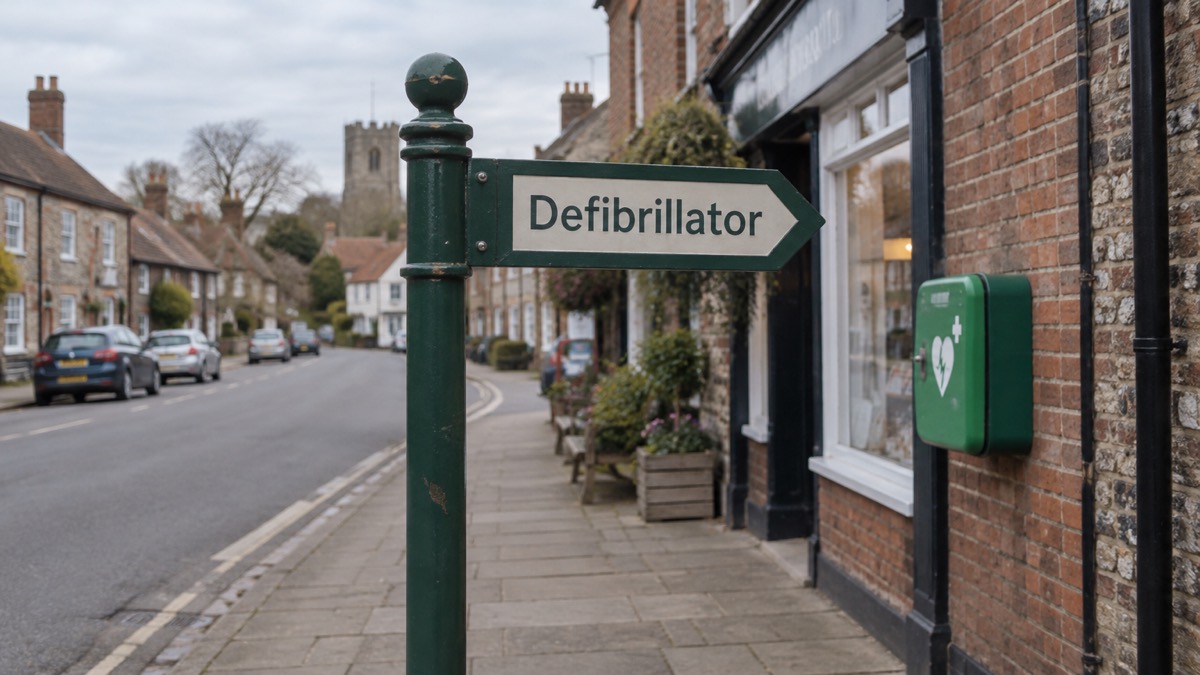
A defibrillator nobody can find in a hurry is little better than one in a cupboard. Community guidance asks groups to assess where directional signs should be placed, complete a test run once signs are installed, and include sign checks in the routine checking process2. The test run matters: walk from the most likely emergency locations, such as the sports field or the car park, and check the device can be found in a couple of minutes by someone who has never seen it before.
The Circuit itself helps with labelling. South Western Ambulance Service explains the sticker system: "One sticker is placed on the cabinet to show that the defibrillator is registered with The Circuit. The second sticker" goes on the defibrillator itself and has room to write the address of the cabinet, a What3Words location and, if the cabinet is lockable, a code for opening it9. Resuscitation Council UK's community guide adds that if you do not have a Circuit sticker, you can tie on a label or use an indelible marker to write the same information directly onto the case2.
The same information serves the return of the device after use. The Circuit provides stickers with spaces to enter a contact number, location (using postcode, What3Words or a location name) and, if needed, the cabinet unlocking code, to assist prompt return7.
Guardians and regular checks: pads, batteries and Circuit reminders
Every defibrillator needs someone responsible for it. Community guidance says a defibrillator guardian should be nominated to undertake tasks and receive alerts from The Circuit, with an agreement to continue the role if the guardian is absent2. In a village that usually means one named person, plus a deputy who can cover holidays. If your group is still forming, our page on setting up a local emergency group covers roles like this.
All defibrillators need to be checked regularly to ensure they are response ready5. The checks themselves are set out in Resuscitation Council UK's guardian checklist and the wider guidance:
- Check the defibrillator is registered on The Circuit, with the device registered correctly and guardian contact details up to date20
- Carry out routine checks, replace the battery when necessary, and replace used or out-of-date pads, razors and plastic gloves, following the manufacturer's instructions7
- Record the checks on The Circuit7
- Carry out checks as per manufacturer guidance and your risk assessment, with a process to ensure this is maintained and recorded2
- Include the signage in the checking process2
The Circuit does some of the remembering for you. It provides defibrillator guardians with reminders such as when pads are due to expire and to regularly check their defibrillator and update The Circuit10. Once registered, The Circuit sends regular reminders to check your device and replace pads and batteries before they expire13. The guardian's job is to act on those reminders rather than let them pile up in an inbox.
One alert deserves a fast response. When a Circuit-registered defibrillator is deployed by the ambulance service, the guardian will receive an email immediately7. The device then needs to be collected, checked, fitted with new pads if it was used, and returned to the cabinet so it is live again. South Western Ambulance Service asks anyone on an incident where someone has collected a public access defibrillator to complete their online form so they can get it back in service, and to keep submitting the report until contacted by a representative9.
Theft and vandalism, which worry many communities deciding on a cabinet, are rare in practice. Very few cases of stolen or vandalised defibrillators have been reported to The Circuit since 201921. That record is worth weighing against the delay a locked cabinet can add.
Using a defibrillator and doing CPR: no training needed
The strongest reassurance in all of the official guidance is that anyone can use one of these devices. London Ambulance Service states: "You don't need to be trained to use a defibrillator. When you switch it on, it will give you clear instructions on what to do"22. North East Ambulance Service is equally blunt: "Anyone can use a defibrillator. You do not need training"23. The Scottish Ambulance Service confirms that no prior training is required to use an AED, and that the device provides clear spoken instructions to guide you through each step15.
The device is safe because it decides for itself. An AED analyses the electrical activity of the heart and delivers a shock if it detects a life-threatening abnormal rhythm15. It will only administer a shock if one is needed, meaning it is extremely unlikely to cause harm15. The East of England Ambulance Service adds that defibrillators provide clear, step-by-step instructions and can be used safely by people with no formal medical training, and that emergency call handlers will help direct callers to the nearest available device and explain how to use it24.
What a bystander should do in a suspected cardiac arrest:
- Call 999 immediately. An immediate 999 call for an ambulance and starting cardiopulmonary resuscitation (CPR) promptly are essential4.
- Start CPR and follow the call handler's instructions.
- If directed to a defibrillator, send a second person to fetch it while CPR continues12.
- Switch on the device and follow its voice prompts22.
- Never take a public access defibrillator without notifying the ambulance service12.
The Scottish Ambulance Service's last point matters for guardians as well as bystanders: a defibrillator taken from its cabinet for any reason other than a live emergency leaves a hole in the village's cover, and the ambulance service needs to know. For households wanting to build confidence, community CPR and defibrillator familiarisation sessions are offered by some ambulance services, with no prior medical knowledge needed25. Our first aid at home guide covers the wider basics.
"You don't need to be medically trained, and you should never hesitate to use one in an emergency."
Who runs The Circuit, and where each nation stands
The Circuit has been developed by the British Heart Foundation in partnership with the Association of Ambulance Chief Executives, Resuscitation Council UK, St John Ambulance and NHS England1. Resuscitation Council UK also names Save a Life Cymru among the partners, with the British Heart Foundation leading on The Circuit10. The network is managed by the British Heart Foundation8, and all data protection governance has been assured8.
All 14 of the UK's ambulance services are linked to The Circuit and can direct a bystander to the closest registered public access defibrillator2. Registration is therefore a single national act: you register once at www.thecircuit.uk and every ambulance service in the UK can see the device. The Welsh Ambulance Services University NHS Trust simply points people to the same address to register26, as does the Northern Ireland Ambulance Service, which notes that as of September 2025 there were over 3,800 public access defibrillators registered on The Circuit in Northern Ireland12.
Some ambulance services also run their own local schemes alongside the national network, and it is worth knowing your local contact:
| Nation or service | Local picture |
|---|---|
| England (South Central) | Over 8,200 defibrillators registered across Hampshire, Berkshire, Oxfordshire and Buckinghamshire; deployed to over 550 incidents in 2024/25. Businesses can email info@sca-charity.org.uk; community groups can use an online form or email scas.defib@nhs.net5 |
| Scotland | Unregistered defibrillators are not visible to the Scottish Ambulance Service; placement guided by the PADmap tool11 |
| Wales | Welsh Ambulance Services University NHS Trust directs registration to www.thecircuit.uk26 |
| Northern Ireland | Over 3,800 defibrillators registered on The Circuit as of September 202512 |
The usage figures are a useful reality check for communities deciding whether to invest. A public access defibrillator is used in fewer than one in ten cases21, which is why placement, signage and registration matter so much: the device has to be findable and directed by a call handler in the small number of emergencies where it is the difference between life and death. In the South Central region, registered devices were deployed to over 550 incidents in 2024/255, showing that a well-placed, well-registered device does get used.
Sources (26)
- Improving outcomes in cardiac arrest: tools and resources, NHS England, 2026
- Public access defibrillators: a guide for communities, Resuscitation Council UK, 2025
- The Circuit: national defibrillator network, British Heart Foundation, 2026
- Consensus statement on AED cabinets, Resuscitation Council UK, 2015
- Public access defibrillators, South Central Ambulance Service, 2026
- ResusReady FAQs, Resuscitation Council UK, 2026
- AED Guide, Resuscitation Council UK, 2026
- The Circuit: the new defibrillator database, North West Ambulance Service, 2025
- Defibrillators, South Western Ambulance Service, 2026
- The Circuit, Resuscitation Council UK, 2026
- AED placement and registration, Scottish Ambulance Service, 2026
- Community involvement: AEDs, Northern Ireland Ambulance Service, 2025
- Register your defibrillator on The Circuit, Defib Warehouse, 2026
- Learn to save a life, North West Ambulance Service, 2024
- Public access defibrillators, Scottish Ambulance Service, 2026
- Defibrillators, Defibshop, 2026
- Care zones, Save a Life Scotland, 2026
- Public access defibrillators, South Central Ambulance Service, 2026
- Purchasing a public access defibrillator, Scottish Ambulance Service, 2026
- Check your defib: guardian checklist, Resuscitation Council UK, 2026
- HeartSafe guide, Resuscitation Council UK, 2024
- Defibrillators: become a London lifesaver, London Ambulance Service, 2026
- Anyone can use a defibrillator, North East Ambulance Service, 2024
- Cardiac arrest, East of England Ambulance Service, 2026
- CPR and defibrillator training, South Western Ambulance Service, 2026
- Register your defibrillator, Welsh Ambulance Services University NHS Trust, 2026
 Emergency Hub Kit Checklist
 Severe Weather Tasks for Groups
 Flood Warden Checklist
 Setting Up an Emergency Group
 Volunteering in Emergencies
 What Volunteers Can Safely Do
 Community Flood Plans
 Flood Wardens
 Starting a Flood Action Group
 Clearing Snow and Ice
 Community Emergency Hubs
 Checking Vulnerable Neighbours
 Neighbourhood Phone Trees
 Funding Resilience Groups
 Voluntary Organisations