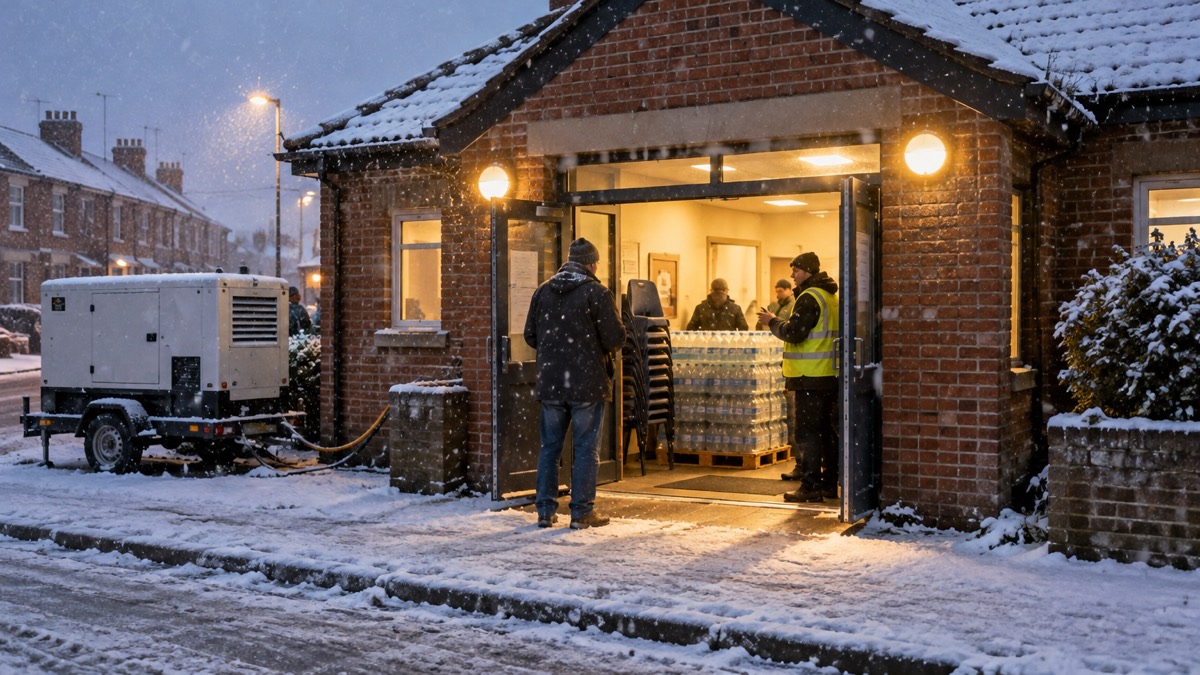
A community emergency hub is a place to go when something has gone wrong: a power cut, a flood, a storm. It is somewhere to get warm, find out what is happening and help one another. What it holds depends on the community running it, but official guidance is clear about the basics. Every hub should have an enclosed building, running water with a sink to wash up in and fill water bottles, toilets, chairs and tables, and some way of providing heating1.
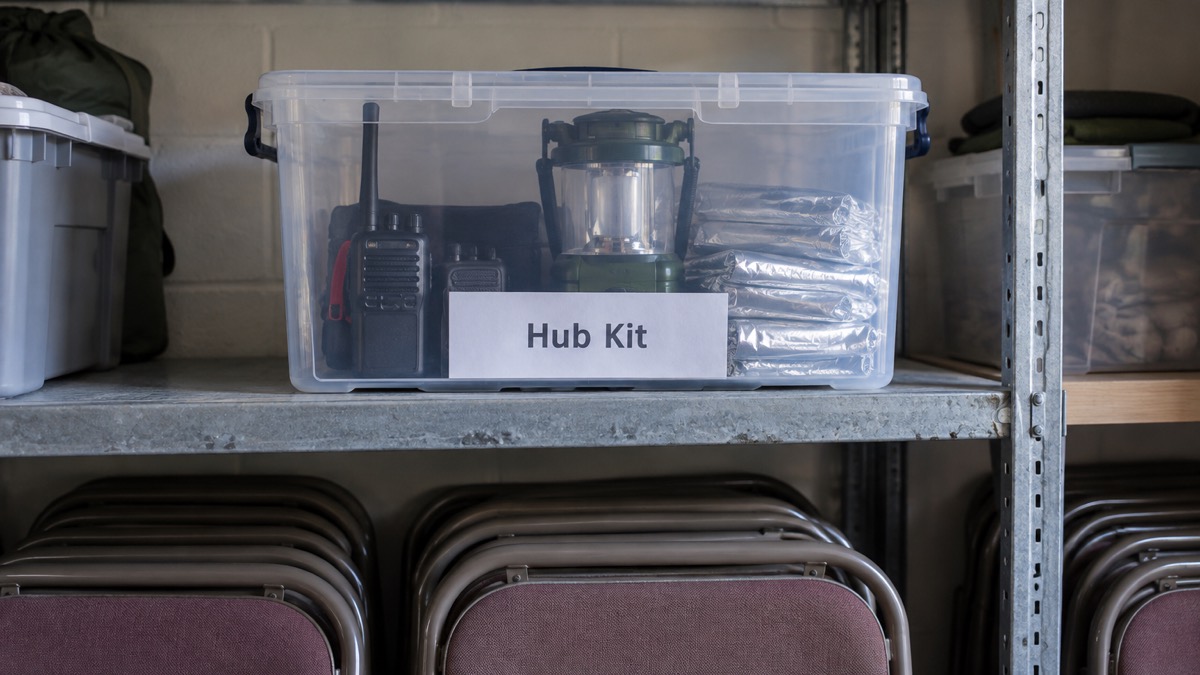
The kit that goes with it is modest. Some councils send a hub kit containing a guide to Community Emergency Hubs, a safety briefing, lanyards for roles, maps of the community, an AM/FM/DAB radio and stationery3. Each hub is also given a toolbox with essentials such as stationery and information about the hub, including suggested roles1. Beyond that, there is no required list of facilities, which lets each hub fit its own community1.
What a hub is not is a shop or a guaranteed food point. Official guidance warns that a hub likely won't come with food, so the community needs to plan how it will feed people who are evacuated4. If you are heading to one, take your own water and something ready to eat, and check before you travel: services and opening times vary from hub to hub5.
The hub kit and facilities checklist
Work through this list when you are setting up a hub, or when you are checking what your local one offers. Each item is here because official guidance names it.
What a hub is for, and what it offers
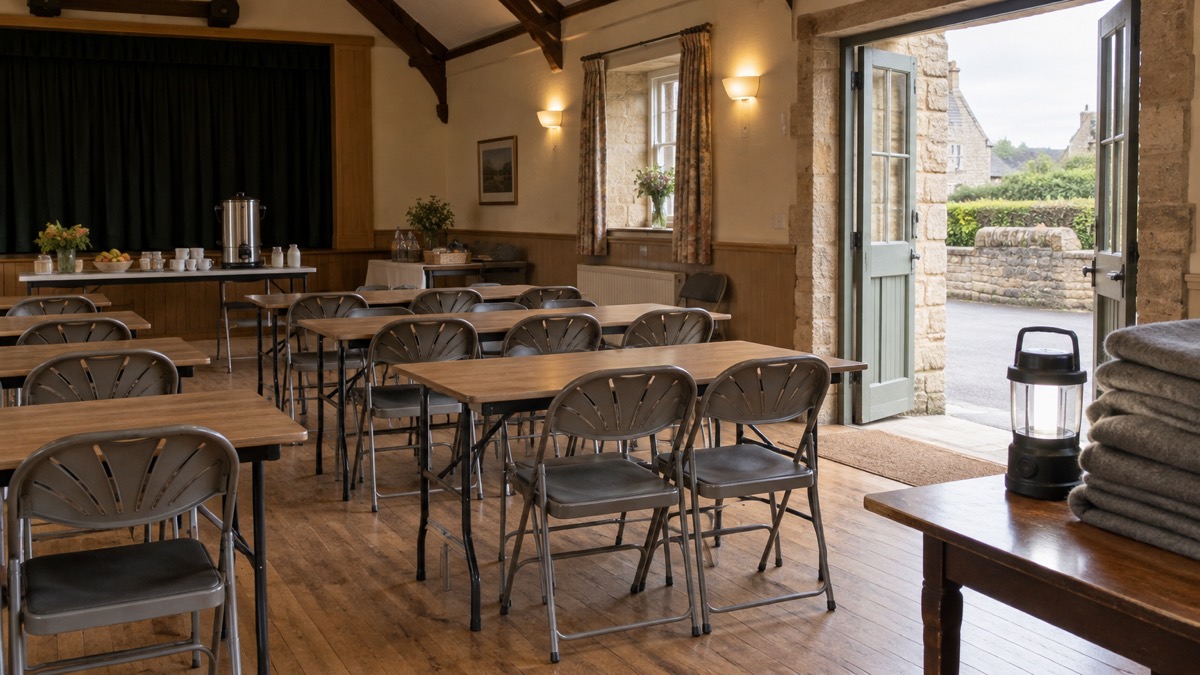
A hub is a place where you can go in a crisis to get support, offer help, or find out reliable information1. In Wiltshire and Swindon the same idea is described as your community's place to go and help one another in an emergency, with a link into the emergency services and other responding agencies in the local area8. Warmth and welfare can be provided within the hub to anyone who needs it, and food and water can be dropped off at the site for residents in need8.
The warm hub idea is the one most people meet first. Cornwall Council describes its Community Hubs as a warm place to go, with the offer of hot food and drink in many locations5. In Norfolk and Suffolk, warm hubs during cold weather are described as a safe, heated place to spend time, meet others and access local support9. Community emergency plans can also cover providing hot meals and assistance within community centres and village halls10.
A hub can do more than warm people up. It can act as a safe shelter, a cool or warm hub, or an assembly point for the community1. Some hubs have extra facilities: a kitchen, showers, display equipment, books and games, and power generators1. Those extras are not standard, so ask rather than assume.
| What the hub offers | Detail | Where it comes from |
|---|---|---|
| Warmth and welfare | Provided to anyone who needs it8 | Wiltshire and Swindon guidance |
| Shelter and assembly point | Safe shelter, cool or warm hub, assembly point1 | Surrey County Council |
| Food and clothing in a flood | Where to find food, clothing, shelter and advice11 | GOV.UK |
| Extra facilities at some hubs | Kitchen, showers, display equipment, books and games, power generators1 | Surrey County Council |
What the hub kit contains and who sends it
The kit itself is small and practical. Buckinghamshire Council says it can send a kit containing a guide to Community Emergency Hubs, a safety briefing, lanyards for roles, maps of the community, an AM/FM/DAB radio and stationery3. To request a kit or set up a hub there, you email the council3. Surrey describes each hub being given a toolbox containing essentials such as stationery and information about the hub, including suggested roles1.
The role lanyards matter more than they look. Roles come with lanyards to help easily identify the staff2. You do not need to give people these roles before an incident: when something happens, a hub can be established and roles assigned then1. Wiltshire and Swindon guidance says each hub will have an emergency pack giving suggestions on roles to help it operate effectively, for example supervisor and welfare, and these do not need to be adhered to and can be altered to suit the group or situation8.
The safety briefing is the other half of that. It tells volunteers what the hub is for and where their part in it begins and ends. If your council does not supply one, the same ground is covered by the wider question of what volunteers can safely do, which is worth reading before anyone takes a role.
Services and opening times vary from hub to hub
Exact services and opening times vary from location to location5. That single line is the most useful thing to know before you set out. A hub in one village may have a kitchen and showers; the next may be a hall with chairs, a kettle and a radio. Some hubs have extra amenities including a kitchen, showers, display equipment, books and games, and power generators2.
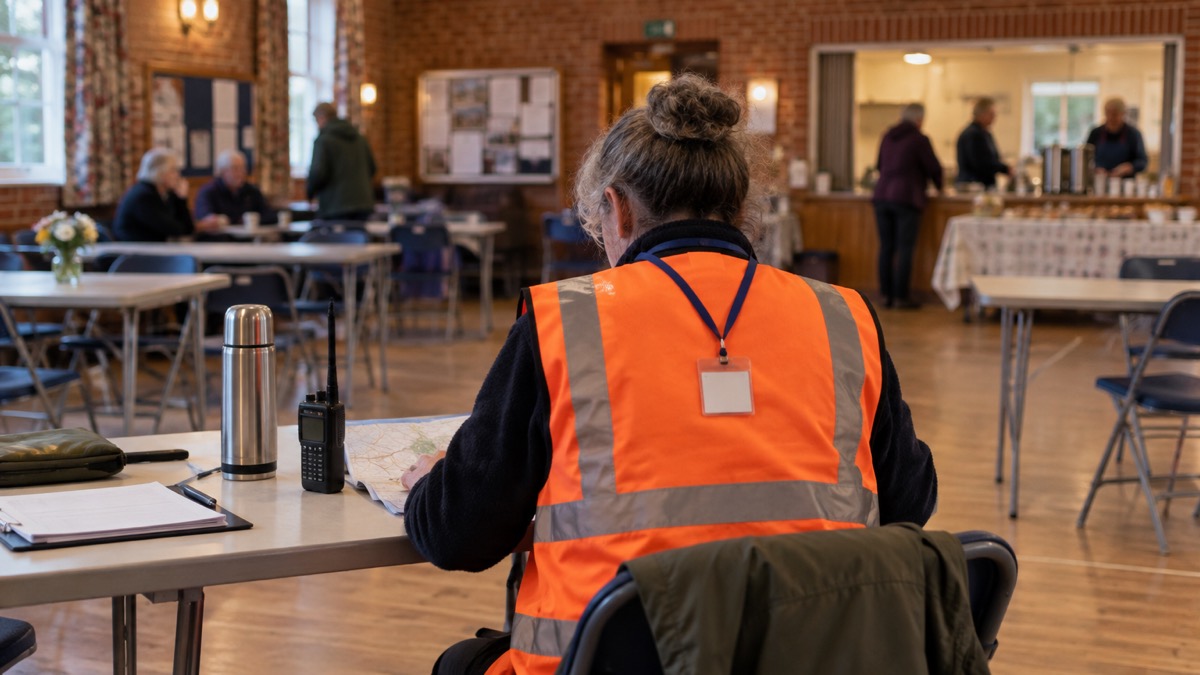
Hubs are run by the community for the community, using community venues and predominantly staffed by community volunteers8. They are only opened when the community feels the need in an emergency, and no authorisation from emergency responders is needed6. Some communities have a small emergency group who will initially open the hub, while others will be run by anyone who turns up; anyone in the community can help run or open them6. The hub will only work with your community working as a team7.
That flexibility is the strength and the catch. Because there is no required list of facilities, a hub can be as accessible as possible to its own community1. But it also means you cannot assume what will be there. If you need something specific, such as a warm room, a charge point or help with a prescription, ask before you travel.
Checking a hub before you travel
Check first, then travel. Where a hub is listed, note its address and what it offers, and if you have a neighbour who might struggle to get there, agree to go together.
Take the basics with you even if you expect the hub to provide them. Official guidance for leaving home in an emergency suggests ready-to-eat food, a warm drink in a flask and bottled water13. A household emergency kit covers the same ground: your household emergency plan with contact numbers, a battery or wind-up torch with spare batteries, a first aid kit, important documents, bottled water and ready-to-eat food that won't go off, a can opener if needed, spare keys, spare glasses or contact lenses, toiletries and details of important medicines, pencil and paper, a penknife and a whistle14. A list of emergency contact numbers is worth keeping at home as well13.
If you are leaving because of a flood, the flood kit lists are more specific. A flood kit should include a torch and spare batteries, a first aid kit, any prescription medicines you might need, warm waterproof shoes and clothes, rubber gloves, bottled water and snacks, essential pet and children's supplies such as pet food and nappies, insurance documents, passports, a wind-up or battery powered radio with spare batteries, and a list of important phone numbers15. Keep it high up in a box16. The Met Office's advice during Storm Chandra was to assemble an emergency flood kit with essentials such as medication, copies of important documents, warm clothing and a phone charger17.
Food, clothing and shelter during a flood
The government's flood guidance describes community hubs as places where you can find food, clothing, shelter and advice during a flood11. That is the promise. The practical position is narrower: a hub likely won't come with food, so the community will need to consider how it will feed people who are evacuated4. Any building used as a hub should support people with the basic essentials such as water, toilets and insurance cover4.
For a household, that means two things. First, take your own bottled water and tinned or dried food as part of your flood preparations11. Second, if you are evacuated, expect the hub to be a place of warmth, information and company rather than a canteen. Communities that plan ahead can provide hot meals and assistance within community centres and village halls10, and food and water can be dropped off at the site for residents in need8, but that depends on local arrangements being made before the water rises.
Shelter is the other question. A hub can act as a safe shelter1. During a major flooding incident, community issues are shared with the local authority or the Environment Agency by phone, email or when a representative visits the hub1. Some communities also place sandbags and domestic floodgates in risk areas to prevent flooding18. Whether it is safe to travel to a hub at all is a judgement for the emergency services, so follow their advice and never walk or drive through flood water.
Power cuts, storms and the wider role of a hub
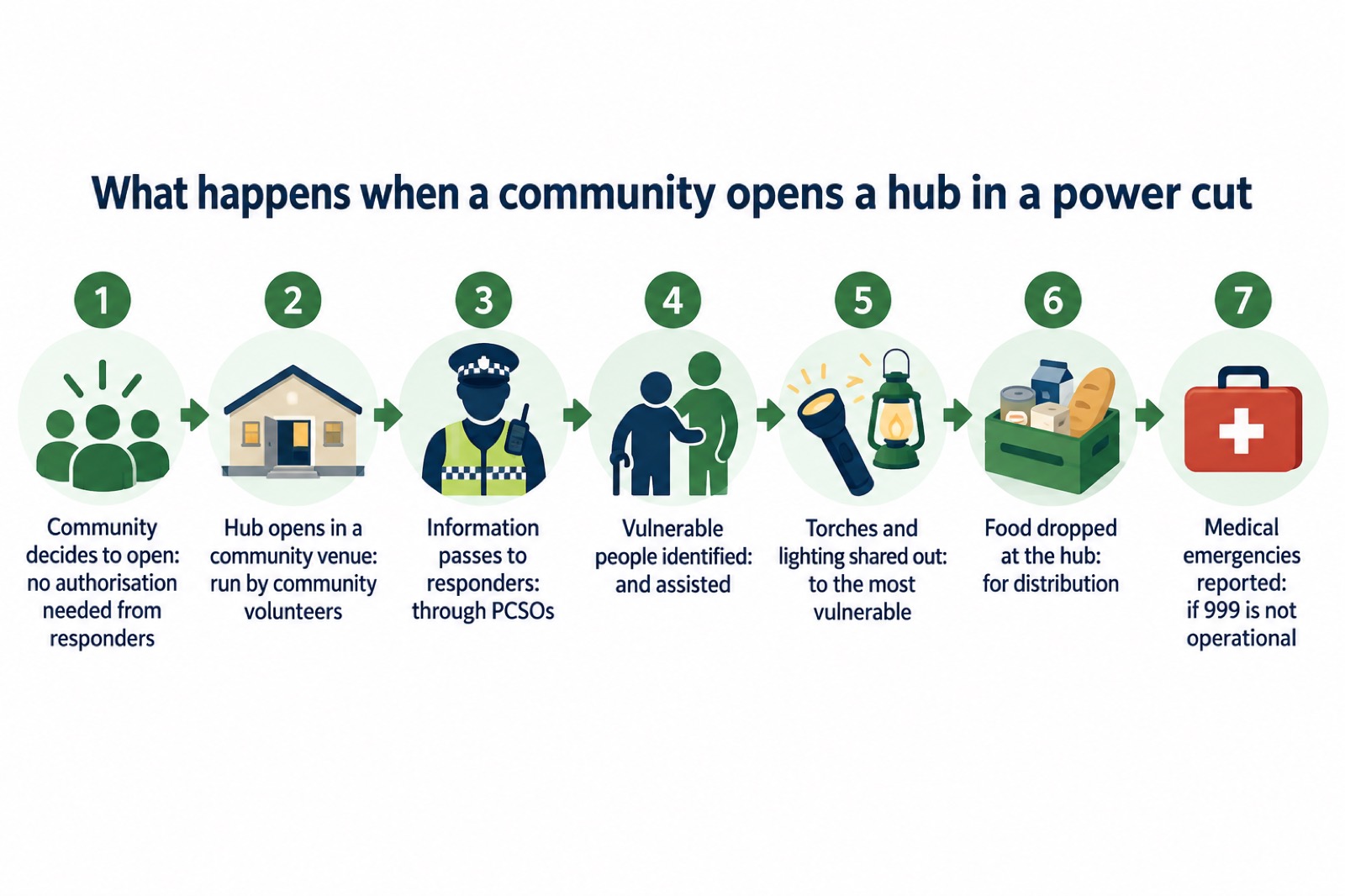
A power cut is one of the clearest cases for opening a hub. Wiltshire and Swindon's example sets out what a community can do: use the hub to identify and assist vulnerable people, share out torches and lights to the most vulnerable, use heating resources to keep as many warm as possible, work together on local issues appropriate for a community response, and liaise with the power company and responders on site6. The same guidance lists the sequence: the community opens the hub, information passes between responders and the community through PCSOs, vulnerable people are identified, food is dropped at the hub for distribution, torches and lighting are shared out, information on safe processes is available, and the hub becomes a focus point to report medical emergencies if 999 is not operational8.
That last point is worth reading twice. A hub is not a substitute for the emergency services, but it can be a place where a community gathers information and passes it on when normal routes are stretched.
Storms bring the same needs. Preparing a household emergency kit and an emergency plan before cold weather is standard advice19, and a hub gives those households somewhere to go when heating fails. In Cornwall, the Community Resilience Network newsletter covers simple tips to help communities get ready, why a community plan is needed, how to use warning messages, getting homes and emergency kits ready, what to do if the power or water stops, and helping people who might need extra support12. Cornwall Council, the Environment Agency and the voluntary sector help communities prepare to respond12.
Where to get help and how to find your local hub
Start with your council. Community resilience pages set out what is available locally, and some councils send hub kits on request3. In Cornwall, the Community Gateway works closely with the Community Hubs across the county and with the NHS and Cornwall Council5. The county's Community Resilience Network is run by the Emergency Management Team, and its newsletter is one way to hear what is happening12.
If you are setting up a hub rather than visiting one, the practical steps are covered in our guide to community emergency hubs, and the wider picture of neighbours helping each other is in Community Resilience: A Guide for Neighbours and Local Groups. Communities that want to plan ahead can use a Community Emergency Plan Toolkit, which provides a step by step guide to help fill out the Community Emergency Plan Template20. For the household side, see our emergency kit guide and, if you are at flood risk, Flooding: A Household Guide.
A few practical points to close on. Keep a list of emergency contact numbers at home13. Check your grab bag regularly and keep a copy of your plan, prescription details, a phone charger, important documents, toiletries, a first aid kit, water, snacks, a wind-up or battery radio and torch with spare batteries, a notebook and pen, essential keys, items for babies, children and the elderly, and cash or cards in it21. And remember that community volunteers help keep the community safe where an incident does not pose an immediate threat to life, including helping out in a power cut or storm and informing neighbours of a flood warning22. That is the work a hub does best.
Sources (22)
- Set up a Community Emergency Information Hub, Surrey County Council, 2026-06-01
- What will you find at the hub, Wiltshire and Swindon Prepared, 2026-10-25
- Community resilience, Buckinghamshire Council, 2026
- Community involvement, Dorset Prepared, 2026-03-25
- Winter support, Cornwall Council, 2025-01-14
- Emergency Contact Hub leaflet, Wiltshire and Swindon Prepared, 2025
- Teamwork and roles, Wiltshire and Swindon Prepared, 2026-10-25
- Emergency Contact Hubs, Wiltshire and Swindon Prepared, 2026-10-25
- Stay warm and nourished, Norfolk and Suffolk ICB, 2026-10-16
- Why should your community prepare an emergency plan, Argyll and Bute Council, 2026
- Prepare for flooding, GOV.UK, 2026-10-25
- Cornwall Community Resilience Network, Cornwall Council, 2026-03-11
- Emergency kit checklist, Neath Port Talbot Council, 2026-10-29
- Get prepared, Carmarthenshire County Council, 2026-10-28
- Before, during and after a flood, Scottish Environment Protection Agency, 2026-10-29
- Flooding checklist for residents, Perth and Kinross Council, 2024-08-01
- Met Office Storm Chandra weatherready advice, Met Office, 2026-01-26
- Resilient communities, Scottish Borders Council, 2026-10-29
- Cold, snow and ice, Ready Scotland, 2026-03-25
- Protect your community, Lancashire Prepared, 2026-10-29
- Home Emergency Plan, Isle of Anglesey County Council, 2020
- How emergency services can help, Surrey County Council, 2016-12-15
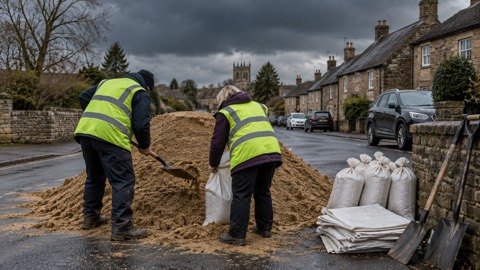 Severe Weather Tasks for Groups
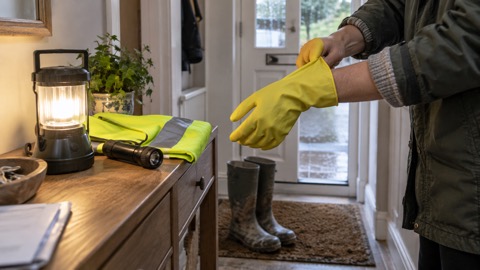 Flood Warden Checklist
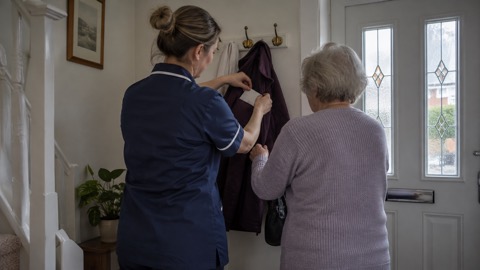 Carer's Emergency Plan