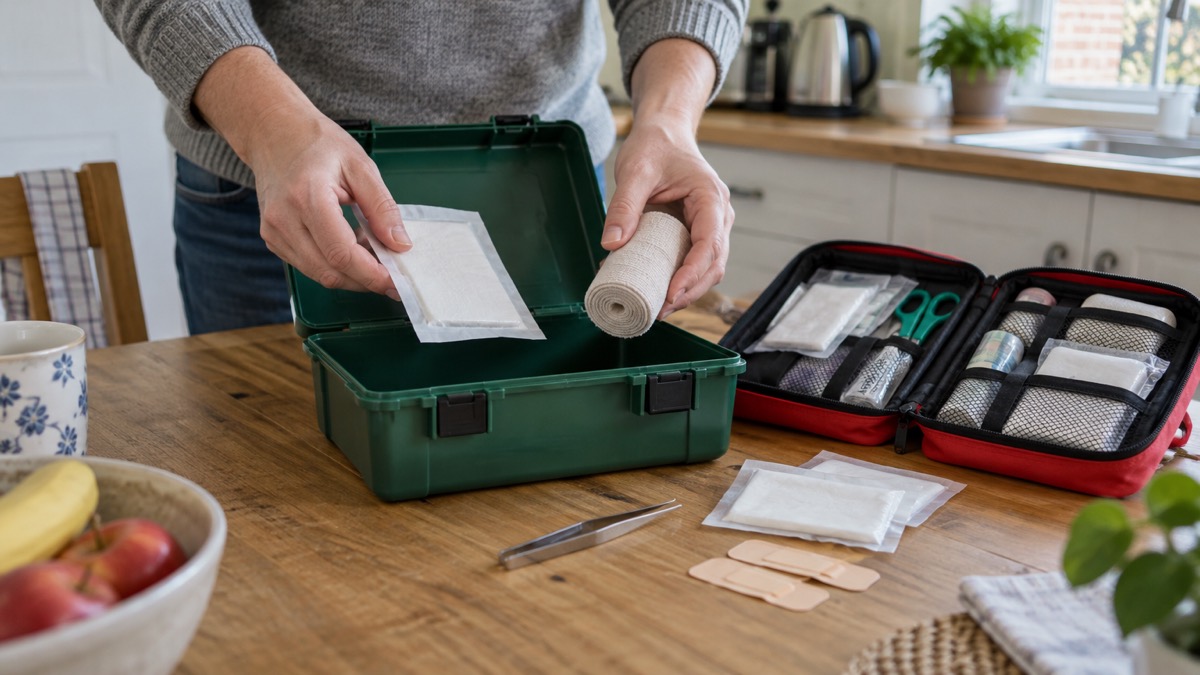
Every UK household should keep a first aid kit at home, and a second one in the car. The NHS says you can keep a home or car first aid kit handy by buying a ready-made one or putting together your own in a clean, waterproof box1. Council emergency preparedness checklists across England and Wales put a first aid kit, alongside essential medication, at the top of what a household should have ready2, and a home emergency plan should make sure everyone in the house knows where the kit is kept3.
A kit does not need to be large or expensive to be useful. What matters is that it covers the injuries an ordinary household actually meets: cuts, grazes, blisters, small burns, splinters, grit in an eye, a raised temperature. This page sets out what the NHS and UK official guidance say should be in the box, how to choose between a ready-made kit and one you build yourself, where to keep it, and how it fits into the wider emergency kit your household should hold for power cuts, floods and storms.
What a home first aid kit should contain
The NHS basic first aid kit list is the standard reference for UK households, and it is worth working through it against what you already have. A basic kit may contain plasters in a variety of different sizes and shapes; small, medium and large sterile gauze dressings; at least two sterile eye dressings; triangular bandages; crêpe rolled bandages; safety pins; disposable sterile gloves; tweezers; scissors; alcohol-free cleansing wipes; sticky tape; a thermometer, preferably digital; skin rash cream such as hydrocortisone or calendula; cream or spray for insect bites and stings; antiseptic cream; painkillers such as paracetamol, or infant paracetamol for children, aspirin (not for children under 16), or ibuprofen; antihistamine cream or tablets; distilled water for cleaning wounds; and eye wash and an eye bath4.
A child health version of the NHS list adds a preference for a digital ear thermometer and infant versions of paracetamol, ibuprofen and antihistamine for families with young children6. A local NHS self-care guide condenses the same list to the essentials: bandages, plasters in a range of sizes and waterproof if possible, eyewash solution, a thermometer, sterile dressings, tweezers and antiseptic7. The UK government's Be Ready campaign checklist, updated in October 2026, agrees: waterproof plasters, bandages, a thermometer, antiseptic, eyewash solution, sterile dressings and gloves, medical tape for dressings, and tweezers8.
| Item | What it is for | Notes |
|---|---|---|
| Plasters, assorted sizes | Small cuts, blisters and sore spots | Waterproof if possible7 |
| Sterile gauze dressings, small, medium and large | Wounds too big for a plaster | At least two sterile eye dressings as well4 |
| Triangular bandages | Slings and supporting an injured arm | Fastened with safety pins4 |
| Crêpe rolled bandages | Holding dressings in place, supporting sprains | 4 |
| Disposable sterile gloves | Protecting yourself and the casualty | 4 |
| Alcohol-free cleansing wipes | Cleaning skin around a wound | 4 |
| Tweezers and scissors | Splinters, cutting tape and plasters to size | 4 |
| Thermometer, preferably digital | Checking a temperature | Ear thermometer preferred for children6 |
| Painkillers | Adults: paracetamol, ibuprofen. Children: infant paracetamol or ibuprofen | Aspirin not for under 16s4 |
| Antiseptic cream, bite cream, antihistamine | Minor skin problems, bites and stings | 4 |
| Eye wash and eye bath | Rinsing dust or grit from an eye | 4 |
Two points on the medicines. First, aspirin should not be given to children under 164. Second, medicines have expiry dates and should be checked and replaced when they pass, which is covered below. For more detail on what each dressing and bandage does, see dressings, bandages and plasters, and for treating the injuries themselves, cuts, grazes and wounds.
Ready-made or build your own: both work
The NHS is explicit that either route is fine: you can keep a home or car first aid kit handy by buying a ready-made one or putting together your own in a clean, waterproof box1. Northern Ireland's household emergency guidance says the same: you can buy a pre-made kit or you can put one together for yourself9, and a child health NHS source notes a basic first aid kit can be bought over the counter, or you can create one yourself6.
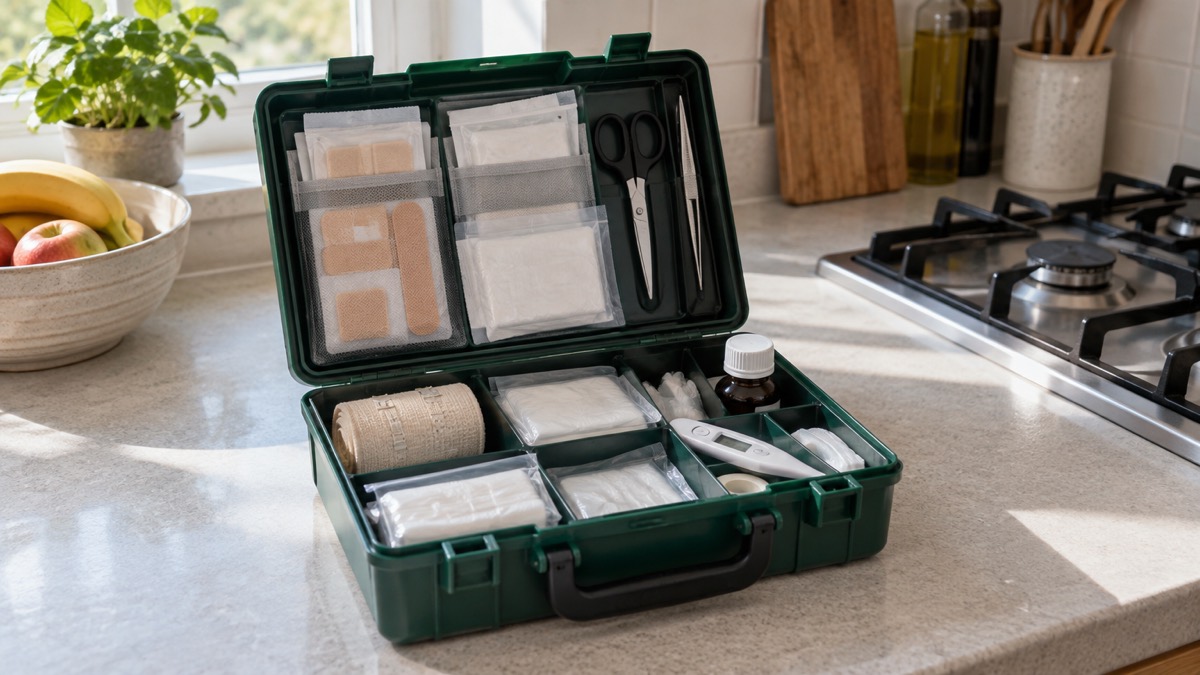
The choice comes down to your household. A ready-made kit saves time and gives you a working set in one purchase, and the case is usually designed to keep contents dry and visible. Building your own lets you match the contents to your family: infant medicines and a digital ear thermometer if you have small children6, extra plasters if you have a teenager who plays sport, antihistamines if anyone has allergies. Many households end up doing both: a bought kit as the base, topped up with the family-specific items.
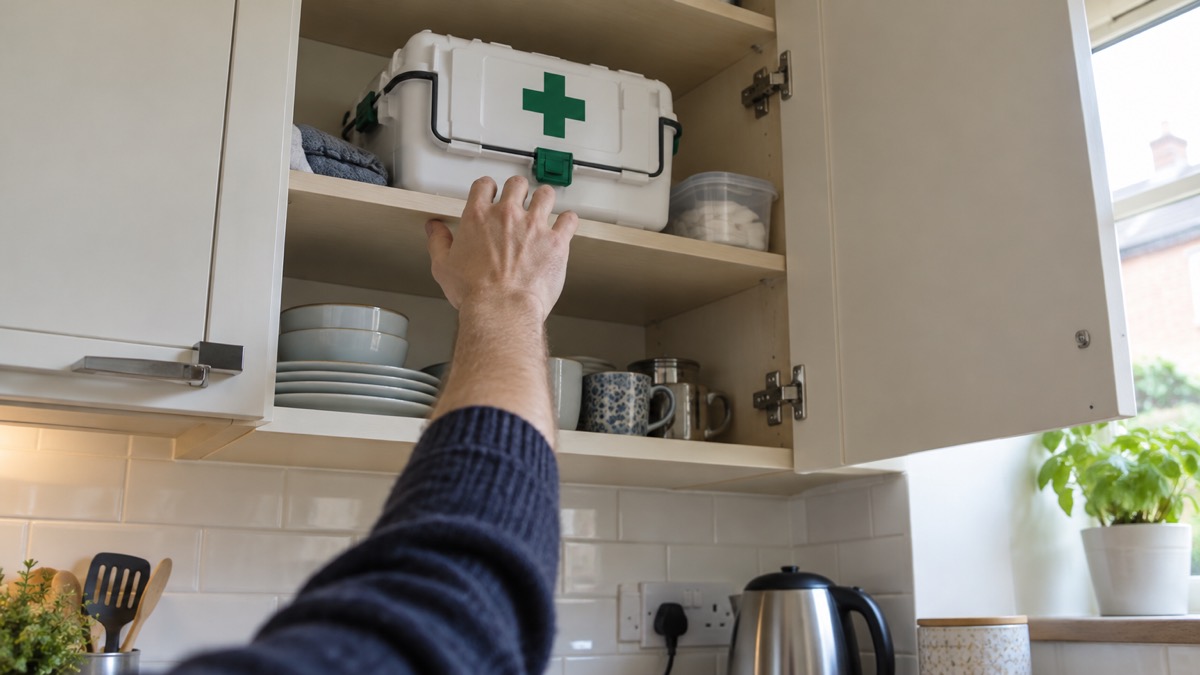
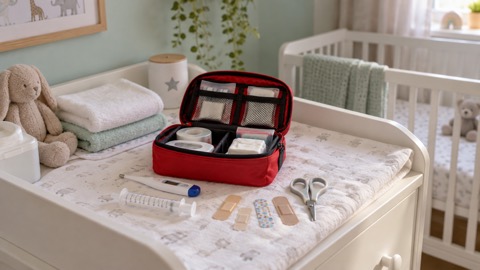
Whichever you choose, the box itself matters. NHS 111 Wales advice on first aid kits for babies, which applies to any household kit, is to choose a waterproof, durable box that is easy to carry, with a childproof lock, kept out of the reach of children but handy for adults10. The same source adds that the box should be tall enough to carry bottles of lotion11. The reasoning is simple: it is much easier to take the box to the injured person than the person to the box, so the kit needs a handle and some strength, and it must not be so accessible that children can help themselves to plasters, pins and medicines.
Check the kit regularly. Look at expiry dates on sterile dressings and medicines, replace anything used or out of date, and restock straight after an incident rather than leaving the kit short. A comparison of the two approaches in more depth is at ready-made kit or building your own.
Two kits: a large one for home and a smaller one for going out
Northern Ireland's first aid guidance suggests a practical split: you may choose to have two kits, a large one that stays at home and a smaller emergency kit for when you go out12. The large kit holds the full NHS list, spare quantities and the medicines cupboard overlap. The small kit holds what fits in a bag or glovebox and covers the injuries that happen away from home.
NHS inform's summer health campaign recommends carrying a small first aid kit to help deal with minor ailments like cuts, grazes and blisters13. That is the shape of the going-out kit: plasters in a few sizes, a couple of sterile dressing pads, wipes, a small bandage, gloves, tweezers and a sachet of saline. It weighs very little and lives in a rucksack pocket, a changing bag or the car.
There is a third reason for the small kit, beyond day trips. Emergency planning guidance from North Hertfordshire advises preparing a household emergency kit and a smaller personal kit, for example in a backpack, for use should you need to be evacuated, and making sure everyone knows where the kits are kept14. If you ever have to leave your home in a hurry because of fire, flood or a gas leak, the backpack kit is the one that goes with you. The household grab bag is covered in more detail below.
Kit for walks, travel and the car
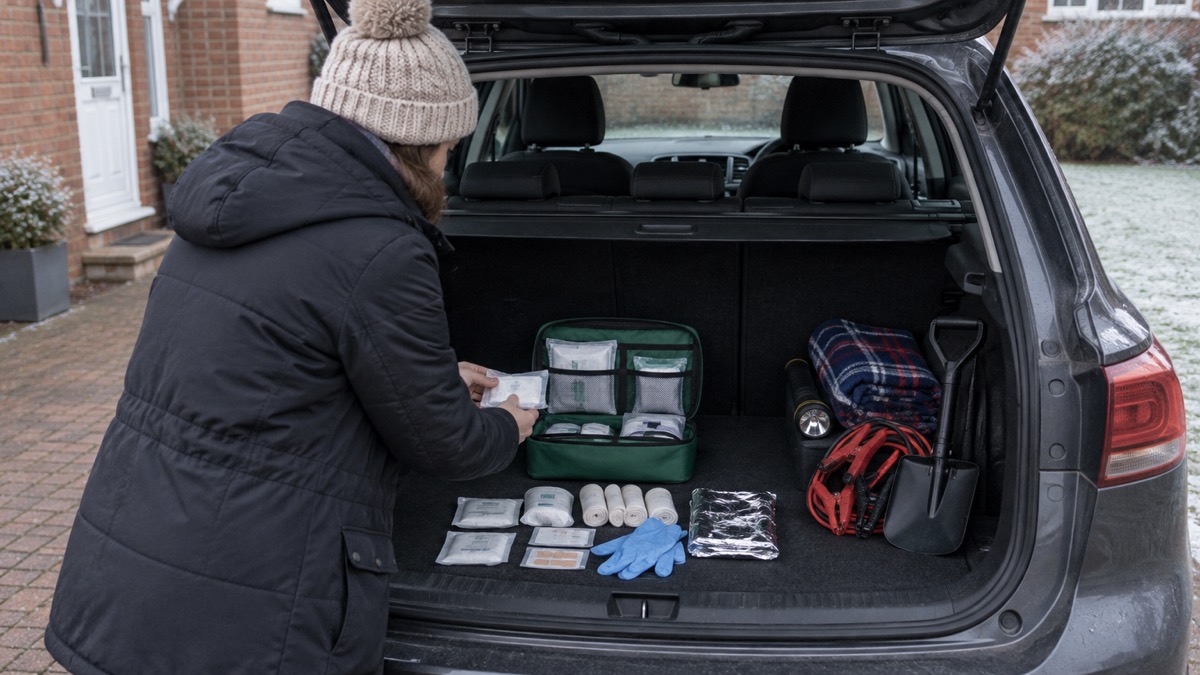
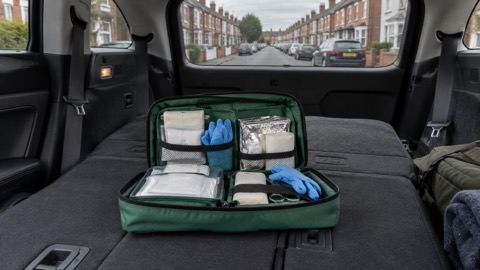
The car kit is the one official guidance is most consistent about. Neath Port Talbot council's emergency kit checklist says to keep a first aid kit in your car in the event of an emergency2. Traffic Scotland's vehicle emergency travel kit list includes a first aid kit alongside jump start cables, an empty fuel can, water and food, a shovel and a phone backup battery15. Ready Scotland's emergency kit advice adds spare warm clothes and boots, a blanket and a phone charger to the car kit16.
The UK government's Be Ready campaign advises packing a few essential items in your car boot for wintry weather: a torch, in-car phone charger, warm clothes and blankets, high-visibility clothing, jump leads, food and drink, and a shovel for snow, and notes a first aid kit can also be helpful17. A car emergency kit built around the same idea is worth keeping year-round rather than only in winter: spare warm clothes and boots, a blanket, a first aid kit and a phone charger mean you can stay warm, treat minor injuries and keep your phone charged if you break down or get stuck18. If you travel with a pet, keep a smaller first aid kit in your car or bag as well, so you can provide any care needed while away from home19.
| Where you are going | First aid items | Other kit to carry with it |
|---|---|---|
| Everyday car boot | First aid kit2 | Jump leads, blanket, torch, phone charger16 |
| Winter journey | First aid kit18 | Ice scraper, de-icer, shovel, hat, gloves, boots, water; blankets, snacks and a flask for longer journeys18 |
| Wintry weather standby | First aid kit17 | Torch, in-car charger, warm clothes, hi-vis, jump leads, food and drink, snow shovel17 |
| Walks and days out | Small kit for cuts, grazes and blisters13 | Water, phone, sun protection |
For a household with children, the baby and child version of the going-out kit has its own additions: scissors for cutting clothes, plasters and tape to size, tweezers for thorns and splinters, and saline solution and an eye bath for washing dust or foreign bodies out of sore eyes10. A fuller checklist for the car is at car kit for injuries on the road.
*A car boot packed for winter: the first aid kit sits with the warm kit and the breakdown items.
Sterile dressing pads: covering wounds too big for a plaster
Sterile dressing pads are the workhorse of any kit beyond the plasters. NHS 111 Wales describes them plainly: the pads come in a variety of sizes and have a bandage attached, and they are used to cover most common wounds whenever a plaster is too small5. Because the bandage is attached, one item both covers the wound and holds itself in place, which is much easier than juggling a separate pad and roll of tape with one hand.
The reason to cover a larger injury at all is infection. NHS self-care guidance is that larger injuries should be covered with a sterile dressing to prevent infection until treatment can be given by a healthcare professional20. A sterile dressing keeps the wound clean in the gap between the injury happening and professional help, whether that is a walk-in appointment the next morning or an ambulance on its way.
The safety instruction that matters most concerns bleeding. NHS 111 Wales advises:
"If the wound is severe, apply the dressing and seek medical advice. If blood soaks through the dressing, do not remove it, apply a large dressing over the top as a second layer."
NHS 111 Wales5
Removing a soaked dressing disturbs the clot forming underneath and can restart bleeding. Add the second layer on top and get help. For heavy bleeding, the steps are at how to stop severe bleeding.
Eye dressings work on the same principle at a smaller scale. Use an eye pad or small dressing for a small wound, or for a non-embedded foreign object such as dirt or grit in the eye, until you get medical advice5. Anything embedded in the eye is a different matter and needs professional care. For choosing between rinse options, see saline pods or an eyewash bottle.
Tweezers and tough cut scissors: what each one is for
Tweezers are for splinters. NHS self-care guidance is that tweezers are for taking out splinters, and that if splinters are left in they can cause discomfort and could become infected20. A fine-point pair in the kit handles the thorns, glass shards and wood splinters that come with gardens, beaches and wooden floors. The technique is at how to remove a splinter safely.
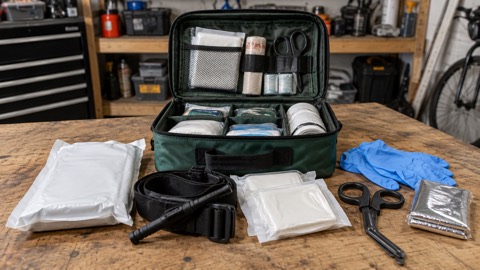
Tough cut scissors, sometimes sold as Tuff-Cut scissors, are for clothing. NHS 111 Wales explains that they are used to cut clothing to get to a wound or a fracture, and that they are safety scissors so there is no danger of cutting skin5. In a serious injury you often cannot see, let alone dress, the wound without removing clothing, and ordinary scissors near an injured limb are a risk. ProtectUK's Public Access Trauma kit standard includes two pairs of Tuff-Cut scissors21, and South Central Ambulance Service's defibrillator guidance recommends buying tuff cut scissors alongside an AED22.
A household kit needs one pair of each at minimum, and the going-out kit benefits from both as well. Baby kit guidance adds the everyday uses: scissors for cutting plasters and tape to size, and tweezers for thorns and splinters10. Keep them clean and dry, and check they still cut cleanly when you check the kit's dates.
Where the first aid kit fits in your emergency pack and grab bag
A first aid kit is one part of a wider household emergency kit, and every official preparedness checklist in the UK includes it. Essex Prepared lists a first aid kit among emergency items23. Wiltshire's emergency kit guidance includes toiletries and a personal first aid kit, and notes that such kits are sometimes called 'grab bags'24. Lincolnshire includes a first aid kit in its emergency advice25, and Dumfries and Galloway's household emergency pack includes one26. North Yorkshire Fire and Rescue Service's flood advice adds any prescription medicines to the first aid kit in an emergency flood kit27.
The grab bag is the version you can carry out of the house at short notice. Essex Prepared lists its contents: essential or prescribed medication, glasses or contact lenses, useful phone numbers, a mobile phone and charger, house and car keys, money and credit cards, a first aid kit, basic toiletries, and a torch and radio23. The first aid kit in a grab bag can be the small going-out kit from earlier, or a dedicated copy, so long as it is packed and ready rather than being assembled on the night.
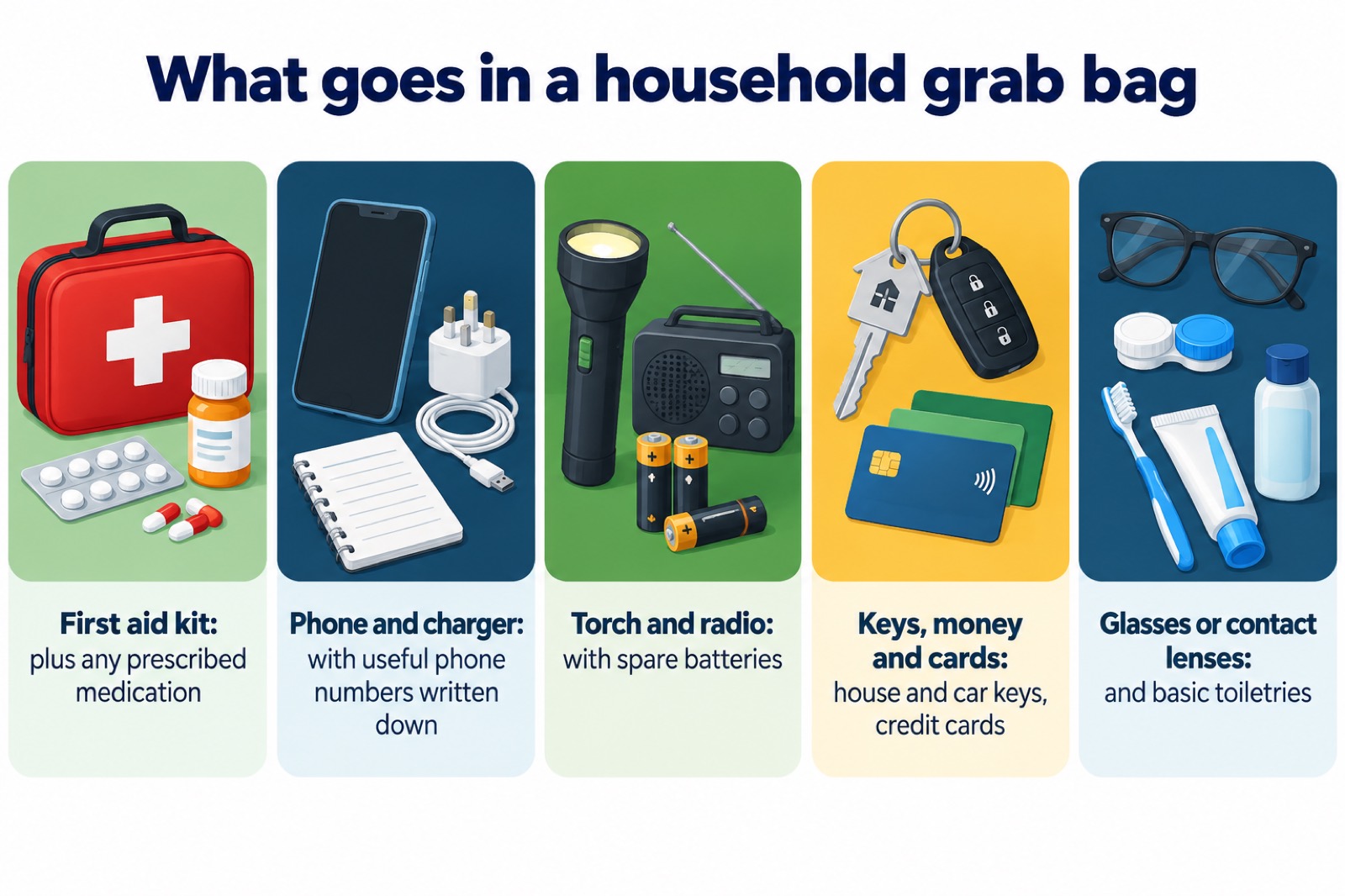
If you are evacuated, the personal backpack kit is the one that goes with you14. If you stay at home through a storm or flood, the large home kit is the one you open. Both need to be findable in the dark, which is why the home emergency plan instruction is to have a first aid kit and make sure everyone in the house knows where it is3. The wider kit, including water, food and lighting, is covered in emergency kit: what a UK household should keep ready.
Burns, foil blankets and other additions
Two further items appear in official kit lists and are worth considering. The first is burn care. The London and South East Basic Surgical Network's first aid guidance covers burn safety, including that if clothes catch fire, extinguish them, and that fully irrigated chemical injuries should be covered with a wet compress28. A dedicated burns addition to the kit, such as a hydrogel burn gel, pairs with knowing the cooling steps at burns and scalds.
The second is the foil blanket. An official flood warden kit checklist includes two foil blankets alongside adhesive and non-adhesive dressings, fabric and waterproof plasters, a triangular bandage, cleansing wipes, gloves, a conforming bandage, scissors, gauze swabs, a resuscitation mask, safety pins, microporous tape, tweezers and an instruction sheet29. A foil blanket keeps body heat in when someone is cold, wet or shocked, and it packs flat enough to sit in a car kit or grab bag without notice.
Learn first aid alongside the kit
A kit is only half the preparation. Essex Prepared's advice is to have a first aid kit in your home and car and learn first aid, including downloading a first aid app for your smartphone, such as the free app from the Red Cross23. An app on your phone talks you through what to do at the moment you need it, and it weighs nothing.
Training matters more than any single item in the box. The types of course available, how long they run and where to find one are covered at first aid courses, and free online CPR training at learning CPR free online. Children can learn too: teaching children basic life-saving skills covers what to teach at what age, including how to ring 999. The core skills every adult should recognise are at what to do first: danger, response, airway and breathing.
ProtectUK's guidance on first aid provisions makes a related point about public kits: a Public Access Trauma First Aid Kit supports the treatment of immediate, life threatening injuries such as major bleeding and those not breathing on their own, and may also be used by an injured person who is able to self-treat themselves30. The same logic applies at home. A kit that anyone in the house can find, open and use, with an instruction sheet inside, serves the household better than a perfect kit nobody can work out under pressure.
Sources (30)
- What should I keep in my first aid kit?, NHS, 2026-10-25
- NPT Prepared emergency kit checklist, Neath Port Talbot Council, 2026-10-29
- Home Emergency Plan, Isle of Anglesey County Council, 2020
- What should I keep in my first aid kit?, Collingwood Surgery NHS, 2026-10-28
- First aid kit contents and use, NHS 111 Wales, 2021
- What to keep in your medicine cabinet, Healthier Together (NHS), 2026-10-28
- Keep a well stocked medicine cabinet at home, NHS Black Country ICB, 2026-10-28
- Get prepared for emergencies, UK Government Be Ready campaign, 2026-10-21
- Household emergency kit, nidirect (Northern Ireland Government), 2026-07-06
- Newborn essentials: first aid, NHS 111 Wales, 2021-04-19
- Safety and your first aid kit, NHS 111 Wales, 2021-04-19
- First aid, nidirect (Northern Ireland Government), 2025-12-04
- Summer health campaign, NHS inform, 2026-08-06
- Preparing for emergencies, North Hertfordshire District Council, 2015-01-12
- Vehicle emergency kit, Traffic Scotland, 2026-10-29
- Emergency kit, Ready Scotland, 2026-10-29
- Be ready for emergencies, UK Government Be Ready campaign, 2026-10-21
- Diogelwch ar y ffyrdd yn y gaeaf (Safety on the roads in winter), Mid and West Wales Fire and Rescue Service, 2026-10-29
- Winter preparedness, NHS Lanarkshire, 2023-11-23
- Self-care advice, NHS Birmingham and Solihull ICB, 2026-10-28
- Standards for Public Access Trauma (PAcT) first aid kits and equipment, ProtectUK, 2026-06-01
- Public Access Defibrillator information pack, South Central Ambulance Service NHS Foundation Trust, 2026-08
- Step 1: preparation, Essex Prepared, 2026-10-29
- Planning for an emergency kit, Wiltshire Council, 2026-10-29
- Get help and advice in an emergency, Lincolnshire County Council, 2026-10-29
- Prepare for emergencies, Dumfries and Galloway Council, 2026-10-29
- Keeping safe during high winds and heavy rain, North Yorkshire Fire and Rescue Service, 2024-01-22
- First aid guidance, London and South East Basic Surgical Network (NHS), 2026
- Be flood ready: guidance for flood wardens, Harborough District Council, 2026-10-29
- First aid provisions, ProtectUK, 2026-06-01
 Baby and Child Kit Checklist
 Bleeding Control Kit Checklist
 Car Kit Checklist
 Danger, Response, Airway
 CPR Steps for Adults
 2025 Resuscitation Guidelines
 Defibrillators (AEDs)
 Public Access Defibrillators
 Choosing a Defibrillator
 The Recovery Position
 Choking First Aid
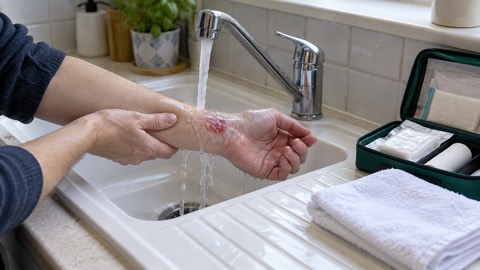 Cuts, Grazes and Wounds
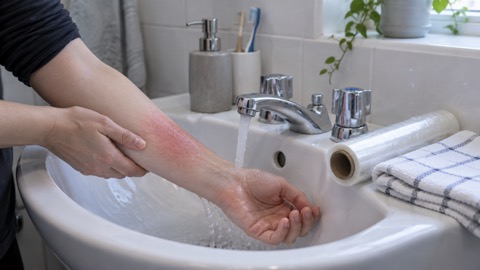 Burns and Scalds
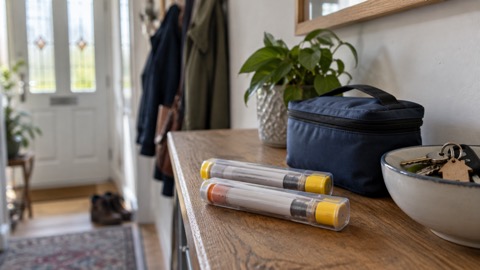 Adrenaline Auto-Injectors
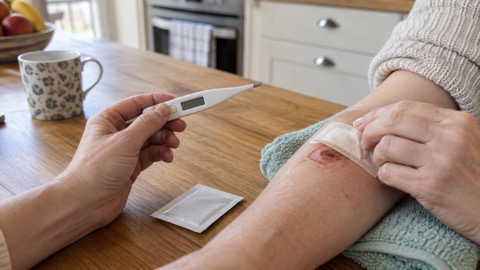 Sepsis Signs to Act On