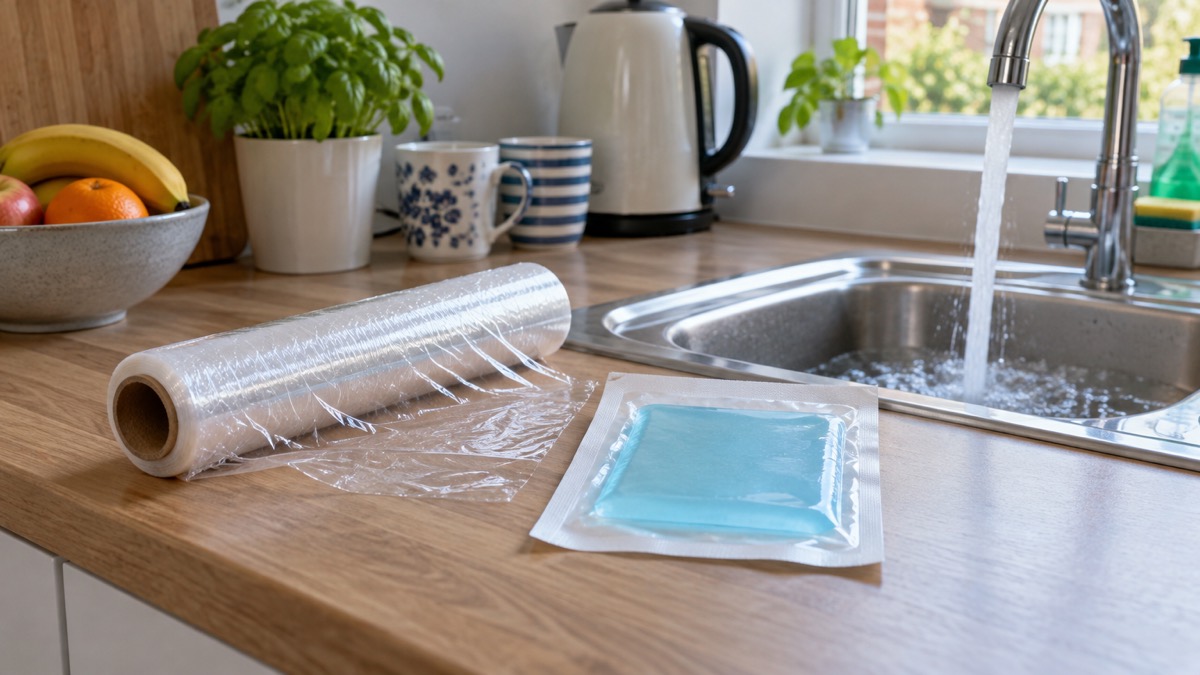
If someone burns themselves at home, the covering is the second decision, not the first. Cool the burn with cool running water for at least 20 minutes, then cover it. For most household burns the covering UK first aid guidance names is cling film, laid over the burn in a layer rather than wrapped around it1. A clean plastic bag does the same job for a hand3.
A hydrogel burn dressing, often sold as burn gel, is the other option in a home kit. It is a sterile, single-use product that comes sealed and is applied straight to the cooled burn4. It suits a household that wants a dressing ready to hand for a larger burn, or one that wants something that will not need improvising. Cling film suits a household that wants a cheap covering that is already in the kitchen drawer and is named in official guidance.
Neither replaces cooling, and neither replaces medical help for a burn that needs it. This page sets out what to do in order, what each covering does and does not do, what never to put on a burn, and when to stop dressing and get advice.
Cool the burn first, then cover it
Cooling is the part that matters most and the part people rush. Run cool water over the burn for at least 20 minutes. St John Ambulance says to continue for at least 20 minutes or until the pain feels better5, and the Royal Society for the Prevention of Accidents gives 20 minutes of cool running water6. NHS 111 Wales says 20 minutes with cool or lukewarm water12. The London and South East Burns Network notes that cooling can still be beneficial up to 3 hours after the injury, so if some time has passed it is still worth starting8.
While cooling, remove clothing, jewellery and nappies from around the burn unless they are stuck to the skin13. Do not remove anything stuck to the burn itself. Cooling with water is the step that limits the damage; the covering only protects what is left.
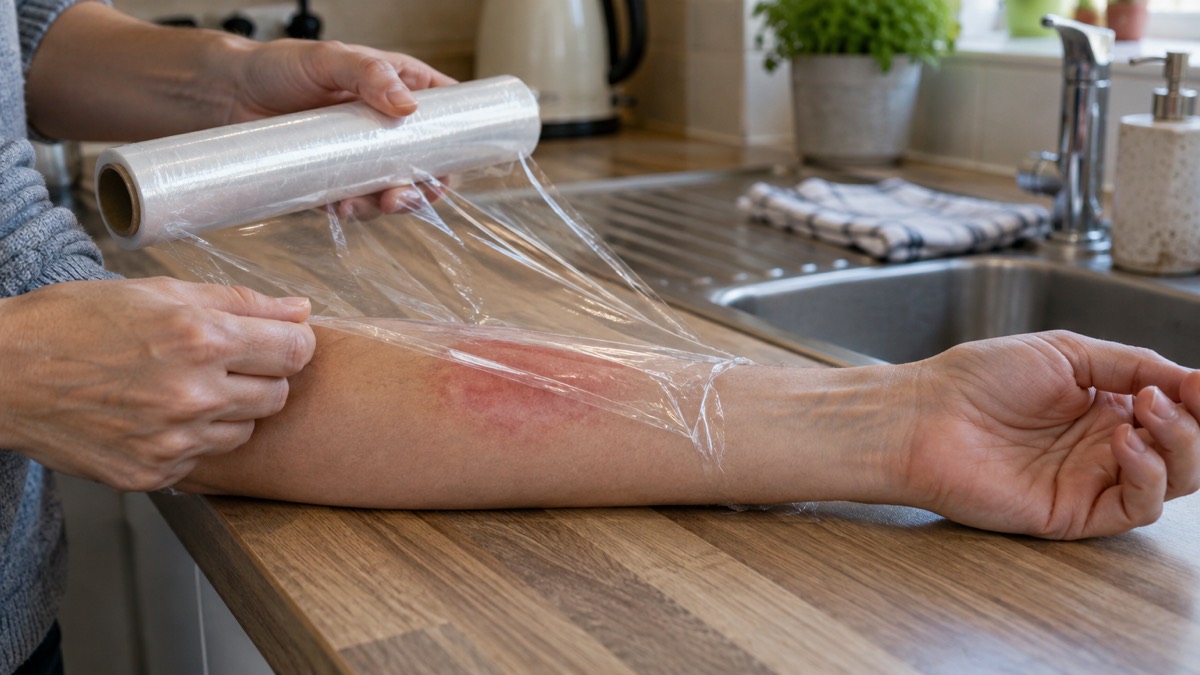
Once the burn is cool, cover it. The NHS advises cling film laid over the burn rather than wrapped around, a clean plastic bag, or something clean and non-fluffy such as a cotton pillowcase or linen tea towel, to reduce the risk of infection1. The reason for laying it rather than wrapping is that the area needs space to swell7. St John Ambulance adds a practical detail: discard the first two turns of the cling film before you use it, so the strip that touches the burn is clean5.
Covering does two jobs. It helps prevent infection by keeping the area clean, and because cling film or plastic will not stick to the burn, it reduces pain by keeping air from the skin's surface14. That is why a loose layer beats a tight bandage for a fresh burn.
Sterile and single use: why each dressing is used once
A hydrogel burn dressing and a roll of cling film are both used once, but for different reasons.
A hydrogel dressing is supplied sterile inside a sealed pack. Burnshield states that its products undergo sterilisation by gamma irradiation, and that its dressings are single-use products, ensuring maximum sterility and efficacy with each application4. Gamma irradiation is the sterilising step applied before packing. The practical consequence for a household is simple: the dressing is only sterile while the pack is sealed, so it should stay sealed until the moment you need it, and it should not be reused afterwards.
Cling film is not sterile, and it is not sold as a medical dressing. It is used because it is clean, it does not stick to a burn, and it forms a barrier against infection14. That is also why it is temporary. One hospital trust states that cling film should not be left on a burn for more than a few hours and only until wounds are assessed by health professionals11. If a burn is going to be looked at by a clinician, the cling film is a bridge to that assessment, not a dressing to leave in place for days.
| Covering | What it is | Sterile | Used how | Best suited to |
|---|---|---|---|---|
| Cling film | Kitchen film, not a medical product | No | Laid over the burn in loose strips, first two turns discarded5 | Most household burns; a covering already in the kitchen1 |
| Clean plastic bag | Ordinary clean bag | No | Over a hand burn3 | Burns on the hand where film is awkward |
| Hydrogel burn dressing | Sterile single-use dressing, gamma irradiated4 | Yes, while sealed | Applied to the cooled burn, then discarded | A household that wants a sealed dressing ready for a larger burn |
| Clean non-fluffy cloth | Pillowcase or linen tea towel | No | Laid over the cooled burn1 | When nothing else is to hand |
A note on approvals: Burn Kool burn gel is listed by its maker as CE marked16, and Burnshield states it holds CE approval among other accreditations4. A CE mark is the maker's declaration that the product meets the rules for its type. It tells you the maker has made that declaration; it does not tell you which covering suits a particular burn.
What not to put on a burn
The list of things not to put on a burn is short and firm. Do not apply ointment or butter10. Do not cover the face with cling film or any other covering8. Do not wrap cling film around the burn, because the area needs space to swell7, and avoid wrapping it around joints when covering a limb13.
There is one more caution that belongs to the kitchen rather than the burn: cling film should not be used where it could melt, such as in the oven or on pots and pans on the hob17. That is a food safety point, but it is the same roll you may reach for in an emergency, so keep the two uses apart.
For a burn on the face, the guidance is to cool it and get medical advice rather than to cover it. The Child Accident Prevention Trust is explicit for children: cover the cooled burn with loose cling film, a plastic bag or a clean non-fluffy cloth, but do not cover the face9. The same caution appears in NHS burns guidance8.
If you have no cling film at all, the British Red Cross suggests a clean plastic carrier bag, a sandwich bag, a freezer bag or similar. These will not stick to the burn and create a barrier to stop infection18. That is a fallback, not a first choice, and it does not change the rule about the face.
When a burn needs medical help
Most small burns settle with cooling and a covering. Some need to be seen. Get medical advice if the burn is larger than the palm of the person's hand, if it is on the face, hands, feet, joints or genitals, if it is white or charred, or if it is a chemical or electrical burn. NHS guidance on burns sets out the signs to act on, including red or peeling skin, blisters, swelling and white or charred skin7.
Children need a lower threshold. Children are particularly at risk from burns and scalds because their skin is thinner than an adult's, so they are more sensitive to high temperatures6. A baby's skin is 15 times thinner than an adult's, so it is very easy for them to get badly hurt19. Cheshire Fire and Rescue Service reported that in 2021, 314 burns injuries in Cheshire resulted in contact with a burns unit, including 97 children aged 0 to 4 and 112 admissions to a burns injury unit20. Those figures are local, but they show how often young children are involved.
If you are unsure, ring 111 or your GP surgery for advice. If the burn is severe, call 999. When you hand over to a clinician, tell them when the burn happened and what you have put on it, including cling film, so they can assess it properly.
Burns on the face or hands, and scalds in children
Face and hand burns are the two places where the covering decision changes. On the face, do not cover with cling film; cool and get advice8. On the hand, a clean plastic bag is the practical alternative to film, and it will not stick to the burn3.
Scalds are burns from wet heat, such as steam, hot liquids or hot tea, while burns come from dry heat such as fire, irons or the sun21. The first aid is the same: cool for at least 20 minutes, remove clothing and nappies near the scald unless stuck, then cover loosely with cling film or a clean non-fluffy cloth1. For a baby or child, the Royal National Lifeboat Institution's first aid guidance and the British Red Cross both say to cover loosely with cling film or a clean plastic bag after cooling6.
Children's burns often happen in the kitchen and bathroom, and prevention is part of the same job. Keep hot drinks away from the edge of surfaces, turn pan handles inwards, and run cold water first in the bath. The Royal Society for the Prevention of Accidents and the Child Accident Prevention Trust both publish prevention advice for households with young children6. Electrical Safety First has reported a surge in burns to children from hair straighteners, which stay hot after use24.
Older people and people living with dementia need the same first aid, but prevention matters more. Age UK publishes burn prevention advice for older households25, and North Wales Fire and Rescue Service advises covering a burn with a clean, non-fluffy cloth or cling film if available, and not applying ointment or butter10.
Keeping burn gel and cling film in a first aid kit
A household kit does not need much for burns: a roll of cling film, and optionally a sealed hydrogel dressing. The NHS list of what to keep in a first aid kit includes a gel-based adhesive wound dressing that cushions an area and prevents further rubbing26, which is a different product from a burn gel but shows the kind of dressing a kit may hold. Sterile dressing pads in a kit come in a range of sizes with a bandage attached, and are used to cover common wounds when a plaster is too small27.
If you keep a hydrogel burn dressing, keep it sealed and check the date. If you keep cling film, keep a dedicated roll with the kit so it is not the same roll used for food, and replace it when it runs low. A clean plastic bag folded into the kit costs nothing and covers a hand burn3.
| Kit item | What it does | Keep it because |
|---|---|---|
| Roll of cling film | Loose covering over a cooled burn1 | Named in official guidance and cheap to replace |
| Clean plastic bag | Covers a hand burn3 | Works where film is awkward |
| Hydrogel burn dressing | Sterile single-use covering4 | Sealed and ready for a larger burn |
| Clean non-fluffy cloth | Fallback covering1 | Useful when nothing else is to hand |
For a fuller list of what a household kit should hold, see First Aid Kits for the Home and Dressings, Bandages and Plasters. If you are building a kit around children, the Baby and Child Kit Checklist sets out what to add.
Where to get help and what to do next
For a burn that needs advice, ring 111 or contact your GP surgery. For a severe burn, call 999. The NHS advises that if a wound is severe, you should apply the dressing and seek medical advice, and if blood soaks through the dressing, do not remove it; apply a larger dressing over the top as a second layer27. That principle applies to a burn covering too: do not peel a stuck covering off a burn to look at it.
The general Burns and Scalds: How to Cool, Cover and Get Help page covers the wider first aid, and Can You Put Butter or Ice on a Burn? explains why those household remedies do harm. If the burn came from electricity, see What to Do if Someone Gets an Electric Shock, and for a chemical splash see Chemical Burns and Eye Splashes.
A burn kit is one part of a wider household plan. The First Aid at Home: A Household Guide sets out the rest, and Preventing Accidents at Home covers the kitchen and bathroom hazards that cause most burns. Keep the kit where an adult can reach it quickly, tell everyone in the house where it is, and check it once a year.
Sources (27)
- What to do if your child has an accident, NHS, 2025-12-18
- Burns first aid skills, British Red Cross, 2026-10-25
- Severe burn, St John Ambulance, 2026-10-28
- Burnshield Large Limb Burn Dressing, Steroplast, 2026-10-29
- Burns and scalds, St John Ambulance, 2026-10-28
- Burns and scalds, RoSPA, 2026-10-26
- Burns and scalds, Andaman Surgery, NHS, 2026
- Burns first aid, London and South East Burns Network, NHS, 2026
- Should I just go straight to hospital if my child has a bad burn?, Child Accident Prevention Trust, 2025-12-16
- Dementia fire safety guidance, North Wales Fire and Rescue Service, 2026-10-29
- Cool, Call, Cover can be crucial first aid for burns, Queen Victoria Hospital NHS Foundation Trust, 2021-10-12
- Burns and scalds, NHS 111 Wales, 2021
- Burns first aid, Northern Burn Care Network, NHS, 2022-03-11
- Burns, British Red Cross, 2026-10-25
- Burns and scalds, NHS inform, 2026-07-24
- Burn Kool 3.5g Burn Gel, Wallace Cameron, 2026-05-15
- Food storage, Food Standards Scotland, 2026-10-25
- No first aid kit, no problem, British Red Cross, 2026-10-25
- Child safety, Berkshire Healthcare NHS Foundation Trust, 2026-10-29
- Burn awareness, Cheshire Fire and Rescue Service, 2021
- Burns and scalds prevention, Healthier Together, NHS, 2026-10-25
- Burns, British Red Cross, 2026-10-25
- Burns, Child Accident Prevention Trust, 2026-07-13
- Surge in burns to children from hair straighteners, Electrical Safety First, 2023
- Burn prevention advice, Age UK, 2026-03-23
- What should I keep in my first aid kit?, NHS, 2026-10-25
- First aid kit, NHS 111 Wales, 2021
 Semi vs Fully Automatic AED
 Indoor or Outdoor Defib Cabinet
 Saline Pods or Eyewash Bottle
 Instant or Reusable Ice Packs
 Ready-Made or Homemade Kit