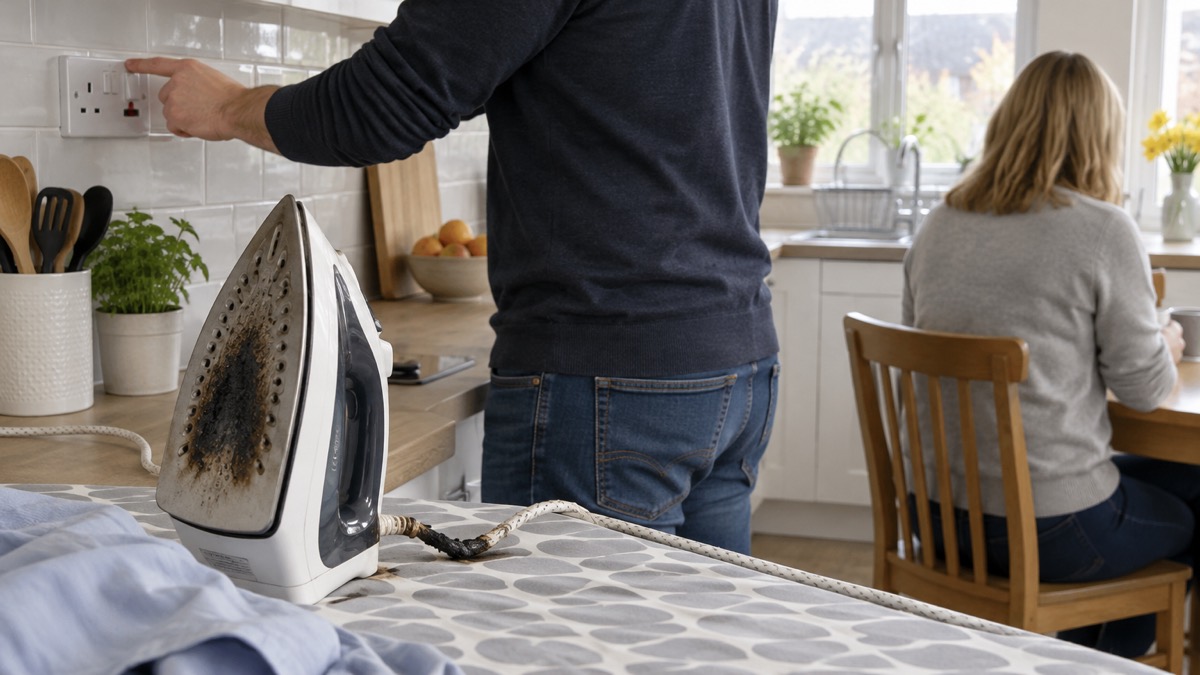
An electric shock happens when current passes through the body. The first thing to do is not to touch the person: if they are still in contact with the electrical source, you risk being electrocuted too1. Look at the area before you do anything else, and only approach once the current is off or the person is clear of it1.
Once they are away from the electricity, phone 999 for emergency help1. An electric shock can burn tissue as the current passes through, so a small mark on the skin does not tell you how serious it is: go to A&E or seek urgent medical advice for an electrical burn2. Do not move someone with an electrical injury unless they are in immediate danger and no longer in contact with the electricity1.
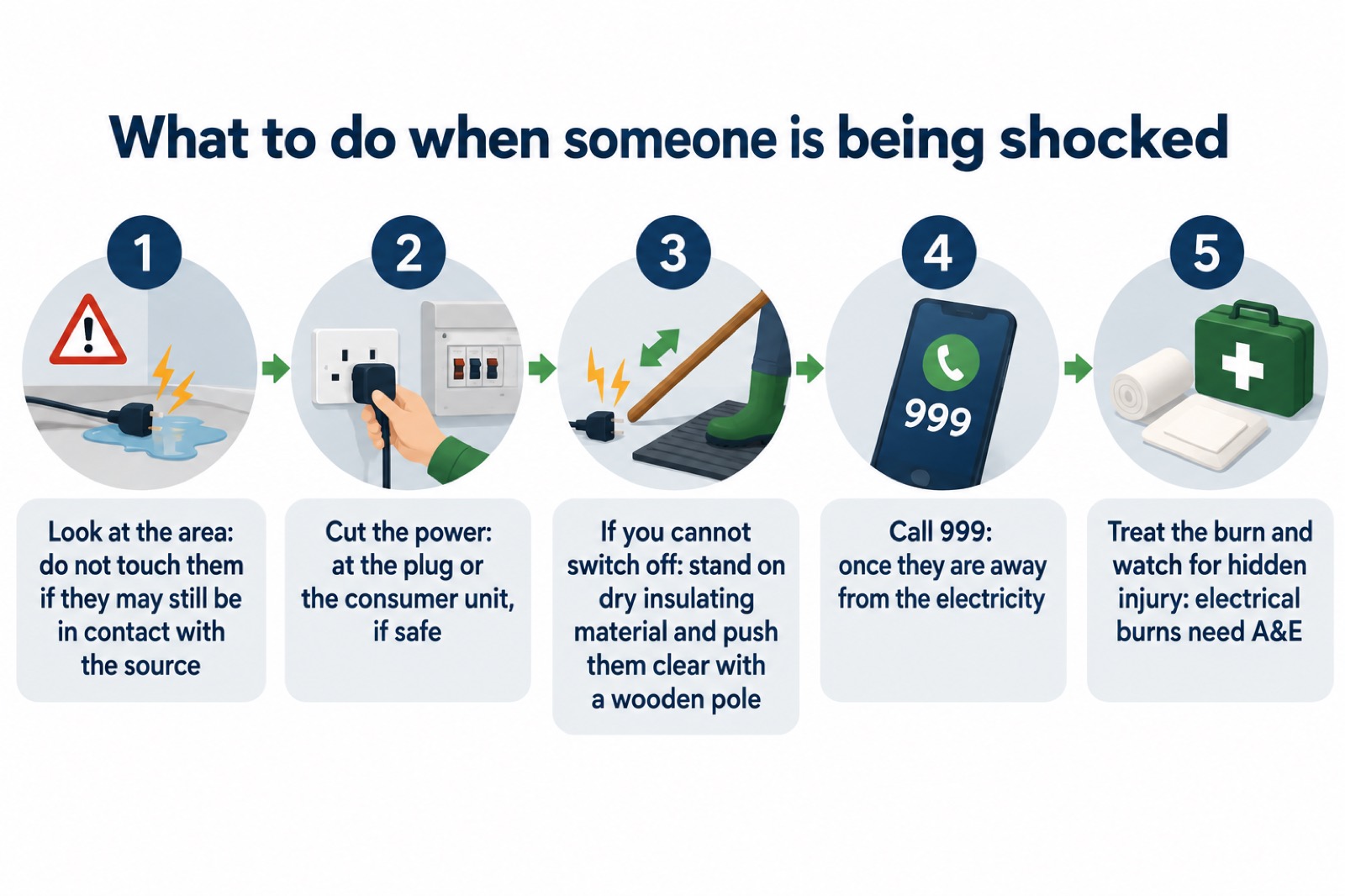
This page sets out the order to work in: make the area safe, cut the power, break contact with dry insulating material if you must, call 999, and then watch for the hidden injury. It also covers the situations that catch households out, from a wet bathroom to cables brought down by a storm.
Look before you touch: make the area safe first
The instinct to grab someone who is being shocked is the most dangerous thing you can do. Official first aid guidance is blunt: do not touch the injured person, because if they are still in contact with the electrical source you will be at risk of electrocution yourself1. Before any treatment, look at the area and work out what is live and what is not1.
That check is the same discipline the Health and Safety Executive asks of anyone working near electricity: look for wires, cables or equipment near where you are going to work, and check for signs warning of danger5. At home the hidden risk is cable you cannot see, because electrical cables may run within walls, floors and ceilings, especially where someone is drilling5. The same principle applies in an emergency: assume a cable or appliance may be live until you have made it safe.
If there is more than one person present, the general rule for any emergency applies: check for injuries, help yourself before attempting to help others, follow the advice of the emergency services, and do not put yourself or others in danger6. A second casualty helps nobody.
Cut the power at the plug or the consumer unit
The cleanest way to break the contact is to switch the electricity off. If the shock is coming from an appliance, pull the plug out or switch the power off at the socket if it is safe to do so8. If the supply itself is the problem, switch off the electricity supply at the fusebox, which is also called the consumer unit, if it is safe to do so3.
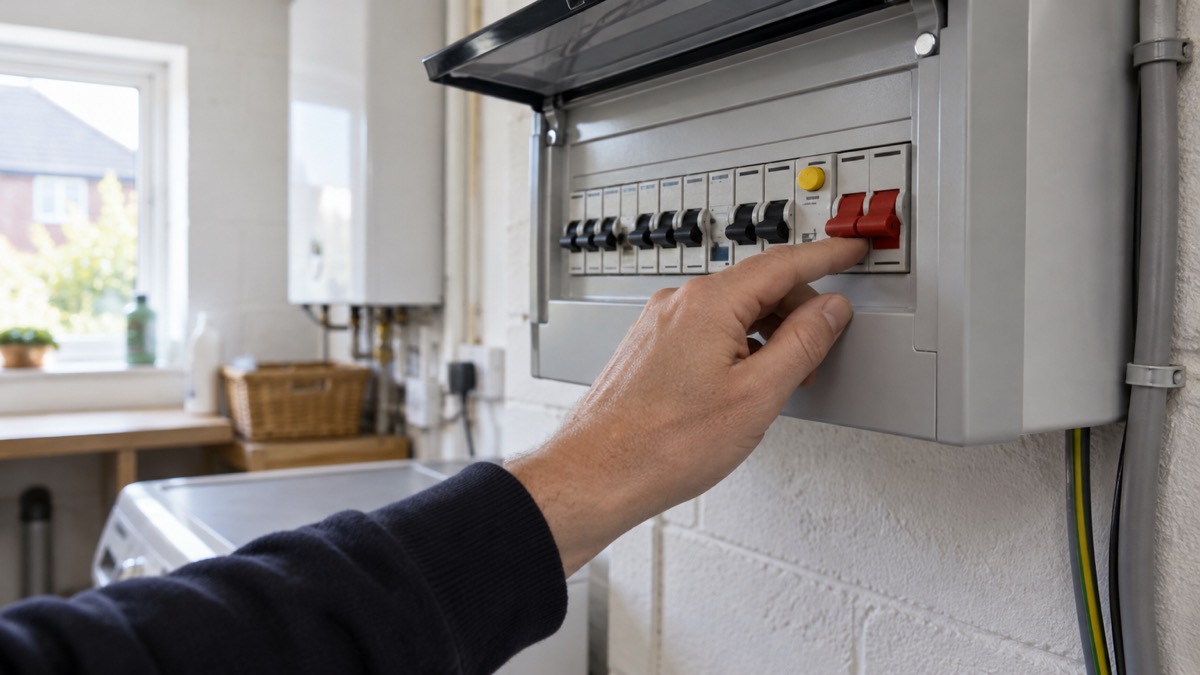
Knowing where that unit is before you need it matters. It is usually a grey or white box with a row of switches, often near the front door, under the stairs or in a hallway cupboard. If your unit has a residual current device, look for a button marked Test or T: pressing it will switch off the power to the areas of the home it protects9. That button is a quick way to confirm the device works, and a quick way to kill the power in an emergency.
A few practical points:
- Keep the route clear. A consumer unit behind stored boxes is no use in a hurry.
- Know the main switch. It is normally the largest switch at one end of the row.
- Have a tool to hand. A wrench or pliers to turn off utilities belongs in a household emergency kit10.
- Switch off at the consumer unit only if it is safe to do so. Electrical Safety First gives that condition for turning off the electricity supply at the fusebox when a home has been flooded7.
If the shock has started a fire, the advice changes: pull the plug out or switch the power off if it is safe to do so, then get out, stay out and call 9998. Do not tackle a growing electrical fire.
Moving someone off a live source with dry insulating material
Sometimes you cannot reach the switch, or the person is gripping something you cannot unplug. In that case you may be able to move the casualty away from the source. Stand on some dry insulating material, such as a plastic mat or a wooden box, and use a broom handle or wooden pole to push the casualty's limb away from the source7.
The same approach is given for children: if you cannot turn off the power, push the child away from the source of the electricity with a wooden or plastic object, such as a broom handle11. The principle is the same at any age: dry, non-conducting material between you and the current.
What you must not do is reach in with your hands, or use anything wet, metal or damp. And once the person is free, do not move them unless they are in immediate danger and no longer in contact with the electricity1. Moving someone with an electrical injury can make things worse.
Call 999 once the person is away from the electricity
Once the person is clear of the current, phone 999 for emergency help1. The St John Ambulance guidance gives the same number, and adds 112 as an alternative: call 999 or 112 for emergency help7. Both work in the UK.
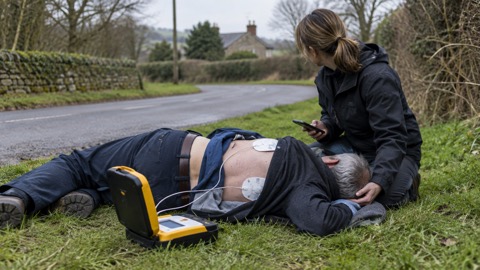
While you wait, stay calm12. Give the call handler the address, what happened, whether the person is breathing and whether there are burns. If the person is unconscious and not breathing normally, start CPR and send someone for a defibrillator; our guide to the primary survey and hands-only CPR sets out the steps.
A power cut can complicate the call. If you have a power cut and no back-up power to your landline, or only a corded phone, and you have a life-threatening emergency, attempt to call 999 or 112 using a mobile: emergency calls automatically roam onto all available networks, so you may get a signal from a nearby area that is not affected13. If you still cannot get through, and it is safe to do so, seek help directly from emergency responders or go to your nearest police station, fire station, ambulance station or hospital14.
If you spot damaged or dangerous electrical equipment, including during or after a power cut, report the problem, but call 999 in an emergency15.
Never touch the casualty with bare hands while the current may be live
This is the rule that saves rescuers. Do not touch the casualty if they are still in contact with the electrical source, as you are at risk of electrocution7. The same warning appears in official storm advice: never touch damaged electricity equipment4. And do not approach any damaged electricity equipment or broken power lines16.
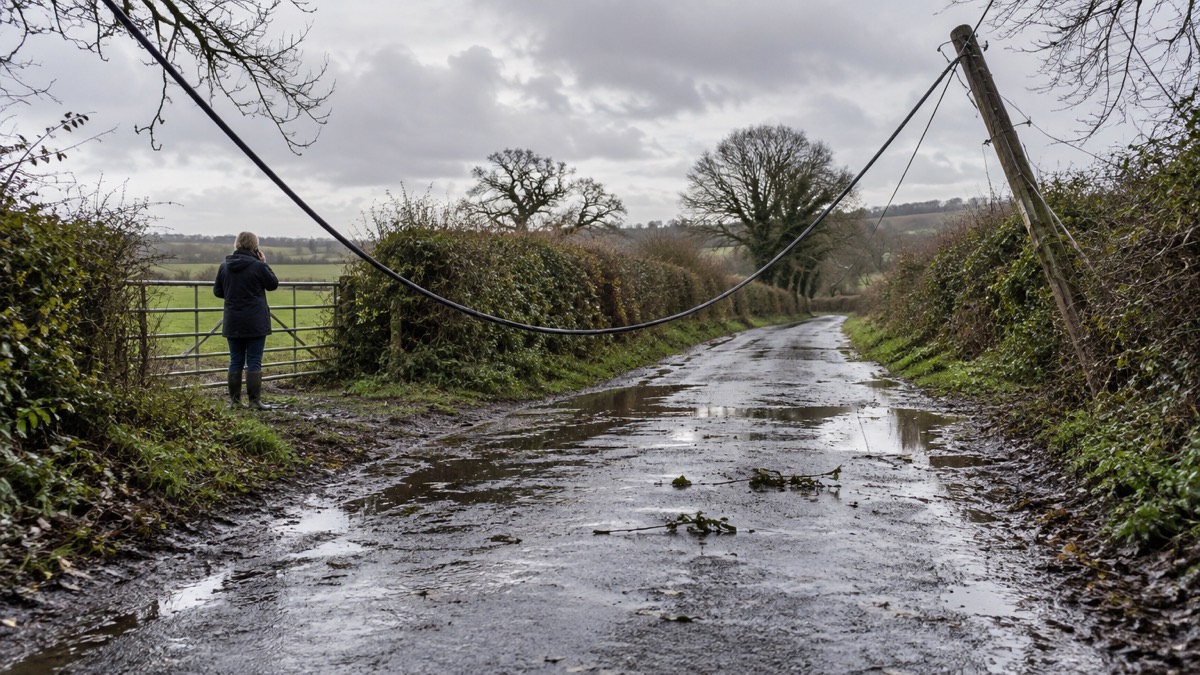
Outdoors, the risk is often a cable you did not expect. High-voltage electric shocks are more likely in industry jobs, and can also happen if you come into contact with a power line1. After a storm, be careful not to touch any electrical or telephone cables that have blown down or are still hanging, and report them to the emergency services or the utility supplier17. The same advice applies in Northern Ireland, where official warnings say not to approach damaged electricity equipment or broken power lines16.
"Do not touch the casualty if they're still in contact with the electrical source as you are at risk of electrocution."
The rule holds even when it feels wrong to wait. If you cannot make the source safe, keep everyone back, call 999 and tell the handler what you can see. The fire and rescue service can isolate a supply that you cannot.
Burns after a shock: the injury you cannot see
An electric shock can burn on the way in and on the way out, and the damage underneath can be worse than the mark on the skin. The official advice is clear: go to A&E or seek urgent medical advice for a chemical or electrical burn2. Do not treat it at home with a plaster and hope.
While help comes, cool the burn. Our guide to burns and scalds covers how long to cool and how to cover, and the comparison of burn gel or cling film explains the covering options. Do not put butter or ice on a burn; the reasons are set out in can you put butter or ice on a burn.
Watch for signs that the person is going into shock, which can follow a serious injury: pale, clammy skin, fast breathing, confusion. Our page on shock explains the signs and what to do while help comes. If the person becomes unconscious and stops breathing normally, move to CPR.
When hospital is needed, and when it is not
Not every shock needs an ambulance, but the threshold for a check is lower than most people assume. Go to A&E or seek urgent medical advice for an electrical burn2. Call 999 if the person is unconscious, has been badly burned, or is unwell.
| Situation | What to do |
|---|---|
| Person still in contact with the source | Do not touch them; cut the power or push them clear with dry insulating material1 |
| Person free of the source but unwell or unconscious | Call 9991 |
| Electrical burn, however small it looks | Go to A&E or seek urgent medical advice2 |
| Person feels fine, no burn, no symptoms | Still worth ringing 111 for advice if you are unsure |
If an ambulance is coming, stay calm and be ready to give the crew the information they need12. Our checklist of information to have ready for the ambulance crew lists what helps.
Shock in a wet bathroom, and shocks from small appliances
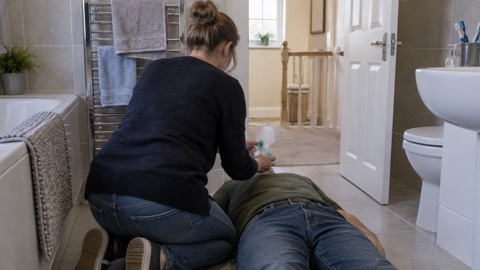
Water is a very effective conductor of electricity, so handling an electric appliance with wet hands can cause a shock7. A bathroom combines water, wet skin and often bare feet, which is why it deserves particular care. Keep electrical items away from baths, showers and sinks, and never reach for a plugged-in appliance with wet hands.
Small appliances cause shocks in ordinary homes too. Low-voltage shocks can happen at home or at work1. Before use, look for visible signs of damage such as frayed cords, exposed wires or discoloured patches18. If you have sight difficulties, check electrical leads by touch before plugging in or switching on, and avoid using anything that feels damaged19.
After a flood, the risk rises sharply. Switch off the electricity supply at the fusebox if it is safe to do so, and do not switch on any electrical appliances in the areas affected by the flood until they have been tested and assessed as safe by a registered electrician3. You will need to turn off any electricity until a qualified electrician or utility company has checked all switches, sockets and appliances, then use a circuit breaker with any electrical equipment used in or to clean and repair the property20. Our guide to flooding covers the wider clean-up.
Sources (20)
- Electric shock first aid, NHS Inform, 2026-07-24
- Burn awareness, Cheshire Fire and Rescue Service, 2026-05-20
- Flooding advice, Electrical Safety First, 2026-10-26
- Strong winds and heavy rain warning: information and advice, nidirect, 2026-01-27
- Introduction to electricity, Health and Safety Executive, 2026
- Prepare yourself, Greater Manchester Combined Authority, 2026-10-29
- Electrocution first aid advice, St John Ambulance, 2026-10-28
- Electrical fire safety, Warwickshire County Council, 2026-10-29
- Electrical safety for an ageing society, Electrical Safety First, 2026-10-26
- Get help and advice in an emergency, Create an emergency kit - Lincolnshire County Council, Lincolnshire County Council
- What to do if your child has an accident, NHS, 2025-12-18
- What to do when the ambulance is coming, South Western Ambulance Service, 2026-10-29
- Loss of essential services, Greater Manchester Combined Authority, 2026-10-29
- Phone and broadband outages, Prepare campaign, 2026-10-12
- Power, gas and water: what if they fail, Surrey County Council, 2025-12-29
- Strong winds weather warning: information and advice, nidirect, 2026-10-24
- Storms and gales, Lancashire Prepared, 2026-10-29
- Electrical fire safety tips, Warwickshire County Council, 2026-10-29
- For people with disabilities, Tyne and Wear Fire and Rescue Service, 2026
- After a flood, Surrey County Council, 2026-09-23
 Baby and Child Kit Checklist
 Bleeding Control Kit Checklist
 Car Kit Checklist
 CPR on a Baby
 CPR on a Child
 Chest Compression Rate and Depth
 Rescue Breaths or Hands-Only CPR
 Checking Breathing
 Agonal Breathing and CPR
 Breathing During CPR
 Recovery Position and Spine
 Cardiac Arrest vs Heart Attack
 Heart Attack First Aid
 Defibrillator Pad Placement
 Defibrillator on a Child