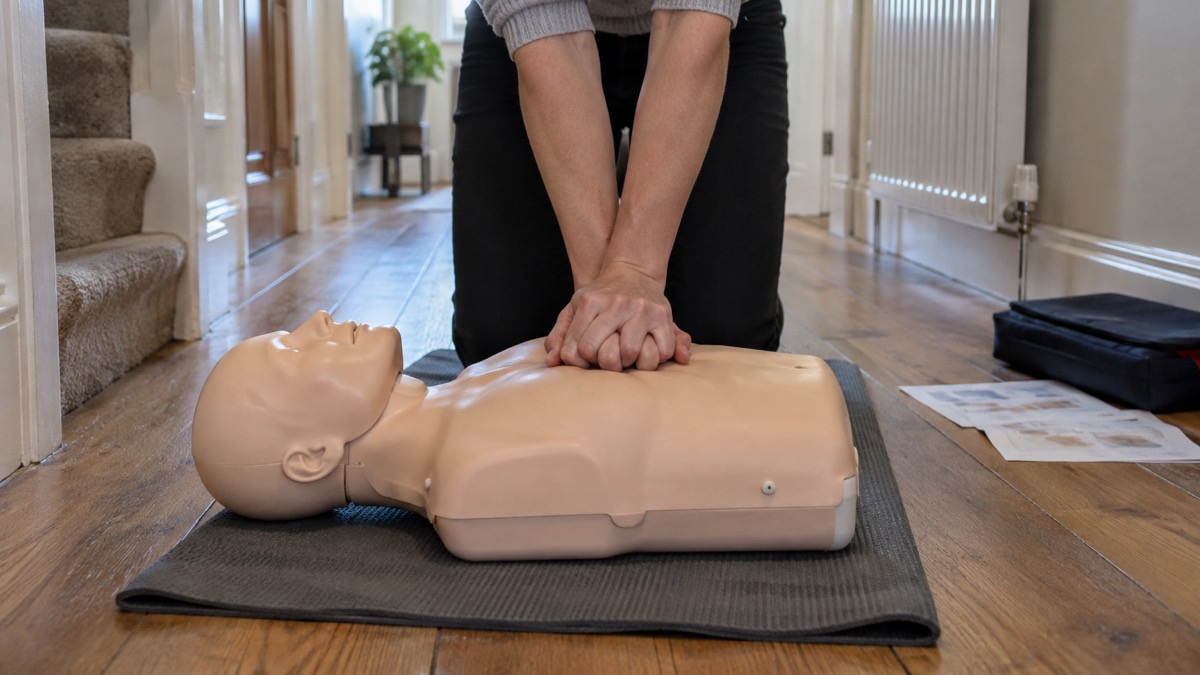
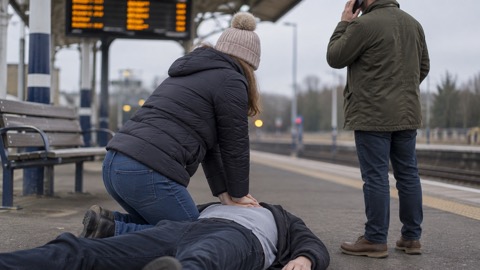
If an adult is unresponsive and not breathing normally, call 999 or 112 immediately and start CPR straight away: put the heel of your hand on the centre of their chest, your other hand on top, and push hard and fast, about twice a second1. Ask someone nearby to fetch a defibrillator if one is available1. You do not need training to do this, and the ambulance call taker will talk you through it while help is on its way1.
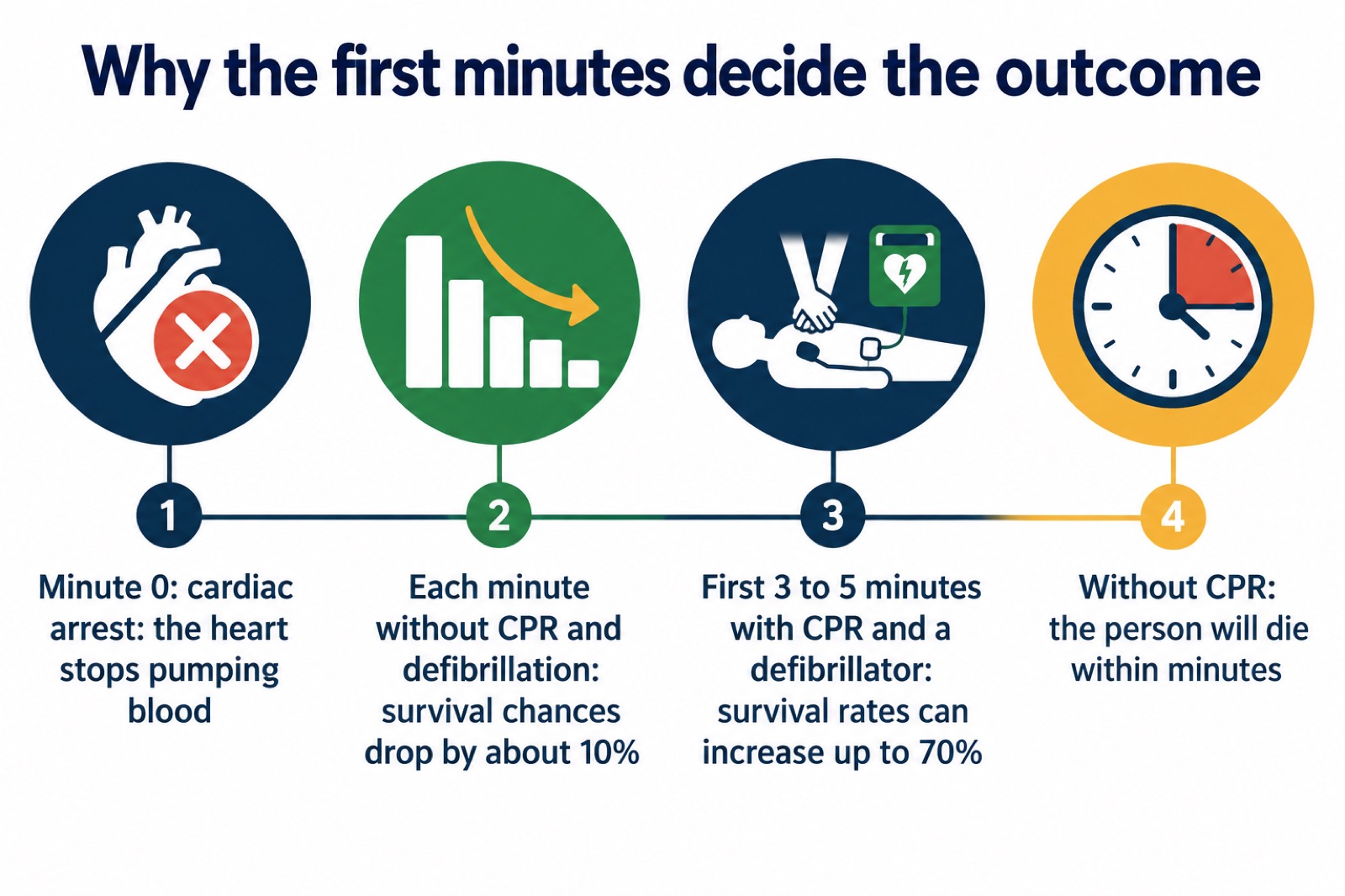
The reason to act without hesitation is simple: a person in cardiac arrest will die within minutes unless treated immediately with CPR, and survival chances drop by about 10% for every minute without CPR and defibrillation2. When early CPR and a defibrillator are used within the first 3 to 5 minutes, survival rates can increase up to 70%4. Your compressions keep blood flowing to the brain and organs until an ambulance crew or a defibrillator can restart the heart.
How to tell someone is in cardiac arrest
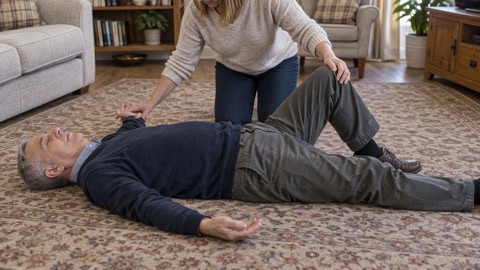
A cardiac arrest is when the heart suddenly stops beating effectively to supply blood to the major organs7. The signs come on instantly. The person loses consciousness and will not respond to you, they collapse, and they stop breathing or do not breathe normally8. NHS inform describes what you may see: slow breaths, gasping, or short periods that look like a fit8.
Check for a response first. Gently shake the person's shoulders and talk to them, asking if they are okay10. If there is no response, shout for help and open the airway: place one hand on the forehead and gently tilt the head back, then place the fingertips of your other hand under the chin and lift10. Then look, listen and feel for up to 10 seconds for normal breathing1.
Before you approach anyone who has collapsed, check for danger to yourself9. This is the first step of the primary survey, and it matters: you cannot help if you are injured too. Our page on what to do first: danger, response, airway and breathing covers the full sequence.
Occasional gasps are a sign of cardiac arrest, not breathing
This is the point most bystanders get wrong, and it costs lives. A person in cardiac arrest will often take occasional gasps. The Scottish Ambulance Service is explicit:
"Patients who are in cardiac arrest will often take occasional gasps, this is a sign of cardiac arrest and not them trying to breathe."9
So when you check breathing, ignore occasional, irregular gasps: they are common in cardiac arrest and do not count as normal breathing1. If the person is unresponsive and you cannot confirm normal breathing within 10 seconds, treat it as cardiac arrest, call 999 and start compressions1. Our page on agonal breathing goes into this in more detail.
Call 999 and send someone for a defibrillator
If the person is not breathing, phone 999 and start CPR immediately, and ask someone nearby to get a defibrillator11. If you are on your own, call 999 first, or 112, which works the same way1. The call taker will give you instructions to help you deliver CPR and can tell you if there is a public access defibrillator nearby13.
Do not put off calling to search for a defibrillator yourself. The intervention the London Ambulance Service asks for, even from people with no formal training, is: calling 999 immediately, starting chest compressions if it is safe to do so, and sending someone to get a defibrillator if one is nearby14. If someone else is present, send them: one of you compresses, the other runs for the defibrillator and waits to let the crew in.
Hands-only CPR step by step
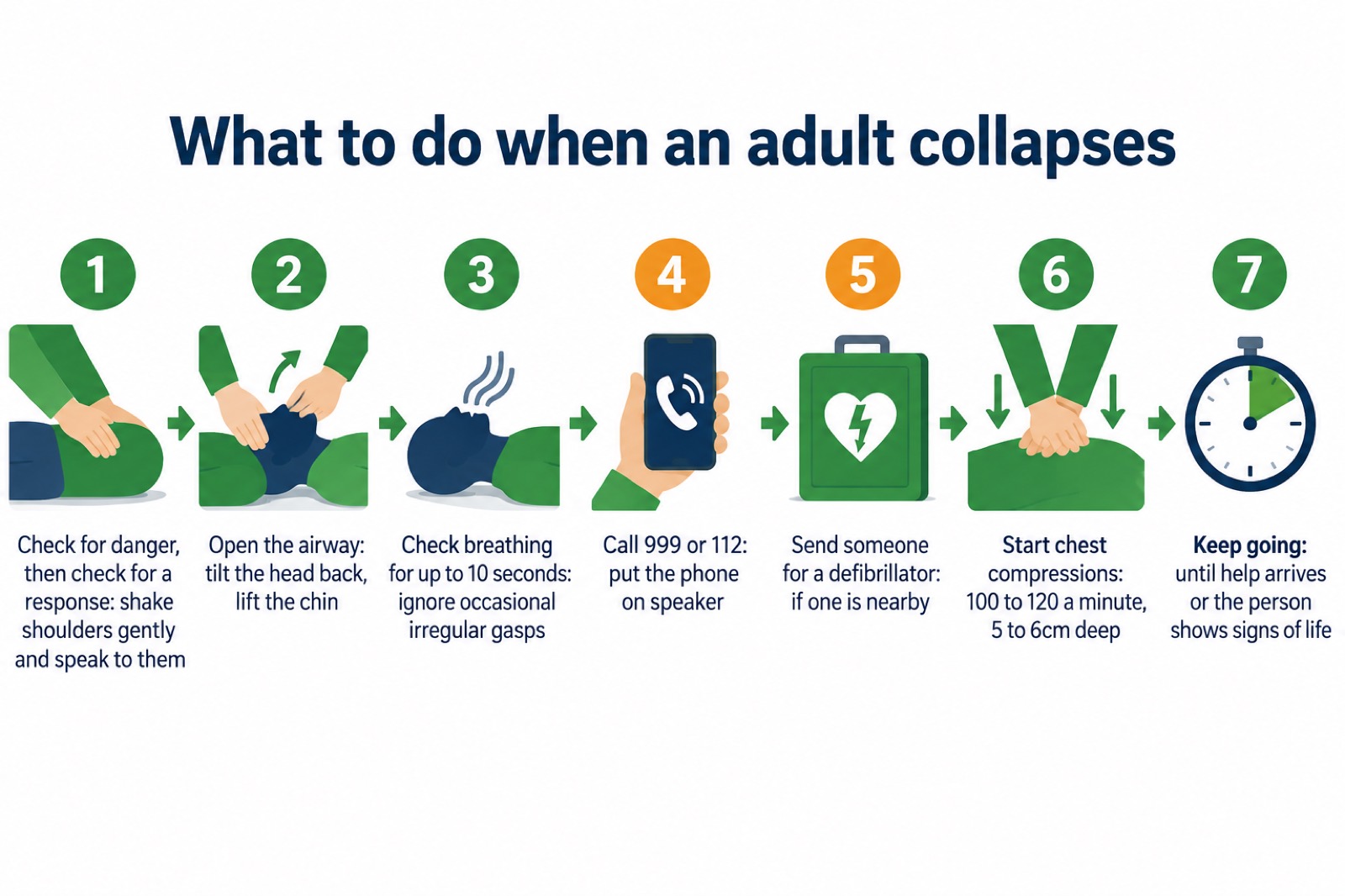
Hands-only CPR means chest compressions without rescue breaths. It is what the ambulance services ask of an untrained bystander, and it works because your compressions take over the heart's job of pumping blood around the body when the heart cannot15. Here is the sequence, following the Yorkshire Ambulance Service's Restart a Heart steps2:
- Check it is safe to approach, then check for a response by gently shaking the shoulders and speaking to the person10.
- Open the airway: tilt the head back with a hand on the forehead and lift the chin with your fingertips10.
- Check breathing for up to 10 seconds, looking, listening and feeling. Ignore occasional irregular gasps1.
- Call 999 or 112 and put the phone on speaker if you can, so you can compress while you talk1.
- Kneel beside the person and place the heel of your hand on the breastbone at the centre of their chest2.
- Place your other hand on top of the first and interlock your fingers2.
- Position your shoulders above your hands and keep your arms straight2.
- Press straight down by 5 to 6cm using your body weight, not just your arms2.
- Release the compression, keeping your hands on their chest, and let the chest return to its original position2.
- Repeat at 100 to 120 compressions a minute until an ambulance arrives, you become exhausted, or the person shows signs of regaining consciousness, such as coughing, opening their eyes, speaking or breathing2.
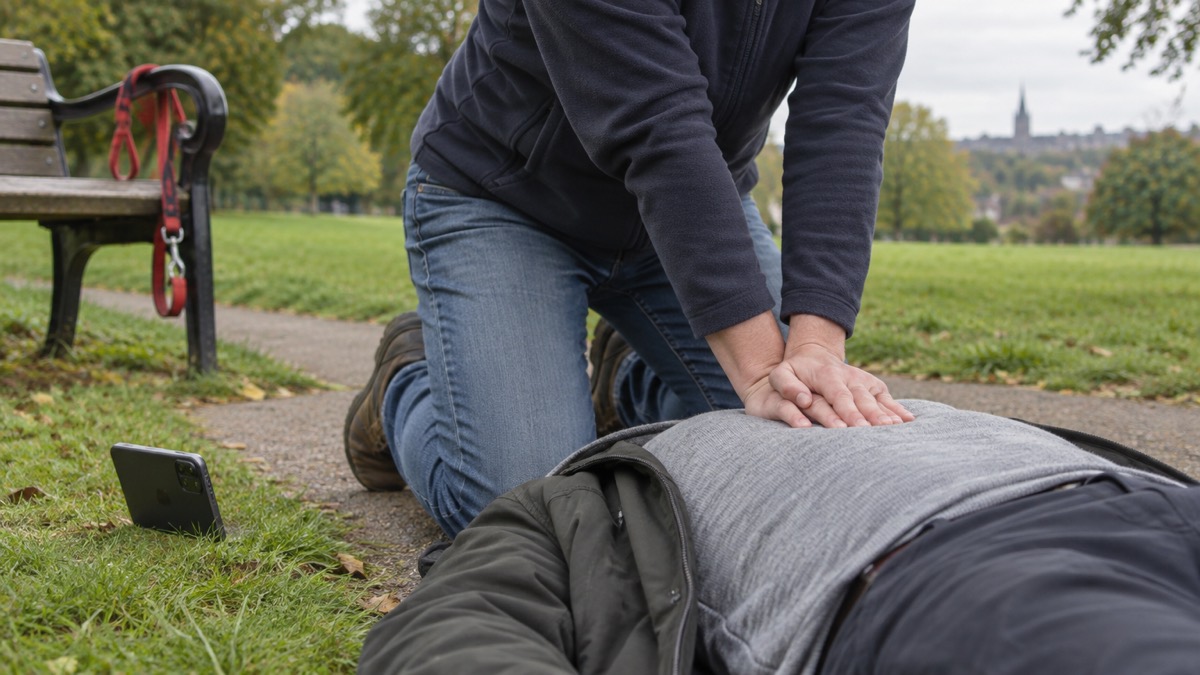
One reassurance worth carrying with you, from the North East Ambulance Service:
The NHS is clear that you should not be afraid to try: chest compressions carry far more benefit than risk, and doing something is always better than doing nothing. Keep going until an ambulance arrives, you become exhausted, or the person starts to show signs of regaining consciousness such as coughing, opening their eyes, speaking or breathing18.
Push hard and fast: twice a second in the centre of the chest
The two numbers that decide whether your compressions work are the rate and the depth. The rate is 100 to 120 compressions a minute2, which the North West Ambulance Service describes as twice per second19, and which the South Western Ambulance Service suggests keeping to the beat of "Staying Alive"20. The depth is 5 to 6cm, roughly two to two and a half inches, about a third of the depth of the person's chest2.
Both numbers matter for the same reason. Press too shallowly and the blood is not moved; press too slowly or too fast and the heart does not refill between compressions. Let the chest come back up fully between compressions before pressing down again, but do not take your hands off the chest1. Keep your arms straight and use your body weight rather than your arm muscles: you will tire far more slowly, and this is a marathon, not a sprint2.
Where you press matters too: the centre of the chest, between the nipples, on the breastbone20. Interlock your fingers and keep them off the ribs so the force goes straight down through the breastbone2. Lean directly over the person so that you press vertically, not at an angle10.
If you want to build the muscle memory before you ever need it, Save a Life Scotland suggests practising the motions on a cushion or pillow at home21. Our page on how fast and how deep chest compressions should be takes the detail further.
Rescue breaths: 30 compressions to 2 breaths if you are trained
Full CPR combines chest compressions with rescue breaths. The ratio is 30 compressions to 2 breaths: give 30 compressions at a rate of 100 to 120 per minute, then 2 rescue breaths, and keep alternating 30:215. NHS inform is clear about who should attempt this: only give rescue breaths if you have been trained in CPR; otherwise provide chest compressions only15.
If you are trained and giving breaths, stick to two attempts to get the breaths in. If one or both do not work, return to chest compressions rather than keep trying1. The compressions are doing the life-saving work, and every second spent on failed breaths is a second without blood flow.
The same 30:2 cycle applies in specific circumstances even for trained rescuers: NHS inform's drowning first aid guidance, for example, says to continue 30 compressions with 2 rescue breaths until help arrives, the person shows signs of becoming responsive, or you are too exhausted to continue18. Our page comparing rescue breaths and hands-only CPR sets out the choice in full.
Using a defibrillator: switch it on and follow the instructions
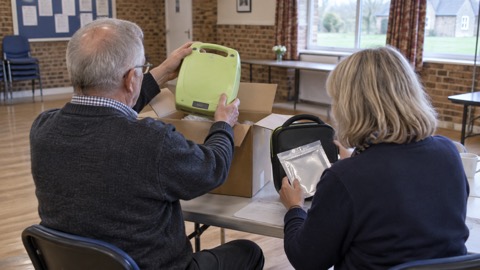
A defibrillator, also called an AED, delivers a controlled shock that can reset the heart's electrical rhythm. You do not need to be trained to use one. The London Ambulance Service puts it plainly:
You do not need to be trained to use a defibrillator. When you switch it on, it will give you clear instructions on what to do. A public access defibrillator talks you through each step when you switch it on, so the machine itself is your guide: attach the pads to the person's bare chest and follow every voice prompt, and it will either deliver a shock automatically or tell you to press a button.
Switch it on as soon as it arrives, follow the spoken instructions, and apply the pads to the bare chest where the diagrams show22. The device analyses the heart rhythm itself and will only deliver a shock if one is needed; it will tell you when to stand clear and when to resume compressions. While it analyses, it will tell you to stop CPR1.
Keep CPR going right up to the moment the defibrillator is ready, and start again the instant it tells you to. The South Central Ambulance Service guidance for community defibrillator schemes notes that the bystander should continue to provide CPR until directed to stop by the ambulance service professionals23. If you want to know more, our pages on defibrillators and how to use one, finding the nearest public access defibrillator and where the pads go cover the detail.
Keep going until the ambulance arrives
Continue chest compressions until one of four things happens: emergency help arrives and takes over; the person shows signs of becoming responsive, such as coughing, opening their eyes, speaking or moving purposefully; the person starts breathing normally; or you are too exhausted to continue10. A fifth stopping point applies if a defibrillator is connected and tells you to stop while it analyses the heart rhythm, in which case you resume when it tells you to1.
While you wait for the ambulance, stay calm24, and if you are outside, stay with the patient until help arrives25. Keep giving CPR until the ambulance service arrives and takes over, the person starts showing signs of life and breathing normally, or you are too exhausted to continue26. If the ambulance crew arrives while you are still giving CPR, keep going until the professionals tell you to stop26.
Exhaustion is a real limit, not a failure. Compressions are hard work, and if there is a second person present, swap every few minutes to keep the depth and rate up. What matters is that the compressions do not stop for long.
Every minute without CPR cuts survival by about 10%
The numbers behind the urgency are consistent across every UK ambulance service. Survival chances drop by about 10% for every minute without CPR and defibrillation, according to the Northern Ireland Ambulance Service27, and the East of England Ambulance Service gives the same figure for every minute in cardiac arrest without CPR and a defibrillator being used3. The South Western Ambulance Service adds that without CPR, the person will die within minutes20.
The other side of that arithmetic is why bystanders matter more than ambulances. When early CPR and a defibrillator are used within the first 3 to 5 minutes, survival rates can increase up to 70%4. No ambulance can reliably reach that window, but a neighbour with hands and a nearby cabinet can. That is also why NHS England's work on improving cardiac arrest outcomes focuses on bystander tools, including a short 2-minute video on how to do CPR, available in nine languages7.
One further point from NHS England's resources deserves plain words: women are statistically less likely to receive bystander CPR than men7. If the person in front of you is in cardiac arrest, the action is the same whoever they are. Call 999, put your hands on the centre of the chest, and push.
Cardiac arrest or heart attack: how they differ
The two conditions are confused constantly, and the confusion changes what people do. A cardiac arrest is caused by an electrical problem in the heart, which then stops pumping blood around the body and brain20. A heart attack is a circulation problem, a blockage that starves the heart muscle of blood. A heart attack can lead to a cardiac arrest, but they are not the same event, and the response differs.
In a cardiac arrest the person is unresponsive and not breathing normally, and the answer is CPR and a defibrillator, now8. In a suspected heart emergency, NHS inform advises calling 999, and if you are outside, staying with the patient until help arrives25. If someone is suffering from either condition you need to call 999 for an ambulance immediately14. Our page on cardiac arrest and heart attack: how to tell them apart gives the full comparison, and what to do if someone is having a heart attack covers that response.
Children and babies need a different technique
Everything on this page is for adults. For a child or baby the technique changes, and rescue breaths carry more weight, so do not apply the adult sequence unchanged. For a child aged 1 or over, open the airway by tilting the head back with a hand on the forehead and lifting the chin, place the heel of one hand on the centre of the chest, and press down vertically on the breastbone to about one third of the chest's depth, keeping your arm straight26. Give 2 rescue breaths after 30 compressions if you are trained28.
For a baby under one, open the airway with the head in a neutral position, head and neck in line, lifting the chin with fingertips under the point of the chin, and place 2 fingertips of your lower hand on the centre of the baby's chest for compressions26. Again, give 2 rescue breaths after 30 compressions if trained29. Continue until the child shows signs of life, such as normal breathing, coughing or movement, or qualified help arrives26.
The full sequences are on our dedicated pages: how to do CPR on a child and how to do CPR on a baby under one.
Choking, drowning and other causes of collapse
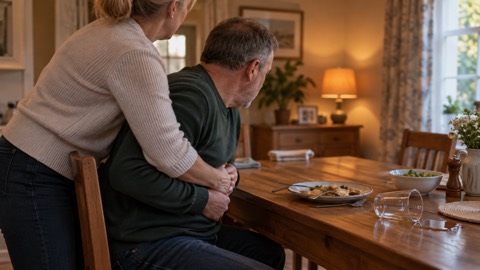
Cardiac arrest is not the only reason someone stops breathing, but the response converges on the same action. If an adult who is choking becomes unresponsive, open the airway by lifting the chin and tilting the head back, check their breathing, and begin CPR if they are not breathing30. Our page on what to do if someone is choking covers the earlier stages, when the person is still conscious and coughing.
The same is true of poisoning: NHS guidance is to start CPR if someone is unresponsive and not breathing31. After a near drowning, trained rescuers continue 30 compressions with 2 rescue breaths until help arrives, the person shows signs of becoming responsive, or exhaustion sets in18. Whatever the cause, the check is the same: unresponsive and not breathing normally means 999 and compressions.
Learning CPR before you need it
The South Western Ambulance Service's community sessions cover how to recognise a cardiac arrest, how to perform effective CPR, how to safely use a public access defibrillator, and what happens when you call 9994. Free online options exist too, and our page on learning CPR free online lists them, alongside our general guide to first aid courses.
Knowing where your nearest defibrillator is kept before an emergency is as valuable as the training. The South Western Ambulance Service notes that for every minute that passes once in cardiac arrest, a person loses a further 10% chance of survival32, so the minutes spent finding a cabinet are the minutes that matter. Walk your local area, note the cabinets, and check our page on how to get the code for a locked defibrillator cabinet so nothing slows you down on the day.
For the wider picture of what a household should be ready for, see our first aid at home guide and our page on how ambulance services prioritise 999 calls.
Sources (32)
- How to do CPR, NHS, 2026
- How do I perform CPR?, Yorkshire Ambulance Service Restart a Heart, 2026
- Cardiac arrest, East of England Ambulance Service, 2026
- CPR and defibrillator training, South Western Ambulance Service, 2026
- What to do when someone isn't breathing, North West Ambulance Service, 2025
- Learning CPR, Scottish Ambulance Service, 2026
- Improving outcomes in cardiac arrest: tools and resources, NHS England, 2026
- Cardiac arrest, NHS inform, 2026
- Cardiac arrest, Scottish Ambulance Service, 2026
- How to give an adult CPR, NHS inform, 2026
- How to do a primary survey, NHS inform, 2026
- Phoning 999, Scottish Ambulance Service, 2026
- Paediatric cardiac arrest first aid guide, North East Ambulance Service, 2024
- Emergency heart care, London Ambulance Service, 2026
- How to give an adult CPR, NHS inform, 2026
- Learning CPR, North East Ambulance Service, 2026
- Remember these steps to learn how to save a life, London Ambulance Service, 2026
- Drowning first aid, NHS inform, 2026
- How to do CPR, North West Ambulance Service, 2025
- Restart a Heart, South Western Ambulance Service, 2026
- How to perform CPR, Save a Life Scotland, 2024
- Defibrillators, London Ambulance Service, 2026
- Public access defibrillator information pack, South Central Ambulance Service, 2026
- What to do when the ambulance is coming, South Western Ambulance Service, 2026
- What to do in a heart emergency, NHS inform, 2026
- How to resuscitate a child, NHS, 2026
- Community first responders, Northern Ireland Ambulance Service, 2026
- How to give a child CPR, NHS inform, 2026
- How to give a baby CPR, NHS inform, 2026
- Adult choking first aid, NHS inform, 2026
- Poisoning, NHS, 2025
- Defibrillators, South Western Ambulance Service, 2026
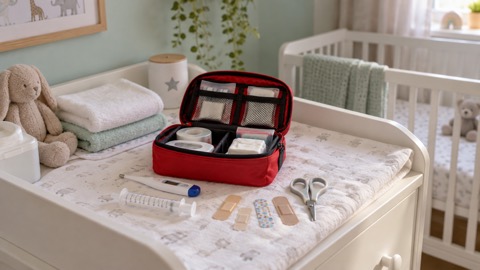 Baby and Child Kit Checklist
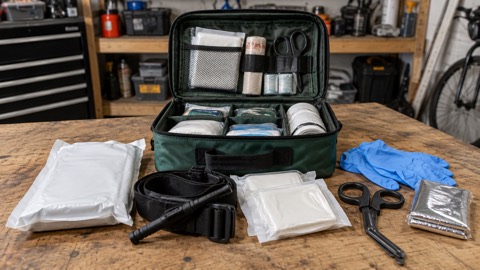 Bleeding Control Kit Checklist
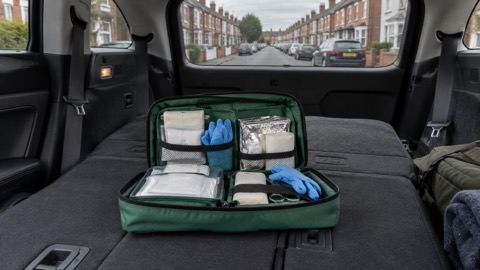 Car Kit Checklist
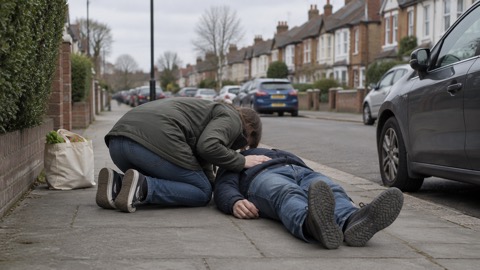 Danger, Response, Airway
 2025 Resuscitation Guidelines
 Defibrillators (AEDs)
 Public Access Defibrillators
 Choosing a Defibrillator
 The Recovery Position
 Choking First Aid
 Cuts, Grazes and Wounds
 Burns and Scalds
 Adrenaline Auto-Injectors
 Sepsis Signs to Act On
 Shock Signs and What to Do