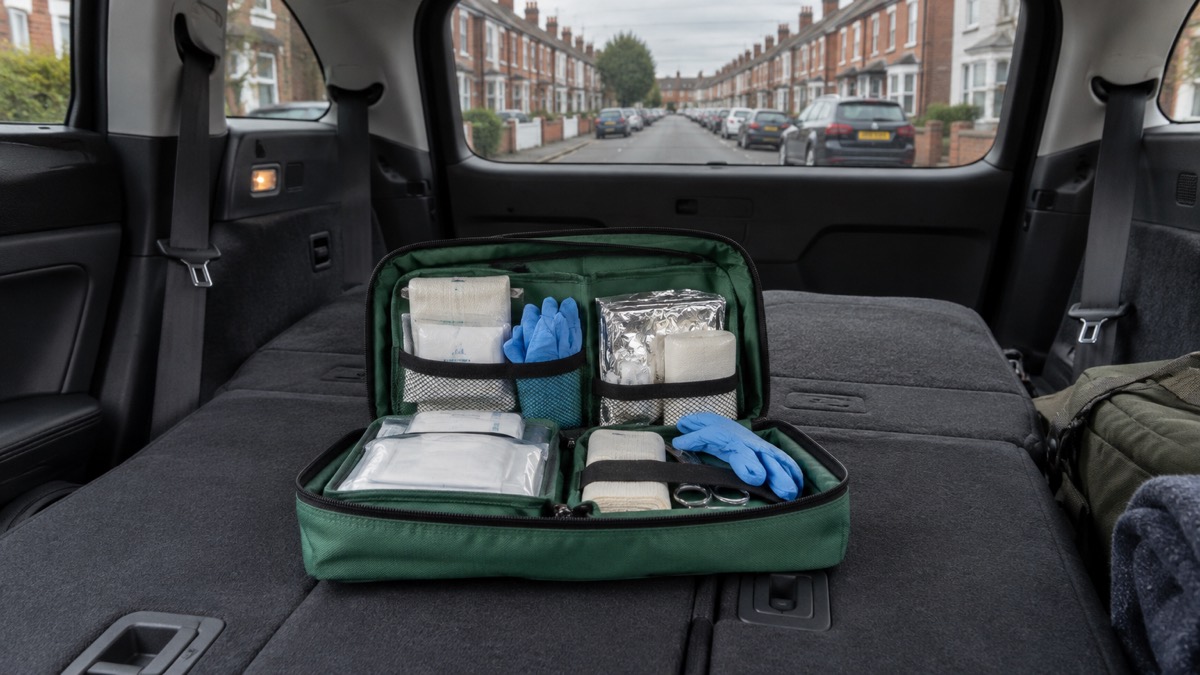
A first aid kit in the car is one of the simplest pieces of household preparation, and one of the most often forgotten. There is no legal duty on an ordinary driver to carry one, but the government's travel advice, the NHS and councils across the UK all recommend keeping a kit in the vehicle in case you are delayed, stranded or first on the scene of a collision1. The NHS suggests you can either buy a ready-made kit or put your own together in a clean, waterproof box1.
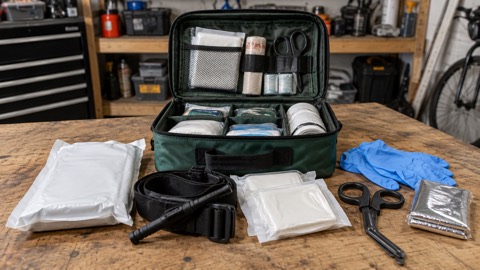
What goes in it is straightforward. The NHS lists plasters in a range of sizes and shapes, small, medium and large sterile gauze dressings, at least two sterile eye dressings, triangular bandages, crepe rolled bandages, safety pins, disposable sterile gloves, tweezers, scissors, alcohol-free cleansing wipes, sticky tape, a thermometer, and distilled water for cleaning wounds, plus an eye wash and eye bath3. For a car, add a foil blanket and a resuscitation mask if you can, and keep a printed guidance leaflet with the kit.
The kit only helps if it is reachable and in date. Store it where you can get to it without leaving your seat, check it twice a year, and replace anything you use straight away. The sections below set out the full checklist, what each item is for, and how to keep the kit usable through hot summers and cold winters.
The car first aid kit checklist
Start with the NHS basic kit list, then add the few extras that matter for a vehicle. The list below covers every item, with a few words on why it earns its place. Tick each one off as you pack.
A first aid kit is one part of a wider car emergency kit, not a substitute for it.
What each item is for
The checklist above is long, but each item has a job. The table below groups the contents by what they do, so you can see at a glance whether your kit is complete.
| Group | Items | What they do |
|---|---|---|
| Covering cuts | Plasters, sterile gauze dressings, sticky tape | Protect a wound and keep it clean1 |
| Holding things in place | Triangular bandages, crepe bandages, safety pins | Support an injury or secure a dressing1 |
| Protecting you | Disposable sterile gloves, resuscitation mask | Reduce the risk of contact with blood and other fluids1 |
| Cleaning | Alcohol-free wipes, distilled water, eye wash and eye bath | Clean around a wound and rinse an eye7 |
| Small jobs | Tweezers, scissors | Remove a splinter, cut a dressing to size1 |
| Checking and keeping warm | Thermometer, foil blanket | Check a temperature, keep a casualty warm1 |
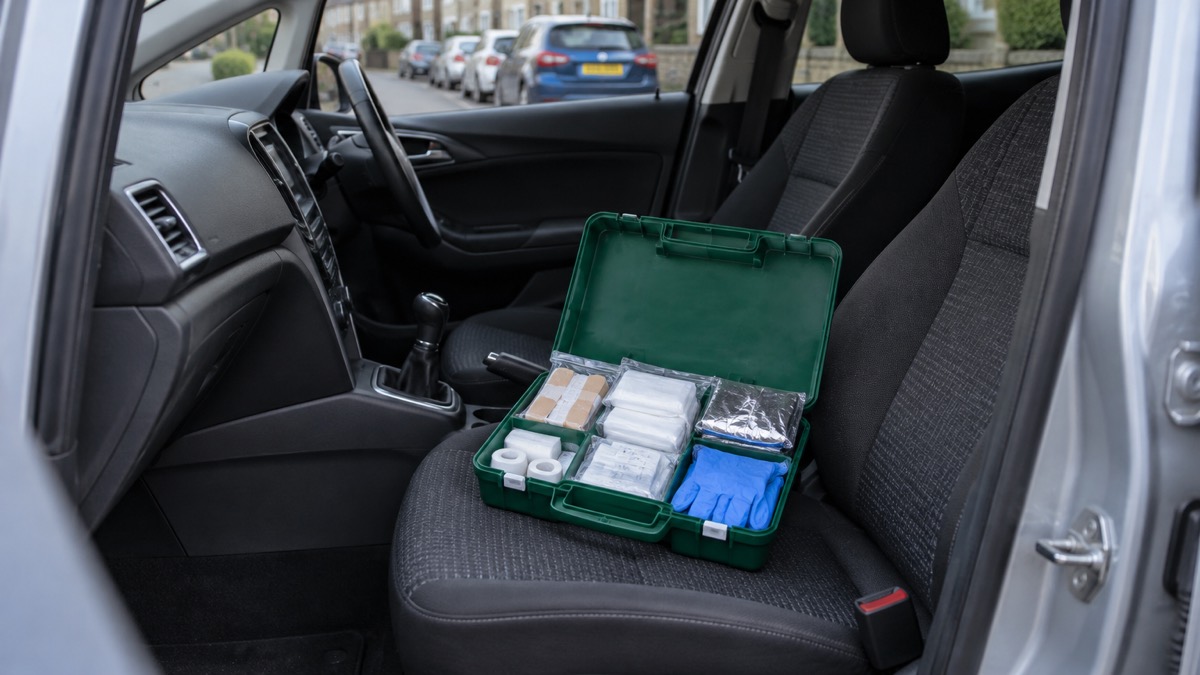
The NHS list is a starting point, not a fixed specification. The Health and Safety Executive is clear that its own workplace contents list is "a suggested contents list" rather than a mandatory one8. The same logic applies at home: build a kit that suits your household, your car and the journeys you make.
For a car, the items that earn their place most often are plasters, cleansing wipes, gloves and a dressing large enough for a road rash or a cut from broken glass. A foil blanket is worth including if you may be waiting for help at the roadside in cold weather1.
Burns at the roadside
A burn is one of the injuries a car kit is most likely to meet: hot exhaust parts, a kettle at a picnic, a cigarette lighter, or a scald from a flask. The NHS advises covering a burn loosely with clean cling film, a plastic bag or a pillowcase5. Do not wrap it tightly, and do not use anything fluffy that will stick to the wound.
For a burn to the eye, the advice is to cover the eye lightly5. For an electrical burn, isolate the electrical source before you touch the casualty9. If the burn is large, deep, on the face, hands or genitals, or caused by electricity or chemicals, get medical help.
A small burn gel or hydrogel dressing can be a useful addition to a car kit, but the basic household items above are what the NHS advises first. If you want to go further, see the guide to burns and scalds and the comparison of burn gel or cling film.
The guidance leaflet and keeping the kit usable
A first aid kit is only as good as its condition. The NHS suggests keeping a home or car kit by buying a ready-made one or putting together your own in a clean, waterproof box1. A waterproof box matters in a car, where condensation, spills and damp coats are common.
The Health and Safety Executive includes a leaflet with general guidance on first aid in its minimum suggested contents for a low-risk workplace kit8. A short printed card in your car kit does the same job: it reminds you what to do and gives you something to follow if you are shaken. Keep it in a plastic sleeve so it stays dry.
Check the kit at least twice a year, and straight after you use anything from it. Replace opened plasters and dressings, and replace sterile items whose packaging is torn or damp. Wipes dry out and adhesive loses its grip in a hot car, so a spring and autumn check keeps the kit ready. If you use the kit at an incident, restock it before the next journey.
Where to get help and what else to carry
A first aid kit is one part of a car emergency kit. The government's travel advice suggests a torch, in-car phone chargers or a power bank, warm clothes and blankets, high-visibility clothing, jump leads, food and drink, a first aid kit and a shovel2. Scotland's traffic guidance lists a first aid kit alongside jump start cables, an empty fuel can, water and food, a shovel and a phone backup battery10.
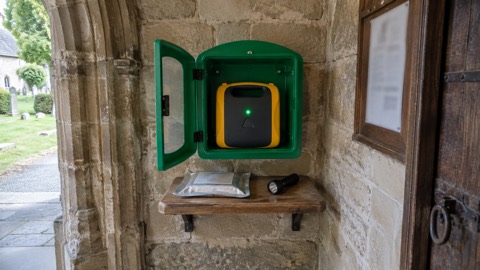
If someone collapses at the roadside, ring 999. Public access defibrillators are found in large shops, GP surgeries, dentists, libraries and many other public places, and anyone can use them6. They are also found in schools, train stations, shopping centres, airports and leisure centres11. The ambulance call handler can tell you where the nearest one is. For more on what to do before help arrives, see what to do first and how to do CPR.
If you have a pet in the car, a small pet first aid kit is worth adding: the PDSA lists bandages, blunt-ended scissors, wound wash, cotton wool, tweezers, tick tweezers, wound dressing, self-adhesive tape, dressings, vinyl gloves, a foil blanket, antiseptic wipes and a blanket to use as a stretcher12. Keep it separate from the human kit.
Sources (11)
- What should I keep in my first aid kit?, NHS, 2026-10-28
- Travel advice, UK Government, 2026-10-06
- What to keep in your Medicine Cabinet :: Hertfordshire and West Essex Healthier Together, Hertfordshire and West Essex Healthier Together (NHS)
- BS8599-2 Vehicle First Aid Kit | Large | Green Pouch Motorist Bag (British Standard Compliant), Steroplast (steroplast.co.uk)
- Burns and scalds prevention, Healthier Together, 2026-10-25
- Emergency heart care, London Ambulance Service, 2026-09-30
- What to put in your first aid kit, Health and Safety Executive, 2026
- getdocument, London and South East England Burn Network (LSEBN)
- Vehicle emergency kit, Traffic Scotland, 2026-10-29
- First aid facts, North West Ambulance Service, 2019-04
- First aid for pets, PDSA, 2026-10-29
 Baby and Child Kit Checklist
 Bleeding Control Kit Checklist
 Defibrillator Guardian Checklist