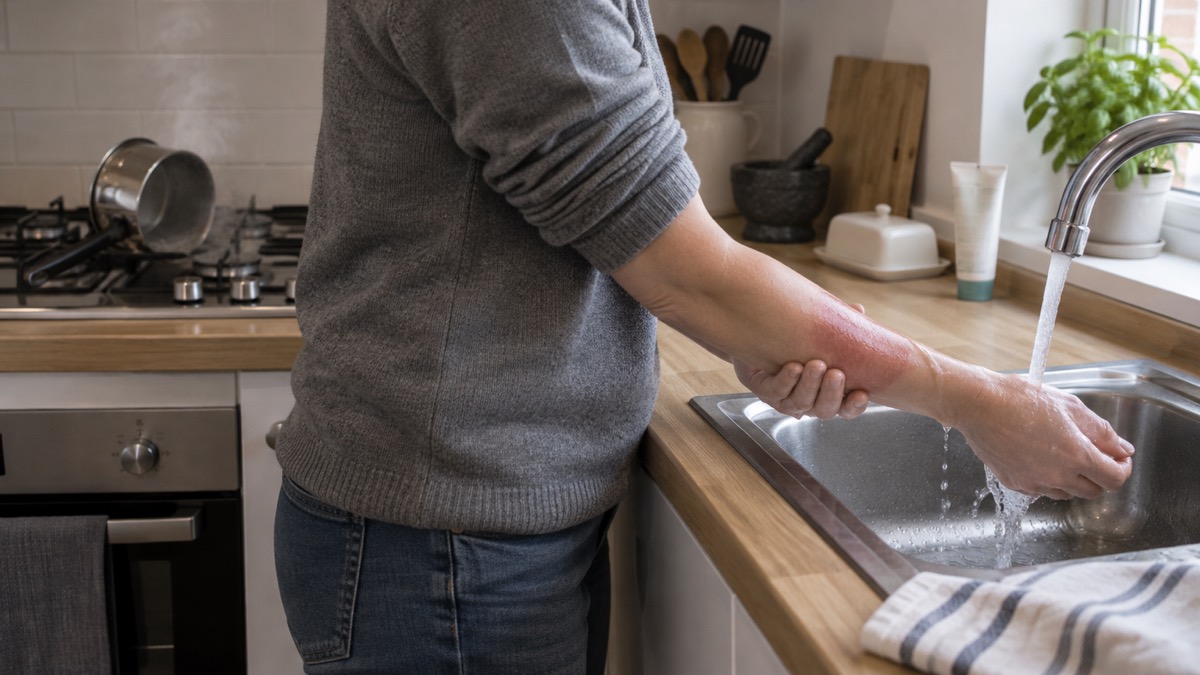
No. Butter, ice, toothpaste and greasy creams all make a burn worse, not better. The treatment that works is cool running water, and the figure to remember is 20 minutes. The NHS says to put a burn or scald under cool running water for 20 to 30 minutes to reduce the heat in the skin1. The Royal Society for the Prevention of Accidents (RoSPA) puts it in three words: cool, call, cover2.
The reason is simple. A burn is damage to the skin caused by heat, and the longer the burning goes on, the more severe the injury is likely to be3. Cooling with water draws that heat out. Butter and oils do the opposite: they hold heat against the skin. Ice and iced water are also wrong, because they can damage skin that has already been injured. Every major first aid body in the UK says the same thing, and has done for years.
This page sets out what to do in the first minutes, why the old remedies fail, how to cover a burn once it is cool, and the signs that mean A&E or a 999 call. It is for anyone who has just been burned, or who is looking after a child who has.
Cool running water for 20 minutes, not butter or ice
The first thing to do is get the burn under cool running water. The NHS advises immediately putting a burn or scald under cool running water for 20 to 30 minutes to reduce the heat in the skin1. The Child Accident Prevention Trust says to cool the burn for at least 20 minutes with cool, not cold, running water8. The British Red Cross gives the same figure: at least 20 minutes under cold running water9.
Twenty minutes is longer than most people expect, and it matters. The NHS explains that the longer the burning goes on, the more severe the injury is likely to be6. Cooling is not a comfort measure; it is what limits the damage. So if some time has passed, cooling is still worth doing.
A few practical points decide whether this works:
- Use cool or lukewarm water, not cold. The NHS describes cool or lukewarm running water3. Very cold water is not better and can cause its own problems.
- Do not put a child in a cold bath. NHS Norfolk guidance is explicit: don't put your child in a cold bath4. Run the water over the burn instead.
- Start immediately. Do not go looking for butter, cream or a dressing first. Water first, everything else after.
- Keep the rest of the person warm. Cooling a burn for 20 minutes can chill someone, particularly a child, so keep the parts that are not burned covered.
Why butter, oils and creams make a burn worse
Butter, oils and greasy creams trap heat in the skin. The British Red Cross explains that butter and cream contain oils, and oils retain heat, which is the opposite of what a burn needs9. The Child Accident Prevention Trust is blunt about the result: putting toothpaste, turmeric, ice or any other substance on a burn will make the burn and scarring worse, not better10.
There is a second, more serious reason to keep oils and creams away from burns. Emollient skin creams have a high oil content, and the London Fire Brigade warns that such creams can easily ignite and intensify fires11. The National Fire Chiefs Council and the Medicines and Healthcare products Regulatory Agency issued a winter safety warning that residue from emollients can build up on clothing, bedding, bandages and soft furnishings, making these materials ignite more easily and burn more rapidly12. Anyone using them should keep away from naked flames like candles or cigarettes, and clothing, bedding, dressings and bandages with cream on them can catch fire very easily if they are close to a naked flame, heater or cooker11.
That is why a burn is the worst possible place for a greasy cream. You are adding fuel to injured skin, and if there is any flame, heater or cooker nearby, you are adding a fire risk as well. The NHS is clear: while the skin heals, keep the area clean and don't apply any creams or greasy substances6.
Why ice and iced water damage burnt skin
Ice feels like the obvious answer, and it is the wrong one. The NHS says do not use ice, iced water, or any creams or greasy substances like butter3. An NHS burns prevention booklet repeats it: never use ice or iced water13.
The reason is that burnt skin has already been damaged, and ice adds a second injury on top. Liquid Gas UK, in a safety notice about cold burns, explains the mechanism: cold burns can occur from skin contact with very cold objects, because the cold withdraws heat and causes tissue damage14. The same principle applies to ice pressed against a burn. You are not cooling the burn gently; you are freezing already injured tissue.
The same rule applies to sunburn. NHS guidance on sunburn says not to put ice or ice packs on sunburnt skin, and not to pop blisters, scratch or remove peeling skin15. Sunburn is a burn like any other, and the treatment is the same: cool it, do not freeze it.
There is a related trap with ice packs used for other injuries. NHS hot weather advice describes applying an ice pack for 15 to 20 minutes every two to three hours, wrapped in a towel so that it doesn't directly touch your skin and cause an ice burn16. That is the correct use of an ice pack for a sprain or a strain, not for a burn. For burns, the answer is water.
Covering a burn after cooling it
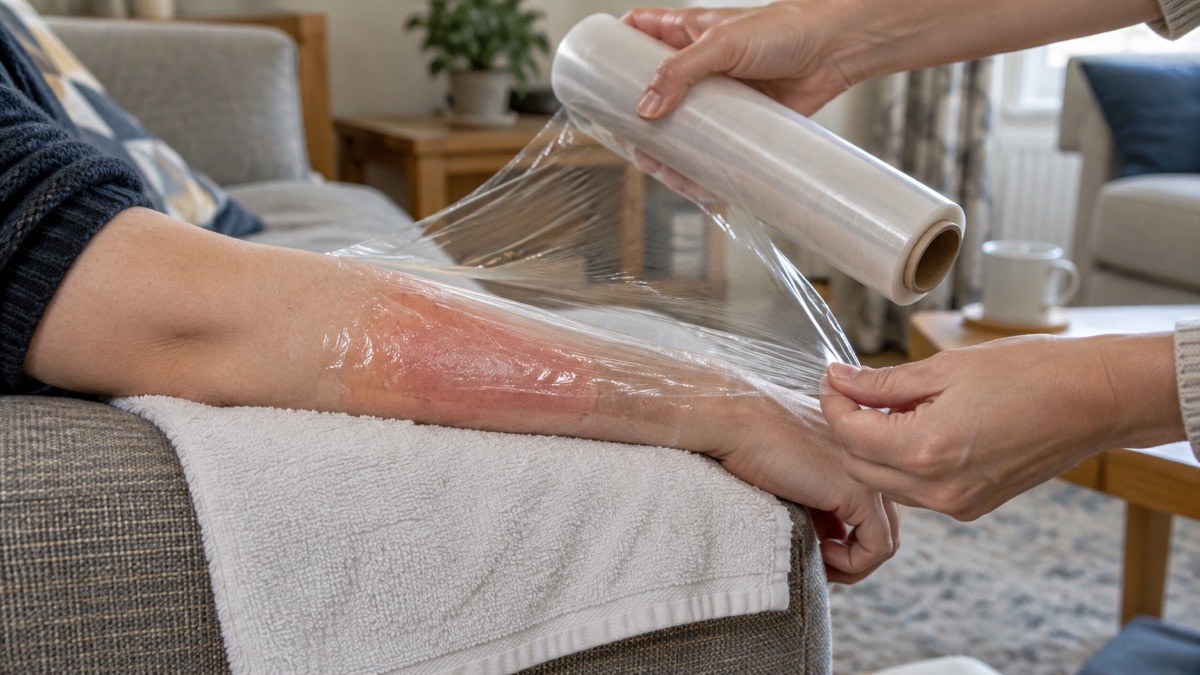
Once the burn has been cooled, cover it. The NHS Inform first aid guidance says that when the burn has been cooled, cover the injured area with kitchen film, which will protect it from infection5. The British Red Cross says to cover it loosely with cling film or a clean plastic bag9. The NHS adds that a clean plastic bag could also be used for burns on the hand4.
How you apply it matters:
- Loosely, lengthways. St John Ambulance advises covering the area loosely with cling film, lengthways, and discarding the first two turns of the cling film17.
- Not tightly. Cling film is there to protect the burn and stop it sticking to a dressing, not to compress it. Swelling can make a tight wrap dangerous.
- Clean, non-fluffy material if there is no cling film. The NHS says to cover the burn with cling film or a non-fluffy, clean dressing to protect the area18. A fluffy towel or cotton wool will shed fibres into the wound.
- Only once cooled. Covering a burn that is still hot traps the heat in. Cool first, cover second.
For a comparison of the options for covering a burn at home, see Burn Gel or Cling Film: Covering a Burn at Home. The wider steps for any burn, from cooling to getting help, are set out in Burns and Scalds: How to Cool, Cover and Get Help.
When a burn needs A&E or 999
Most small burns can be treated at home with cooling and a loose covering. Some need hospital treatment, and a few need an ambulance. The NHS says to phone 999 or go to A&E if you have a burn or scald that is very large or deep, is on your face, genitals or bottom, or has been caused by an acid or chemical, or by electricity6.
The NHS also lists the burns that should go to a hospital A&E department19:
| Burn | Why it needs A&E |
|---|---|
| All chemical and electrical burns | Damage can continue beneath the skin |
| Large or deep burns, any burn bigger than the injured person's hand | Size and depth need assessment |
| Burns that cause white or charred skin, any size | A sign of a deeper burn |
| Burns on the face, neck, hands, feet, any joints or genitals | These areas need specialist care |
Age UK adds burns that cause white or charred skin to the list of burns needing A&E20. For children, the NHS says to get urgent help if the burn is very large or deep, is on their face or bottom, or has been caused by acid or a chemical, or by electricity21.
The emergency numbers are the same across the UK, but the wording differs slightly by nation. The Northern Ireland Ambulance Service lists severe burns and scalds among the conditions for which you should call 99922. The Scottish Ambulance Service lists severe burns or scalds in the same way23. NHS Western Isles winter guidance says to call 999 in an emergency for a serious burn or scald24.
Burns on children: cool first, then get advice
Children are the group most often burned, and hot drinks are the most common cause in the UK21. The priority is the same as for an adult: cool the burn or scald as quickly as possible21. The British Red Cross says that if a baby or child has been burned, seek medical advice, making sure you cool their burn for at least 20 minutes first7.
There are a few child-specific points:
- Do not use ice, iced water, butter or greasy creams, and do not put a child in a cold bath4.
- Sit a child up if the face or eyes are burned. NHS guidance says this helps to reduce swelling25.
- Keep hot drinks away from young children. The NHS identifies this as the way to prevent many severe burns and scalds19.
- Seek advice after cooling. Even a burn that looks minor in a child is worth a call, because young skin burns more deeply.
For the full sequence for a burned child, see Burns and Scalds: How to Cool, Cover and Get Help. If a child has swallowed or been exposed to a chemical, see What to Do if a Child Swallows Pills or Chemicals.
Chemical burns and other special cases
Chemical burns are always a hospital matter. The NHS says all chemical and electrical burns should go to A&E19. St John Ambulance gives the first aid steps: if the chemical is in powder form, it can be brushed or patted off the skin, and clothing should be removed as it could be contaminated26. Then rinse the area under cool running water.
For a chemical splash to the eye, the rinsing time and method matter, and these are set out in Chemical Burns and Eye Splashes: How Long to Rinse. For an electric shock, do not approach the person until the power is off; the steps are in What to Do if Someone Gets an Electric Shock.
Sunburn is a burn too. NHS guidance says not to use petroleum jelly, put ice or ice packs on sunburnt skin, pop blisters, scratch or remove peeling skin, or wear tight-fitting clothes over sunburnt skin15. Cool the skin, cover it loosely if needed, and keep out of the sun while it heals.
If you are outdoors, such as at a barbecue, Humberside Fire and Rescue Service advises keeping a bucket of water or sand nearby for emergencies27. That is not a substitute for running water on a burn, but it is a sensible precaution.
Sources (27)
- What to do if your child has an accident, NHS, 2025-12-18
- Burns and scalds, RoSPA, 2026-10-26
- Burns and scalds, Andaman Surgery (NHS), 2026
- Burns and scalds, NHS Norfolk, 2026-10-25
- Burns first aid, NHS Inform, 2026-07-24
- Burns and scalds, NHS Inform, 2026-07-31
- Burns, British Red Cross, 2026-10-25
- Should I just go straight to hospital if my child has a bad burn?, Child Accident Prevention Trust, 2025-12-16
- Burns, British Red Cross, 2026-10-25
- What should I put on a burn?, Child Accident Prevention Trust, 2025-12-17
- Fire safety using medication and medical equipment, Warwickshire County Council, 2026-10-29
- Keep the warmth, lose the risk, National Fire Chiefs Council, 2025-12-24
- Burns prevention booklet 2024, Salisbury NHS Foundation Trust, 2024-12
- Cold burns from LPG, Liquid Gas UK, 2022
- Staying safe over the summer, Healthier Together (NHS), 2026-10-29
- Hot weather advice, Central East ICB (NHS), 2026-08-04
- Severe burn, St John Ambulance, 2026-10-28
- Burns prevention and tips, Mid and South Essex NHS Foundation Trust, 2026-10-25
- Burns and scalds, Victoria Road Surgery (NHS), 2026
- Burn prevention advice, Age UK, 2026-03-23
- Burns and scalds prevention, Healthier Together (NHS), 2026-10-25
- When to call 999, Northern Ireland Ambulance Service, 2026-10-29
- When should you call 999?, Scottish Ambulance Service, 2026-10-29
- Your Health Guide Winter 2025, NHS Western Isles, 2025-12
- Burns and scalds, Cambridgeshire and Peterborough Children's Health (NHS), 2026-06-23
- Chemical burn, St John Ambulance, 2026-10-28
- Barbecue safety, Humberside Fire and Rescue Service, 2026-10-29
 Baby and Child Kit Checklist
 Bleeding Control Kit Checklist
 Car Kit Checklist
 CPR on a Baby
 CPR on a Child
 Chest Compression Rate and Depth
 Rescue Breaths or Hands-Only CPR
 Checking Breathing
 Agonal Breathing and CPR
 Breathing During CPR
 Recovery Position and Spine
 Cardiac Arrest vs Heart Attack
 Heart Attack First Aid
 Defibrillator Pad Placement
 Defibrillator on a Child