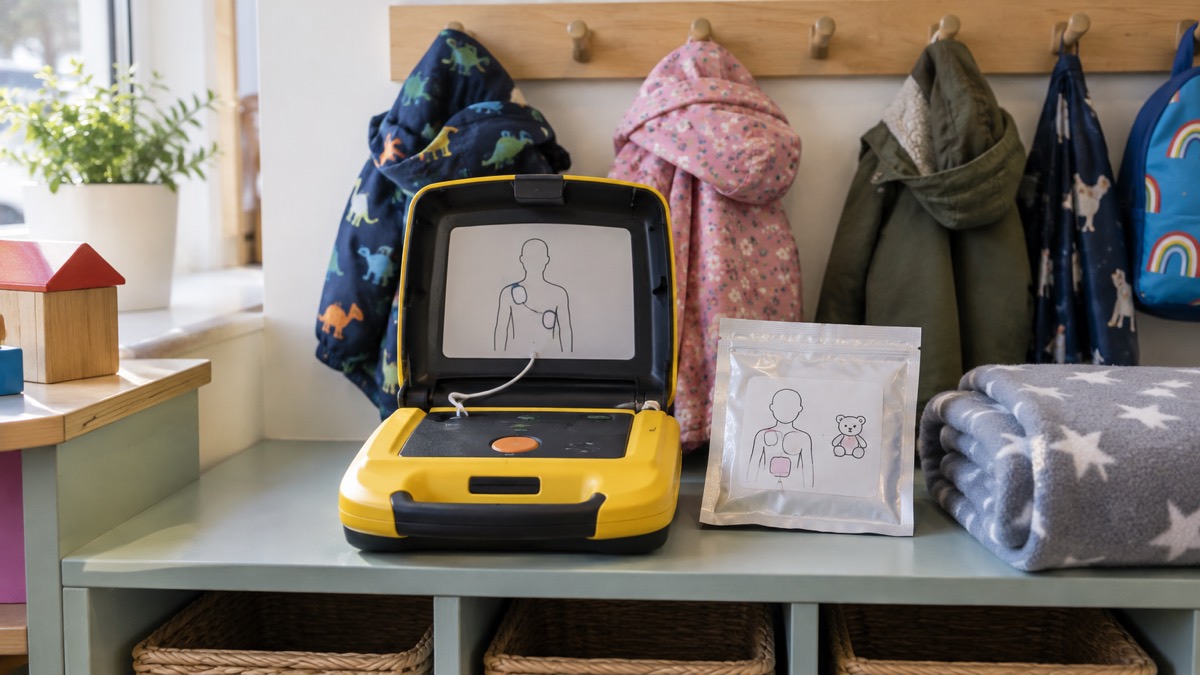
Yes. If a child or baby has collapsed and is not breathing normally, an automated external defibrillator (AED) can be used, and using one quickly gives them the best chance. The machine analyses the heart rhythm and tells you what to do, so you do not need to make a clinical judgement. What changes with a child is the size of the shock and where the pads go.
Use child pads or a child setting if the device has one. Resuscitation Council UK advises using an AED with a paediatric attenuator for children below eight years old if possible, and the standard AED if not1. The British Red Cross says that for children aged one to eight, paediatric pads should be used, and if they are not available, standard pads should be placed with one on the centre of the chest and one on the centre of the back2. The Scottish Ambulance Service states that paediatric pads or programmes typically decrease the output of the machine to 50 to 75 joules3.
The most important thing is not to wait. If there is no child option, use the adult pads. The Resuscitation Council UK guide for communities states that adult pads and energy can be safely used on a child if this is the only resource available, taking care that the pads are not in contact with each other when delivering a shock4. Start CPR, send someone for the nearest defibrillator, and follow its spoken instructions.
Yes, an AED can be used on a child: what to do first
The sequence is the same as for an adult. Check for danger, check whether the child is responsive and breathing normally, and if they are not, start CPR and ask someone to fetch the nearest AED7. The NHS says to check for hazards, such as electrical equipment or traffic, before starting8.
When the AED arrives, switch it on and follow the prompts. The British Heart Foundation advises placing the pads on immediately and turning the machine on, following its instructions, and using child mode and child-sized pads if available. If you do not have a defibrillator, keep doing CPR6. The Resuscitation Council UK 2025 First Aid Guidelines say that if an AED is available, dry the chest quickly and follow the device prompts to apply and use it, which matters after a drowning9.
A defibrillator is a portable machine that can shock the heart back into normal rhythm2. It is designed to be used by anyone, even without training, and is often found in workplaces, schools, gyms and other public areas10. The Scottish Ambulance Service says AEDs are designed to be safe and accessible for everyone11.
Children under eight: paediatric pads, child key or child switch
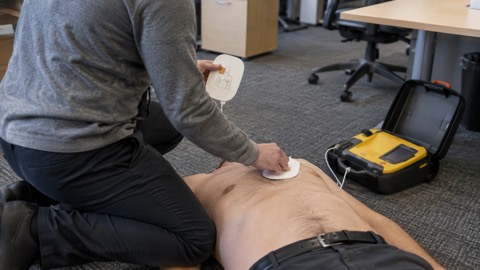
For a child aged one to eight, the aim is to use the child option. The British Red Cross says that if the child is one to eight years old, use paediatric pads, placing one pad in the centre of the child's back and the second over the centre of their chest2. The Resuscitation Council UK guide for communities gives the same principle: adult pads and energy can be safely used on a child if this is the only resource available, but pads must not touch each other when the shock is delivered4.
Different machines provide the child option in different ways. Some have a switch or key; some use separate pads. The Mediana A16 semi-automatic AED, as described by the retailer Red Cross First Aid Training, has the ability to change from adult to child mode with one button12. The Philips HeartStart FRx works differently: when treating an infant or child, you insert the optional infant/child key and the FRx adjusts instructions and therapy13. The ZOLL AED Plus uses paediatric pads: the maker states that paediatric patients under 8 years old or under 25kg use Pedi-Padz II5.
| What the device offers | What you do | Who it suits |
|---|---|---|
| A child button or switch | Press or turn it before applying pads, then follow prompts12 | Homes, clubs and village halls where adults and children are both present |
| A child key | Insert the key when prompted; the device adjusts instructions and therapy13 | Workplaces and public sites that want one device for all ages |
| Separate paediatric pads | Fit the child pads instead of the adult pads5 | Sites that store both pad types and check them regularly |
| No child option at all | Use the adult pads, keeping them apart, and do not delay4 | Any emergency where the nearest device is an adult-only model |
If you are responsible for a defibrillator, check which of these it uses before you need it, and keep the child pads or key with the device. The Resuscitation Council UK recommends that all school children are taught CPR and how to use an AED4.
Babies under one year old: when an AED may still be used
The advice for babies is where people most often get confused, because different official pages phrase it differently. NHS Inform states that AEDs can be used on adults and children over 1 year14. Its baby CPR page, covering a baby under one year, says you can ask someone to get an automated external defibrillator if there is one nearby15. The British Red Cross says an AED can be used on children over a year old2.
Read together, these are not instructions to withhold an AED from a baby. They reflect that cardiac arrest in babies is uncommon and that the evidence base is thinner. Resuscitation Council UK guidance, which underpins UK training, says to use a paediatric attenuator for children below eight years old if possible, and the standard AED if not1. A baby is below eight. If a baby is unresponsive and not breathing normally, start baby CPR, send for the AED, and use it when it arrives, following the prompts.
The practical points for a baby are the same as for a small child. Use child pads or a child setting if the device has one. If it does not, use the adult pads, placing them so they do not touch each other4. The British Red Cross advises that if you have used a defibrillator, you should leave it attached16. The same applies to a baby: leave the pads on and the machine connected until ambulance staff take over.
How AEDs are made child-friendly
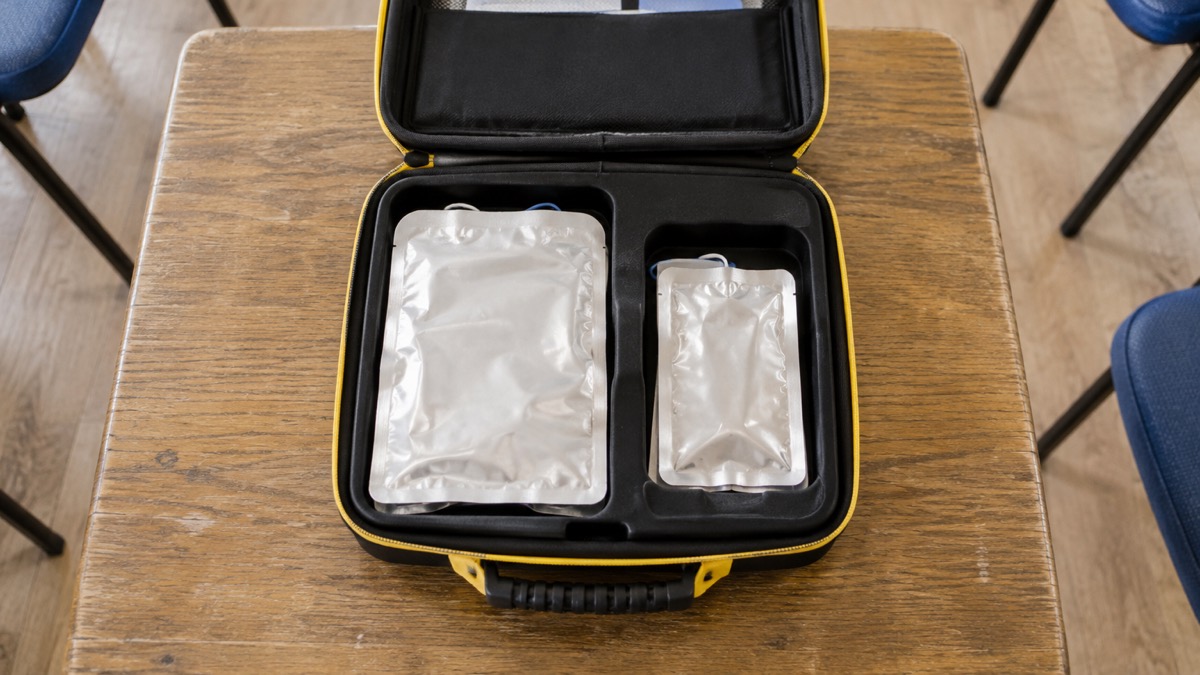
A child-friendly AED does two things: it lowers the energy of the shock, and it may adjust the pad position. That is the "paediatric attenuator" in practice. It is not a different machine; it is a setting, a key or a set of pads that changes what the same device delivers. All AEDs sold can be used on children using either the correct child electrode pads, child key or child switch where available13.
The pad position matters because a child's chest is small. The British Red Cross gives two placements depending on size. For a larger child, more than 25kg in weight and about eight years of age, the first pad goes on the upper right side below the collarbone and the second on the child's left side below and in line with their armpit. For a smaller child, less than 25kg and under about eight years of age, the first pad goes in the middle of the front of the chest and the second on the child's back between their shoulder blades6. The St John Ambulance guidance for infants and smaller children uses the same chest-and-back approach10.
Some devices are built with child use in mind from the start. The ZOLL AED 3 has child pads fitted to the device, along with audio and visual prompts and a CPR metronome1. The iPAD SP1 fully automatic AED has a quick switch between adult and child mode17. The Mediana A16 Core HeartOn AED, in the maker's own description, can change from adult to child mode at the touch of a button18.
None of this replaces reading the device. The Resuscitation Council UK guide to AEDs explains that AEDs can be used anywhere, by anyone, to try to save the life of a person who has a cardiac arrest19. The machine's prompts are the instruction that matters in the moment.
Checking a public defibrillator before you need it
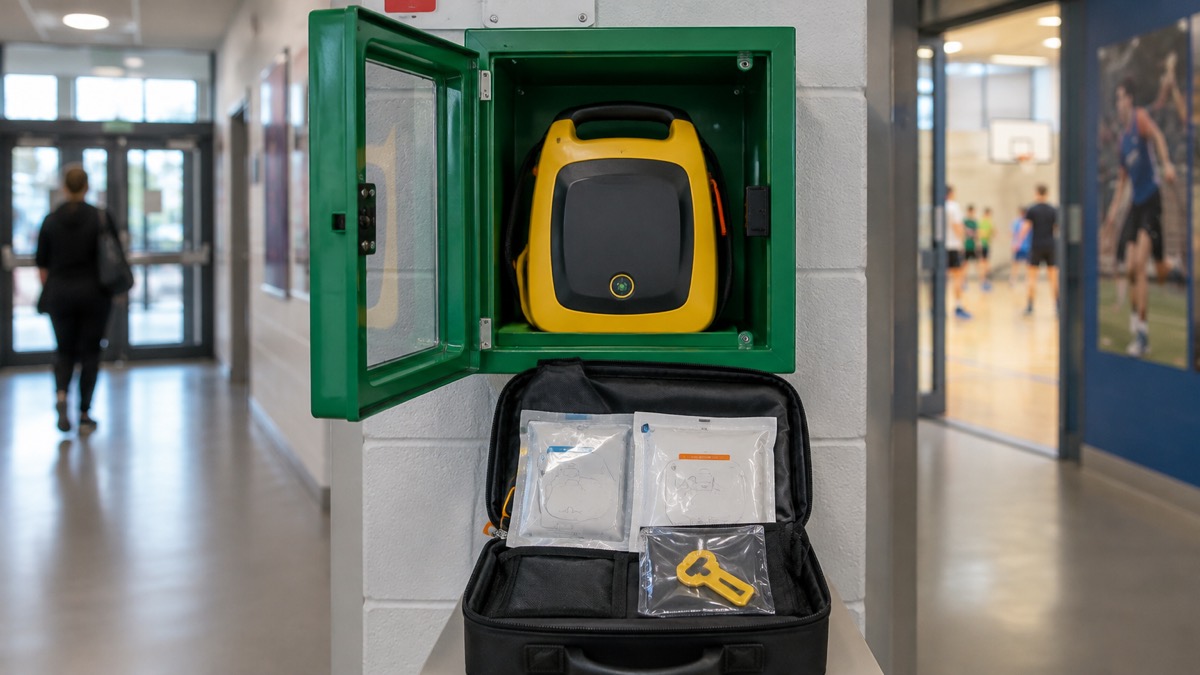
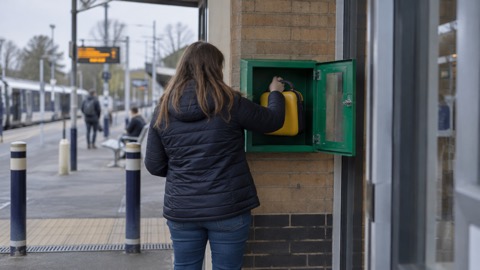
A public access defibrillator is an AED designed for use by anyone in a cardiac emergency20. Most are registered with the local ambulance service so that 999 call handlers can direct people to them. In Northern Ireland, the Northern Ireland Ambulance Service explains how community AEDs are registered and supported20.
If you look after a defibrillator at a school, sports club or village hall, check it as part of a regular routine. That is all the more reason to know what is in the case: a device bought for adults may have no child pads.
- Check whether the case contains child pads, a child key or a child switch, and where they are kept.
- Check the pad and battery expiry dates; the HeartSine Pad-Pak combines battery and electrodes in one cartridge with a single expiry date21.
- Check that the device is registered with the ambulance service if you want it available to the public20.
- Check that the cabinet code or key is known to the people who might need it.
If you are choosing a defibrillator for a home, club or village, the child option is one of the specifications worth comparing. The guide to choosing a defibrillator sets out what else to weigh. For the general principles of using any AED, see Defibrillators (AEDs): What They Do and How to Use One, and for finding the nearest one, see Public Access Defibrillators.
HeartSine and other makes: what the child option looks like
HeartSine samaritan defibrillators use a Pad-Pak, which the maker describes as an integrated battery and electrode single-use cartridge with one expiration date, simplifying maintenance and removing the need for a separate battery21. That design is convenient, but it means the child option depends on the model and the pads supplied. If you own or manage a HeartSine unit, check its user manual for the child option that applies, and keep the right pads with the device.
Other makers describe their child provision plainly. The Philips HeartStart FRx uses an optional infant/child key that adjusts instructions and therapy13. The ZOLL AED Plus uses Pedi-Padz II for paediatric patients under 8 years old or under 25kg5. The Mediana A16 has a one-button change between adult and child mode12. The iPAD SP1 has a quick switch between adult and child mode17.
Availability is a separate question. HeartSine was established in 1998 and is now a division of Stryker22. Ask about lead time if you are buying for a community site.
Where the official guidance comes from
The guidance in this article comes from Resuscitation Council UK, NHS ambulance services, NHS Inform and the British Red Cross. Resuscitation Council UK publishes the 2025 First Aid Guidelines, which include the instruction to dry the chest quickly and follow the device prompts if an AED is available after a drowning9. It also publishes a guide to automated external defibrillators for communities, which covers adult pads on children and the need to keep pads apart4.
NHS ambulance services publish public instructions. The North West Ambulance Service advises using an AED with a paediatric attenuator for children below eight years old if possible, and the standard AED if not1. The Scottish Ambulance Service public access defibrillator information pack covers pad and battery life, device features and the encouragement for schools to have an AED3. The Northern Ireland Ambulance Service explains community AED registration20.
The British Red Cross and St John Ambulance provide the practical steps most households will follow. The British Red Cross child first aid page gives the pad placements for larger and smaller children and the advice to leave the defibrillator attached6. St John Ambulance gives the same chest-and-back placement for infants and smaller children10. The British Heart Foundation explains that child and baby CPR differs from adult CPR23.
For the wider picture, the 2025 Resuscitation Guidelines: What Changed for Bystanders explains what the latest guidance means in practice. If you want to learn CPR and AED use, the guide to learning CPR free online covers the free options, and the guide to first aid courses covers training. The Resuscitation Council UK works with GoodSAM so that people who complete its Lifesaver scenarios can sign up as volunteer cardiac responders4.
Sources (23)
- PAD Information Pack, Scottish Ambulance Service, August 2026
- Unresponsive and not breathing when an AED is available, British Red Cross, 2026
- Public Access Defibrillators: A guide for communities, Resuscitation Council UK, October 2025
- A guide to Automated External Defibrillators (AEDs), Resuscitation Council UK, January 2026
- ZOLL AED Plus Semi Automatic Defibrillator, Steroplast, 2026
- Unresponsive and not breathing: child, British Red Cross, 2026
- How to do CPR, North West Ambulance Service, 2026
- How to resuscitate a child, NHS, 2026
- 2025 First Aid Guidelines, Resuscitation Council UK, October 2025
- How to use a defibrillator, St John Ambulance, 2026
- Public Access Defibrillators, Scottish Ambulance Service, 2026
- Mediana A16 Semi Automatic AED, Red Cross First Aid Training, 2026
- HeartStart FRx AED, Philips, 2026
- How to use an AED, NHS Inform, 2026
- How to give a baby CPR, NHS Inform, 2026
- How To Do CPR On a Child | St John Ambulance, St John Ambulance
- iPAD SP1 Fully Automatic AED Defibrillator, Steroplast, 2026
- Mediana A16 Core HeartOn AED, Reliance Medical, February 2026
- CPR and defib learning drivers, Resuscitation Council UK, 2026
- AED, Northern Ireland Ambulance Service, 2026
- HeartSine samaritan PAD 500P, Stryker, 2026
- HeartSine Samaritan stock update, Defib Store, 2026
- How to do CPR on a child or baby, British Heart Foundation, 2026
 Baby and Child Kit Checklist
 Bleeding Control Kit Checklist
 Car Kit Checklist
 CPR on a Baby
 CPR on a Child
 Chest Compression Rate and Depth
 Rescue Breaths or Hands-Only CPR
 Checking Breathing
 Agonal Breathing and CPR
 Breathing During CPR
 Recovery Position and Spine
 Cardiac Arrest vs Heart Attack
 Heart Attack First Aid
 Defibrillator Pad Placement
 Defibrillator Without Training