

Mediana makes the A16 semi-automatic AED, an automated external defibrillator: a portable device that a bystander can use on someone who has collapsed and is not breathing normally, while waiting for an ambulance. For a household that is getting itself ready for emergencies, it is the one piece of Mediana kit that appears in the preparedness picture, and it sits alongside the first aid kit rather than replacing it.
The A16 is supplied as a complete kit: the device itself, an operator's manual, a battery pack, an SD card and one set of adult and paediatric pads1. Its battery is rated at 3000mAh/15V, which the supplier describes as enough for 200 shocks or six hours of monitoring1. It runs its own self-tests, so keeping it ready is mostly a matter of checking its status indicator and replacing pads and battery when they are due.
This page covers what the A16 does, the specifications that matter when you are choosing and storing one, how to keep it and its battery safe, how to register it and check for recalls, and where to get help in the UK. It does not cover medical treatment beyond first aid: in a cardiac arrest, call 999 and follow the ambulance service's instructions.
What Mediana makes for UK households
Mediana's presence in the UK household preparedness market is narrow and specific: the A16 semi-automatic AED. It is not a maker of torches, power stations, water filters or the other general kit that fills an emergency cupboard. What it makes is a defibrillator, and the case for having one at home or in a small workplace rests on the same logic as the rest of a household plan: the emergency you prepare for is the one where help is minutes away and you are the person on the spot.
That logic is why official guidance puts a first aid kit in almost every emergency list it publishes. Scottish emergency kit guidance includes a first aid kit in the car kit4, Welsh checklist guidance includes one in the home kit5, and English council advice lists a first aid kit among the basics6. A defibrillator is a step beyond a first aid kit, and it belongs in the same part of the plan. If you are building that part of your plan from scratch, the site's First Aid at Home: A Household Guide sets out what a household should hold and how to keep it current, and the Emergency Kit: What a UK Household Should Keep Ready page shows where first aid sits among the other supplies.
The A16 is also described as suitable for workplaces, at one kit per 1 to 25 employees in low-risk settings or one kit per 1 to 5 employees in high-risk settings1. That gives a household a rough sense of scale: a defibrillator is designed to serve a small group of people who are likely to be together when someone collapses, which is exactly what a household or a small team is.
Mediana's kit by type
Mediana's kit for UK households is a single product line, the A16 semi-automatic AED. The full product page is at Mediana A16 Semi-Automatic AED, and the wider subject of first aid supplies is covered in the First Aid at Home: A Household Guide.
The A16 semi-automatic AED
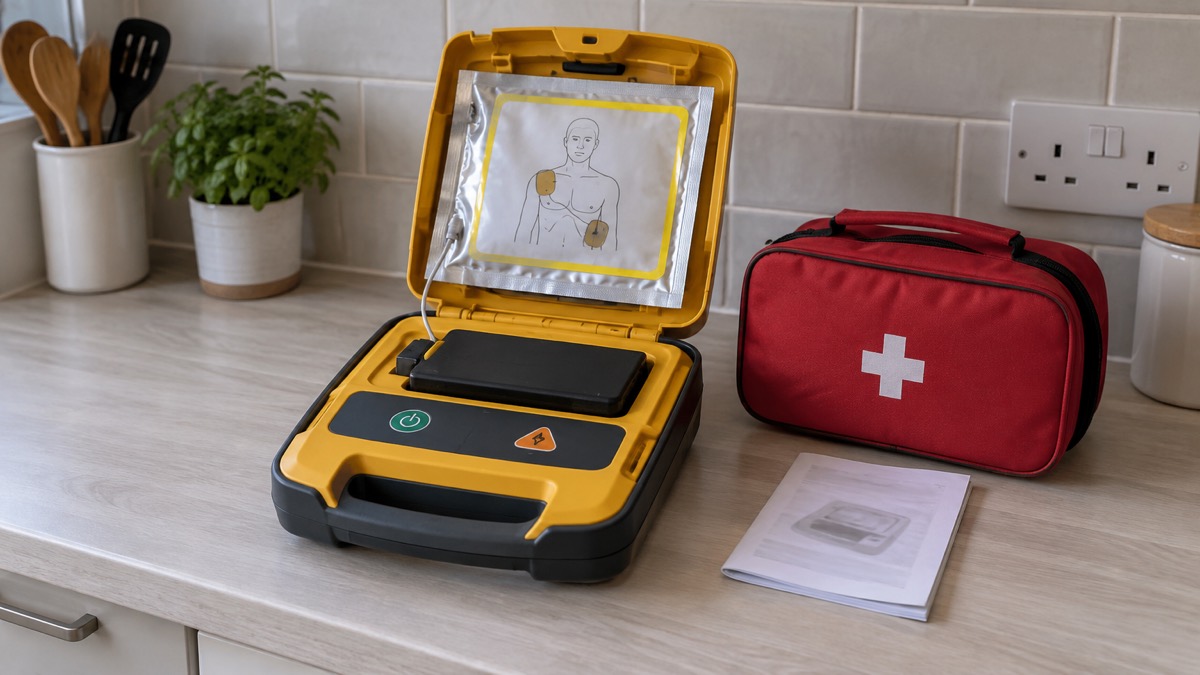
The A16 is a semi-automatic defibrillator, which means it analyses the heart rhythm and tells the operator what to do, and the operator delivers the shock when prompted. It is supplied with an operator's manual, a battery pack, an SD card and one set of adult and paediatric pads1. The pads switch between adult and child mode with one button, so the same kit can be used on an adult or a child without swapping pads1.
In an emergency, the device gives voice prompts and shows action icons on an LED indicator and a status LCD, so a household member who has never used it before can be talked through the steps1. It includes pace-pulse detection with a rejection function, fast shock delivery, voice recording and quality checks, and the supplier states that it meets 2015 AHA and ERC guidelines1. The SD card and infrared communication support allow event review afterwards, using optional computer software1.
Key specifications to check on a Mediana product
When you are deciding where to keep an AED and whether it suits your household, a small number of specifications decide it. The table below sets out what the supplier lists for the A16.
| Specification | What the supplier states |
|---|---|
| Type | Semi-automatic AED (automated external defibrillator)1 |
| Dimensions | H 286.5mm x W 200mm x D 90cm1 |
| Battery | 3000mAh/15V, described as 200 shocks or six hours of monitoring1 |
| Pads | One set of adult and paediatric pads, adult and child mode switched with one button1 |
| Indicators | Voice prompt, action icon (LED) indicator, status LCD1 |
| Self-tests | Power on self-test, periodic daily, weekly and monthly tests, pad quality check, battery insertion self-test1 |
| Data | SD card and IR communication support, optional event review software1 |
| Standards | Supplier states it meets 2015 AHA and ERC guidelines1 |
Two of these matter most for a household. The first is the battery figure: 200 shocks or six hours of monitoring is the supplier's description of what a fresh battery will do, and it tells you the device is designed to run through a full resuscitation attempt without running out1. The second is the self-test schedule. Because the device tests itself daily, weekly and monthly, a fault is likely to show up on the status indicator before you need the kit, provided you look at it1.
The dimensions as listed by the supplier read H 286.5mm x W 200mm x D 90cm1. The depth figure is given in centimetres while the others are in millimetres, so check the physical unit against the space you have in mind rather than relying on the numbers alone.
Using Mediana kit safely in an emergency
An AED is used in a cardiac arrest, and the first instruction is always to call 999. The device supports resuscitation while the ambulance is on its way; it does not replace the emergency services, and the ambulance call handler can talk you through what to do. The A16's voice prompts and action icons are designed to guide a bystander through the steps, and the adult and child mode switch means you can select the right mode for the person in front of you with one button1.
Keep the kit where you can reach it quickly and where anyone in the household knows to look. The same principle applies to the rest of the household's first aid supplies: official guidance stresses that keeping your first aid kit up to date ensures you can respond quickly and confidently7. A defibrillator that is buried at the back of a cupboard, or whose pads have expired, does not do that job.
There is a practical point about how the kit is stored that official guidance on first aid provisions makes directly. ProtectUK advises that tamper-seals, similar to those used on fire safety equipment such as fire extinguishers, must not inhibit the accessibility and functionality of the kit when required in an emergency8. In other words, if you seal a kit to show it has not been opened, make sure the seal can be broken instantly by someone in a hurry.
Households with children, pets or mobility needs should also think about who else is in the plan. Scottish guidance suggests letting children help with the emergency plan and household kit, which can help them remember the information and feel safer9, and it lists a spare walking stick or mobility devices in the home kit4. A child who knows where the defibrillator is kept, and that they should fetch an adult rather than use it themselves, is part of the same preparation.
Charging, batteries and safe storage
The A16's battery is a rechargeable pack, and the fire and rescue service advice that applies to rechargeable batteries in general applies to it. The maker's own instructions for using, charging, storing and disposing of the battery come first: official guidance is to always follow the manufacturer's instructions for rechargeable batteries10. Where the maker's manual and general guidance differ, follow the manual for the device.
The general guidance is consistent across fire and rescue services. Charge batteries in a safe, visible location, away from flammable materials or escape routes11. Charge on a hard, flat, heat-resistant surface, away from extreme heat, cold, direct sunlight and flammable materials10, such as a kitchen worktop12. Do not cover a device while it is charging, because this traps heat and increases fire risk13. Keep spare batteries in a cool, dry place and away from metal objects like keys or coins14.
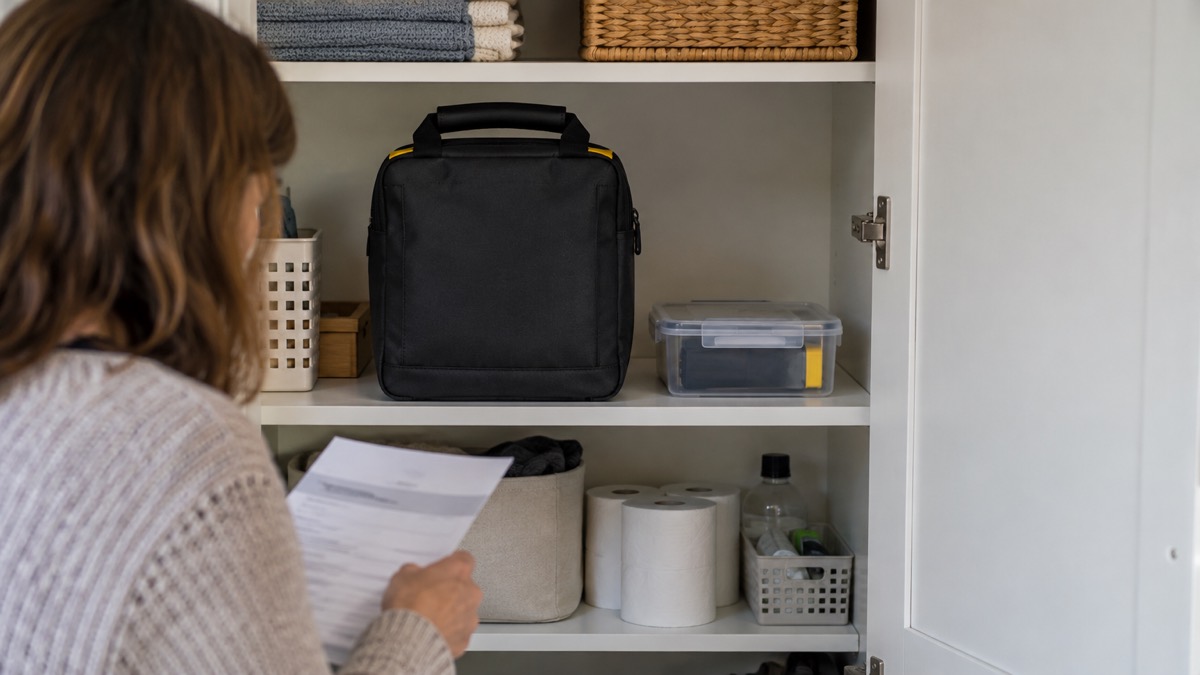
For a household storing an AED, the practical version of this advice is straightforward. Keep the device and its spare battery in a cool, dry place, out of direct sunlight and away from anything flammable. If you charge the battery, do it on a hard, flat surface where you can see it, not under a cushion or in a drawer. Keep spare button cells and small batteries securely stored and out of reach of young children, with battery compartments secured before an item is placed within a child's reach16.
Checking and maintaining your kit
The A16 is built to check itself. The supplier lists a power on self-test, periodic tests run daily, weekly and monthly, a pad quality check and a battery insertion self-test1. That means routine maintenance for a household is mostly about looking at the status indicator and acting on what it says, plus keeping the pads and battery within their usable life.
The same habit applies to the rest of the household's first aid supplies. Official guidance is to keep your first aid kit up to date so you can respond quickly and confidently7. For an AED, the parts that age are the pads and the battery, and the supplier's kit list names both as supplied items1. Ask your supplier or the UK contact centre about replacements for your model when they are due.
A short maintenance routine for a household with an A16 looks like this:
- Check the status LCD and action icon indicator regularly, and act on any fault shown1.
- Check the pads and battery are within their usable life, and replace them through your supplier when they are due1.
- Keep the operator's manual with the device, so a household member who has not used it before can read it1.
- Keep the whole kit in one known place, and make sure everyone in the household knows where that is7.
- Inspect and clean connection points where the maker's instructions call for it, so the battery and device fit securely17.
If the device shows a fault, do not assume it will work in an emergency. Seek support from the supplier or the UK contact centre, and record what the indicator showed so you can describe it.
Safety notices and recalls
Product safety notices and recalls are a fact of life for electrical goods, and the way to stay ahead of them is the same for an AED as for a tumble dryer or a fire alarm. Check for recalls or safety notices on the Electrical Safety First website3, and check for product recalls at www.electricalsafetyfirst.org.uk/product-recalls/18.
Recall notices show how manufacturers identify affected units. In a government recall notice for a range of pumps, the affected pumps can be identified by the serial number on the label affixed to the pump18. The lesson for a Mediana owner is to note the serial number from the label on your device and keep it with your household records, so you can check it against any notice quickly.
Registration is the other half of the defence. Official guidance is to register your appliance so manufacturers can contact you about faults or recalls2. The Register My Appliance service asks for the brand name, model, serial number and purchase date, and the process is described as very simple to follow19. Registering the A16 means that if a notice is issued for your unit, you hear about it directly.
Support and warranty
The Mediana A16 product page lists a UK contact centre number, 0344 871 8000, for ordering and product details1. Use it as your first point of contact for questions about the device, and have your model and serial number ready. The supplier also states that the item is in stock, with an estimated delivery time of 7 working days from the point of order, shipped free by DX Express1.
The A16's support features are worth knowing before you need them. The device records voice and event data, and the SD card and infrared communication support allow that data to be reviewed afterwards using optional event review computer software1. In a household setting, that is mainly useful if you want to review a use of the device with the ambulance service or your supplier. The status LCD and action icon indicator are the day-to-day support tools: they tell you whether the device is ready1.
On warranty, the supplier's product page does not set out warranty terms in the details available here. Ask the UK contact centre directly about the warranty for your unit. If you bought through a retailer, keep the receipt with your household records as well.
Where to get help in the UK
For a medical emergency, call 999. The NHS asks that A&E is used only in a genuine emergency, which helps prioritise care for those who need it most22. An AED is there to support resuscitation until the ambulance arrives, not to replace that call.
For help after an emergency, support is available. Official guidance advises looking for signs of stress after an emergency, and says you may be able to access support through your GP service, sites such as the counselling directory, or through support services signposted by the local authority23. For flooding, the British Damage Management Association can be contacted on 01858 41427824.
For product support, start with the Mediana UK contact centre on 0344 871 80001, and check the Electrical Safety First website for recalls and safety notices3. If you are building out the rest of your household plan, the site's Getting Started: Preparing Your Household for an Emergency page sets out the order to do it in, and Extra Help in an Emergency: Older, Disabled and Medically Dependent Households covers households where someone may need more support.
Sources (24)
- Mediana A16 Semi-Automatic AED, British Red Cross, 2026-10-29
- Register your appliance, Cornwall Council, 2026-10-29
- White goods, Cheshire Fire and Rescue Service, 2026-05-20
- Emergency kit, Ready Scotland, 2026-10-22
- Emergency kit checklist, Neath Port Talbot Council, 2026-10-29
- Get help and advice in an emergency, Lincolnshire County Council, 2026-10-29
- What should I keep in my first aid kit?, NHS, 2026-10-25
- First aid provisions, ProtectUK, 2026-06-01
- Emergency plan, Ready Scotland, 2026-03-24
- Battery safety, Greater Manchester Fire and Rescue Service, 2026-10-29
- Lithium battery fire safety, Tandridge District Council, 2026-10-29
- Batteries, Humberside Fire and Rescue Service, 2026-10-29
- Lithium battery fire safety, Mid and West Wales Fire and Rescue Service, 2026-10-26
- Battery safety, West Yorkshire Fire and Rescue Service, 2026-10-29
- Battery safety, Portsmouth City Council, 2026-10-26
- Product safety campaigns, Peterborough City Council, 2026-10-29
- Fire safety tips: smoking, vaping and e-cigarettes, Warwickshire County Council, 2026-10-29
- Product recall: Tucson 5m, 6m and 8m pumps, GOV.UK, 2025-10-08
- Stay fire safe, Greater Manchester Fire and Rescue Service, 2026-10-29
- Product recall: Bull and Cygnus fire alarm detection system, GOV.UK, 2026-08-12
- How to check if your tumble dryer is a fire risk, London Fire Brigade, 2026-10-25
- Hot weather, Mersey and West Lancashire Teaching Hospitals NHS Trust, 2026-10-29
- Prepare yourself, Greater Manchester Combined Authority, 2026-10-29
- Flooding useful links and numbers, Cornwall Council, 2026-10-29
 Mediana A16 Semi-Automatic AED