

Wallace Cameron is a UK maker of first aid kits and first aid supplies, selling kits for homes, cars, pets and workplaces through its own website. For an ordinary household, its most relevant products are the Wallace Cameron Family First Aid Kit for the home and the Wallace Cameron Pet First Aid Kit for looking after an animal at home, on walks, during travel or on holiday1. Its workplace range, built to HSE and BS 8599-1 (2019) standards, is also available to any household that wants a comprehensively stocked box2.
A first aid kit is one of the core items every UK household is advised to keep ready. Official emergency guidance for England lists a first aid kit as part of a household emergency kit3, the Scottish Government's Ready Scotland kit advice includes one4, and NHS advice is to ensure you have a first aid kit at home and to ask a pharmacist what over-the-counter medicines they recommend keeping available5. A GP surgery's published advice adds the two rules that matter most for storage: a first aid kit should be locked and kept in a cool, dry place out of the reach of children6.
This page sets out what Wallace Cameron makes, what is inside its kits, how to check and refresh a kit over time, where to keep it, and how to reach the maker. It does not cover first aid techniques themselves; for those, see First Aid at Home: A Household Guide.
What Wallace Cameron makes for UK households
Wallace Cameron's range falls into three groups that matter to a household. The first is first aid kits for people, from a family kit for the home through to British Standard workplace kits. The second is a pet first aid kit, made for treating an injured animal. The third is the supporting stock around those kits: refills and replacement items so a part-used kit can be brought back to full strength without buying a whole new one.
The maker's own description of its range is that each kit is packed with supplies in quantities that meet the latest standards, and its sustainable range is described as trusted by workplaces, schools and homes across the UK, meeting HSE and BSI standards2. For a household, the practical significance of those standards is simple: a kit built to them will contain the dressings, bandages, gloves and guidance leaflets in the quantities the standard specifies, rather than an arbitrary selection.
Within the workplace range, the maker groups its kits by industry: Construction and Industrial, Education and Childcare, Healthcare and First Aid, Hygiene and Janitorial, Offices and Workspaces, Recreation, Sports and Leisure, and Retail and Public Spaces2. It also offers kits by type: BSI, Dispenser, First Aid Kit, HSE and Station2. A household does not need to think in those categories, but they explain what you will see on the maker's website: the same core contents, packaged in different boxes and sizes for different settings.
For guidance on where a first aid kit fits in a household's wider preparations, see Emergency Kit: What a UK Household Should Keep Ready and Getting Started: Preparing Your Household for an Emergency.
First aid kits for the home
For the home, the starting point is the Wallace Cameron Family First Aid Kit, which covers the everyday cuts, grazes and minor injuries a household actually encounters. Alongside it, the maker's pet first aid kit doubles as a well-specified home kit in its own right, and its workplace kits suit a household that wants a larger, standard-compliant box kept in one place.
The Health and Safety Executive, whose first aid kit guidance applies to workplaces but is widely used as a benchmark for home kits, advises that a kit should be checked regularly, that many items, particularly sterile ones, are marked with expiry dates, and that expired items should be replaced and disposed of safely9. That single piece of official advice shapes most of what follows on this page: buy a kit that is sensibly stocked, keep it somewhere known and safe, and put a routine in place for checking it.
NHS guidance for Scotland, published as part of its advice on health over public holidays, is to keep a first aid kit at home10, and South Central Ambulance Service's advice on alternatives to calling 999 is to ensure you have a first aid kit at home and to ask a pharmacist what over-the-counter medicines they recommend having available5. A pharmacist's advice is worth seeking because medicines are the one part of a home kit that a standard first aid kit does not supply: dressings and bandages come in the box, but pain relief and other treatments are bought separately, and a pharmacist can tailor that to your household.
For what to do with the kit once you have it, see First Aid at Home: A Household Guide, and for the wider question of medicine supplies during an emergency, Health Emergencies: A Household Guide.
First aid kits for the car and travel
Official guidance is clear that a first aid kit belongs in the car as well as the home. Ready Scotland's emergency kit advice for vehicles includes a first aid kit4, and Lincolnshire County Council's emergency advice lists a first aid kit among the items to have ready11. The logic is straightforward: an injury away from home, a road closure in bad weather or a long delay means the kit in the hall cupboard is of no use to you.
Wallace Cameron's pet first aid kit is explicitly described by the maker as suitable for use at home, on walks, during travel or while on holiday1, which makes it a natural travel kit for a pet-owning household: one box that serves the dog walk, the car boot and the holiday cottage. Its contents list, set out in the next section, is broad enough for people as well as animals in a pinch, though it is sold and specified for pet use.
For travel and car preparedness more widely, see Staying Informed and in Touch in an Emergency and Storms, Snow and Ice: A Household Guide, which covers being caught out in bad weather on the road.
The Wallace Cameron Pet First Aid Kit in detail
The Wallace Cameron Pet First Aid Kit is the maker's kit for treating an injured pet. The maker states that it includes gloves and a clinical waste bag to help protect the user while treating a pet's injuries1, which reflects the real risk in pet first aid: an injured animal may bite, and bodily fluids need to be handled and bagged safely.
The maker's published contents list is as follows1:
| Item | Quantity |
|---|---|
| Plasters | 40 |
| Sterile saline wipes | 20 |
| Safety pins | 12 |
| Gloves (pairs) | 4 |
| Aprons | 4 |
| Medium dressings | 6 |
| Large dressings | 2 |
| Triangular bandages | 6 |
| Conforming bandages | see maker's page |
| Eye wash bottles (500ml) | 2 |
| Microporous tapes | 1 |
| Fabric dressing strip | 1 |
| Resuscitation aids | 1 |
| Thermal blankets | 1 |
| Scissors | 1 |
| Clinical waste bags | 1 |
| First aid guidance leaflets | 1 |
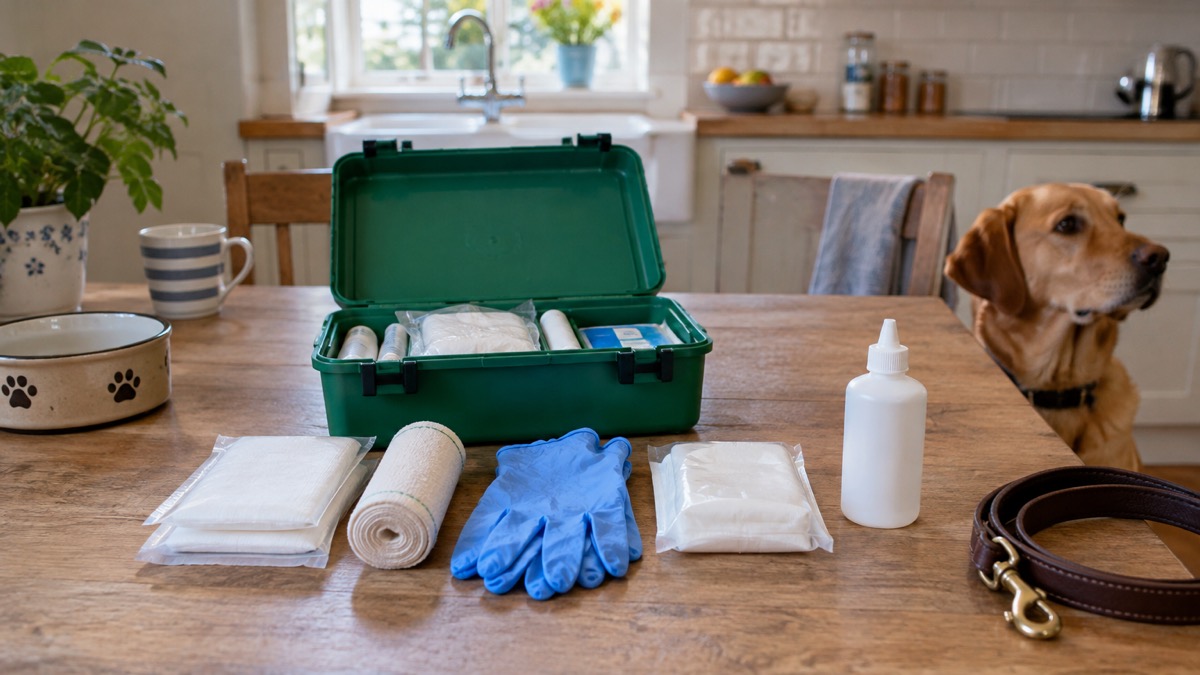
Two things stand out for a household. First, the quantities are generous for a pet kit: 40 plasters and 20 sterile saline wipes mean the kit survives more than one incident without running dry. Second, the protective items, 4 pairs of gloves, 4 aprons and a clinical waste bag, are there for the person doing the treating, not the animal1. The two 500ml eye wash bottles are the bulkiest items and the ones most worth checking for expiry dates, since sterile fluids carry dates.
For looking after pets in emergencies more widely, see Pets and Animals in an Emergency: A Household Guide.
Refills and replacement items
A first aid kit is not a one-off purchase. Dressings get used, plasters disappear, sterile items pass their expiry dates, and a kit that was complete two years ago can be half empty when it is needed. Wallace Cameron sells refills and replacement items so a part-used kit can be topped up, and the maker's product pages list individual contents, which is what makes matching a replacement to the right kit straightforward.
The Health and Safety Executive's advice on what to put in a first aid kit is directly relevant here: check your kit regularly, note that many items, particularly sterile ones, are marked with expiry dates, and replace expired items, disposing of them safely9. The Be Ready campaign's household checklist puts a rhythm on that: set a reminder every six months to check expiry dates and swap out items that need replacing, or update your kit if your circumstances change8.
When ordering replacements, the product code matters. Wallace Cameron's sustainable BS 8599-1 (2019) workplace kits, for example, carry distinct codes by size, 1000144 for the small kit, 1000145 for medium and 1000146 for large7, and the contents differ between them, as the table in the next section shows. Ordering against the code, rather than against a description, avoids receiving a refill packed for a different size of kit.
What to check on a first aid kit before you rely on it
Before you put a kit away and forget about it, three checks are worth making. The first is contents: does the box actually hold what you expect? The maker's product pages publish full contents lists, like the pet kit table above, so you can verify what should be there1. The second is dates: the Health and Safety Executive notes that many items, particularly sterile ones, are marked with expiry dates, so check them at the point of purchase as well as later9. The third is suitability: a kit specified for one setting may not suit another, and the maker is explicit about where each product is aimed, for example the pet kit for use at home, on walks, during travel or on holiday1.
For the workplace range, the maker states that its kits are developed to meet HSE and BS 8599-1 (2019) standards2, and its sustainable BS 8599-1 (2019) kit is described as suitable for a wide range of businesses, including construction and industrial, education and childcare, transport, recreation, sports and leisure, retail and public spaces, and offices, and as particularly suitable for construction, manufacturing and logistics7. A household buying one of these kits gets a box whose contents are set by a published standard rather than by the seller's judgement.
The sustainable BS 8599-1 (2019) kit's contents by size, as published by the maker7:
| Item | Small (1000144) | Medium (1000145) | Large (1000146) |
|---|---|---|---|
| Plasters | 40 | see maker's page | see maker's page |
| Medium dressings | 2 | 4 | see maker's page |
| Large dressings | 2 | see maker's page | 4 |
| Gloves (pairs) | 6 | 9 | 12 |
| Conforming bandages | 1 | 2 | see maker's page |
| Finger dressings | see maker's page | 3 | see maker's page |
| Thermal blankets | 1 | 2 | see maker's page |
| Scissors | see maker's page | 1 | see maker's page |
| First aid guidance leaflets | see maker's page | see maker's page | 1 |
The pattern is the point: the same categories of item, in rising quantities, as the kit size grows. The maker also confirms that all Wallace Cameron first aid kits supplied in a box are wall-mountable7, which matters for the next section.
Where to keep a first aid kit
A GP surgery's published advice for patients states the rule plainly: your first aid kit should be locked and kept in a cool, dry place out of the reach of children6. Each part of that rule exists for a reason. Locked and out of reach because a first aid kit contains sharp scissors and pins; cool and dry because sterile dressings and wipes degrade in heat and damp, which is why they carry expiry dates9.
In practice, a household has three sensible options. A kitchen cupboard high up and away from the hob and sink keeps a home kit central and dry. A locked box in the car boot or a dedicated compartment keeps a travel kit with the vehicle, as Ready Scotland's vehicle kit advice implies4. And for a larger workplace-standard kit, the maker confirms that all its boxed kits are wall-mountable7, so a garage, utility room or hallway can hold a fixed kit that everyone in the house knows the location of.
One further placement point follows from official emergency guidance: the first aid kit belongs with the rest of the household emergency kit, not scattered around the house. Lincolnshire County Council's emergency advice lists a first aid kit among the items a household should have ready together11, and the Be Ready campaign's checklist treats the kit as one item to check on a six-monthly cycle alongside everything else8. For the wider kit, see Emergency Kit: What a UK Household Should Keep Ready.
Checking and replacing a kit over time
The Be Ready campaign's advice gives the interval: set a reminder every six months to check expiry dates and swap out items that need replacing, or update your kit if your circumstances change8. Circumstances matter as much as dates. A household with a new baby, an older relative moving in, or a new pet needs different things from its kit, and a kit that was right two years ago may no longer match the people it serves.
The Health and Safety Executive adds the detail on what to look for: many items, particularly sterile ones, are marked with expiry dates, and expired items should be replaced and disposed of safely9. In a Wallace Cameron kit, the items most likely to carry dates are the sterile ones: saline wipes, dressings, eye wash and gloves. Non-sterile items such as safety pins, scissors and triangular bandages do not expire in the same way, but should still be checked for damage.
When an item is a medicine rather than a dressing, disposal has a specific route. United Lincolnshire Hospitals NHS Trust's guidance on storing medicines at home advises that to get rid of damaged, expired or old medicines, you should place them in a clear plastic bag, seal it and take it back to your local pharmacy, where staff can safely dispose of it12. For other cleared-out household items, Devon and Somerset Fire and Rescue Service advises arranging removal of bulky waste through your local council13, and Warwickshire County Council's hoarding and fire safety advice offers a method for decluttering generally: focus on one room or area at a time and sort belongings into keep, donate and discard14.
A simple routine, built from the official advice:
- Set a six-monthly reminder8.
- Take the kit out and check it against the maker's contents list1.
- Check expiry dates on sterile items and replace anything out of date9.
- Replace used or missing items from refills, ordering against the product code7.
- Seal old medicines in a clear bag and take them to a pharmacy12.
- Put the kit back locked, in a cool, dry place out of children's reach6.
Safety notices and recalls
No safety notice or recall affecting Wallace Cameron products appears in the material reviewed for this page. Households should nonetheless know how recalls work, because first aid kits sit alongside other household products that are subject to them.
The general system is run by the Office for Product Safety and Standards. London Fire Brigade notes that the Office for Product Safety and Standards issues recalls and alert notices on its website15, and North Yorkshire Fire and Rescue Service advises checking the government's product safety alerts and recalls on GOV.UK before using costumes or decorations16. Cheshire Fire and Rescue Service points to the Electrical Safety First website as a place to check for recalls or safety notices on white goods17.
The habit that catches most recalls is registration. Manchester Fire and Rescue Service and London Fire Brigade both advise registering electrical items with the manufacturer so you are informed of any safety recalls18, Cheshire Fire and Rescue Service advises registering products such as e-bikes and e-scooters with the manufacturer for safety updates, recalls and warranties19, and Scottish Fire and Rescue Service notes that registering an appliance typically needs the model name or number, the serial number and the purchase date20. The same principle applies to any branded product: keep a note of what you bought and where, so a maker can reach you if a problem emerges.
Recalls identify affected products by batch or serial reference. A recent example shows the form this takes: a recalled radiator fan was identified by batch numbers 967, 968 and 970, located on the packaging next to the bar code and on the label on the base of the product21. This is why keeping a product's code, as discussed under refills above, is useful beyond ordering replacements.
Support and warranty
Wallace Cameron sells and supports its range through its own website, wallacecameron.com, where its product pages, workplace kit categories and refill items are listed2. For questions about a specific kit, its contents, product codes or replacement items, the maker's website is the route, and the product pages themselves publish the contents lists and codes a household needs when ordering refills1.
No warranty terms for Wallace Cameron products appear in the material reviewed for this page, so none are stated here. Where a warranty does apply to a household product, registration is generally what activates the maker's ability to contact you, as Cheshire Fire and Rescue Service notes in advising customers to register products for safety updates, recalls and warranties19.
For the wider question of help in an emergency, including for households that need extra support, see Extra Help in an Emergency, and for what to do in a health emergency, Health Emergencies: A Household Guide.
Sources (21)
- Wallace Cameron Pet First Aid Kit product page, Wallace Cameron, 2026
- Workplace first aid kits category, Wallace Cameron, 2026
- Be informed about hazards: water supply interruptions or outages, Prepare campaign, 2026
- Emergency kit, Ready Scotland, 2026
- Alternatives to 999, South Central Ambulance Service NHS Foundation Trust, 2026
- Accidents, first aid and treatments: what should I keep in my first aid kit?, Collingwood Surgery, 2026
- Wallace Cameron Sustainable BS 8599-1 (2019) Workplace First Aid Kit, Wallace Cameron, 2026
- Be ready for emergencies, Be Ready campaign, 2026
- What to put in your first aid kit, Health and Safety Executive, 2026
- Health advice for public holidays, NHS inform Scotland, 2026
- Get help and advice in an emergency, Lincolnshire County Council, 2026
- Storing medicines at home, United Lincolnshire Hospitals NHS Trust, 2026
- Reducing arson risk, Devon and Somerset Fire and Rescue Service, 2026
- Hoarding fire safety, Warwickshire County Council, 2026
- Electrical items, London Fire Brigade, 2026
- Halloween safety tips, North Yorkshire Fire and Rescue Service, 2025
- Electrical fire safety: white goods, Cheshire Fire and Rescue Service, 2026
- Electrical fire safety leaflet, Manchester Fire and Rescue Service, 2026
- E-bikes, Cheshire Fire and Rescue Service, 2026
- Electrical safety at home, Scottish Fire and Rescue Service, 2026
- Product recall: Valiant radiator fan, GOV.UK, 2025
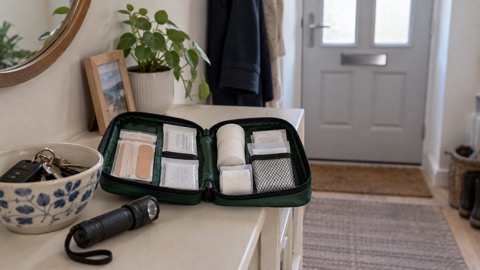 Wallace Cameron Family First Aid Kit
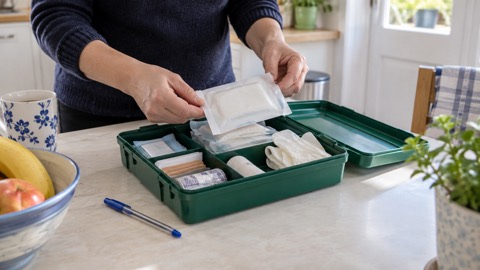 Wallace Cameron Small Workplace First Aid Kit
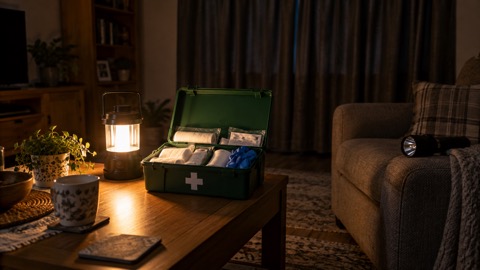 Wallace Cameron Medium Workplace First Aid Kit
 Wallace Cameron Large Workplace First Aid Kit
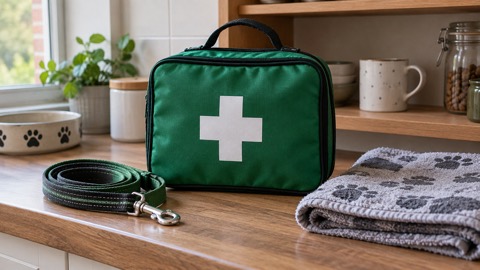 Wallace Cameron Pet First Aid Kit