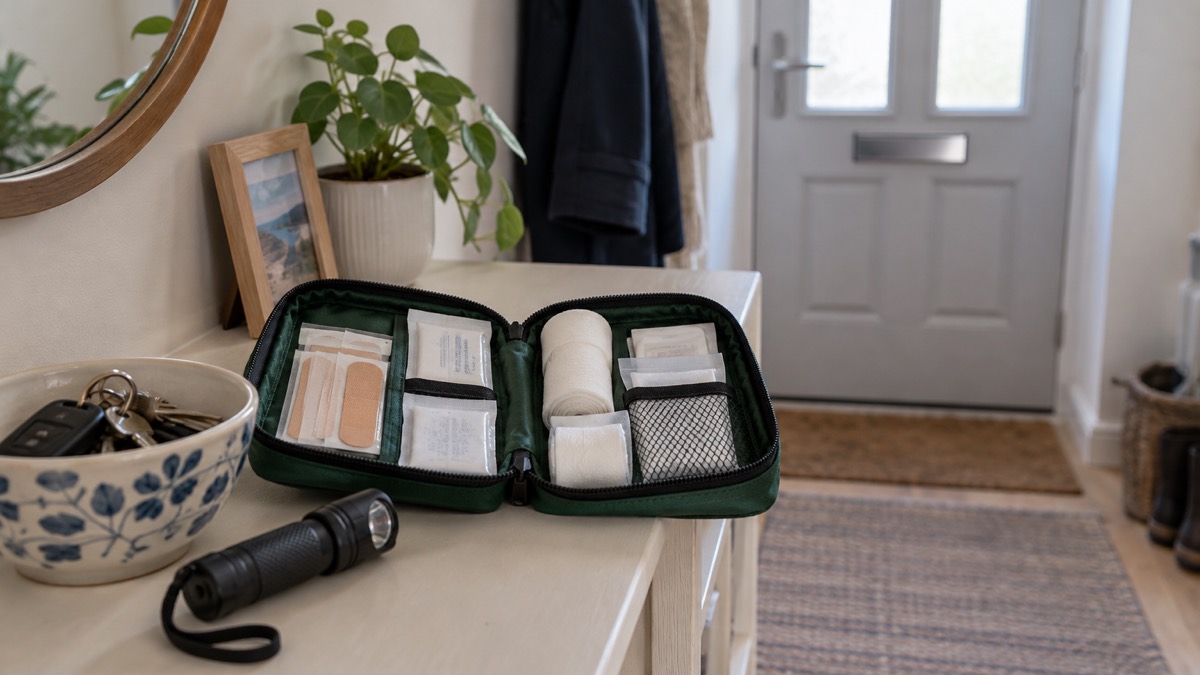
The Wallace Cameron Family First Aid Kit is a small, zip-up first aid kit in an EVA pouch, made by Wallace Cameron and intended for households and families dealing with everyday minor injuries at home or on the go1. The maker says it is designed to manage common cuts, grazes and minor incidents quickly and effectively, and it is classed as a micro kit, so it fits in a small compartment of a car or truck1.
What you get is a compact kit rather than a full household cabinet. It holds four sterile saline wipes, and the maker lists it as CE marked1. It contains no medicines, so it does not replace the plasters, dressings, thermometer and painkillers that NHS advice says a family first aid kit should hold2. Think of it as the kit you keep where injuries actually happen: in the car, in a bag, or by the door for days out.
This page sets out what the kit is for, what is inside it, how to use the wipes and plasters properly, how to store it so it is ready when needed, and where it fits into a wider household first aid plan. It also covers what the kit cannot do, because knowing when a cut needs more than a plaster matters more than the kit itself.
What the kit is for: cuts, grazes and minor injuries
The kit's job is the everyday injury: a cut finger in the kitchen, a graze from a bike fall, a scrape on a walk. The maker describes it as designed to manage common cuts, grazes and minor incidents quickly and effectively, and as ideal for households and families providing reliable first aid support for everyday minor injuries at home or on the go1. That is a modest, honest scope, and it matches what official advice says a first aid kit is for.
NHS advice is that a well-prepared first aid kit can help treat minor cuts, sprains and bruises, and reduce the risk of cuts becoming infected4. Scotland's summer health campaign makes the same point for days out: carry a small first aid kit to help deal with minor ailments like cuts, grazes and blisters5. The value of a kit like this is not that it does anything clever, but that it is there, complete and clean, at the moment someone needs a sterile wipe and a plaster.
The maker's own plasters illustrate the principle. Wallace Cameron Heavy Duty Fabric Plasters are for covering minor cuts, grazes and scrapes, helping to protect wounds from dirt, knocks and irritation as they heal6. A plaster does not heal a wound; it keeps it clean and protected while the body does the healing. The same is true of the kit as a whole: it buys you a clean, covered wound and a few minutes to decide whether more help is needed.
Where the kit stops matters just as much. It is not designed for severe bleeding, burns, suspected broken bones, head injuries or eye injuries, and it will not tell you whether a wound is infected. For those, the right move is to get proper help: call 999 for severe bleeding or a serious injury, use NHS 111 for urgent advice, and treat any wound with care to reduce the risk of infection3. The sections below explain how to use what is in the kit well, and when to stop and ask for help.
What comes in the kit
The maker's product page lists the contents in detail, and the headline item for most households is the four sterile saline wipes1. Saline is salty water, and it is useful because it cleans without stinging the way some antiseptics can. NHS advice describes cleansing wipes as used to gently clean the skin around the wound and for hygienic cleaning in any first aid situation2. St John Ambulance puts it simply: clean the wound by rinsing it under running water or using sterile wipes7.
The maker's page also lists a single sterile saline pod of 20ml alongside the four wipes, and the two entries have not been reconciled, so the maker's own listing is unclear on whether the kit holds wipes, a pod, or both1. If you are buying the kit, check the contents list on the pack you receive rather than relying on either entry alone.
Beyond the wipes, the kit is a compact set of the basics: plasters and dressings for covering minor wounds, in the quantities a family is likely to use1. It does not include painkillers, a thermometer, antiseptic cream or eye wash, which NHS advice lists as part of a fuller home kit2. That is not a fault in the kit; it is a reason to keep it alongside a home cabinet rather than instead of one.
If you want to build out from here, the NHS list for a basic first aid kit is a good checklist: plasters in a variety of sizes and shapes, sterile gauze dressings, sterile eye dressings, triangular bandages, crêpe rolled bandages, safety pins, disposable sterile gloves, tweezers, scissors, alcohol-free cleansing wipes, sticky tape, a thermometer, skin rash cream, insect bite cream, antiseptic cream, painkillers, antihistamine cream or tablets, distilled water for cleaning wounds, and eye wash with an eye bath2. Northern Ireland's nidirect list is similar, adding a medical spoon or syringe for giving babies and children their medicines, cotton wool, and sun block of factor 25 or higher for children8. The Health and Safety Executive's minimum list for low-risk workplaces is shorter: a first aid guidance leaflet, assorted sterile plasters, sterile eye pads, triangular bandages, safety pins, sterile wound dressings and disposable gloves9.
| What the kit gives you | What NHS advice adds for a home kit |
|---|---|
| Four sterile saline wipes for cleaning around wounds1 | Alcohol-free cleansing wipes, distilled water for cleaning wounds2 |
| Plasters and dressings for minor cuts and grazes1 | Plasters in assorted sizes, gauze dressings, eye dressings, bandages, tape2 |
| A CE marked kit in a zip-up pouch1 | Gloves, tweezers, scissors, safety pins2 |
| No medicines | Thermometer, painkillers, antiseptic cream, bite cream, antihistamine2 |
The EVA zip-up pouch: a micro kit that fits a small car compartment
The pouch is the reason this kit travels well. The maker says the durable zip-up pouch can be easily stored in any small compartment of a car or truck, and classes the box type as micro1. That matters because the kit you have with you is worth more than the better kit in a cupboard at home. A glovebox, a door pocket or a seat-back pocket is enough.
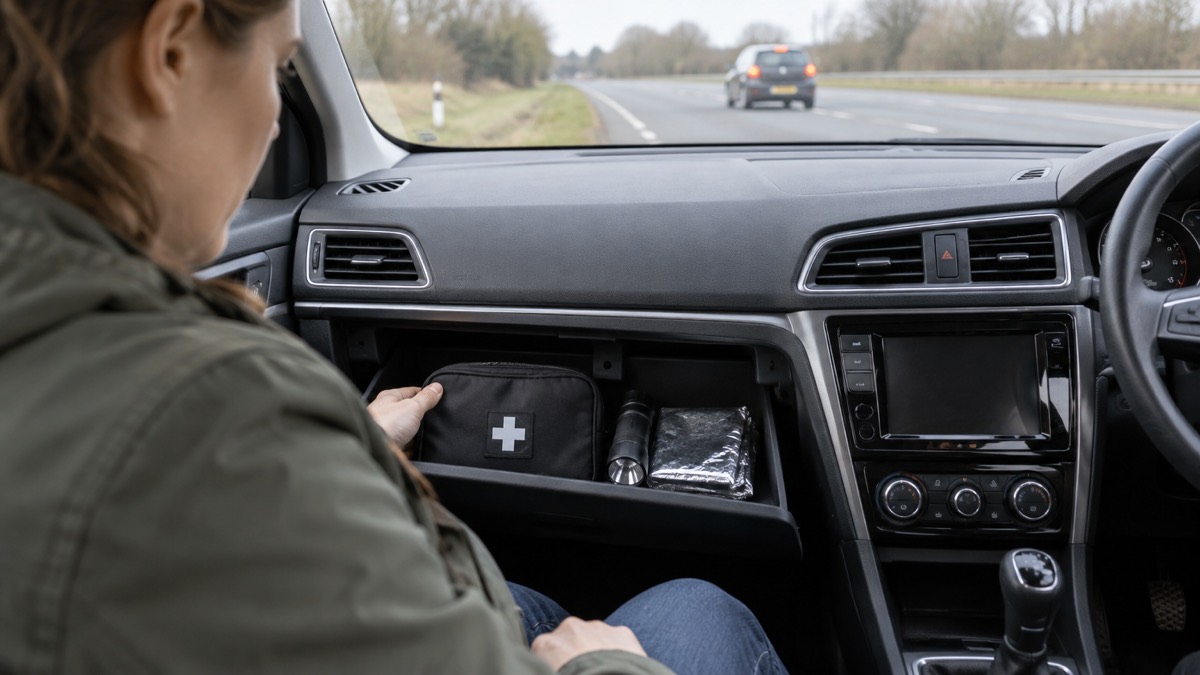
Official advice across the UK recommends a first aid kit in the car, not as a legal duty but as sensible preparation. The government's travel advice says to keep an emergency kit in your vehicle in case you are delayed or stranded, including a torch, in-car phone chargers or power bank, warm clothes and blankets, high-visibility clothing, jump leads, food and drink, a first aid kit, and a shovel10. The Be Ready campaign gives the same list for winter weather10. Anglesey council's winter driving tips list a first aid kit in good order among the items to carry, alongside a tow rope, shovel, Wellington boots, hazard warning triangle, de-icing equipment, a working torch, a car blanket, warm clothes, emergency rations including a hot non-alcoholic drink in a flask, and a fully charged mobile phone11.
Argyll and Bute council's winter advice is similar: warm clothes, boots and a blanket, a fully charged mobile phone, a hot drink in a flask, energy boosting food, a pen or pencil, a first aid kit, a torch, an ice-scraper, a map for unplanned diversions, and a shovel for snow12. NHS Lanarkshire tells drivers to keep an emergency kit in the car filled with items such as battery jump leads, a blanket and a first aid kit13. The pattern is consistent: the first aid kit is one item in a car kit, not the whole of it.
For a fuller list of what to keep in the vehicle, see the car kit checklist. For the household side, the first aid kits for the home guide sets out what a fuller kit should hold.
Using it at home, on the go and during an evacuation
The maker lists the kit's usage as evacuation and transport, which is a fair description of where a micro kit earns its place1. At home it sits by the door or in a kitchen drawer for the small injuries of daily life. On the go it goes in a bag or the car. In an evacuation it goes in the grab bag, because a cut or graze during a stressful move is exactly when you want a sterile wipe to hand.
Official emergency kit lists across the UK include a first aid kit as a standard item. Dumfries and Galloway's household emergency pack advice includes a first aid kit14. Lincolnshire council's emergency kit list includes one15. North Port Talbot's checklist includes a first aid kit and essential medication16. Moray council's evacuation advice says that if there is time, take any medication, warm clothes, any special foods, personal documents and valuables with you, and before you leave make sure fires are off or out, switch off gas and electricity and lock up doors and windows17. A first aid kit belongs in the bag you take when you follow that advice.
The Scottish Flood Forum's emergency flood kit guidance includes a first aid kit for when people are evacuated to a rest centre18. West Yorkshire's community risk register lists a first aid kit and essential medication alongside a torch, a radio, a power bank and phone chargers19. Anglesey's home emergency plan says to have a first aid kit and make sure everyone in the house knows where it is20. That last point is the one most often missed: a kit nobody can find is no kit at all.
For the wider grab bag, see the emergency kit guide. For what to do when someone is actually injured, the cuts, grazes and wounds guide covers cleaning and dressing in more depth, and the primary survey guide covers the first steps with any casualty.
Using the saline wipes and plasters properly
A kit is only as good as the technique used with it. The maker's saline wipes are for cleaning, and the official advice on how to clean a wound is straightforward. St John Ambulance says to clean the wound by rinsing it under running water or using sterile wipes7. NHS advice describes cleansing wipes as used to gently clean the skin around the wound and for hygienic cleaning in any first aid situation2. The distinction matters: wipe around the wound and away from it, rather than scrubbing inside it.
- Wash your hands where you can, or use a wipe on them first.
- Rinse the wound under running water, or use a sterile saline wipe to clean the skin around it7.
- Pat the area dry with a clean dressing or gauze.
- Cover the wound with a plaster or sterile dressing to keep dirt out while it heals6.
- Check the wound later for redness, swelling or pain that is getting worse, and get advice if it does.
The maker's plasters are for covering minor cuts, grazes and scrapes, protecting wounds from dirt, knocks and irritation as they heal6. Change a plaster when it gets wet or dirty, and do not leave one on for days at a time. If a cut keeps bleeding through a plaster, that is a sign to get help rather than add another layer.
For more on dressings and plasters, see the dressings and bandages guide. For eye injuries, which this kit is not designed for, see the eye injuries guide, and for the difference between saline pods and an eyewash bottle, the saline pods or eyewash bottle comparison.
Certification: CE marked
The maker lists the kit as CE marked1. CE marking is a declaration that a product meets the requirements that apply to it, and for a first aid kit it is a marker of conformity rather than a guarantee of contents. It tells you the maker has made a declaration about the product; it does not tell you the kit is complete for every injury, and it does not replace the contents list on the pack.
The maker's wider range gives some context. Wallace Cameron's workplace first aid kits are described as developed to meet HSE and BS 8599-1 (2019) standards, and its sustainable range is described as meeting HSE and BSI standards21. Those are workplace standards, and they are a different thing from the CE marking on a family kit. If you need a kit for a workplace, the standard that applies is BS 8599, which the BS 8599 guide explains. For a household, CE marking plus a clear contents list is the practical check.
Where to buy it in the UK
The maker's product page lists four stockists for this kit1. That is a small number, so availability may vary, and it is worth checking the maker's own page for the current list before travelling to a shop. Wallace Cameron's refills are more widely stocked, with 19 premium stockists listed including Screwfix, CLH Healthcare, Banner UK, Bowak, Commercial Body Fittings, Defibs., Direct365, Elliott Hygiene, GTS-MedOH, HealthCare Direct Limited, Pf Cusack, Jacksons (Clear Glass) Ltd., Nu-Care Products Ltd., Premier Vanguard, Smart Image Workwear, Staples, Vow Wholesale and Warrior Protects22. Those stockists are listed for refills, not necessarily for this kit, so check before you go.
If you cannot find this kit locally, the practical alternative is to build a kit of your own. NHS advice says you can keep a home or car first aid kit handy by buying a ready-made one or putting together your own in a clean, waterproof box2. The ready-made or homemade kit comparison sets out the trade-offs. For a family with children, the baby and child kit checklist covers the extras that a child-friendly kit should hold.
Restocking, storage and what the kit cannot do
First aid kits are consumables. Plasters get used, wipes dry out, and sterile packaging can be damaged. Wallace Cameron sells first aid kit refills for routine restocking or replacing used contents after an incident22. Check the refill matches your kit before buying, because refills are made for specific kits. If you cannot find a match, replace the used item with a like-for-like sterile product and check the rest of the kit at the same time.
Storage matters more than people expect. Keep the kit somewhere cool and dry, out of direct sun, and away from children's reach if it contains anything sharp. In a car, the glovebox or a door pocket is fine, but heat and cold over a summer and winter will degrade plasters and wipes, so check the kit each season. At home, keep it where everyone knows to look, as Anglesey's home emergency plan advises20.
What the kit cannot do is just as important as what it can. It is designed for common cuts, grazes and minor incidents1. It is not for severe bleeding, burns, suspected broken bones, head injuries, eye injuries or signs of infection. For those, get proper help: call 999 for severe bleeding or a serious injury, use NHS 111 for urgent advice, and clean and care for any wound to reduce the risk of infection3. For sepsis, which can follow an infection, the sepsis guide sets out the signs to act on. For burns, see the burns guide, and for severe bleeding, the severe bleeding guide.
For a fuller household kit, the first aid at home guide is the place to start. For the medicine cabinet that sits alongside it, NHS advice on what to keep at home is a good checklist2. And for the wider household emergency kit, the emergency kit guide covers water, light, warmth and the rest.
Sources (22)
- Wallace Cameron Family First Aid Kit in EVA Pouch, Wallace Cameron, 2026-10-29
- What should I keep in my first aid kit?, NHS, 2026-10-25
- Sepsis, NHS 111 Wales, 2026-01-12
- Keep well stocked medicine cabinet at home, NHS Black Country ICB
- Summer health, NHS Inform, 2026-08-06
- Wallace Cameron Heavy Duty Fabric Plasters, Wallace Cameron, 2026-05-15
- Cuts and grazes, St John Ambulance, 2026-10-28
- First aid, nidirect, 2025-12-04
- What to put in your first aid kit, Health and Safety Executive, 2026
- Travel advice, UK Government, 2026-10-06
- Winter driving tips, Isle of Anglesey County Council, 2026-10-29
- What advice can you give me on driving in winter weather?, Argyll and Bute Council, 2026
- Winter preparedness, NHS Lanarkshire, 2026-10-29
- Prepare for emergencies, Dumfries and Galloway Council, 2026
- Get help and advice in an emergency, Lincolnshire County Council, 2026-10-29
- Emergency kit checklist, Neath Port Talbot Council, 2026-10-29
- Emergency preparations you can do, Moray Council, 2026-10-29
- Emergency Flood Kit, Scottish Flood Forum, 2018
- Community Risk Register, West Yorkshire Prepared, 2025
- Home Emergency Plan, Isle of Anglesey County Council, 2020
- Workplace First Aid Kits, Wallace Cameron, 2026-10-29
- Wallace Cameron First Aid Kit Refills, Wallace Cameron, 2026-05-15