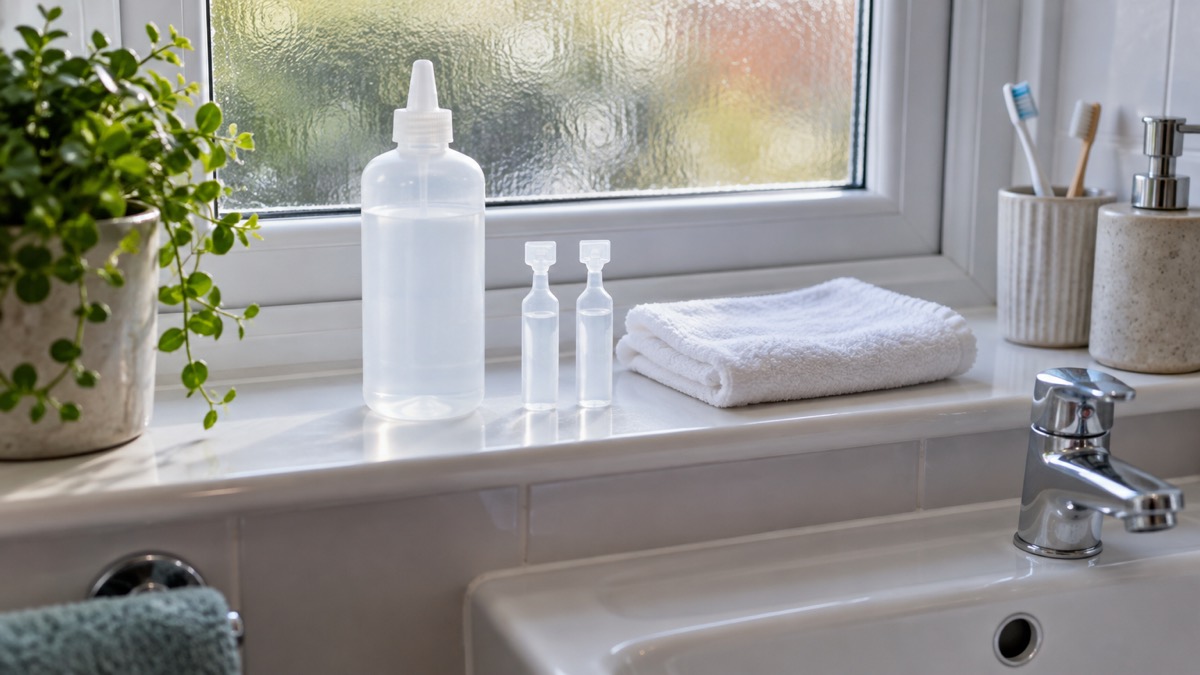
If something gets in your eye, the first job is to rinse it, and the choice in front of most households is between small single-use saline pods and a larger eyewash bottle. Both hold sterile saline, a 0.9% salt solution, and both are used to flush dust, dirt and splashes from the eye until the object is gone or medical help arrives1. The difference is how much you get in one go and how you hold it.
A 20ml pod gives you one measured rinse in a sealed container you twist open and squeeze. A 500ml bottle gives you a much larger volume in a soft bottle with a precision nozzle, and Steroplast says each bottle is single use only and should be discarded after opening to maintain sterility2. Pods are single-use too, and the maker says to dispose of the pod and any remaining solution straight after use3.
For a household, the practical answer is often both: a few pods kept sealed and in date for small irritations, and a bottle or a small station where more rinsing may be needed. Whichever you choose, keep it somewhere you can reach it quickly with one hand, and check it regularly.
| 20ml saline pod | 500ml eyewash bottle | |
|---|---|---|
| Volume per unit | 20ml3 | 500ml2 |
| Use | Single use3 | Single use, discard after opening2 |
| Opening | Twist-off cap, slim neck3 | Twist-cap with precision nozzle5 |
| Suits | Small irritations, compact kits, one eye | Longer rinsing, both eyes, a fixed point |
| Sterility | Sterile, pyrogen-free, sealed3 | Sealed and sterile until use2 |
Saline pods or a bottle: how each one rinses an eye
Both formats deliver the same solution. Saline eyewash is an isotonic solution of 0.9% pharmaceutical grade salt mixed into water, and it is commonly used to remove dust, dirt, wood, metal, oil and solvents from the eye and to soothe irritation until the object is removed or further medical help is available1. The pods and bottles from Steroplast carry the same 0.9% w/v sodium chloride in purified water, free from antimicrobial agents or added substances3.
What changes is the delivery. A pod is a small sealed ampoule with a twist-off cap and a slim neck, which the maker describes as a slim neck design for precise application3. You twist the top off and squeeze, and the whole thing is thrown away afterwards. A 500ml bottle is an ergonomic, soft plastic, easy-to-squeeze bottle with a twist-cap and a precision nozzle that allows controlled irrigation from different angles5. Reliance Medical, which makes the Reliwash range, describes its bottle as having a uniquely designed eye cup that lets the eye be irrigated whether the user is standing, sitting or lying down1.
The trade-off is straightforward. Pods suit a small amount of rinsing, a single eye, and a kit that has to stay compact. Bottles suit a longer flush, both eyes, or a situation where you may need to keep going for several minutes. The maker's own guidance is that a station with 20ml pods is ideal where only minimal first aid is needed3.
20ml per pod: what a single pod gives you

Each Sterowash pod holds 20ml of sterile saline, and they are sold as single-use pods3. That is a small, measured amount: enough for a quick flush of one eye, not a long irrigation. The maker sells them in packs of 25, each pod containing 0.9% sodium chloride in purified water3.
The solution is sterile and pyrogen-free, and the maker states it is suitable for adults and children3. Because there are no antimicrobial agents or added substances, there is nothing in the pod beyond salt and water, which is what you want in an eye. The pods are manufactured from soft, squeezable plastic so you can control the flow by how hard you press3.
A single pod is not designed to be recapped or kept. The maker's instruction is to dispose of the ampoule and any remaining solution immediately after use to maintain hygiene3. If you are rinsing a chemical splash or a persistent piece of grit, one pod may not be enough, and that is where a bottle or a station with several pods earns its place. The maker's compliance note says the pods meet ACOP L74 under the health and safety (first aid) regulations, which is the approved code of practice behind workplace first aid provision3.
Twist-caps and narrow openings for a precise rinse
The design of the opening is what decides whether a rinse helps or makes things worse. Sterowash pods have twist-caps that the maker says make them easy to open and hygienic to use, with a twist-off cap for quick access in an emergency4. The narrow neck lets you direct the flow at the inner corner of the eye rather than the centre, which is the technique the maker describes: tilt the head back slightly, hold the eyelid open, and carefully flush the eye from the inner corner to the outer corner3.
Bottles take a different approach. The Sterowash 500ml bottle has a twist-cap with a precision nozzle that allows controlled eye irrigation from different angles, and the maker says the twist-off top makes it ready for use in seconds5. The Reliwash bottle uses an eye cup rather than a bare nozzle, which the maker says allows irrigation whether the user is standing, sitting or lying down1.
Whichever you use, the principles are the same. Wash your hands first if you can. Hold the eyelid open. Aim for the inner corner so the flow carries debris away from the tear duct rather than into it. Do not touch the eye with the nozzle or the pod tip. And if the irritation follows a chemical splash, rinse for longer than you think and get medical advice; the page on chemical burns and eye splashes sets out how long to keep going.
Eyewash stations: 10 pods kept together in one place
A station is simply a holder that keeps pods, a mirror and dressings in one visible place. The Sterowash 20ml Eyewash Station (Complete) is a wall-mounted dispenser containing ten individual 20ml eyewash pods, two eye dressings, instructions and a shatter-proof mirror4. The maker describes it as everything you need to quickly wash an eye, mounted on a highly visible wall dispenser, compact and easy to access7.
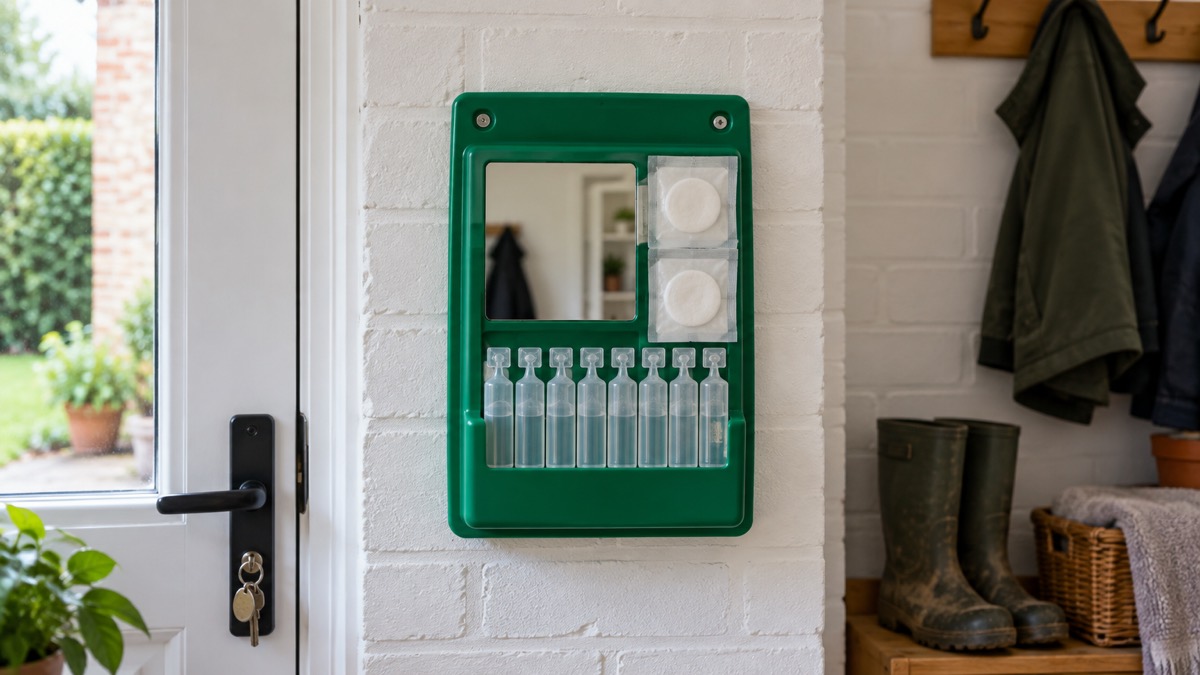
The mirror matters more than it looks. Reliance Medical's guidance on what stations typically contain lists bottled 500ml eyewash or smaller 20ml pods, a mirror to help locate the debris or contaminant in the eye, and eye pad dressings1. Its Reliwash 908 Eye Pod Station holds eight 20ml sterile saline pods, two eye pad dressings and one mirror, and the maker says it is for minor eye irritations only, is made with 100% recycled and recyclable plastic, and is smaller than A58.
Stations come in two broad sizes. Pod stations hold several small pods and suit a kitchen, workshop or small office where a quick rinse is the likely need. Bottle stations hold two 500ml bottles, and the Sterowash 500ml station is supplied with two bottles allowing both eyes to be rinsed simultaneously for a quicker response in an emergency9.
| Station type | What it holds | Suits |
|---|---|---|
| 20ml pod station | 10 pods, 2 eye dressings, mirror, instructions4 | Kitchens, workshops, small workplaces, a home where space is tight |
| 20ml pod station (Reliwash 908) | 8 pods, 2 eye pad dressings, mirror8 | Smaller wall space, minor irritations |
| 500ml bottle station | 2 x 500ml bottles, eye pads, mirror9 | Somewhere a longer or two-eye rinse may be needed |
Keeping pods sterile until you need them
Sterility is the whole point of a sealed pod, and it only lasts while the seal does. The pods are supplied as a sterile, pyrogen-free solution in sealed disposable containers3. The 500ml bottles are sealed and sterile until use, and the maker says each bottle is single use only and should be discarded after opening to maintain sterility2. The 500ml station's bottles are sealed to maintain sterility until opened, which the maker says removes the need for ongoing hygiene maintenance9.
Storage conditions affect the solution as well as the seal. Store pods below 25 °C, and store bottles at room temperature, avoiding extreme heat or cold, to keep the solution comfortable to use3. A cupboard away from a radiator or a sunny windowsill is the obvious place.
There is a wider household lesson here about small sealed items. The Child Accident Prevention Trust advises storing washing pods in their original containers and not decanting them into a different box that is easier to access, and putting products away out of reach as soon as you have used them10. The same discipline applies to saline pods: keep them in their original packaging or station, out of reach of small children, and put them back as soon as you have taken one.
Where eyewash pods sit alongside the rest of a first aid kit
Eyewash is one item in a kit, not the whole kit. NHS guidance on what to keep at home lists eyewash solution alongside bandages, plasters in a range of sizes (waterproof if possible), a thermometer, sterile dressings, tweezers and antiseptic12. A surgery's own first aid list goes further and specifies at least two sterile eye dressings13.
That pairing of rinse and dressing is deliberate. After rinsing, an eye pad protects the eye from further contamination; the Sterowash 500ml station contains two sterile eye pads for dressing after an injury, minimising the chance of further contamination6. If you are building or restocking a household kit, the page on first aid kits for the home sets out the full contents, and the guide to dressings, bandages and plasters explains which dressing does what.
For eye injuries specifically, the page on eye injuries covers grit, objects and blows to the eye, and is the place to go if rinsing has not solved the problem. If you are choosing between a ready-made kit and building your own, the comparison of ready-made or homemade kits weighs the two.
Public places increasingly carry a different kind of kit. A Public Access Trauma (PAcT) first aid kit is for serious bleeding, and the British Red Cross says such kits are becoming more common in public places, often alongside AEDs14. Official guidance says PAcT kits must be located in publicly accessible locations and areas people can easily access, in a sealed container clearly labelled "Public Access Trauma First Aid Kit" with a clearly visible white cross on the front15. Their contents vary and can include gloves, face shields, wound dressings and tourniquets14. They are not eyewash kits, but knowing they exist helps you recognise what is in the cabinet by the defibrillator.
Steroplast: the UK maker behind Sterowash pods
Steroplast Healthcare makes the Sterowash range of pods, bottles and stations. The company says it has over 25 years of experience supplying wound care and rehabilitation equipment, and it lists no minimum order and offers free samples of its products before you buy17. Its contact number is 0161 902 3030, with a fax number of 0161 902 3040.
The Sterowash pods comply with ACOP L74 under the health and safety (first aid) regulations, and the 500ml bottle is CE marked as a Class IIA medical device and compliant with the Health and Safety (First-Aid) Regulations 19813. The 500ml bottle is also CE marked as a Class I sterile medical device2. These markings tell you the product has been through the relevant conformity process; they do not tell you which format suits your home, which is a question of volume and storage.
The range is designed to fit together. The 500ml bottles fit Sterowash Eyewash Stations and Eyewash Plates and can be used alongside Sterowash Eye Baths2. The empty 20ml station is supplied without pods so you can fill it with 20ml saline eyewash pods, and the maker says it is easy and convenient to refill the complete station with new saline pods18. Refill packs are designed for use with the Sterowash Eyewash Station, Eyewash Plate or Eye Bath to keep wall-mounted eyewash points full5. The 500ml station also has replacement covers, bases and refill bottles available9.
Reliance Medical is the other UK maker whose products appear in this range, with the Reliwash pod and bottle stations. Its Compact Eye Pod Station replaced its existing eye pod station product, and the 908 model is the current pod station19.
Sources (19)
- Eyewash FAQs, Reliance Medical, 2023-05-04
- Sterowash Sterile Eyewash Bottle 500ml, Steroplast Healthcare, 2026-10-29
- Sterowash Eyewash Pods 20ml, Steroplast Healthcare, 2026-10-28
- Sterowash 20ml Eye and Wound Wash Station, Steroplast Healthcare, 2026-10-28
- Sterowash 500ml Eyewash Plate Refill, Steroplast Healthcare, 2026-10-29
- Sterowash 500ml Eyewash Plate, Steroplast Healthcare, 2026-10-28
- Sterowash 20ml Eyewash Plate Complete, Steroplast Healthcare, 2026-10-28
- Reliwash Eye Pod Station 908, Reliance Medical, 2022
- Sterowash 500ml Eyewash Station, Steroplast Healthcare, 2026-10-28
- Washing pods and capsules, Child Accident Prevention Trust, 2025-01-20
- Poisoning prevention, Child Accident Prevention Trust, 2026-02-26
- Keep well stocked medicine cabinet at home, NHS Black Country ICB, undated
- What should I keep in my first aid kit, Collingwood Surgery (NHS), undated
- Bleeding heavily, British Red Cross, 2026-10-25
- Standards for Public Access Trauma (PAcT) first aid kits, ProtectUK, 2026-06-01
- First aid provisions, ProtectUK, 2026-06-01
- Sterofreeze Instant Ice Packs, Steroplast Healthcare, 2026-10-29
- Sterowash 20ml Eyewash Plate Empty, Steroplast Healthcare, 2026-10-28
- Compact Eye Pod Station, Reliance Medical, 2022-01-19
 Semi vs Fully Automatic AED
 Indoor or Outdoor Defib Cabinet
 Burn Gel vs Cling Film
 Instant or Reusable Ice Packs
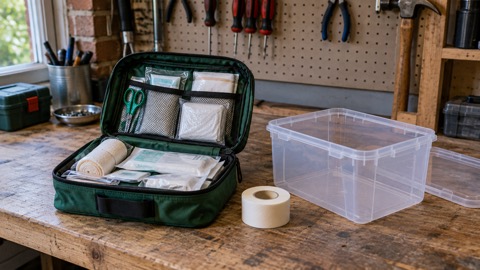 Ready-Made or Homemade Kit